@tom4okstate @dmitri @Pwnallthethings the correct question is “is there any level of damage the Ukrainians will write off to let the Russians go in peace?”
From speaking with people the mood has shifted from March/April. Back then it was anger and “fuck the Orcs” and so on. They were upset, but it was anger. Now when I speak to people they have hatred. They are truly furious at Russians and want to see them thoroughly beaten.
My friend who is always saddened over the lives lost in the war, who mourns offensives because people will die. That friend blames Russia and Russians for the war. They are committed to ending Russian occupation and their resolve has only hardened over time.
In war the Enemy gets a vote. For peace, the same. I don’t know if the Ukrainian people will accept any peace that Russia can offer. One mustn’t forget that war is a political activity, and the goal is to achieve victory to enable a political outcome.
The Clausewitz trinity of the Army the Government and the People have to be aligned to wage war. But they also need to be aligned to have peace. If the People demand blood then they will change the government to align with their interests.
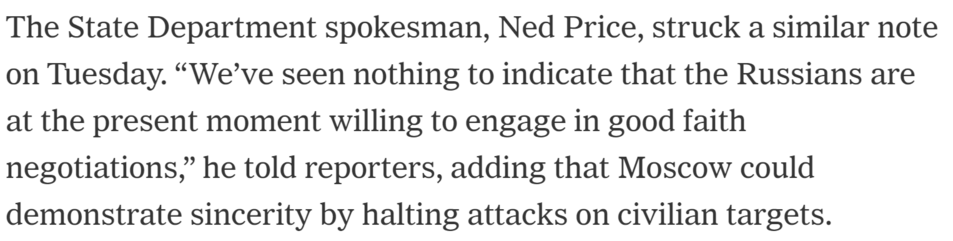
What peace terms could Zelensky accept that would be acceptable to the Ukrainian people? Are those terms acceptable to Russia?
War has an underlying physical reality (the events), and the interpretation of that reality (the version).
Strategic narrative is essentially an aspirational version of events which associates the two. If one’s strategic narrative is to defeat the enemy in order to impose a given political outcome on him, one is victorious, or has ‘succeeded’ in today’s parlance, once that is understood to have happened. In this sense, success or failure in war are perceived states in the minds of one’s intended audience. War can be understood as a competition between strategic narratives,
For Clausewitz, although he did not use the term, the definition of ‘strategic audiences’ in war was very straightforward: the first division was between one’s own side and the enemy, according to the principle of polarity; the second division was between the army, people and government within each side (assuming, as Clausewitz did, that the sides were state actors).
In today’s terms these would be seen as ‘strategic audiences’, that is, the groups of people whom strategy seeks to convince of its narrative. Ultimately they are the arbiters of war’s outcome: their perceptions are the strategist’s objective, in terms of influencing them, or of making them irrelevant, in accordance with the intent of policy.
When strategy fails to unify the strategic audiences who are within one’s own side, the state cannot act as a ‘judge’ to provide a coherent verdict of war’s outcome…if victory, or success, is only interpreted as such by one element of the state, it is compromised as a legitimate analysis.
Emile Simpson, “War from the ground up.” p62
 Pwnallthethings

 blackfire
 Peregrine993 ☑️ 🗿
 Jeff Hall - PCIGuru
 John Allison
 DanFell
 Dave
Dave Dmitri Alperovitch
 tom4okstate
 LT
LT Darren
 the grugq
 Conrad Longmore
 AntiComposite
 Steve Torrente
 Dave Wilburn
 Tafkak
 Jonny Axelsson