Fun to watch the battle of the anonymous US officials in the press.

Here are some anonymous US officials suggesting a sustainable peace deal might be available in winter: https://www.nbcnews.com/politics/national-security/ukraine-russia-war-winter-diplomacy-rcna56190?icid=election_results

Winter could be diplomatic opportunity in Ukraine-Russia war, U.S. and Western officials say

Ukraine and Russia could have an opportunity for diplomacy as winter arrives and U.S. and Western officials anticipate a potential fighting slowdown in the war.

NBC News
By contrast, here are some other anonymous officials suggesting a sustainable peace deal is still very far off https://www.nytimes.com/2022/11/09/us/politics/ukraine-russia-peace-talks.html
Ukraine Peace Talks Remain Distant Even as Moscow Signals a Retreat

President Biden and European leaders say they cannot push Ukraine and Russia into negotiations, though some U.S. lawmakers are questioning aid for an open-ended war.

DOD seems to be on team "winter peace deal is possible" https://twitter.com/DanLamothe/status/1590500796118228c
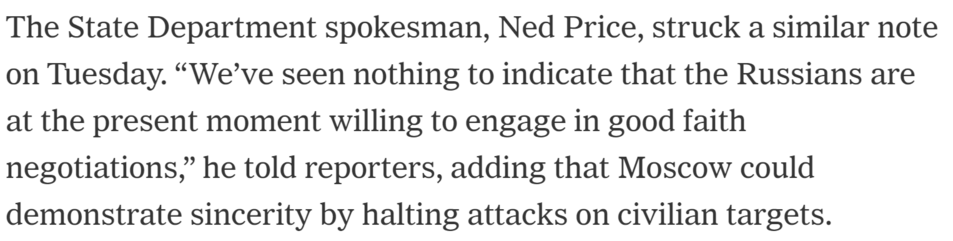
State Dept seems to be on team "eh, I don't see it"
My opinion (take it or leave it, you get what you pay for) is that R would definitely go for an operational pause under guise of a ceasefire, but no peace deal would be sustainable until middle of next year at the bare minimum.
@Pwnallthethings I don't think any peace deal is likely at all for at least the next 2 years. Assuming Ukraine keeps receiving western military aid
@dmitri @Pwnallthethings is there any level of damage the Ukrainians could realistically do to the Russian forces that would force the Russians to the table sooner? Like if we gave the Ukrainians the much talked about ATACMS would that do the job or would that just be more the same?

@tom4okstate @dmitri @Pwnallthethings the correct question is “is there any level of damage the Ukrainians will write off to let the Russians go in peace?”

From speaking with people the mood has shifted from March/April. Back then it was anger and “fuck the Orcs” and so on. They were upset, but it was anger. Now when I speak to people they have hatred. They are truly furious at Russians and want to see them thoroughly beaten.

My friend who is always saddened over the lives lost in the war, who mourns offensives because people will die. That friend blames Russia and Russians for the war. They are committed to ending Russian occupation and their resolve has only hardened over time.

In war the Enemy gets a vote. For peace, the same. I don’t know if the Ukrainian people will accept any peace that Russia can offer. One mustn’t forget that war is a political activity, and the goal is to achieve victory to enable a political outcome.

The Clausewitz trinity of the Army the Government and the People have to be aligned to wage war. But they also need to be aligned to have peace. If the People demand blood then they will change the government to align with their interests.

What peace terms could Zelensky accept that would be acceptable to the Ukrainian people? Are those terms acceptable to Russia?

War has an underlying physical reality (the events), and the interpretation of that reality (the version).

Strategic narrative is essentially an aspirational version of events which associates the two. If one’s strategic narrative is to defeat the enemy in order to impose a given political outcome on him, one is victorious, or has ‘succeeded’ in today’s parlance, once that is understood to have happened. In this sense, success or failure in war are perceived states in the minds of one’s intended audience. War can be understood as a competition between strategic narratives,

For Clausewitz, although he did not use the term, the definition of ‘strategic audiences’ in war was very straightforward: the first division was between one’s own side and the enemy, according to the principle of polarity; the second division was between the army, people and government within each side (assuming, as Clausewitz did, that the sides were state actors).

In today’s terms these would be seen as ‘strategic audiences’, that is, the groups of people whom strategy seeks to convince of its narrative. Ultimately they are the arbiters of war’s outcome: their perceptions are the strategist’s objective, in terms of influencing them, or of making them irrelevant, in accordance with the intent of policy.

When strategy fails to unify the strategic audiences who are within one’s own side, the state cannot act as a ‘judge’ to provide a coherent verdict of war’s outcome…if victory, or success, is only interpreted as such by one element of the state, it is compromised as a legitimate analysis.

Emile Simpson, “War from the ground up.” p62

@tom4okstate @dmitri @Pwnallthethings crap. The formatting I put in place to show block quotes from “War from the ground up” all got stripped.

Everything after “are those terms acceptable to Russia?” is a block quote.

@dmitri @tom4okstate @Pwnallthethings Twitter has one now! Haha

What I love about here is that I can develop an argument, cite a source and actually include the quotes I want! This would have been a dozen on more tweets. It’s refreshing to have space to do a proper discussion.

Btw, I usually summarise the above argument as, “what peace agreement would the Ukrainians allow Zelensky to sign?” Or, “if Zelensky signed a peace agreement the Ukrainians would toss him out and keep fighting.”

@thegrugq @dmitri @tom4okstate yeah, "what terms do you think zelensky and putin could agree on that would not see them immediately removed from office in their respective nations and war continue by their successors"

@Pwnallthethings @dmitri @tom4okstate I love how everyone removes agency from the Ukrainians. “What peace terms would Europe and the US accept? An analysis…” motherfucker, they don’t get to decide! Certainly they can help influence the outcome of the war by withdrawing support for Ukraine, but they cannot dictate the peace treaty. That’s between Ukraine and Russia, the actual belligerents.

I don’t think peace is possible for a while yet. No one will trust anything Putin says, so why give him a chance to get his military sorted out? The best chance for making Putin’s will irrelevant is now, by keeping the pressure on and never giving him space to recover.

War is like an MMA fight without a referee. Sometimes one fighter has to be choked out because they refuse to tap. That’s Russia.

@thegrugq @Pwnallthethings @dmitri @tom4okstate The Munich Agreement worked so *well*, didn't it? Why not try it again?