 Shastadon
 Pumpkin Spice Jen
You: English pronunciation is random and lawless. It is a chaos language no one can make sense of.
Me:
Me:
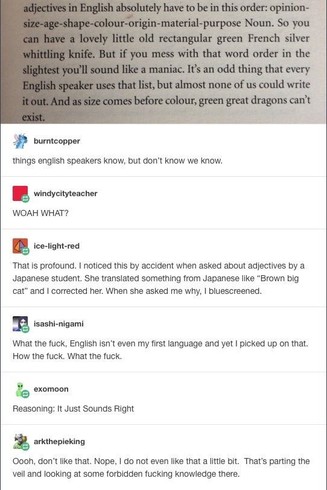
@ConfusedImp #language #adjectives are so much fun.
Thanks for finding this!
1.08K Posts, 56 Following, 68 Followers · Headmate to @[email protected], still figuring out how things are after a long absence. Twenty-something feminine-leaning androgynous arcaninetales taur usually with two heads. Interests in puzzles, engineering, and a good book, and curling up with a good friend. Pronouns... zhe/zhir for now, but that might change in future. Rosemary#3888 on Discord. Talk to me here before adding, please! Time: UTC-6
As a native speaker, who grew up in an English speaking country, I would just like to say that #English is completely wack.
Most French adjectives that describe the characteristics of a noun are placed after that noun. Some adjectives, however, must be placed before the noun they describe, and still others can go either before or after, depending on their meaning. French adjectives that go after the nouns they describe In general, and unlike English, French adjectives …
this gets thrown around now and then and it's always refreshing to me just how much of PITA English is about this particular issue
you can really discombobulate people sometimes if you're willing to get weird and violate a few elements of that order in some way, lemme tell you what
(also, technically IIRC it's more 'quantity opinion size temperature age shape color origin material purpose noun', but who wants to talk about TWO lovely little ROOM-TEMPERATURE old rectangular green French silver whittling knives)
@sydneyfalk @ConfusedImp
…but I felt it like something natural, intuitively! With no need to learn any rules!
It should be mensioned, English is not my native tongue, though I started to study it when I was 7.
I did some research and apparently this is (to some degree) present in other languages, so maybe that's why?
I had assumed it was "an English thing", and now I have to apologize to the whole language. (It's gonna take me a while. -_- )
@sydneyfalk @ConfusedImp 'why'… it's a real question. This is not a simple coincidence…
In [many] Roman languages, and some Slavic ones, I know, adjectives stand after nouns, but order of the first may also be the same. I'm not a Romanist to say it's true, I am even not a linguist at all. 'Just kidding since being a kid'.
…A mystery of human intellect, indeed, I consider 😃
I looked at it as utility vs. expectation -- things that aren't dangerous unless they have certain adjectives (an *angry* neighbor versus a neighbor) encouraged putting some of them first, then categorization started shaking all the different possibilities out, etc. etc.
I think it's somewhat *different* in other languages, which might support this theory -- if a language was cooked in a radically different culture, shape might be way more vital than size, etc.
@sydneyfalk @ConfusedImp
*dangerous* before all another... *More valuable* for our's being before less valuable...
We usually remember best the beginnings and the endings... Emotional attitude help us to keep smth in memory better, too. #memory_technique
It seems to be tied one to another. That might be the common for all languages, despite all possible differences between cultures. So, we seem to have found two borders of construction of natural languages' syntax.
And sometimes in real life even we change that usual word order to pay smbd's attention to the most significant for the certain moment. :-) Oftenly accenting the words by intonation.
@ConfusedImp "The dog was big and orange"
"The dog was orange and big"
Dang it. Checks out even in that form.
 James Webpage
 Sol
Sol Dr. Coffee
 OldBrushNewPaper
 𝓜𝓪𝓵𝓲𝓽𝓲𝓪 (Malitia)
 VelociRaptor 📷
 FelixArden
 Ronflaix™ (inactive)
 Rosemary
 Pyrite
 Marsxyz - sponsored
 penartur
 Cathal Garvey
 vector (book aspect)
 elomatreb (moved to cybre.space)
 Shadow D. Wolf
 acb
acb Christian 🔜 MOVING ACCOUNTS
 Blort™ 🐀Ⓥ🥋☣️
 ➡ @
➡ @ a dragon
 Asimech
 Wim 🈂️
 Dan Hon
 Michal Migurski 🍉
 Ontploffing Boer
 Sydney “The Word” Falk
 Michael Lubert
 modula t.