Quote of the day, 28 January: Venerable Mãezinha

  • Strive to live the perfection of love through daily fidelity. Forget what is past, and live generously in the will of God.
  • As long as your will is united to Jesus and you seek to please Him, all goes well—despite falls and failures.
  • It is worth making the effort. It is worth renouncing ourselves for the One who sacrificed everything for us. After a few brief moments of struggle, there awaits an eternity of joy and unending happiness.

Venerable Maria Immaculata of the Most Holy Trinity, “Mãezinha”

Pensamentos, Thoughts on the path of holiness

Venerable Maria Immaculata of the Most Holy Trinity

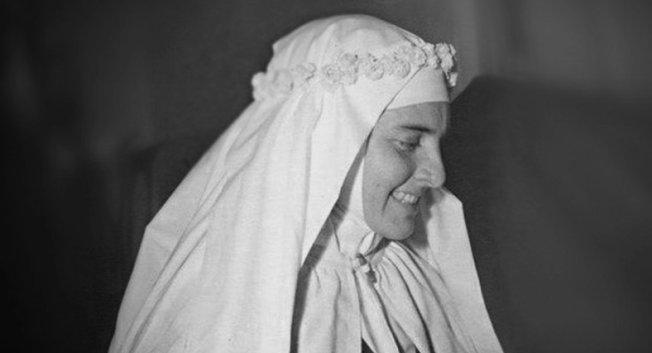
Born on January 12, 1909, in Maria da Fé, in the state of Minas Gerais, Maria Giselda Villela was marked from an early age by a deep and abiding faith and by a desire for total consecration to God. Upon professing her religious vows, she took the name Sister Maria Immaculata of the Most Holy Trinity (known as “Mãezinha,” meaning “Little Mother” in Portuguese) and distinguished herself by a spirituality centered on the mystery of the Trinity and by an intense life of prayer, lived with silent fidelity and persevering dedication.

Her vocation found full expression in the founding of the Carmel of the Holy Family in Pouso Alegre. There, she played a decisive role in establishing Carmelite life within the local Church and in fostering a contemplative witness attentive to the concrete realities and needs of the people.

Venerable Maria Immaculata of the Most Holy Trinity died on January 20, 1988, in Pouso Alegre, leaving as her spiritual legacy a community marked by fidelity to the Carmelite charism, the centrality of prayer, and filial trust in the action of God.

On Thursday, January 22, 2026, Pope Leo XIV approved the decree recognizing the heroic virtues of Mãezinha.

Prayer

Most Holy Trinity, Father, Son, and Holy Spirit,
I adore You profoundly and, with all the affection of my heart,
I thank You for having chosen the Servant of God
Maria Immaculata of the Most Holy Trinity (Mãezinha)
to belong entirely to You in Carmel.

I ask You that, if it be Your will,
she may soon be canonized.
I also ask You, through the intercession of the Servant of God,
to grant me the following grace:

Here mention your intention

Pray the Ave Maria and the Gloria Patri three times

Those who receive graces through the intercession of the Servant of God Maria Immaculata of the Most Holy Trinity are asked to communicate them to:

Carmel of the Holy Family
Rua Comendador José Garcia, 1307
CEP 37553-101 – Pouso Alegre – MG
Brazil

Phone: +55 (35) 3421-1103
Email: [email protected]

Translation from the Portuguese text is the blogger’s own work product and may not be reproduced without permission.

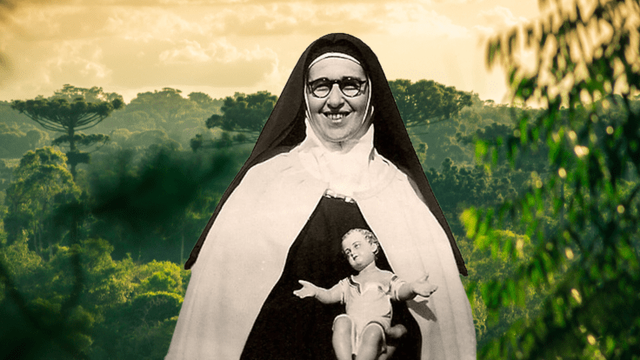
Featured image: Venerable Mãezinha holds an image of the Infant Jesus. Image credits: Photograph of Mãezinha courtesy of the Discalced Carmelites (by permission); collage created in Adobe Express by Carmelite Quotes.

#holiness #MariaGiseldaVillela #MariaImmaculataOfTheMostHolyTrinity #VenerableMãezinha #willOfGod

Quote of the day, 22 January: St. Teresa of the Andes

I’ve been in Carmel 6 months, Isabel, 6 months of heaven, undisturbed by anything on earth, 6 months of living hidden in my adored Word, listening to His Word of life, contemplating His infinite beauty.

If I could but explain to you the immense void in which I live as far as anything having to do with the world is concerned, you’d envy me.

It’s Jesus, my Isabel, who is the only attraction in my life. It’s He, with His charms and sweetness, who leads me to forget everything.

Still, there are times—believe me—when a person suffers. And don’t think that a Carmelite’s sufferings are of any ordinary type. And yet in her suffering it’s as though a Carmelite rejoices, isn’t that so, sister dear? Especially when it is Jesus Himself who crucifies us, who breaks us to pieces. We find ourselves happy to be His plaything.

You understand all too well the language of the cross; I don’t need to tell you to love the cross; for it is on the cross that our soul’s transformation in God is accomplished. But don’t think that because of this that I suffer, for believe me, I wish I could suffer much more.

The best thing of all is to love God’s will. It is there that we find the cross better than in any other place. It is there that this blessed tree grows correctly, without hindrance, for it is without our choice, without any personal satisfaction whatsoever.

Do you feel in your soul this love for God’s will?

Saint Teresa of Jesus of the Andes

Letter 149 to Elisa Valdes Ossa, November 1919 (excerpts)

Note: This lengthy, undated letter also reflects—especially in its later paragraphs—the spiritual influence of Saint Elizabeth of the Trinity on Teresa, the young Carmelite. On this date in 1986, Saint John Paul II signed the decree recognizing the heroicity of her virtues, by which she received the title Venerable.

Griffin, M D & Teresa of the Andes, S 2023, The Letters of Saint Teresa of Jesus of the Andes, ICS Publications, Washington DC.

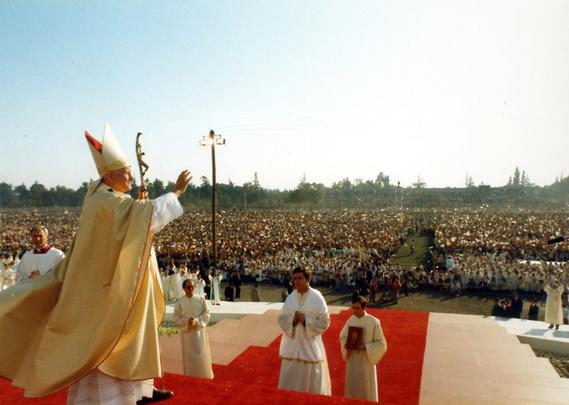
Featured image: Saint John Paul II waves farewell to the faithful at the conclusion of the Mass of Beatification of Teresa of Jesus of the Andes in Parque O’Higgins, Santiago, Chile, 3 April 1987. Image credit: Discalced Carmelites (by permission).

#cross #JesusChrist #StTeresaOfTheAndes #suffering #willOfGod

Quote of the day, 18 January: Père Jacques de Jésus

Mr. Zamansky, who was a prisoner with Père Jacques at the Royallieu camp, gave the following account of the moment when Père Jacques knew that he was leaving in one of the convoys heading east:

“We saw them off. Père Jacques was among them, his face imbued with the same peace we knew him for, but he was serious in his look and his walk. Surrendering oneself to God can only be done without any ulterior motive, and above all, without any hope of choice. And I think that’s what Père Jacques was saying the last minute I saw him: ‘Fiat voluntas tua.’

In an interview given at the Carmelite convent in Avon, Mr. Michel de Bouard recounts how he was with Père Jacques in the quarantine block at the Mauthausen camp, when he told Père Jacques that he’d made a vow if he got out of that hellhole alive. Père Jacques thought about it for a moment, then said:

“No, you mustn’t tempt God; he’s the one who decides. Say ‘Fiat voluntas tua’ [Thy will be done (cf. Mt 26:42)].”

Fr. Didier-Marie Golay, ocd

Lent 2024 Carmelite Online Retreat, Week 5

Servant of God Père Jacques de Jésus—Discalced Carmelite priest and headmaster of the Carmelite boys school in Avon, France—endeavored to live the truth of his message, living a life of silence, obedience, and charity.

During the Nazi occupation of France, he enrolled three Jewish boys under false names and employed a fourth boy as a worker at the school and monastery of the friars. With the aid of a local villager, he was able to shelter the father of one of the students. Furthermore, he hired a noted Jewish botanist as a faculty member at the boarding school.

On 15 January 1944 between 10:00 and 10:30 in the morning, the German officers came for Père Jacques and the three students he had been sheltering at the boarding school; in a separate Gestapo raid in Fontainebleau, the botanist, his mother, and his sister were arrested at their home.

Although Père Jacques was sent to different concentration camps, the students, their botany teacher, and his family were incarcerated in the Melun detention center in Paris on 15 January. On 18 January they were transferred to the Drancy transit camp in the northeastern suburb of Paris.

On 3 February 1944 the students, their teacher, and his family were deported to Auschwitz in a transport of roughly 1200 persons. Upon their arrival in Auschwitz on 6 February, 985 persons were sent directly to the gas chambers. The Carmelite students from Avon, their botany teacher, his mother, and his sister all perished that day.

Only the fourth boy survived because he was working in the monastery on 15 January when the Gestapo arrived.

Prayer for the Beatification of Père Jacques de Jésus

Translation from the French text is the blogger’s own work product and may not be reproduced without permission.

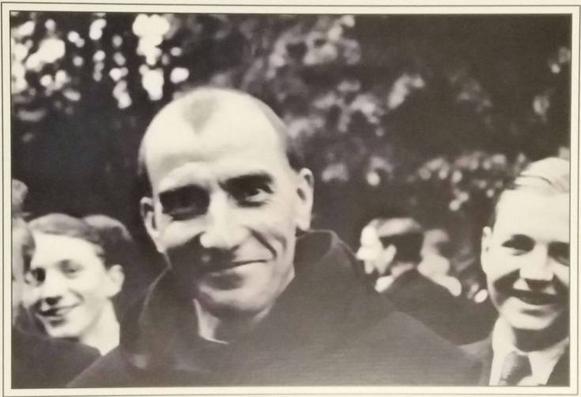
Featured image: Père Jacques and some of the boys he cared for through the years. Image credit: Discalced Carmelites (by permission).

#Jews #obedience #PèreJacquesDeJésus #ServantOfGod #willOfGod

St. John of the Cross Novena, Day 6: Prayer

Reading

Whoever flees prayer flees all that is good.

Sayings of Light and Love, 169

Scripture

When evil men advance against me
to devour my flesh,
they, my opponents, my enemies,
are the ones who stumble and fall.

When evil men advance against me
to devour my flesh,
they, my opponents, my enemies,
are the ones who stumble and fall.

Though an army pitched camp against me,
my heart would not fear;
though war were waged against me,
my trust would still be firm.

One thing I ask of Yahweh,
one thing I seek:
to live in the house of Yahweh
all the days of my life,
to enjoy the sweetness of Yahweh
and to consult him in his Temple.

For he shelters me under his awning
in times of trouble;
he hides me deep in his tent,
sets me high on a rock.

And now my head is held high
over the enemies who surround me,
in his tent I will offer
exultant sacrifice.

I will sing, I will play for Yahweh!

Yahweh, hear my voice as I cry!
Pity me! Answer me!
My heart has said of you,
“Seek his face.”
Yahweh, I do seek your face;
do not hide your face from me.

Do not repulse your servant in anger;
you are my help.
Never leave me, never desert me,
God, my savior!
If my father and mother desert me,
Yahweh will care for me still.

Yahweh, teach me your way,
lead me in the path of integrity
because of my enemies;
do not abandon me to the will of my foes
false witnesses have risen against me,
and breathe out violence.

This I believe: I shall see the goodness of Yahweh,
in the land of the living.
Put your hope in Yahweh, be strong, let your heart be bold,
put your hope in Yahweh.

Psalm 27

Meditation

Let’s have a virtual show of hands: who among us has had an experience where God seemed to be hiding or even absent when we pray? Who among us has ever prayed, “God, where are you?” Has anyone ever said, “prayer isn’t working for me, God doesn’t care about me, I give up”? Has anyone ever experienced dryness in prayer, where you can’t feel anything anymore? Or, has someone ever discovered one day that they drifted away from the fervor of the practice of prayer they once had?

If you answered, “yes” to any one or more of these questions, you are in good company. All of us experience difficulties in prayer. In yesterday’s fifth novena meditation, we read one of St. Teresa’s accounts where she experienced difficulties in prayer; she was going through a moment of tribulation and the practice of prayer that usually brought her encouragement and comfort simply didn’t work.

Growing in friendship with God is a lifelong journey along the way of perfection. There will be many moments when we will stumble and fall. Ask any old friend of God and they will testify to this age-old fact of the spiritual life. The most important lesson that those who travel the way of perfection (or the Little Way of St. Thérèse) must learn is that it’s not a matter of how frequently or infrequently we fall, it’s how quickly we get up again and keep moving along the way. Saint Teresa herself says in the Interior Castle’s Second Mansion (IC II), “if you should at times fall don’t become discouraged and stop striving to advance. For even from this fall God will draw out good.” (IC II:9)

“Don’t become discouraged” is advice we read and hear often in Carmelite spirituality. Here’s what St. Elizabeth of the Trinity said to her younger sister a few months before Elizabeth died:

Darling little sister, you must cross out the word “discouragement” from your dictionary of love; the more you feel your weakness, your difficulty in recollecting yourself, and the more hidden the Master seems, the more you must rejoice, for then you are giving to Him, and, when one loves, isn’t it better to give than to receive? God said to Saint Paul: “My grace is sufficient for you, for power is made perfect in weakness” (2 Cor 12:9), and the great saint understood this so well that he cried out: “For the sake of Christ, then, I am content with weaknesses, For when I am weak, then I am strong” (2 Cor 12:10). What does it matter what we feel; He, He is the Unchanging One, He who never changes: He loves you today as He loved you yesterday and will love you tomorrow. (Letter 298)

St. Teresa was more blunt when writing about those facing discouragement in prayer, especially beginners in prayer:

Ah, my Lord! Your help is necessary here; without it one can do nothing (cf. Jn 15:5). In Your mercy do not consent to allow this soul to suffer deception and give up what was begun. (IC II:6)

It will seem to you that you are truly determined to undergo exterior trials, provided that God favors you interiorly. His Majesty knows best what is suitable for us. There’s no need for us to be advising Him about what He should give us, for He can rightly tell us that we don’t know what we’re asking for (cf. Mt 20:22). The whole aim of any person who is beginning prayer—and don’t forget this, because it’s very, very important—should be that he work and prepare himself with determination and every possible effort to bring his will into conformity with God’s will. (IC II:8)

We can have all the determination in the world to be devout, faithful, and persistent in our prayer, but our own devotion, fidelity, and persistence alone are not sufficient. We need the Lord’s guidance. Here, St. Teresa refers to acquiring spiritual directors, but her point is more valid than ever: 

Provided that we don’t give up, the Lord will guide everything for our benefit, even though we may not find someone to teach us. There is no other remedy for this evil of giving up prayer than to begin again; otherwise the soul will gradually lose more each day—and please God that it will understand this fact. (IC II:10)

“Provided that we don’t give up,” Teresa writes. “Whoever flees prayer,” St. John of the Cross echoes, “flees all that is good.”

What is this “all that is good” to which John refers?

This time, we will let him answer the question, by sharing an excerpt from his 8 July 1589 letter to Madre Leonor de San Gabriel in Córdoba. A companion of St. Teresa in founding the monasteries of Beas and Sevilla, Mother Leonor was feeling alone in Córdoba without the companionship of Teresa and the sisters she knew and loved the best. St. John of the Cross wrote a letter to encourage her in her new mission as prioress:

Jesus be in your soul, my daughter in Christ.

Thank you for your letter. And I thank God for having desired to use you in this foundation, since His Majesty has done this in order to bring you greater profit. The more he wants to give, the more he makes us desire—even to the point of leaving us empty in order to fill us with goods. You will be repaid for the goods (the love of your sisters) that you leave behind in Sevilla. Since the immense blessings of God can only enter and fit into an empty and solitary heart, the Lord wants you to be alone. For he truly loves you with the desire of being himself all your company. And Your Reverence will have to strive carefully to be content only with his companionship, so you might discover in it every happiness. Even though the soul may be in heaven, it will not be happy if it does not conform its will to this. And we will be unhappy with God, even though he is always present with us, if our heart is not alone, but attached to something else. (Letter 15)

“He loves you today as He loved you yesterday and will love you tomorrow,” St. Elizabeth wrote, echoing the sentiments of St. John of the Cross. But if God is “always present with us”, how can we become present to God, so that our hearts are alone and not “attached to something else”? 

Brother Lawrence of the Resurrection tells us what he did:

Thus, after offering myself entirely to God in atonement for my sins, I renounced for the sake of his love everything other than God, and I began to live as if only he and I existed in the world. Sometimes I considered myself before him as a miserable criminal at his judge’s feet, and at other times I regarded him in my heart as my Father, as my God. I adored him there as often as I could, keeping my mind in his holy presence and recalling him as many times as I was distracted. I had some trouble doing this exercise, but continued in spite of all the difficulties I encountered, without getting disturbed or anxious when I was involuntarily distracted. I was as faithful to this practice during my activities as I was during my periods of mental prayer, for at every moment, all the time, in the most intense periods of my work I banished and rid from my mind everything that was capable of taking the thought of God away from me (Letter 12).

Prayer 

O St. John of the Cross
You were endowed by our Lord with the spirit of self-denial
and a love of the cross.
Obtain for us the grace to follow your example
that we may come to the eternal vision of the glory of God.

O Saint of Christ’s redeeming cross
the road of life is dark and long.
Teach us always to be resigned to God’s holy will
in all the circumstances of our lives
and grant us the special favor
which we now ask of you.

Mention your request

Above all, obtain for us the grace of final perseverance,
a holy and happy death and everlasting life with you
and all the saints in heaven.
Amen.

Let’s continue in prayer

Day 1 — Self-trust
Day 2 — Self-giving
Day 3 — Cleansing
Day 4 — Walking in love
Day 5 — Trust
Day 6 — Prayer
Day 7 — Humility
Day 8 — Eternal Silence
Day 9 — Silent love

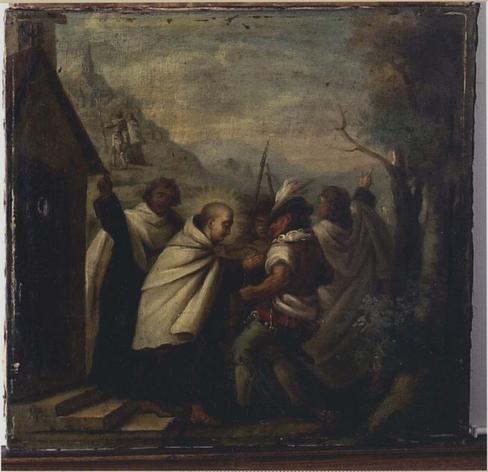
The Arrest of St John of the Cross
18th c. French
Oil on canvas, 1772 or 1777
Carmel of Pontoise
© Ministère de la Culture (France), Médiathèque de l’architecture et du patrimoine, Diffusion RMN-GP. Used by permission.

The novena prayer was composed from approved sources by Professor Michael Ogunu, a member of the Discalced Carmelite Secular Order in Nigeria.

John of the Cross, St 1991, The Collected Works of St. John of the Cross, rev. edn, Kavanaugh, K & Rodriguez, O (trans.), ICS Publications, Washington DC.

Teresa of Avila, St 1985, The Collected Works of St. Teresa of Avila, Kavanaugh, K & Rodriguez, O (trans.), ICS Publications, Washington DC.

Elizabeth of the Trinity, S 2003, The Complete Works of Elizabeth of the Trinity volume 2: Letters from Carmel, Nash, A (trans.), ICS Publications, Washington DC.

Lawrence of the Resurrection, B; De Meester, C 1994, Writings and Conversations on the Practice of the Presence of God,  translated from the French by Salvatore Sciurba, OCD, ICS Publications, Washington DC.

All scripture references in this novena are from the New Revised Standard Version Bible: Catholic Edition, copyright © 1989, 1993 the Division of Christian Education of the National Council of the Churches of Christ in the United States of America as accessed from the Bible Gateway website.

Don’t become discouraged and give up prayer, says St. John of the Cross. We offer varying novenas to Our Lady of Mount Carmel, as well as novenas to St. Teresa of Avila, St. John of the Cross, St. Thérèse of Lisieux, Sts. Louis and Zélie Martin, St. Elizabeth of the Trinity, and St. Joseph.

Let us unite in prayer

#beginners #brotherLawrence #brotherLawrenceOfTheResurrection #determination #difficulty #discouragement #doctorOfTheChurch #dryness #elizabethCatez #fall #givingUp #godsWill #icsPublications #interiorCastle #johnOfTheCross #journey #letter #letters #loneliness #mentalPrayer #novena #practiceOfThePresenceOfGod #psalms #sabeth #sanJuanDeLaCruz #stElizabethOfTheTrinity #stJohnOfTheCross #stTeresa #stTeresaOfAvila #stTeresaOfJesus #stumble #teresa #way #willOfGod

Quote of the day, 26 June: Blessed Mary Josephine

It has always been my heart’s burning desire to fulfill the will of God; I have never wanted anything else. I have lived and am living the divine will. It is something I need more than the food I eat and the air I breathe.
— Blessed Mary Josephine of Jesus Crucified
Autobiography

Looking more closely at the history and message of Blessed Mary Josephine, we better understand the inescapable need for a contemplative dimension in every Christian life. Her example shows us a concrete path for cultivating it. Her very existence was a true school of charity—toward her fellow sisters and, through her cloistered life, toward a wide apostolic field she served only to help others love the Lord more deeply.

She, too, like Saint Thérèse of the Child Jesus, did not want to “become a saint by halves.”

With her own unique character and mystical gifts—marked by extraordinary spiritual experiences—she embodied a life entirely rooted in one guiding conviction: “I want to live by feeding on the will of God… I want my will to be made one with His.”

Again, in her Diary, she wrote: “I ardently desire to live in the will of God. I know that this is how saints are made, and I want to become a saint to give glory to God.”

This program of life should be the great aspiration of every Christian, in perfect harmony with the words of Christ, our only and supreme model: “My food is to do the will of the Father” (Jn 4:34), because “whoever does the will of God lives forever” (1 Jn 2:17).

Cardinal José Saraiva Martins

Message at the Beatification of Blessed Mary Josephine of Jesus Crucified
Naples, 1 June 2008

Translation from the Italian text is the blogger’s own work product and may not be reproduced without permission.

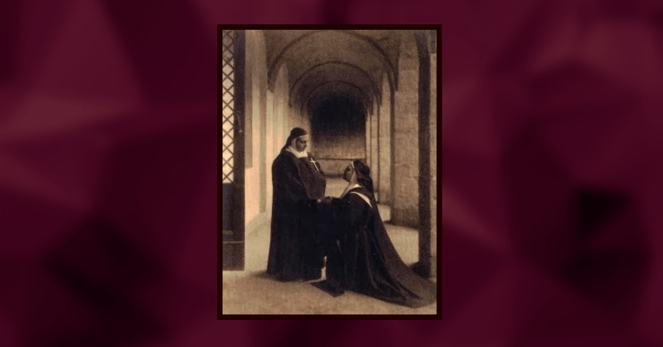
Featured image: A nun kneels before Blessed Mary Josephine in the cloister of the Carmel at Ponti Rossi. Image credit: Discalced Carmelites (Used by permission).

⬦ Reflection Question ⬦
What would it mean for you to feed on the will of God in your daily life?
Join the conversation in the comments.

#beatification #BlessedMaryJosephineOfJesusCrucified #gloryToGod #homily #willOfGod

Quote of the day, 4 May: St. Raphael Kalinowski

‘Do you love me? Do you love me?’ [Cf. Jn 21:15-17]. Love gives strength to do the will of God in every situation, to avoid everything that might displease Him, to work and to suffer for His glory.

St. Teresa wanted to suffer or to die; St. Magdalen de Pazzi did not want to die, but to suffer.

Love is strong as death [Sg 8:6]. And just as nothing can resist death, love gives strength to triumph over every challenge. Then you don’t feel pain, and if you do you welcome it. From this fire of God’s love the flame of love of neighbor arises.

Anyone who loves God with all his heart desires that God be loved by all and this desire pervades his whole life….

But who is able to achieve such a degree of perfect love, which will free our soul from attachment to any earthly goods and completely unite our will with God’s will?

When the Divine Savior again asks us for our hearts, let us ask Him to take them to Himself; only He can purify them and light the fire of holy love and an ardent desire to be detached from everything and to want only His holy will.

Saint Raphael Kalinowski

Tierney, chap. 8: Vicar Provincial for the Carmelite nuns (1901)

Tierney, T  2016,  Saint Raphael Kalinowski: Apprenticed to Sainthood in SiberiaBalboa Press,  Bloomington, IN

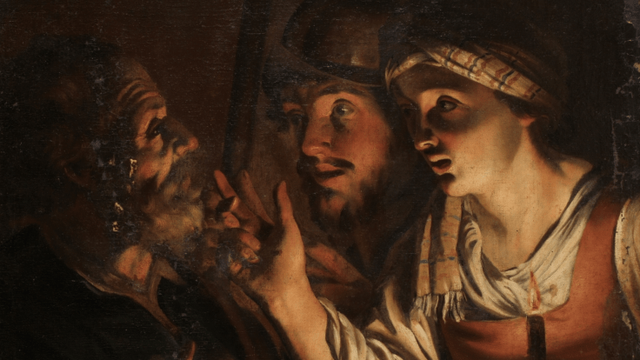
Featured image: This detailed view of The Denial of St. Peter by an anonymous follower of Gerard (Gerrit) van Honthorst (Dutch, 15921656) was painted in the 17th century and is now in the Prado Museum in Madrid. The canvas, cut on all four sides, is believed to be based on an engraving after van Honthorst’s original, dated around 1620–25 and held in the Minneapolis Institute of Art. Christian tradition has long seen Jesus’ threefold question to Peter in John 21 as a loving invitation to reaffirm his devotion, undoing his triple denial on the night of Christ’s Passion. Image credit: Copyright ©Museo Nacional del Prado (Public domain)

⬦ Reflection Question ⬦
How is Jesus inviting me to respond more fully to His love, even in the face of weakness or failure?
Join the conversation in the comments.

#detachment #GodSLove #hearts #inspiration #love #perfection #StRaphaelKalinowski #strength #suffering #willOfGod

Bible Gateway passage: John 21:15-17 - New Revised Standard Version Catholic Edition

Jesus and Peter - When they had finished breakfast, Jesus said to Simon Peter, “Simon son of John, do you love me more than these?” He said to him, “Yes, Lord; you know that I love you.” Jesus said to him, “Feed my lambs.” A second time he said to him, “Simon son of John, do you love me?” He said to him, “Yes, Lord; you know that I love you.” Jesus said to him, “Tend my sheep.” He said to him the third time, “Simon son of John, do you love me?” Peter felt hurt because he said to him the third time, “Do you love me?” And he said to him, “Lord, you know everything; you know that I love you.” Jesus said to him, “Feed my sheep.

Bible Gateway

Quote of the day, 28 April: Blessed Chiquitunga

During her postulancy at the Carmel of Asunción, Blessed Maria Felicia of the Blessed Sacrament (Chiquitunga) passed through a dark night that tested her vocation.

After a month of “heaven” in her new Carmelite life, during Lent of 1955, Sister Maria Felicia began to feel profound insecurity about her choice, made against the advice of almost everyone she knew. She thought: Wasn’t my decision to enter a cloistered monastery simply an act of self-will?—an opinion expressed strongly by the newly appointed Auxiliary Bishop of Asunción, Monsignor Ramón Bogarín.

From this insecurity came the fear that she had taken the wrong path; the fear produced deep spiritual dryness; and from all of this arose the obsessive temptation: I must leave the cloister… and if I don’t, it’s because I’m a coward.

The community confessor, the same one who had actively resisted her entrance into Carmel, pressured her to decide once and for all. Finally, on 9 August, Sister Maria Felicia made her decision—to leave. She recounts it herself:

Today, I was resolved to leave, but with the anguish of bearing the cross of my infidelity without any merit. The confessor flatly told me to say whether I was leaving or staying. I told him I would leave. A coldness of death came over me, an anguish so deep it even choked back my tears (Spiritual Diary, C, folio 15).

Before giving her final word, Sister Maria Felicia suggested they cast lots—and the confessor, eager to settle the matter once and for all, agreed. Accompanied by the Prioress at that supreme moment, they prayed before the Blessed Sacrament and placed two folded papers at the feet of a statue of Mary.

Sister Maria Felicia drew one. The confessor opened it. It read: I want to die in Carmel.

Immediately, she cried out, convinced and determined: Jesus, my Jesus! Yes, this is Your will.

At the same time, she experienced her weakness and poverty: You see my weaknesses, my cowardice, my fears, my miseries! Alone I can do nothing!

She entrusted everything to the Lord: Jesus, into Your hands I entrust my vocation!

She knew that only He could give her the strength needed to overcome herself, for at times: The weight of Your will is so heavy that I would rather die! I fear sacrifice, I fear the Cross. Help me, Blessed Virgin! Little Jesus of Prague, miracle worker of my vocation! (Spiritual Diary, C, folios 15–16).

Supported by this conviction, trust, and surrender, she renewed the offering she had made from her early youth:

Father! My Father, God of my life. My nothingness—so truly Yours—I offer it back to You today, not knowing how many times I will yet snatch it away again, desperately kicking and screaming to do my own will and not Yours.

In reality, she had never truly withdrawn her will from God. The anguish before the Cross is not a rebellion—just as it was not rebellion in Jesus at Gethsemane.

Still, she renewed her complete surrender:

Here I am, Lord! Your will! But aided by Your strength, Your love, and Your mercy, my God!

Thus, even in the midst of the “dark night,” without emerging from it, in faith, hope, and love, God’s will triumphed.

The Carmelite postulant had died to herself, united to the death of Christ.

Father Julio Félix Barco, o.c.d.

Enseñanzas desde el Carmelo (Lessons from Carmel)

Monte Carmelo 2018, Enseñanzas desde el Carmelo. De los escritos de María Felicia de Jesús Sacramentado-Chiquitunga, no. 1, vol. 126, Monte Carmelo, Burgos. Available at: https://bcd.digicarmel.com (Accessed: 26 April 2025). Licensed under Creative Commons Attribution-NonCommercial 4.0 International.

Translation from the Spanish text is the blogger’s own work product and may not be reproduced without permission.

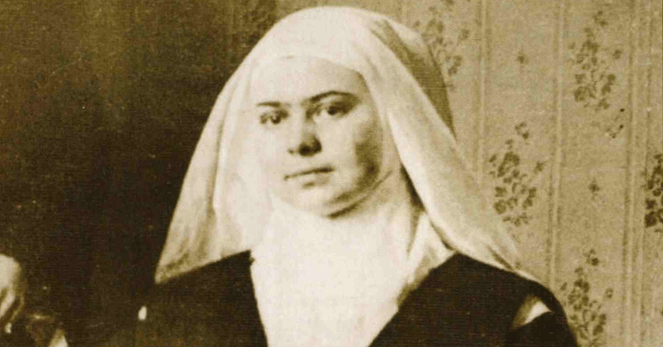
Featured image: Blessed Maria Felicia of the Blessed Sacrament—Chiquitunga—on the day of her clothing in the Carmelite habit, 14 August 1955. Image credit: Discalced Carmelites (Used by permission).

⬦ Reflection Question ⬦
Where in my life is Christ asking me to entrust everything to Him, even when I cannot see the way forward?
Join the conversation in the comments.

#anguish #BlessedMariaFeliciaOfJesusInTheBlessedSacrament #Chiquitunga #darkNight #discernment #lottery #mercy #postulant #willOfGod

Quote of the day, 15 April: St. Teresa of the Andes

I want you to know that I’d give anything to preach to the whole world blind abandonment into God’s hands.

Believe me, I’ve felt Him within me as I work along, since I’ve asked Him for nothing but what He wants and nothing more.

I’ve told my Jesus that He’s the Captain. Let Him give the orders. His soldier will follow Him to death, as long as He helps me with His grace.

Saint Teresa of Jesus of the Andes

Letter 86 to Mother Angelica Teresa of the Blessed Sacrament, O.C.D. (excerpt)
20 April 1919

Note: Father Michael Griffin, O.C.D.—translator and editor of the Letters of St. Teresa of the Andes—comments on her correspondence with the prioress of the Carmel of the Holy Spirit at Los Andes, Mother Angelica Teresa:

At age seventeen, Juanita began corresponding with Mother Angelica Teresa in hopes of being admitted to the Carmel of Los Andes. All in all, she wrote Mother Angelica Teresa twenty letters. These letters shed great light on Juanita’s understanding of the Carmelite vocation and show how earnestly she wanted to become “the perfect friend and bride of the Lord’s heart” (L 51).

One is especially struck by the complete honesty and sincerity with which the aspirant allowed Mother Angelica “to read her soul” to the point that she can say, “Rev. Mother, you can’t complain that your little daughter doesn’t talk to you heart-to-heart” (L 30).

Assuring Mother Angelica of her great desire to enter the Order and to “be able to wear the habit of Carmel with honor” (L 36), she never hesitated to manifest her faults, some of which she felt could disqualify her from this beautiful vocation.

What were these possible impediments to her vocation? For one thing, Juanita did not feel she was holy enough. Furthermore, she was afraid she might not have the health required for such an austere vocation.

There is no doubt but that Mother Angelica was powerfully impressed with Juanita’s letters. In fact, she told Juanita she was a “born Carmelite.” Just how impressed she was can be garnered from a reading of the outstanding Circular Letter Mother Angelica wrote to the other Carmels immediately after Sister Teresa’s death. Mother Angelica was fully convinced “that her knowledge of the Carmelite vocation did not come from her intelligence and reflection alone. These thoughts came, she said, from an understanding which God put in her soul concerning the vocation to which He was calling her.”

Griffin, M D & Teresa of the Andes, S 2023, The Letters of Saint Teresa of Jesus of the Andes, ICS Publications, Washington DC.

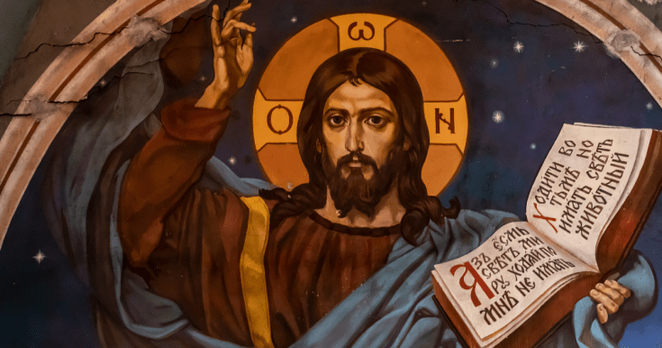
Featured image: This striking image of Christ Pantocrator—inspired by the style of Viktor Vasnetsov—shows Jesus blessing with His right hand while holding the Gospel open in His left. The Slavonic text and iconographic details suggest it originates from a Russian or Serbian Orthodox church. Image credit: oleg_ru / Adobe Stock (Used under license).

Reflection Question
What helps you trust Jesus as your Captain—even when you don’t know where He’s leading?
Join the conversation in the comments.

#abandonment #CarmeliteSpirituality #grace #SequelaChristi #soldier #StTeresaOfTheAndes #willOfGod

God the Joy of My Life: A Biography of Saint Teresa of Jesus of the Andes

Quote of the day, 19 January: St. Mary Magdalen de’ Pazzi

Turning to an image of the Blessed Virgin, [Sister Mary Magdalen de’ Pazzi] said:

“O Mary! I see after all the most pure and resplendent eyes of my Spouse, looking down upon me with a countenance no longer troubled but benign. But, pray! tell me, O my Jesus, what did I do in so short a space of time for which I may have deserved so sweet and smiling a look?”

And she was answered: “Conformity of will.”

In August of 1588, the wine in a keg in the monastery having become sour and the mother prioress having no means to provide good wine, she ordered Sister Mary Magdalen to pray to Jesus that He might be pleased to turn the spoiled wine again into good wine.

Then our Saint, strengthened by obedience, took a little framed picture which represented St. [James], and going with it to the wine cellar, after a short prayer, made the sign of the cross over the keg.

After this, the sister butler came to draw wine, and found it, in fact, restored to its former good taste. The nuns gave thanks to God, who had so miraculously provided for their needs.

A fellow sister, Mary Angiola Santucci, was then confined to her bed by a serious illness, and, on hearing of this miracle, asked for a drink of the wine. No sooner had she tasted it than she felt a notable relief from her illness, and, feeling her hope of ultimate recovery increase, she wanted to taste more of it on the following day. After this, she felt better; and on the third day, taking the same small quantity, she recovered her health entirely, to the inexpressible wonder of the sisters, who could not help being cognizant the double prodigy worked through the virtue of our humble and holy [Sister].

Father Placido Fabrini

Chapters 25 and 17 (excerpts)

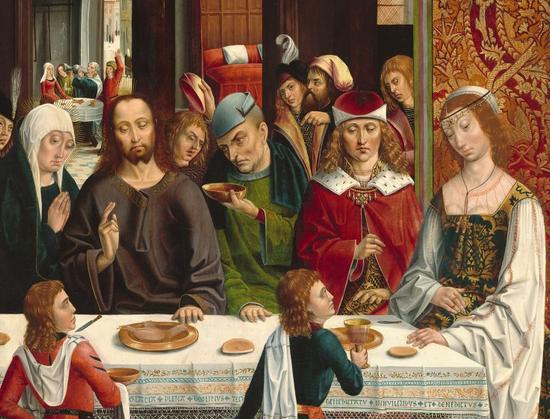
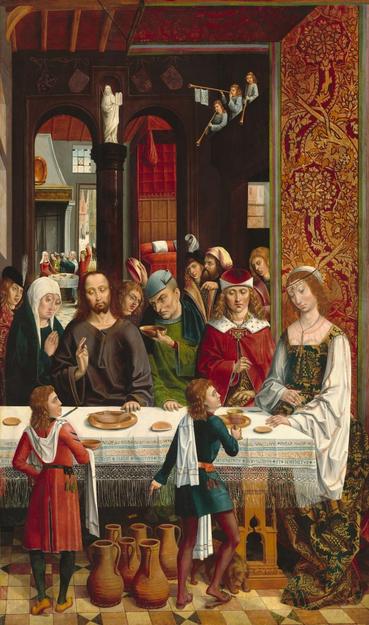
The Marriage at Cana
Master of the Catholic Kings (Spanish, active c. 1485/1500)
Oil on panel, c. 1495/1497
National Gallery of Art, Washington DC

Fabrini, P. & De’ Pazzi, M.M. 1900, The life of St. Mary Magdalen De-Pazzi: Florentine noble, sacred Carmelite virgin, translated from the Italian by Isoleri A., [publisher not identified] Philadelphia.

#beloved #BlessedVirgin #conformity #miracle #obedience #StMaryMagdalenDePazzi #willOfGod #wine

The Marriage at Cana

Master of the Catholic Kings

Quote of the day, 15 January: Père Jacques

In contemplating the life of Christ Jesus, Père Jacques sees him fulfilling the Father’s will. Often, he would quote the Gethsemane story: “Fiat voluntas tuas” (“Thy will be done,” Lk 22:42).

On 29 September 1936, he wrote to a friend:

“Don’t forget to pray with the weight of your worries. Suffering is such a powerful prayer! Let your trial detach you from the earth, and, freed, rest in God without trouble or worry. Say over and over to God: Fiat voluntas tua!”

He knew the cost of saying Fiat. In 1929, when he wished to enter Carmel, his bishop wrote to Rome and he was prevented from doing so. He confided in the prioress of the Carmel of Le Havre:

“For two days I struggled against a thousand feelings of sadness, despondency, discouragement and, above all, revolt. No matter how much my will repeated a sincere Fiat to the Good Lord, all sensitivity and pride shook and put wicked thoughts into my mind.”

With the breath of the Holy Spirit, Père Jacques would have the fortitude to repeat this Fiat in the deportation camps and to help his fellow prisoners say it. Several testimonies bear witness to this.

Mr. Zamansky, who was a prisoner with Père Jacques at the Royallieu camp, gave the following account of the moment when Père Jacques knew that he was leaving in one of the convoys heading east:

“We saw them off. Père Jacques was among them, his face imbued with the same peace we knew him for, but he was serious in his look and his walk. Surrendering oneself to God can only be done without any ulterior motive, and above all, without any hope of choice. And I think that’s what Père Jacques was saying the last minute I saw him: ‘Fiat voluntas tua.’

In an interview given at the Carmelite convent in Avon, Mr. Michel de Bouard recounts how he was with Père Jacques in the quarantine block at the Mauthausen camp, when he told Père Jacques that he’d made a vow if he got out of that hellhole alive. Père Jacques thought about it for a moment, then said:

“No, you mustn’t tempt God; he’s the one who decides. Say ‘Fiat voluntas tua’ [Thy will be done (cf. Mt 26:42)].”

Mr. de Bouard continued:

“I’ve been thinking about it, and I’ve realized that the true thought of faith, the deepest, the highest thought, is to say ‘Thy will be done’. Saying Fiat voluntas tua as we often did in the morning, on the roll-call square, in the smoke of the crematorium, was hard to say without reluctance. By giving me this instruction, Père Jacques, once again, showed me where the ridgeline was, where I had to try to place myself.”

Père Jacques didn’t just preach this abandonment to Divine Providence, he lived it to the end in his own flesh.

During the retreat that he preached at the Carmel of Pontoise, in a conference entitled: “Hope and abandonment,” he quoted from the Book of Job and concluded as follows:

“’Though he kill me, yet I will hope in him!’ [Job 13:15]. Here is a soul who knows what it is to hope—who knows what it is to trust in God—to say to God: ‘Our Father, Thy will be done!’

Didier-Marie Golay, o.c.d.

Through the Cross Toward the Light
2024 Advent Online Retreat, Week 5

Prayer for the Beatification
of Père Jacques de Jésus

Learn more about Père Jacques

Translation from the French text is the blogger’s own work product and may not be reproduced without permission.

Featured image: Père Jacques with students from the Discalced Carmelite boarding school in Avon, France, Le Petit Collège Sainte Thérèse de l’Enfant Jésus. Père Jacques served as headmaster from 1934 until his arrest. Image credit: Discalced Carmelites

#concentrationCamp #faith #fiat #Mauthausen #PèreJacquesDeJésus #politicalPrisoner #prayer #ServantOfGod #suffering #trust #willOfGod

Luke 22:42 - Bible Gateway