St. John of the Cross Novena, Day 7: Humility

Reading

To be taken with love for a soul, God does not look on its greatness, but on the greatness of its humility.

Sayings of Light and Love, 103

Scripture

Have mercy on me, God, in your kindness.
In your compassion blot out my offense.
O wash me more and more from my guilt
and cleanse me from my sin.

My offenses truly I know them;
my sin is always before me
Against you, you alone, have I sinned;
what is evil in your sight I have done.

That you may be justified when you give sentence
and be without reproach when you judge,
O see, in guilt I was born,
a sinner was I conceived.

Indeed you love truth in the heart;
then in the secret of my heart teach me wisdom.
O purify me, then I shall be clean;
O wash me, I shall be whiter than snow.

Make me hear rejoicing and gladness,
that the bones you have crushed may revive.
From my sins turn away your face
and blot out all my guilt.

A pure heart create for me, O God,
put a steadfast spirit within me.
Do not cast me away from your presence,
nor deprive me of your holy spirit.

Give me again the joy of your help;
with a spirit of fervor sustain me,
that I may teach transgressors your ways
and sinners may return to you.

O rescue me, God, my helper,
and my tongue shall ring out your goodness.
O Lord, open my lips
and my mouth shall declare your praise.

For in sacrifice you take no delight,
burnt offering from me you would refuse,
my sacrifice, a contrite spirit,
a humbled, contrite heart you will not spurn.

In your goodness, show favor to Zion:
rebuild the walls of Jerusalem.
Then you will be pleased with lawful sacrifice,
holocausts offered on your altar.

Psalm 51

Meditation

“O sweetest love of God, so little known, whoever has found this rich mine is at rest!” (Sayings, 16) This is the song of St. John of the Cross, his canticle of love distilled down to its very essence. 

God truly loves us, St. John reminds us through his letters. He tells us that God cannot fit in hearts that are occupied with distractions, that are attached to people, places, or things that mean more to us than God himself. God only fits in hearts that have been emptied to make room for him.

It seems that nada—nothingness within us—isn’t so far-fetched after all. Cleansing our souls is like the necessary spiritual housekeeping that must be done prior to any Nativity moment in our spiritual lives; without that soul-cleansing, that housecleaning in our hearts, there will always be a NO VACANCY light shining outside the inn within. How can God find space to squeeze in here?

St. Edith Stein says that the moment we reach the realization that we need to clean house is the moment when we are on the threshold of making the greatest spiritual progress. Recalling the spiritual sense of dryness, darkness, and emptiness that we mentioned in the meditation for our sixth day of this novena, Edith offers this reflection on the state of the soul in her final masterpiece, The Science of the Cross (SC):

She [the soul] is put into total darkness and emptiness. Absolutely nothing that might give her a hold is left to her anymore except faith. Faith sets Christ before her eyes: the poor, humiliated, crucified one, who is abandoned on the cross even by his heavenly Father. In his poverty and abandonment, she rediscovers herself. Dryness, distaste, and affliction are the “purely spiritual cross” that is handed to her. If she accepts it she experiences that it is an easy yoke and a light burden. It becomes a staff for her that will quickly lead her up the mountain. (SC 10)

Accepting the dryness we experience in prayer, the distaste, the affliction, these are all signs that we actually are clearing out space for God within. 

When she realizes that Christ, in his extreme humiliation and annihilation on the cross, achieved the greatest result, the reconciliation and union of mankind with God, there awakens in her the understanding that for her, also, annihilation, the “living death by crucifixion of all that is sensory as well as spiritual” leads to union with God. (SC 10)

And by the way, there is a little voice in Dijon, France who takes up the refrain: it is St Elizabeth of the Trinity, singing so sweetly in the pages of her Last Retreat (LR):

If my interior city (cf. Rev. 21) is to have some similarity and likeness to that “of the King of eternal ages” (I Tim 1:17) and to receive this great illumination from God, I must extinguish every other light and, as in the holy city, the Lamb must be “its only light.”

Here faith, the beautiful light of faith appears. It alone should light my way as I go to meet the Bridegroom. The psalmist sings the He “hides Himself in darkness” (Ps 17:12), then in another place he seems to contradict himself by saying that “light surrounds Him like a cloak” (Ps 103:2). What stands out for me in this apparent contradiction is that I must immerse myself in “the sacred darkness” by putting all my powers in darkness and emptiness; then I will meet my Master, and “the light that surrounds Him like a cloak” will envelop me also, for He wants His bride to be luminous with His light, His light alone, “which is the glory of God.” (LR 4)

So there it is: the challenge, the call is to accept, welcome, embrace and—so to speak—hide in the dark and empty spaces within us, not running to another distraction, another attachment, another new idol in our lives to fill up that interior void. It is at the point when we feel (and know) the emptiness within, the void that we are creating and/or that God is helping us to create so that we can spend time and focus on him—whether that is accepting a loss of some sort of attachment, or purposefully choosing to give up a distracting activity in order to spend more time going to daily Mass, making time for daily Scripture reading, or praying the Liturgy of the Hours, or the rosary, or going to Eucharistic adoration, or practicing silent mental prayer instead of (name your distraction here).

At this point when we have a hunger and a thirst for God that is so strong and powerful that we are willing to sacrifice and say, “all for you and nothing for me” (Sayings 111), we also find ourselves crying out to God, “but I can’t do this alone, by myself!” When we are ready to give up and have reached the point of abandon, we’ve reached the most crucial moment of all because…

That is the truth.

“I never sought anything but the truth,” St. Thérèse said in the hours before her death (Yellow Notebook, 30 September).

St. Teresa set the benchmark in the Interior Castle: “To be humble is to walk in truth” (IC VI, 10:7)

And how will we know when we’re meeting the benchmark for St. John of the Cross?

The humble are those who hide in their own nothingness and know how to abandon themselves to God (Sayings 163).

Prayer

O St. John of the Cross
You were endowed by our Lord with the spirit of self-denial
and a love of the cross.
Obtain for us the grace to follow your example
that we may come to the eternal vision of the glory of God.

O Saint of Christ’s redeeming cross
the road of life is dark and long.
Teach us always to be resigned to God’s holy will
in all the circumstances of our lives
and grant us the special favor
which we now ask of you.

Mention your request

Above all, obtain for us the grace of final perseverance,
a holy and happy death and everlasting life with you
and all the saints in heaven.
Amen.

Let’s continue in prayer

Day 1 — Self-trust
Day 2 — Self-giving
Day 3 — Cleansing
Day 4 — Walking in love
Day 5 — Trust
Day 6 — Prayer
Day 7 — Humility
Day 8 — Eternal Silence
Day 9 — Silent love

Bust of St. John of the Cross
17th c. French
Oil on canvas, no date
Carmel of Pontoise
© Ministère de la Culture (France), Médiathèque de l’architecture et du patrimoine, Diffusion RMN-GP. Used by permission.
Latin inscription upper left: QVID TIBI PRO LABOR
Latin inscription at base: PATI. ET. CONTEMNI. PROTE

 The novena prayer was composed from approved sources by Professor Michael Ogunu, a member of the Discalced Carmelite Secular Order in Nigeria.

John of the Cross, St 1991, The Collected Works of St. John of the Cross, rev. edn, Kavanaugh, K & Rodriguez, O (trans.), ICS Publications, Washington DC.

Teresa of Avila, St 1985, The Collected Works of St. Teresa of Avila, Kavanaugh, K & Rodriguez, O (trans.), ICS Publications, Washington DC.

Stein, E 2002, The Science of the Cross, The Collected Works of Edith Stein, Book 6, translated from the German by Koeppel, J, ICS Publications, Washington D.C.

Elizabeth of the Trinity, S 2014, I Have Found God, The Complete Works of Elizabeth of the Trinity Volume 1: Major spiritual writings, translated from the French by Kane, A, ICS Publications, Washington DC.

All scripture references in this novena are from the New Revised Standard Version Bible: Catholic Edition, copyright © 1989, 1993 the Division of Christian Education of the National Council of the Churches of Christ in the United States of America as accessed from the Bible Gateway website.

Don’t become discouraged and give up prayer, says St. John of the Cross. We offer varying novenas to Our Lady of Mount Carmel, as well as novenas to St. Teresa of Avila, St. John of the Cross, St. Thérèse of Lisieux, Sts. Louis and Zélie Martin, St. Elizabeth of the Trinity, and St. Joseph.

Let us unite in prayer

#abandonment #darkness #drynessInPrayer #edithStein #elizabethCatez #godsLove #humble #humility #icsPublications #interiorCastle #johnOfTheCross #lastConversations #lastRetreat #letter #letters #love #loveOfGod #nada #nothingness #novena #sabeth #sanJuanDeLaCruz #santaTeresaDeJesus #sayingsOfLightAndLove #selfEmptying #stEdithStein #stElizabethOfTheTrinity #stJohnOfTheCross #stTeresa #stTeresaBenedictaOfTheCross #stTeresaOfAvila #stTeresaOfJesus #stTherese #stThereseOfLisieux #stThereseOfTheChildJesus #teresa #theScienceOfTheCross #truth

St. John of the Cross Novena, Day 6: Prayer

Reading

Whoever flees prayer flees all that is good.

Sayings of Light and Love, 169

Scripture

When evil men advance against me
to devour my flesh,
they, my opponents, my enemies,
are the ones who stumble and fall.

When evil men advance against me
to devour my flesh,
they, my opponents, my enemies,
are the ones who stumble and fall.

Though an army pitched camp against me,
my heart would not fear;
though war were waged against me,
my trust would still be firm.

One thing I ask of Yahweh,
one thing I seek:
to live in the house of Yahweh
all the days of my life,
to enjoy the sweetness of Yahweh
and to consult him in his Temple.

For he shelters me under his awning
in times of trouble;
he hides me deep in his tent,
sets me high on a rock.

And now my head is held high
over the enemies who surround me,
in his tent I will offer
exultant sacrifice.

I will sing, I will play for Yahweh!

Yahweh, hear my voice as I cry!
Pity me! Answer me!
My heart has said of you,
“Seek his face.”
Yahweh, I do seek your face;
do not hide your face from me.

Do not repulse your servant in anger;
you are my help.
Never leave me, never desert me,
God, my savior!
If my father and mother desert me,
Yahweh will care for me still.

Yahweh, teach me your way,
lead me in the path of integrity
because of my enemies;
do not abandon me to the will of my foes
false witnesses have risen against me,
and breathe out violence.

This I believe: I shall see the goodness of Yahweh,
in the land of the living.
Put your hope in Yahweh, be strong, let your heart be bold,
put your hope in Yahweh.

Psalm 27

Meditation

Let’s have a virtual show of hands: who among us has had an experience where God seemed to be hiding or even absent when we pray? Who among us has ever prayed, “God, where are you?” Has anyone ever said, “prayer isn’t working for me, God doesn’t care about me, I give up”? Has anyone ever experienced dryness in prayer, where you can’t feel anything anymore? Or, has someone ever discovered one day that they drifted away from the fervor of the practice of prayer they once had?

If you answered, “yes” to any one or more of these questions, you are in good company. All of us experience difficulties in prayer. In yesterday’s fifth novena meditation, we read one of St. Teresa’s accounts where she experienced difficulties in prayer; she was going through a moment of tribulation and the practice of prayer that usually brought her encouragement and comfort simply didn’t work.

Growing in friendship with God is a lifelong journey along the way of perfection. There will be many moments when we will stumble and fall. Ask any old friend of God and they will testify to this age-old fact of the spiritual life. The most important lesson that those who travel the way of perfection (or the Little Way of St. Thérèse) must learn is that it’s not a matter of how frequently or infrequently we fall, it’s how quickly we get up again and keep moving along the way. Saint Teresa herself says in the Interior Castle’s Second Mansion (IC II), “if you should at times fall don’t become discouraged and stop striving to advance. For even from this fall God will draw out good.” (IC II:9)

“Don’t become discouraged” is advice we read and hear often in Carmelite spirituality. Here’s what St. Elizabeth of the Trinity said to her younger sister a few months before Elizabeth died:

Darling little sister, you must cross out the word “discouragement” from your dictionary of love; the more you feel your weakness, your difficulty in recollecting yourself, and the more hidden the Master seems, the more you must rejoice, for then you are giving to Him, and, when one loves, isn’t it better to give than to receive? God said to Saint Paul: “My grace is sufficient for you, for power is made perfect in weakness” (2 Cor 12:9), and the great saint understood this so well that he cried out: “For the sake of Christ, then, I am content with weaknesses, For when I am weak, then I am strong” (2 Cor 12:10). What does it matter what we feel; He, He is the Unchanging One, He who never changes: He loves you today as He loved you yesterday and will love you tomorrow. (Letter 298)

St. Teresa was more blunt when writing about those facing discouragement in prayer, especially beginners in prayer:

Ah, my Lord! Your help is necessary here; without it one can do nothing (cf. Jn 15:5). In Your mercy do not consent to allow this soul to suffer deception and give up what was begun. (IC II:6)

It will seem to you that you are truly determined to undergo exterior trials, provided that God favors you interiorly. His Majesty knows best what is suitable for us. There’s no need for us to be advising Him about what He should give us, for He can rightly tell us that we don’t know what we’re asking for (cf. Mt 20:22). The whole aim of any person who is beginning prayer—and don’t forget this, because it’s very, very important—should be that he work and prepare himself with determination and every possible effort to bring his will into conformity with God’s will. (IC II:8)

We can have all the determination in the world to be devout, faithful, and persistent in our prayer, but our own devotion, fidelity, and persistence alone are not sufficient. We need the Lord’s guidance. Here, St. Teresa refers to acquiring spiritual directors, but her point is more valid than ever: 

Provided that we don’t give up, the Lord will guide everything for our benefit, even though we may not find someone to teach us. There is no other remedy for this evil of giving up prayer than to begin again; otherwise the soul will gradually lose more each day—and please God that it will understand this fact. (IC II:10)

“Provided that we don’t give up,” Teresa writes. “Whoever flees prayer,” St. John of the Cross echoes, “flees all that is good.”

What is this “all that is good” to which John refers?

This time, we will let him answer the question, by sharing an excerpt from his 8 July 1589 letter to Madre Leonor de San Gabriel in Córdoba. A companion of St. Teresa in founding the monasteries of Beas and Sevilla, Mother Leonor was feeling alone in Córdoba without the companionship of Teresa and the sisters she knew and loved the best. St. John of the Cross wrote a letter to encourage her in her new mission as prioress:

Jesus be in your soul, my daughter in Christ.

Thank you for your letter. And I thank God for having desired to use you in this foundation, since His Majesty has done this in order to bring you greater profit. The more he wants to give, the more he makes us desire—even to the point of leaving us empty in order to fill us with goods. You will be repaid for the goods (the love of your sisters) that you leave behind in Sevilla. Since the immense blessings of God can only enter and fit into an empty and solitary heart, the Lord wants you to be alone. For he truly loves you with the desire of being himself all your company. And Your Reverence will have to strive carefully to be content only with his companionship, so you might discover in it every happiness. Even though the soul may be in heaven, it will not be happy if it does not conform its will to this. And we will be unhappy with God, even though he is always present with us, if our heart is not alone, but attached to something else. (Letter 15)

“He loves you today as He loved you yesterday and will love you tomorrow,” St. Elizabeth wrote, echoing the sentiments of St. John of the Cross. But if God is “always present with us”, how can we become present to God, so that our hearts are alone and not “attached to something else”? 

Brother Lawrence of the Resurrection tells us what he did:

Thus, after offering myself entirely to God in atonement for my sins, I renounced for the sake of his love everything other than God, and I began to live as if only he and I existed in the world. Sometimes I considered myself before him as a miserable criminal at his judge’s feet, and at other times I regarded him in my heart as my Father, as my God. I adored him there as often as I could, keeping my mind in his holy presence and recalling him as many times as I was distracted. I had some trouble doing this exercise, but continued in spite of all the difficulties I encountered, without getting disturbed or anxious when I was involuntarily distracted. I was as faithful to this practice during my activities as I was during my periods of mental prayer, for at every moment, all the time, in the most intense periods of my work I banished and rid from my mind everything that was capable of taking the thought of God away from me (Letter 12).

Prayer 

O St. John of the Cross
You were endowed by our Lord with the spirit of self-denial
and a love of the cross.
Obtain for us the grace to follow your example
that we may come to the eternal vision of the glory of God.

O Saint of Christ’s redeeming cross
the road of life is dark and long.
Teach us always to be resigned to God’s holy will
in all the circumstances of our lives
and grant us the special favor
which we now ask of you.

Mention your request

Above all, obtain for us the grace of final perseverance,
a holy and happy death and everlasting life with you
and all the saints in heaven.
Amen.

Let’s continue in prayer

Day 1 — Self-trust
Day 2 — Self-giving
Day 3 — Cleansing
Day 4 — Walking in love
Day 5 — Trust
Day 6 — Prayer
Day 7 — Humility
Day 8 — Eternal Silence
Day 9 — Silent love

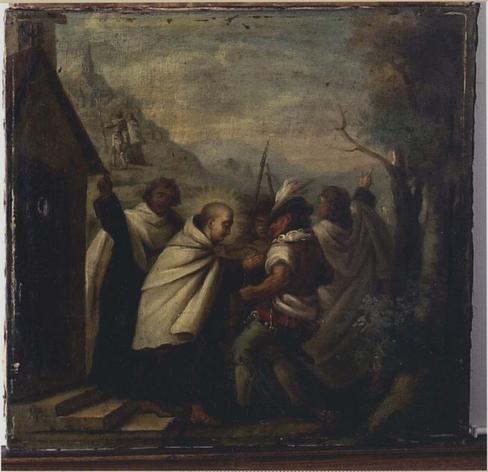
The Arrest of St John of the Cross
18th c. French
Oil on canvas, 1772 or 1777
Carmel of Pontoise
© Ministère de la Culture (France), Médiathèque de l’architecture et du patrimoine, Diffusion RMN-GP. Used by permission.

The novena prayer was composed from approved sources by Professor Michael Ogunu, a member of the Discalced Carmelite Secular Order in Nigeria.

John of the Cross, St 1991, The Collected Works of St. John of the Cross, rev. edn, Kavanaugh, K & Rodriguez, O (trans.), ICS Publications, Washington DC.

Teresa of Avila, St 1985, The Collected Works of St. Teresa of Avila, Kavanaugh, K & Rodriguez, O (trans.), ICS Publications, Washington DC.

Elizabeth of the Trinity, S 2003, The Complete Works of Elizabeth of the Trinity volume 2: Letters from Carmel, Nash, A (trans.), ICS Publications, Washington DC.

Lawrence of the Resurrection, B; De Meester, C 1994, Writings and Conversations on the Practice of the Presence of God,  translated from the French by Salvatore Sciurba, OCD, ICS Publications, Washington DC.

All scripture references in this novena are from the New Revised Standard Version Bible: Catholic Edition, copyright © 1989, 1993 the Division of Christian Education of the National Council of the Churches of Christ in the United States of America as accessed from the Bible Gateway website.

Don’t become discouraged and give up prayer, says St. John of the Cross. We offer varying novenas to Our Lady of Mount Carmel, as well as novenas to St. Teresa of Avila, St. John of the Cross, St. Thérèse of Lisieux, Sts. Louis and Zélie Martin, St. Elizabeth of the Trinity, and St. Joseph.

Let us unite in prayer

#beginners #brotherLawrence #brotherLawrenceOfTheResurrection #determination #difficulty #discouragement #doctorOfTheChurch #dryness #elizabethCatez #fall #givingUp #godsWill #icsPublications #interiorCastle #johnOfTheCross #journey #letter #letters #loneliness #mentalPrayer #novena #practiceOfThePresenceOfGod #psalms #sabeth #sanJuanDeLaCruz #stElizabethOfTheTrinity #stJohnOfTheCross #stTeresa #stTeresaOfAvila #stTeresaOfJesus #stumble #teresa #way #willOfGod

Quote of the day, 21 March: St. Teresa of Avila

I know a person to whom our Lord wanted to show what a soul in mortal sin was like [Teresa is referring to herself. Cf. Spiritual Testimonies, 20]. That person says that in her opinion if this were understood it would be impossible to sin, even though a soul would have to undergo the greatest trials imaginable in order to flee the occasions. So the Lord gave her a strong desire that all might understand this.

May He give you, daughters, the desire to beseech Him earnestly for those who are in this state, who have become total darkness, and whose works have become darkness also. For just as all the streams that flow from a crystal-clear fount are also clear, the works a soul in grace, because they proceed from this fount of life, in which the soul is planted like a tree, are most pleasing in the eyes of both God and man.

There would be no freshness, no fruit, if it were not for this fount sustaining the tree, preventing it from drying up, and causing it to produce good fruit. Thus in the case of a soul that through its own fault withdraws from this fount and plants itself in a place where the water is black and foul-smelling, everything that flows from it is equally wretched and filthy.

It should be kept in mind here that the fount, the shining sun that is in the center of the soul, does not lose its beauty and splendor; it is always present in the soul, and nothing can take away its loveliness. But if a black cloth is placed over a crystal that is in the sun, obviously the sun’s brilliance will have no effect on the crystal even though the sun is shining on it [Cf. The Book of Her Life, 40:5, Spiritual Testimonies, 52].

O souls redeemed by the blood of Jesus Christ! Understand and take pity on yourselves. How is it possible that in realizing these things you don’t strive to remove the pitch from this crystal? See that if your life comes to an end you will never again enjoy this light.

O Jesus, how sad a thing it is to see a soul separated from this light! How miserable is the state of those poor rooms within the castle! How disturbed the senses are, that is, the people who live in these rooms! And in the faculties, that is, among the custodians, the stewards, and the chief waiters, what blindness, what bad management!

In sum, since the tree is planted where the devil is, what fruit can it bear?

Saint Teresa of Avila

Note: In her Spiritual Testimonies, 20, Teresa writes:

Once while I was in prayer, the Lord showed me by a strange kind of intellectual vision what a soul is like in the state of grace. I saw this (through an intellectual vision) in the company of the most Blessed Trinity. From this company the soul received a power by which it had dominion over the whole earth. I was given an understanding of those words of the Song of Songs that say: Veniat dilectus meus in hortum suum et comedat [Let my beloved come into his garden, and eat. Song 5:1]. I was also shown how a soul in sin is without any power, but is like a person completely bound, tied, and blindfolded; for although wanting to see, such a person cannot, and cannot walk or hear, and remains in great darkness. Souls in this condition make me feel such compassion that any burden seems light to me if I can free one of them. I thought that by understanding this condition as I did—for it can be poorly explained—it wasn’t possible for me to desire that anyone lose so much good or remain in so much evil.

Teresa of Avila, St. 1985, The Collected Works of St. Teresa of Avila, translated from the Spanish by Kavanaugh, K; Rodriguez, O, ICS Publications, Washington DC.

Featured image: Photographer Sam Agnew captured this image of the desert in Zekreet, Qatar in April 2012. Image credit: Sam Agnew / Flickr (Some rights reserved)

#fruit #InteriorCastle #redemption #soul #StTeresaOfAvila

Song of Solomon 5:1 - Bible Gateway

Now let us speak about the type of soul that enters the second dwelling places and what such a soul does in them.

This stage pertains to those who have already begun to practice prayer and have understood how important it is not to stay in the first dwelling places. But they still don’t have the determination to remain in this second stage without turning back, for they don’t avoid the occasion of sin.

These rooms, in part, involve much more effort than do the first, even though there is not as much danger, for it now seems that souls in them recognize the dangers, and there is great hope they will enter further into the castle.

I say that these rooms involve more effort because those who are in the first dwelling places are like deaf-mutes and thus the difficulty of not speaking is more easily endured by them than it is by those who hear but cannot speak. Yet, not for this reason does one have greater desire to be deaf, for after all it is a wonderful thing to hear what is being said to us.

So these persons are able to hear the Lord when He calls. Since they are getting closer to where His Majesty dwells, He is a very good neighbor. Yet this Lord desires intensely that we love Him and seek His company, so much so that from time to time He calls us to draw near Him. And His voice is so sweet the poor soul dissolves at not doing immediately what He commands.

[His appeals and calls] come through words spoken by other good people, or through sermons, or through what is read in good books, or through the many things that are heard and by which God calls, or through illnesses and trials, or also through a truth that He teaches during the brief moments we spend in prayer; however lukewarm these moments may be, God esteems them highly.

And you, Sisters, don’t underestimate this first favor, nor should you become disconsolate if you don’t respond at once to the Lord. His Majesty knows well how to wait many days and years, especially when He sees perseverance and good desires. This perseverance is most necessary here. One always gains much through perseverance.

But the attacks made by devils in a thousand ways afflict the soul more in these rooms than in the previous ones. In the previous ones the soul was deaf and [mute]—at least it heard very little and resisted less, as one who has partly lost hope of conquering. Here the intellect is more alive and the faculties more skilled.

Saint Teresa of Avila

The Interior Castle, Second Dwelling Place, chap. 1, nos. 1–3

Teresa of Avila, St. 1985, The Collected Works of St. Teresa of Avila, translated from the Spanish by Kavanaugh, K; Rodriguez, O, ICS Publications, Washington DC.

Featured image: A Discalced Carmelite novice embraces the silence in a profound moment of prayer. Image credit: Ángel Cantero, Iglesia en Valladolid / Flickr (Some rights reserved)

https://carmelitequotes.blog/2024/09/07/stj-icii1/

#Call #deafMute #God #hear #InteriorCastle #love #patience #perseverance #prayer #sin #StTeresaOfAvila

St. Teresa of Ávila