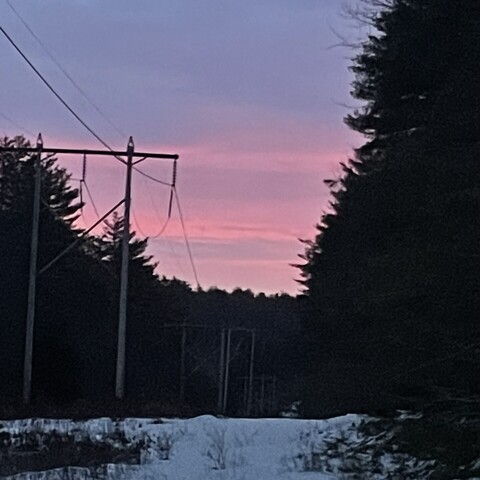
Old Wives’ Tales – Nature’s Winter Weather Signals

It’s creeping towards midwinter here in Derbyshire and the rain has the sort of persistence that feels personal. It taps at the window, sulks down the lanes, and sluices the last of the autumn leaves into sad little piles, while the rest of us stare hopefully at the sky and mutter, “Any day now.”

Every winter, without fail, I start this same quiet vigil, because snow in Buxton is never just weather. It is a promise, a portent, and occasionally, a terrible joke told by the jet stream. And while the forecasters issue their percentages and probabilities, some of us prefer to fall back on something far older. The signs, the superstitions, the old country ways of reading the sky that our grandparents swore by and we still half-believe on the darker evenings.

The old folks always said you could smell snow before it came and I believe this to be true. It’s a sharp, metallic tang on the air, as if the cold has teeth. Most people insist it isn’t real, that you can’t possibly scent a weather system, but anyone who grew up with horses knows it’s true.

There’s something in the stillness, a pause, a hush, a tightening of the world, as though the land itself is holding its breath. My grandad used to step outside, tilt his head, sniff and declare, “We’ll have it by morning,” with a confidence no satellite has ever matched.

The sky was and still is the great storyteller of the season. A pale, whitish dome means nothing. Blue means rain. But a heavy grey with a faint yellow underbelly, stretching low like an old wet blanket – that’s snow without question.

Shepherds have a whole vocabulary for winter skies. A “bellied cloud” sags when snow is brewing. A “weeping sky” is one that can’t quite decide, and often brings sleet that stings your face like thrown gravel. A “blind sky” is the one every child loves… dense, colourless, depthless, giving nothing away until the first lazy flakes drift down as if from nowhere at all.

Birds have always been regarded as an oracle. Robins hopping close to the house mean a cold snap is coming. Crows gathering in odd places foretell a storm and if the little garden birds vanish all at once? Well, the old folks would simply nod grimly and tell you to bring in the washing.

Some old miners swore that when snow was imminent, the pit ponies grew restless and the dogs refused to settle. One old fella I used to know in Barnsley claimed his cat could predict snow two days before the Met Office. She used to turn her back on him and stare pointedly at the pantry door, a sure sign of impending trouble.

Then there’s the winds, each of them with their own personality. A wind from the east carried the threat of “the beast” long before it had a catchy name. An oddly warm breeze in December means the weather is winding up for mischief. And if the wind suddenly drops altogether, leaving a bright uncanny stillness, the older folk would mutter, “The snow’s packing its bags.” – You could almost see it forming, silently, somewhere just beyond the horizon.

Frost itself is said to be a messenger. A heavy white frost in early December was said to “lock in the winter,” ensuring snowfall before Christmas. A soggy, muddy morning – like most of this week in Derbyshire – meant the cold spell was hesitating and might yet lose its nerve. But a rime glistening on the hedges, thick as sugar icing, was the surest sign of a hard winter.

The old rhyme went:

“Frost on the gate, snow can’t wait.

Frost on the sill, snow climbs the hill.”

People repeated it with great seriousness, even though half of them couldn’t remember the rest.

The moon, naturally, has a say in everything. A bright ring around it – a winter halo – was seen as a classic sign of approaching snow, the ice crystals high above catching the light like a warning. Some families would even leave a candle in the window when they saw a halo, to welcome in the “snow spirits” and coax a gentler fall.

A red or orange moon in December meant unsettled weather ahead, while a silver-blue one, cold and crystalline, was believed to herald a dry, biting frost. And of course, if the moon seemed “too close” – larger than usual, looming like a watcher – the elders would glance at it as though it were telling them secrets.

Animals, too, played their part. Cows lying down has always a favourite of mine, although cows lie down for their own inscrutable reasons whenever they feel like it. Horses rolling more than usual meant the ground was about to harden. When the sheep cluster tightly, wool to wool, you can safely fetch your boots and begin the traditional practice of peering into the sky every twenty minutes with unrealistic optimism.

There were, of course, stranger beliefs in the past. Some people swore that when snow was incoming, your dreams changed – turning clearer, sharper, as though the cold crept into the subconscious. Others said the world grew quieter before a snowfall, the birdsong thinning out, the trees standing still, the air settling into a peculiar waiting – there’s truth in that one, I think. Anyone who’s experienced real snow knows the world hushes itself in readiness.

Yet for all these signs, for every omen and whisper of the weather, winter still delights in wrong-footing us – Derbyshire especially loves to pretend it’s about to snow for a week, only to dump a single apologetic flurry in February out of spite.

But still we look up. Still we check the moon, sniff the air, and try to convince ourselves that the clouds seem heavier today. Because reading the sky isn’t really about predicting the weather at all. It’s about belonging to the land, listening to its stories, trusting the instincts we inherited whether we admit it or not.

And maybe this year, with the rain drumming its steady rhythm and the hills wrapped in wet mist, the signs will align. The air will sharpen. The robins will hop a little closer. The sky will shift from grey to that peculiar shade that means business, and in the hush before dusk, snow will finally drift over Derbyshire, soft and slow and ancient as the old wives who taught us how to see it coming.

Until then, I’ll watch the sky. And I’ll wait.

#Folklore #Snow #Superstitions #UK #weatherFolklore #WeatherLore
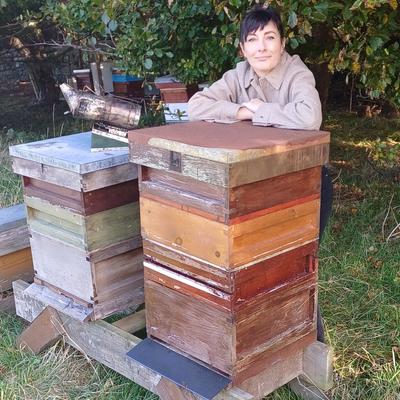
Old Fashioned Frost Rituals

There’s something almost sacred about stepping outside on a winter morning and hearing that first crrrrk of frost under your boots. It’s nature’s way of saying, “Good morning, human. I’ve iced every possible surface. Please try not to fall on your backside.” And historically, people took this annual glittering menace very seriously indeed. Before central heating, gritters, and padded jackets that make us look like disgruntled marshmallows, frost was a real opponent, a force of nature to be appeased, negotiated with, and occasionally bribed.

Across Britain and beyond, communities once practised a whole array of old-fashioned frost rituals: some charming, some bizarre, and some clearly invented by someone who had been left alone with a jug of mead for too long. Today, we honour them in our own small ways, mostly by muttering at the car windscreen, but the spirit remains.

And so, in the darker mornings and brighter nights of late November, let’s wander through the glittering folklore of frost, and the strange old customs that helped our ancestors survive it.

Whistling for Jack Frost

Jack Frost may be more of a Victorian PR rebrand, but the character – the nipping, icing sprite of winter – has roots in Northern European folklore long before he got his jaunty name. In some rural communities, children were encouraged to whistle for the frost on the first really cold morning of winter, a kind of invitation ritual. The idea was simple: show the frost you were expecting him, that you respected his handiwork, and in return he’d go easier on your toes.Today, we replicate this in our own way: by swearing creatively at the pavement when it tries to assassinate us.

The Doorstep Ritual

A rather charming old custom involved sprinkling a pinch of flour, ash, or oats on the doorstep before bed on the first frosty night. In some places it was said to keep away mischievous winter spirits; in others it was a way of checking for unwanted visitors (human or otherwise). A clean, untouched surface in the morning meant good luck. Footprints meant… well, that depended on the size.

I suppose we now recreate this ritual every morning when we check the cat hasn’t brought home a “gift” and laid it proudly by the front door. Same concept. Slightly more unpleasant result.

Bonus Tip – Sprinkling salt on your doorstep or path WILL stop it freezing for a while at least. Try it. The Amazon delivery man will thank you.

Frost Divination – Because of course they did!

The Victorians adored a bit of divination, and winter gave them endless opportunities. Single women in the north were once told to breathe onto a frosty windowpane and draw a circle with their finger; if the circle stayed clear in the middle, their future husband would be loyal. If it misted over again, the man would be unreliable. If it cracked, best stay single and buy a cat.

Even today, we have our own frost-based divination rituals – like gazing at the icy car windscreen and predicting your entire mood for the day based on how quickly you can find the scraper.

Wake The Winter aka Hedge Tapping

This delightful little tradition involved lightly tapping hedges, trees, or fence posts with a stick on the first frost of the season. It’s thought to have been a holdover from older animistic beliefs – a way of acknowledging the spirits of the land and “waking” the sleeping world into its winter phase. Think of it as nature’s version of clocking in for the season.

Nowadays, we recreate this by banging the ice off the wheelie bin in full view of the neighbours, hoping they assume we’re “very involved in the garden” and not just late putting out the recycling again.

OLD-FASHIONED FROST RITUALS: A CELEBRATION OF CRUNCHY MORNINGS AND MISCHIEVOUS MAGIC

Nearly every European tradition has its winter goddess, crone, or hag – from Frau Perchta to the Cailleach. Many frost rituals involved leaving her offerings: a bowl of cream, a crust of bread, a sip of ale. The idea was to keep her appeased so she didn’t bury your cottage in snow while you were trying to dry your only pair of socks.

We still honour her, in our own way. Every time we leave a biscuit out “for later,” knowing full well we’ll forget it until it has the exact texture of a paving slab – that’s an offering. So is the mug of tea you lose, rediscover at a worrying temperature, and declare “for the spirits now.”

THE FIRST FROST RUN

Children in parts of East Anglia once raced outside barefoot at the first frost – yes, barefoot, because parents in the past were apparently built of sterner stuff – to stamp patterns into the whitened grass. Doing so was believed to secure good health for the winter and strengthen the body.

Today, this ritual survives in the modern practice known as “running outside in your pyjamas because you’ve forgotten to put the bin out and the lorry is already turning the corner.”

THE FROST GUARDIAN

Some cottages, especially in upland regions, had a designated “frost guardian”: usually the eldest member of the household, whose honoured role was to rise first, check the windows for ice, and declare the nature of the day. “Hard frost,” “white frost,” “hoar frost,” “black frost,” and the ever-ominous “oh dear God it’s Baltic” were all acceptable proclamations.

We continue this noble tradition when someone in the house peeks out of the curtains and announces, solemnly:“It’s cold.”

Everyone else: “We know.”

HONOURING THE CRUNCH

In some traditions, walking through the first frost before anyone else set foot on it was a blessing: a promise that you’d meet challenges head-on, break trails, and move boldly into the winter. There’s a quiet, private triumph in being the first one to leave footprints in a fresh frosty field.

We still feel that little thrill today – even if the field is now the lid of your wheelie bin, and the footprint is made by the fox who’s eaten half it’s contents.

WINTER’S LITTLE RITUALS TODAY

Despite our radiators, heated seats, and full-fat insulated jumpers, we still practise frost rites without knowing it. We warm our palms on a mug. We breathe like dragons in the morning air. We mutter thanks to the gods when the boiler behaves. We curse creatively at the car that won’t defrost fast enough. We light candles, switch on fairy lights, and lean into the season’s slow magic.

The old frost rituals weren’t really about controlling winter – they were about accepting it. Marking the moment. Acknowledging the shift. Finding the wonder in the whiteness, and a bit of humour in the hardship.

And truly, what better way to honour the cold months than with the simplest ritual of all: stepping outside on a crisp morning, scarf wrapped high, boots crunching, and whispering into the glittering air,

“Right then. Let’s get on with it.”

#cosyReads #folklore #frostRituals #weatherLore #winterMagic

A popular Irish custom, carried out to this day, is leaving a Child of Prague statue outdoors under a bush the night before a wedding to ensure good weather If the statue's head breaks off it heightens the odds of sunny weather! 💫🔆 #FolkyFriday #weatherlore #folklore #speirgorm #tradition #Ireland

A Nisly Day over Aireyholme

An old book of weather proverbs I own offers an array of predictions for March, ensuring that, whatever the weather, one can always find something vaguely reassuring within its pages. One such gem is a French proverb: “When March is like April, April will be like March.” How profound.

The notion of “April showers” stems from se ...

http://www.fhithich.uk/2025/03/14/a-nisly-day-over-aireyholme/

#Aireyholme #NorthYorkMoors #RoseberryTopping #WeatherLore

A Nisly Day over Aireyholme

An old book of weather proverbs I own offers an array of predictions for March, ensuring that, whatever the weather, one can always find something vaguely reassuring within its pages. One such gem …

Out & About ...

We're expecting some fairly warm, nay, hot weather for April (see forecast below) and I expect to go through the same proceedings with my #gardening neighbors as I do every single year. Over and over again, they'll ask me, if they can transplant their nightshade family and similar seedlings outside already. And my answer, for Central Europe at least, will always be a big NOPE (and likely a facepalm - because they're tirelessly optimistic and overzealous)!

There's an ancient weather lore of the Three Ice Saints, followed by Cold Sophia (see Wiki link) that still applies, despite all the recent changes to our climate. Our last frost day is May 15. It's been observed and recorded by Galileo Galilei in the 17th century and it is still observed nowadays. You simply don't plant hot season plants into cold soil with chance of frost. So... patience! If your seedlings won't get stunted by cold, they'll grow healthier and much, much faster. I'm always the last in our neighborhood to transplant things like tomatoes, peppers, eggplants et. al onto my garden and always the first to harvest.

https://en.wikipedia.org/wiki/Ice_Saints

#GardeningAdvice #PlantingSeason #Weather #Climate #WeatherLore #Farming #FarmingLore #Folklore #IceSaints #Frost #Europe #CentralEurope

Ice Saints - Wikipedia

‘it's not snow till you can see the cat’s tracks on the barn roof’ #snow #flurry #WeatherLore
Weatherlore. With our ears to the ground, following stories and sayings about the weather in times of climate change.

#weatherlore #weather #climatechange #proverbs #residency

https://anarchive.fo.am/wabisabi/weatherlore/
Weatherlore — anarchive

FoAM anarchive

Canada’s Wildfire Smoke Smashes Annual Pollution Record in Just Seven Months

Smoke from this year’s perilous wildfire season has lowered air quality in Canada, the U.S. and beyond.

Gizmodo

"In like a lamb, out like a lion" this year.

The month of March started quietly in the UK, but in the south at least will be going out this year with stormy conditions tomorrow.

https://www.metoffice.gov.uk/weather/warnings-and-advice/uk-warnings#?date=2023-03-31

#Weather #Meterology #WeatherLore

UK weather warnings

Met Office UK weather warnings for rain, wind, snow, ice, fog, thunderstorm, lightning and extreme heat.

Met Office
Looks like we're getting some #weather
#WinterStormWarning #WeatherLore