Cybersecurity Industry Scrambles to Adapt to AI-Powered Vulnerability Discovery

In a flash, an AI-powered tool uncovered a vulnerability that took down Moderna's development environment, leaving security teams scrambling to keep up with the lightning-fast capabilities of emerging tech. This game-changing incident highlights the incredible potential of AI-driven testing to…

https://osintsights.com/cybersecurity-industry-scrambles-to-adapt-to-ai-powered-vulnerability-discovery?utm_source=mastodon&utm_medium=social

#AipoweredVulnerability #OffensiveSecurity #VulnerabilityDiscovery #EmergingThreats #Moderna

Cybersecurity Industry Scrambles to Adapt to AI-Powered Vulnerability Discovery

Discover how AI-powered vulnerability discovery is changing cybersecurity. Learn to adapt and protect your business with expert insights and actionable tips now.

OSINTSights
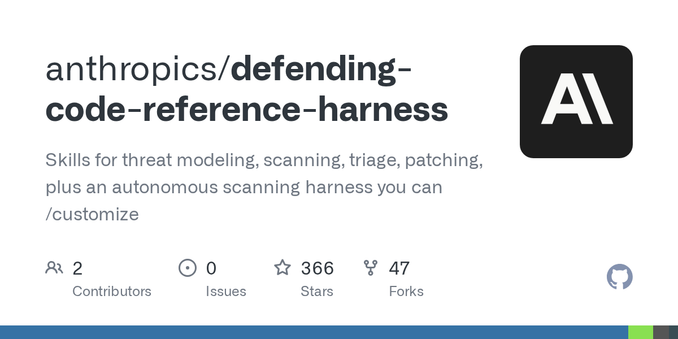
🤖🎉 Oh joy, another #AI framework claiming to be the superhero of vulnerability discovery, complete with a "customizable scanning harness" that sounds more like a S&M accessory than a coding tool. 🛠️🚀 GitHub's smorgasbord of #buzzwords promises to automate everything, except maybe the act of actually fixing any bugs. 🙄💥
https://github.com/anthropics/defending-code-reference-harness #Frameworks #VulnerabilityDiscovery #GitHub #Automation #TechHumor #HackerNews #ngated
GitHub - anthropics/defending-code-reference-harness: Skills for threat modeling, scanning, triage, patching, plus an autonomous scanning harness you can /customize

Skills for threat modeling, scanning, triage, patching, plus an autonomous scanning harness you can /customize - anthropics/defending-code-reference-harness

GitHub

Multi-Agent LLM System for Automated Vulnerability Discovery and Reproduction

https://arxiv.org/abs/2605.21779

#HackerNews #MultiAgent #LLM #VulnerabilityDiscovery #AutomatedTesting #AIResearch

FuzzingBrain V2: A Multi-Agent LLM System for Automated Vulnerability Discovery and Reproduction

Software vulnerabilities pose critical security threats, with nearly 50,000 CVEs reported in 2025. While Large Language Models (LLMs) show promise for automated vulnerability detection, three key challenges remain. First, LLM-generated vulnerability reports suffer from high false positive rates and lack reproducible verification. Second, existing LLM-based approaches use suboptimal granularities for vulnerability localization: function-level analysis overlooks bugs when context becomes extensive, while line-level analysis lacks sufficient context. Third, existing approaches have difficulty reasoning about vulnerabilities with complex cross-function dependencies and triggering conditions. We present FuzzingBrain V2, a multi-agent system that addresses these gaps through four key contributions: (1) fully automated vulnerability analysis built on Google's OSS-Fuzz, ensuring all reported vulnerabilities are fuzzer-reproducible; (2) Suspicious Point, a novel control-flow-based abstraction for precise vulnerability localization at the optimal granularity; (3) logic-driven hierarchical function analysis with dual-layer fuzzing enhancing function coverage under resource constraints; (4) MCP-based static and dynamic analysis tools with context engineering enhancing complex vulnerability reasoning. On the AIxCC 2025 Final Competition C/C++ dataset, FuzzingBrain V2 achieved 90% detection rate (36 of 40 vulnerabilities). In real-world deployment, FuzzingBrain V2 discovered 29 zero-day vulnerabilities across 12 open-source projects, all confirmed and fixed by maintainers, with 2 assigned CVE IDs.

arXiv.org

“Our study uncovers an unexpected behavior of current LLMs for
vulnerability discovery. While these models are widely believed
to offer sophisticated analysis, we find that they largely capture
basic statistical properties rather than deeper, structural insights of
code. Simple code metrics can measure the very same properties
using just a fraction of the computing resources”

LLM-based Vulnerability Discovery through the Lens of Code Metrics https://mlsec.org/docs/2026-icse.pdf

#LLM #VulnerabilityDiscovery

Vulnerability Discovery Outpaces Remediation Infrastructure

The latest AI-powered vulnerability discovery tool, Anthropic's Claude Mythos Preview, can identify a massive number of security risks at unprecedented speed, raising crucial questions about whether organizations can keep up with remediation. With AI outpacing human teams, the real challenge now is turning these findings into actionable…

https://osintsights.com/vulnerability-discovery-outpaces-remediation-infrastructure?utm_source=mastodon&utm_medium=social

#VulnerabilityDiscovery #Ai #ClaudeMythos #Anthropic #EmergingThreats

Vulnerability Discovery Outpaces Remediation Infrastructure

Discover how AI-powered vulnerability discovery is outpacing remediation infrastructure and learn how to stay ahead - read our expert analysis now.

OSINTSights

Open Source Models Challenge Dominance in Automated Bug Finding

The impressive performance of Anthropic's Mythos in automated bug finding, which uncovered 271 Firefox flaws, has been called into question by Ari Herbert-Voss, who argues that open-source models can be just as effective. Herbert-Voss suggests that Mythos's success can be attributed to its ability to detect both simple and…

https://osintsights.com/open-source-models-challenge-dominance-in-automated-bug-finding?utm_source=mastodon&utm_medium=social

#AutomatedBugFinding #VulnerabilityDiscovery #OpenSource #AiSecurity #BlackHatAsia

Open Source Models Challenge Dominance in Automated Bug Finding

Discover how open source models rival Anthropic's Mythos in automated bug finding, and learn why they're a viable alternative for vulnerability discovery - read now and explore your options.

OSINTSights

Anthropic's Claude Mythos Exposes AI Vulnerability Risks

The recent exposure of Anthropic's Claude Mythos highlights a chilling reality: AI tools designed to improve software quality can be easily repurposed to accelerate vulnerability discovery for malicious ends. This underscores the growing threat of AI-powered attacks, as malicious actors exploit commercial tools…

https://osintsights.com/anthropics-claude-mythos-exposes-ai-vulnerability-risks?utm_source=mastodon&utm_medium=social

#AiVulnerabilityRisks #EmergingThreats #VulnerabilityDiscovery #AiSecurity #CommercialToolingMisuse

Anthropic's Claude Mythos Exposes AI Vulnerability Risks

Discover AI vulnerability risks with Anthropic's Claude Mythos and learn how to protect against malicious exploitation - read the expert insights now.

OSINTSights
Fourth in the session was Kim et al.'s "Fuzzing Acceleration for Memory Safety Bug Discovery with Slicer," which speeds bug finding by slicing away irrelevant code. (https://www.acsac.org/2025/program/final/s448.html) 5/6
#Fuzzing #VulnerabilityDiscovery #MemorySafety

AI Models Turbocharge Vulnerability Discovery

Imagine a world where AI models don't just help find software bugs, but actually behave like expert security researchers - that's the reality we're facing, and it's changing the vulnerability discovery game. Frontier AI models are now capable of autonomously discovering zero-day vulnerabilities and speeding up patching processes.

https://osintsights.com/ai-models-turbocharge-vulnerability-discovery?utm_source=mastodon&utm_medium=social

#VulnerabilityDiscovery #AiModels #ZeroDay #AutonomousSecurityResearch #FrontierAi

AI Models Turbocharge Vulnerability Discovery

Discover how AI models turbocharge vulnerability discovery, enabling autonomous zero-day detection and faster patching - learn more about frontier AI's impact now.

OSINTSights