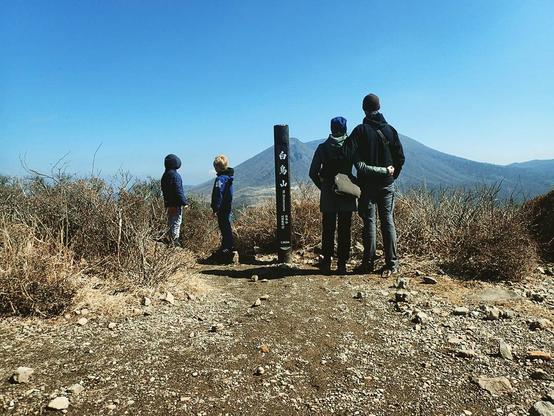
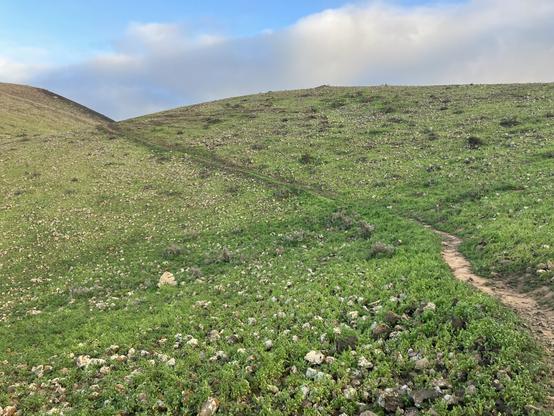
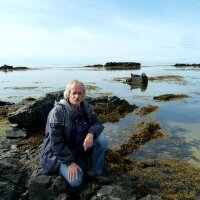
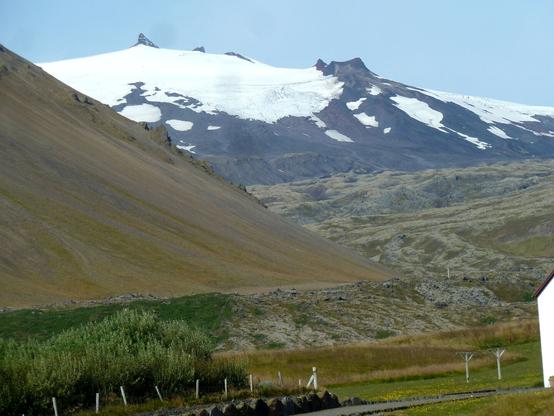
Hiking in a gorgeous scenery.
#Japan #kirishima #kirishimanationalpark #mtshiratoriyama #hiking #travellingwithkids #volcanos #gourgeous #view #greatlocation
#wanderlust
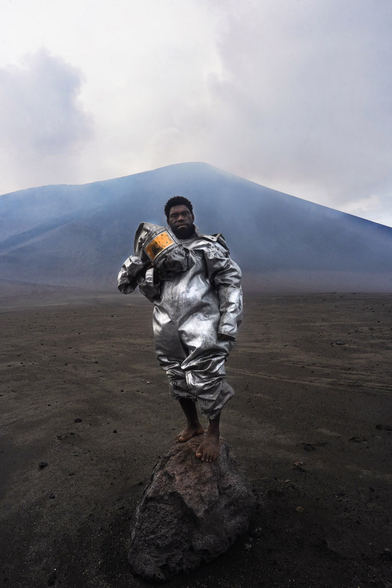
The Barefoot Volcanologist
On the ash plains of Mount Yasur, on the island of Tanna, Vanuatu, Phillip, an internationally recognised, self-taught volcanologist, stands barefoot atop a volcanic rock bomb. Wearing a lava-protection suit gifted to him by some visiting researchers, the volcano smoulders behind him, sending a plume of gas and sulphur into the sky.
Photograph: Elle Leontiev/Sony World Photography Awards 2026
## Volcanos III
### Divergent plate boundaries
Main article: Divergent boundary
Map showing the divergent plate boundaries (oceanic spreading ridges) and recent sub-aerial volcanoes (mostly at convergent boundaries)
At the mid-ocean ridges, two tectonic plates diverge from one another as hot mantle rock creeps upwards beneath the thinned oceanic crust. The decrease of pressure in the rising mantle rock leads to adiabatic expansion and the partial melting of the rock, causing volcanism and creating new oceanic crust. Most divergent plate boundaries are at the bottom of the oceans, and so most volcanic activity on Earth is submarine, forming new seafloor. Black smokers (also known as deep sea vents) are evidence of this kind of volcanic activity. Where the mid-oceanic ridge is above sea level, volcanic islands are formed, such as Iceland.[16][3]
source:
https://en.wikipedia.org/wiki/Volcano
#Volcanos #Geology #Terra #Chemistry #Physics #QuantumPhysics #Mathematics #ExoGeology
>Etymology and terminology
The word volcano (UK: /vɒlˈkeɪnəʊ/; US: /vɑːlˈkeɪnoʊ/) originates from the early 17th century, derived from the Italian name Vulcano, a volcanic island in the Aeolian Islands of Italy, which in turn comes from the Latin name Volcānus or Vulcānus, referring to Vulcan, the god of fire in Roman mythology.[12][13]
The set of processes and phenomena involved in volcanic activity is called volcanism [early 19th century: from volcano + -ism]. The study of volcanism and volcanoes is called volcanology [mid-19th century: from volcano + -logy], sometimes spelled vulcanology.[12]
source:
https://en.wikipedia.org/wiki/Volcano
#Volcanos #Geology #Terra #Chemistry #Physics #QuantumPhysics #Mathematics #ExoGeology
Volcanos
> A volcano is a vent or fissure in the crust of a planetary-mass object, such as Earth, that allows hot lava, volcanic ash, and gases to escape from a magma chamber below the surface.[1]
On Earth, volcanoes are most often found where tectonic plates are diverging or converging, and because most of Earth's plate boundaries are underwater, most volcanoes are found underwater. For example, a mid-ocean ridge, such as the Mid-Atlantic Ridge, has volcanoes caused by divergent tectonic plates whereas the Pacific Ring of Fire has volcanoes caused by convergent tectonic plates. Volcanoes resulting from divergent tectonic activity are usually non-explosive whereas those resulting from convergent tectonic activity cause violent eruptions.[2][3] Volcanoes can also form where there is stretching and thinning of the crust's plates, such as in the East African Rift, the Wells Gray-Clearwater volcanic field, and the Rio Grande rift in North America
source:
https://en.wikipedia.org/wiki/Volcano
#Volcanos #Geology #Terra #Chemistry #Physics #QuantumPhysics #Mathematics #ExoGeology
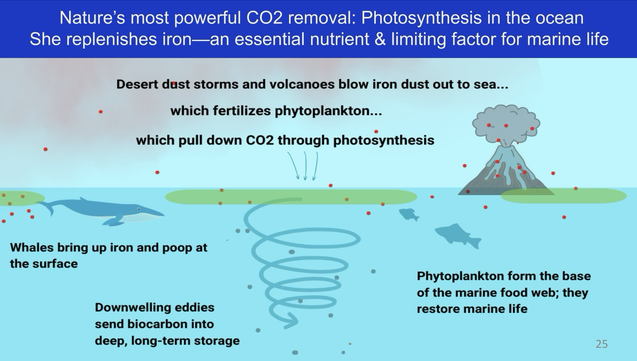
My new video…
Climate Restoration by 2050 via Localized Ocean Fertilization - LOF with Iron in Downwelling Eddies
https://youtu.be/MR-9NvW8NI4?si=27tD-3xZihN_ggok
#climate #oceans #science #engineering #weather #dust #volcanos
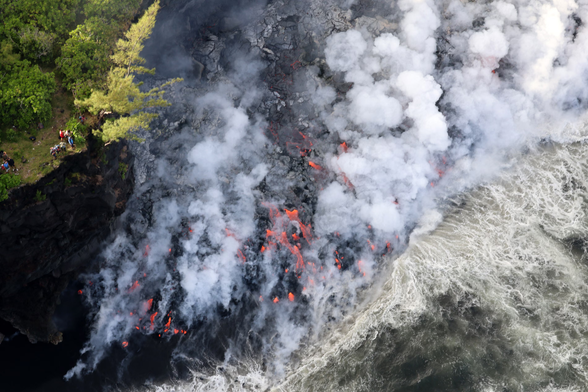
Sainte-Rose, #Reunion
Lava from the Piton de la Fournaise volcano reaches the ocean.
Photograph: Richard Bouhet/AFP/Getty Images
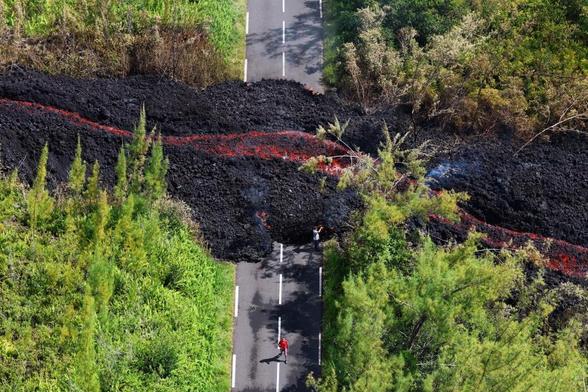
#Reunion,# France
Lava flows across a road from the Piton de la Fournaise volcano on the Indian Ocean island. The volcano became active a month ago, for the first time in nearly 20 years.
Photograph: Richard Bouhet/AFP/Getty Images