We have our next ✨ 𝗘𝗺𝗲𝗿𝗴𝗶𝗻𝗴 𝗥𝗼𝗰𝗸𝘀𝘁𝗮𝗿 ✨ of @IEEEPervasive: Dr. Anandghan Waghmare!

🔬 Interested in learning more about Anandghan's research?
Check out this article, which includes an interview with Anandghan conducted by our editorial board member, Dr. Lakmal Meegahapola: https://ieeexplore.ieee.org/document/11320926

#PervasiveComputing #IEEEPervasive #UbiComp #Sensing #DigitalHealth
1/2

✨ We’re excited to share the fourth of our five posters at this year's UbiComp ISWC Conference!

🖖Inspired by the intelligent doors in Star Trek, which seem to open only when someone truly intends to enter, we introduce the “spontaneous context” interaction pattern for everyday devices. Here, concrete action is spontaneously adapted based on information about the user situation that the interactors gather and interpret ad hoc.

#UbiComp2025 #UbiComp #IoT #StarTrek

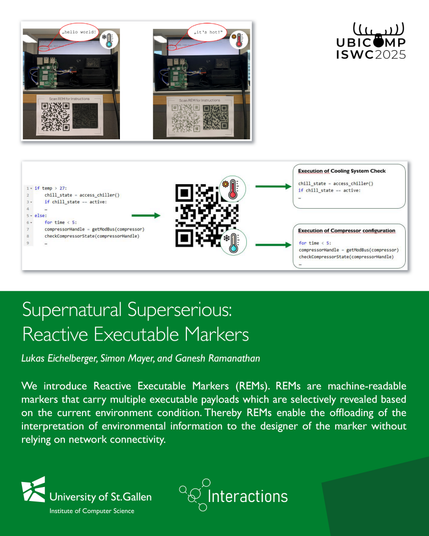
📢 Happy to share the third of our five posters at this year's UbiComp/ISWC Conference!

🔥❄️ We introduce Reactive Executable Markers (REMs)—a new type of machine-readable marker that can reveal different executable payloads based on the on the current environment condition (e.g., temperature). REMs build on recent advances in reactive and executable QR codes, enabling designers to embed context-sensitive logic directly into the marker itself.

#UbiComp2025 #IoT #QRCode #REM #UbiComp

... small line-contained changes went completely unnoticed by readers—even though they were obvious to bystanders.

Our research demonstrates how invisible adaptations during natural reading rhythms could enable more seamless and personalized reading assistance.

👉 Read the full paper here: https://www.alexandria.unisg.ch/handle/20.500.14171/123236

Authors: Kai Schultz | Kenan Bektas (@kenan) | Jannis Strecker-Bischoff (@jannis) | Simon Mayer

#ReadingAssistance #Reading #EyeTracking #UbiComp #HCI

Open your Eyes: Blink-induced Change Blindness while Reading

Reading assistants provide users with additional information through pop-ups or other interactive events which might interrupt the flow of reading. We propose that unnoticeable changes can be made in a given text during blinks while the vision is obscured for a short period of time. Reading assistants could make use of such change blindness to adapt text in real time and without infringing on the reading experience. We developed a system to study blink-induced change blindness. In two preliminary experiments, we asked five participants to read six short texts each. Once per text and during a blink, our system changed a predetermined part of each text. In each trial, the intensity and distance of the change were systematically varied. Our results show that text changes — although obvious to bystanders — were difficult to detect for participants. Concretely, while changes that affected the appearance of large text parts were detected in 80% of the occurrences, no line-contained changes were detected.

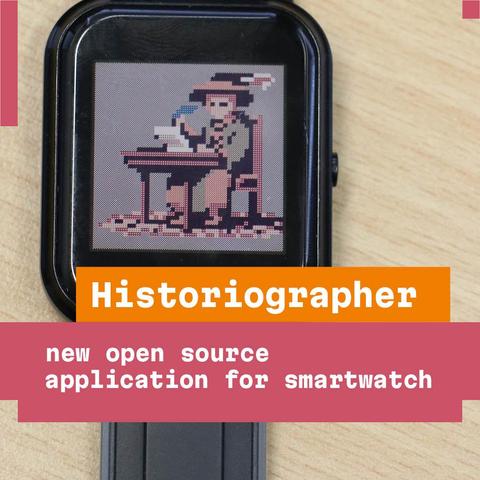
Gathering data in the wild with wearables made easy. Michael Brilka and Kristof van Laerhoven published their open source Historiographer application for the Bangle.js 2 Smartwatch at Ubicomp’24 in Melbourne, Australia.
Interested? https://dl.acm.org/doi/10.1145/3675094.3678484

#Wearables #UBICOMP

Historiographer: An Efficient Long Term Recording of Real Time Data on Wearable Microcontrollers | Companion of the 2024 on ACM International Joint Conference on Pervasive and Ubiquitous Computing

ACM Conferences

Hello, we are the Interactions Research Group at the University of St. Gallen🇨🇭!

We investigate technology-mediated interactions in complex socio-technical systems. Within this broad field, we are interested in a great many aspects of the interaction of (computer) systems with other systems as well as with people, and specifically in pervasive computing environments.

👉 Find out more about our group and our research here: https://interactions.ics.unisg.ch

#introduction #ubicomp #systems #computerscience

Chair of Simon Mayer | ICS-HSG | University of St.Gallen

The Interactions Research Group investigates technology-mediated interactions in complex socio-technical systems.

ICS

On Sunday, I'll present our vision paper "Personalized Reality: Challenges of Responsible Ubiquitous Personalization"
at the International Workshop on Personalization and Recommendation at #muc2024!

With this paper we intent to start a discussion on how ubiquitous #personalization using #MR and #UbiComp devices can be designed in a responsible way to make PR experiences beneficial for individuals and society.

📄 Read the paper here: https://doi.org/10.18420/muc2024-mci-ws11-200

@mucConf @InteractionsUniSG

Personalized Reality: Challenges of Responsible Ubiquitous Personalization

The expanding capabilities of Mixed Reality and Ubiquitous Computing technologies enable personalization to be increasingly integrated with physical reality in all areas of people’s lives. While such ubiquitous personalization promises more inclusive, efficient, pleasurable, and safer everyday interaction, it may also entail serious societal consequences such as isolated perceptions of reality or a loss of control and agency. We present this paper to initiate a discussion towards the responsible creation of ubiquitous personalization experiences that mitigate these harmful implications while retaining the benefits of personalization. To this end, we present the concept of Personalized Reality (PR) to describe a perceived reality that has been adapted in response to personal user data. We provide avenues for future work, and list open questions and challenges towards the creation of responsible PR experiences.

My review of the book "The Philosopher of #Palo_alto: Mark Weiser, #Xerox_PARC, and the Original Internet of Things" by John Tinnell has been published. A very readable book, especially where it leaves the biographical and becomes more systematic and structural #IoT, #internethistory #UbiComp: https://muse.jhu.edu/article/933130
Project MUSE - The Philosopher of Palo Alto: Mark Weiser, Xerox PARC, and the Original Internet of Things by John Tinnell (review)

Just noticed that I haven't written an #introduction since I joined 😀

I'm a PhD student at the University of St.Gallen (CH) where I study how ubiquitous #personalization systems can make our interactions with our environment more efficient, safer and more inclusive, and how they can be built in a responsible and societally beneficial way. My research combines #mixedreality , #UbiComp, #privacy, #algorithms, and #eyetracking.
Feel free to reach out, if you'd like to have a chat!

We're delighted to announce Professor Aaron Quigley @aquigley as our third #Keynote speaker for #EverythingOpen!

Professor Quigley is Deputy Director of #CSIRO #Data61 and a noted #scholar and #researcher in #HCI, #ubicomp, #dataviz and pervasive #computing.

His keynote will focus on "Intelligent Interfaces", where he explores new forms of #interaction enabled by #sensing technologies such as sound, light, electric fields, radio waves and #BioSignals.

https://2024.everythingopen.au/news/keynote-aaron-quigley/

Everything Open 2024 | Keynote announcement - Professor Aaron Quigley