 David Usharauli
Generally speaking, for Tregs to mediate antigen-specific tolerance in the periphery, they must be educated in the thymus by pairing with T cells that share the same antigen specificity.
1/2
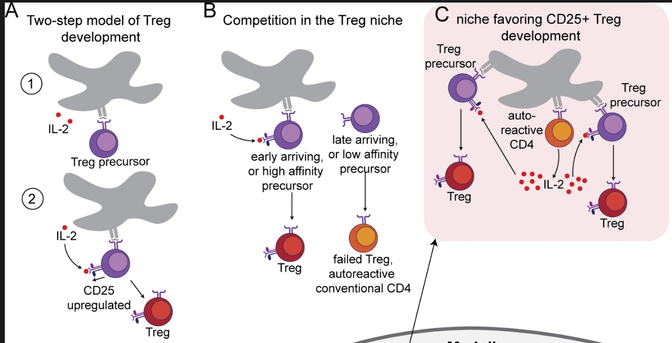
Generally speaking, for Tregs to mediate antigen-specific tolerance in the periphery, they must be educated in the thymus by pairing with T cells that share the same antigen specificity.
1/2
https://bsky.app/profile/utu.fi/post/3mldm3hkwza2i #UTU #yliopisto Nobel-palkittu professori Shimon Sakaguchi luennoi Turun yliopistossa tiistaina 12.5. Sakaguchin löydökset ovat luoneet uusia mahdollisuuksia muun muassa syöpien ja autoimmuunisairauksien hoitojen kehittämiseen.
#MedSky #ImmunoSky #Treg
Lahesmaa Lab Turku Bioscience

Nobel-palkittu professori Shimon Sakaguchi luennoi Turun yliopistossa tiistaina 12.5. Sakaguchin löydökset ovat luoneet uusia mahdollisuuksia muun muassa syöpien ja autoimmuunisairauksien hoitojen kehittämiseen. #MedSky #ImmunoSky #Treg Lahesmaa Lab Turku Bioscience https://www.utu.fi/fi/ajankohtaista/mediatiedote/nobelisti-professori-shimon-sakaguchi-vierailee-turun-yliopistossa
https://bsky.app/profile/inflames-flagship.bsky.social/post/3mldm3hi62z2v #UTU #yliopisto Nobel-palkittu professori Shimon Sakaguchi luennoi Turun yliopistossa tiistaina 12.5. Sakaguchin löydökset ovat luoneet uusia mahdollisuuksia muun muassa syöpien ja autoimmuunisairauksien hoitojen kehittämiseen.
#MedSky #ImmunoSky #Treg
Lahesmaa Lab Turku Bioscience

Nobel-palkittu professori Shimon Sakaguchi luennoi Turun yliopistossa tiistaina 12.5. Sakaguchin löydökset ovat luoneet uusia mahdollisuuksia muun muassa syöpien ja autoimmuunisairauksien hoitojen kehittämiseen. #MedSky #ImmunoSky #Treg Lahesmaa Lab Turku Bioscience https://www.utu.fi/fi/ajankohtaista/mediatiedote/nobelisti-professori-shimon-sakaguchi-vierailee-turun-yliopistossa
Why do studies claiming #Treg induction by novel designer drugs test them only when given before or with antigen, rather than in established disease that more closely reflects human cases?
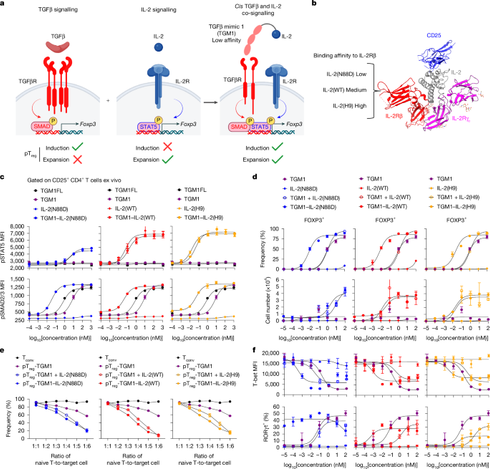
A fusion protein designed to comprise IL-2 and a helminth-derived TGFβ mimic activates IL-2 and TGFβ signalling pathways in IL-2 receptor-expressing T cells and induces stable antigen-specific regulatory T cells in peripheral lymphoid organs.
This study of natural food-specific #Treg development, two years in the making, reveals surprising results that challenge using artificial antigens like OVA. “BioRxiv v2, posted recently, likely signals journal acceptance.
Food antigens elicit immune tolerance through the action of intestinal regulatory T (Treg) cells. Unlike food allergens, the proteins that mediate tolerance are mostly undescribed. Here, we found that epitopes derived from seed storage proteins are targets of murine intestinal Treg cells, with the most frequent response targeting the C-terminus of the maize protein alpha-zein. An MHC tetramer loaded with this antigen revealed that zein-specific T cells are predominantly intestinal Treg cells, develop concurrently with weaning, and constitute up to 2% of the peripheral Treg cell pool. Zein-responsive Treg cells repressed naïve T cell proliferation ex vivo and prior dietary exposure resulted in a constrained response upon multiple inflammatory challenges in vivo, supporting a specific role for gut-resident Treg cells in suppressing systemic immune responses. Together, our work reveals the development, immune suppressive characteristics, and function of naturally occurring Treg cells that recognize dietary seed-storage proteins, a previously undescribed class of antigens in oral tolerance. One-sentence summary Immunodominant epitopes from seed storage proteins are a target of intestinal regulatory T cells that modulate immune challenge to food. ### Competing Interest Statement D.R.L. consults and has equity interest in Vedanta, Immunai, Imidomics, Sonoma Biotherapeutics and Pfizer Pharmaceuticals. M.A.F. is a co-founder of Kelonia and Revolution Medicines, a member of the scientific advisory boards of the Chan Zuckerberg Initiative, Stand Up to Cancer, NGM Biopharmaceuticals, and TCG Labs/Soleil Labs, and an innovation partner at The Column Group. The remaining authors have no conflict of interest. Life Sciences Research Foundation, https://ror.org/0195dxj21 National Science Foundation NIH, F32AI181496 NIH, K08CA283272 Rosenfield and Glassman Foundation ONO Pharma Foundation NIH, R01AI158687 NIH, K99AI173524 NIH, S10RR027431-01 and 1S10OD023831-01
Recent Treg biotech trajectories show that current Treg-based tech do not work. Why? Unlike conventional T cells, Tregs operate within a tripartite system involving the microbiota and naturally IL-2–producing T cells.

0 likes, 0 comments - drhowardsmithreports on August 26, 2025: "Novel Approach To Transplant Immunosuppression Immunologists at the Medical University of South Carolina have found a way to direct the body’s immune system to censor itself permitting transplanted human organs to flourish with medicinal immunosuppression. Their study appeared recently in Frontiers in Immunology. The investigators genetically engineered so-called regulatory T cells, Treg lymphocytes, to selectively destroy those B lymphocytes programmed to produce the antibodies that attack transplanted organs. This self-immunosuppression could extend the life of transplanted organs and permit so-called presensitized patients with pre-existing B lymphocytes ready to churn out anti-organ antibodies an opportunity for successful transplantation. Let’s hope clinical trials demonstrate the utility of this approach. https://www.news-medical.net/news/20250817/Genetically-engineered-immune-cells-show-promise-for-preventing-organ-rejection.aspx https://www.frontiersin.org/journals/immunology/articles/10.3389/fimmu.2025.1601385/full #transplantation #immunosuppression #Treg #antibodies #presensitized".


Regulatory T cells (Tregs) are heterogeneous and maintain immune tolerance, thereby preventing autoimmune disease and hindering anti-tumor immunity. This study shows that Vps34 and Atg14 regulate signaling events that control effector Treg heterogeneity and functional adaptation, with pathophysiological consequences on autoimmunity and anti-tumor immunity.
Leggevo su un giornale generalista di una recentissima pubblicazione scientifica di una università in Svizzera riguardo ad un innovativo approccio nella ricerca di base per la cura della #celiachia (un'amica in classe di mia figlia è celiaca) con l'uso delle #Treg. Ovviamente il giornale si guarda bene da citare puntualmente dove sia tale pubblicazione come fonte, ma ok, con una rapida ricerca la trovo. Volevo leggermela più in dettaglio, ma è a pagamento
https://www.science.org/doi/abs/10.1126/scitranslmed.adr8941

0 likes, 0 comments - drhowardsmithreports on March 11, 2025: "Nasal Spray Blunts Traumatic Brain Injury So say neurologists at Harvard’s Brigham and Women’s Hospital. In a mouse model, they show that a nasal spray containing an anti-CD3 monoclonal antibody significantly reduces brain inflammation and speeds recovery after a traumatic brain injury (TBI). This antibody, sprayed into the nasal cavities, activates regulatory T cells, Tregs, that then travel to the brain and release IL-10 that in turn reduces microglial-medial inflammation there. This anti-CD3 nasal spray must still prove its effectiveness in humans. If so, it will become a treatment for the TBI that follows concussions, motor vehicle accidents, and other sports-related head trauma. https://www.nature.com/articles/s41593-025-01877-7 #traumaticbraininjury #tbi #sports #cd3 #treg #il10 #mva #nasalspray".
 Yliopistobotti
 Howard Smith MD, AM
 PLOS Biology
 OpenSoul ✅