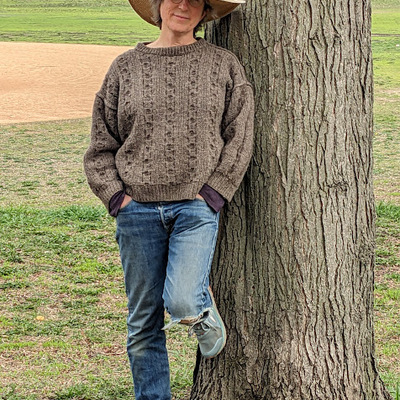
My voice is starting to change this week, after just over 3 months on #LowDoseTestosterone, but i think so far if it sounds different at all to people it probably just sounds like i'm a little bit sick LOL 😮‍💨

#trans #transgender #testosterone #transvoice #transmasc #transmasculine #transjoy

Time to get serious about my voice training.

I really did not have overpowering dysphoria about my male voice before. I tried voice coaching at Seattle Voice Lab and completed about four sessions. I did not see any progress, and after losing my job, I stopped voice training. On top of that, I was very discouraged.

Any time I stumbled upon a voice training video on YouTube, I would save it to a playlist. I never had the motivation to actually watch them or practice. Or rather, I did not want to feel disappointed with myself, remembering my previous experience. I also paid for a couple of voice training apps, and even the full course from Jasmine Vine.

I also began following a lot of transgender content creators, and many of them are trans women who still use their "male" voice and have stated that they are not pursuing voice training at all. I thought that maybe I could take that path too. Voice training is not a requirement for being a trans woman, so I stopped looking for ways to resume/start again from scratch.

Ten days ago, Seattle Voice Lab published a video about one of their former coaches, who was fired after several complaints from students, low performance, and questionable behavior. That was the very same coach who was assigned to me back then, and learning about the types of complaints this person got (which line up with my own experience) made me wonder if voice training itself might not be as bad as the experience I had with that particular coach.

Yesterday’s experience was my first time having really bad dysphoria about my voice. Today I am a lot calmer. I think that as long as I do not hear my own voice through a recording, I will be mostly OK, but now I have renewed motivation to move forward with training.

I have had the pleasure of talking with Jasmine, and she has been really sweet every time, so I am going to give her coaching a serious try. I might even return to Seattle Voice Lab once I can afford it, of course.

Getting SRS within the next year is a possibility, but it is not entirely under my control. Engaging in voice training IS under my control, so I am making the commitment to it, with the goal of having a female-passing voice by this time next year.

My wife really encouraged me today, and she mentioned that sometimes, especially when I say "Thank you," I sound totally cis.

So this fight begins. Wish me luck.

#TransVoice #VoiceTraining #TransWomenAreWomen #TransitionJourney

Having a real bad voice dysphoria day.

It's frustrating. I am on day 465 of my daily voice training journey and... I've developed so much control. I can hear it... I'm so fucking close... And somehow that makes it worse.

I won't be quitting. I'm too stubborn for that... But god... I feel so broken

#Trans #transvoice

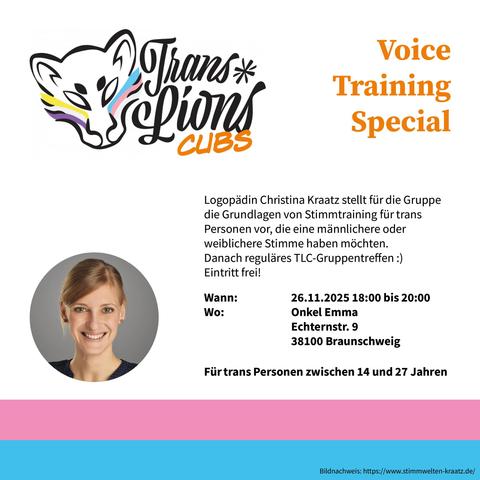
🎤✨ Stimme finden, Stimme formen!
Am 26.11. stellt Logopädin Christina Kraatz im Rahmen der Trans* Lions Cubs die Grundlagen von Stimmtraining für trans Personen vor – egal ob du eine weiblichere oder männlichere Stimme suchst. Danach reguläres Gruppentreffen 💬

📍 Onkel Emma, Braunschweig
🕕 18:00–20:00 Uhr
💜 Eintritt frei, für trans Personen zwischen 14 und 27 Jahren

#TransLionsCubs #Braunschweig #TransVoice #Community #Empowerment

Just finished watching another video by voice coach Renée Yoxon entitled Will My New Voice Ever Become My Default?.

We don't feel like we need or want (let alone even have the spoons!) to do a breakdown of the video like we've done for another video of theirs, but we wanted to share this lovely metaphor Renée used within the video with you all:

Imagine your brain is a giant, overgrown jungle. Your old voice habits are like a well-paved road. Clear, easy and fast to walk down because you've travelled it every day for years. Now you're trying to build a new path, one that leads to the voice you actually want to use. At first, you're bushwhacking. It's hard to find, it's easy to lose, and honestly, you might get discouraged and end up back on the old road. But every time you take the new path, it gets a little easier. A few branches clear, some grass gets trampled. Eventually, the new path becomes more familiar and the old one starts to get overgrown. That's what it's like when your new voice becomes your default.

#trans #transgender #TransVoice #VoiceTraining #VoiceFeminisation #VoiceFeminization #VoiceDysphoria #RenéeYoxon

Will My New Voice Ever Become My Default?

YouTube

I'm also looking for a singing voice coach who is reasonably trans and queer competent.

Is this you? Are you accepting new students? PM me?

I'm not presently looking to present my voice as any perceived gender, my voice is a woman's voice in whatever timbre I sing, but I do sing in roughly the tenor range.

I recently reached out to a few who advertise as such but haven't heard back as yet.

#transVoice #Vocalist #voice #voiceCoach

Vocalists of mastodon, a question for you.

Do you include falsetto/soprano in your vocal warmups?

I have a T-affected voice, and mostly don't, but maybe I should?

#vocalist #transVoice

Before reading any further, if you're currently experiencing any of:

  • a negative MH spiral;
  • negative self-talk; and/or
  • rumination over perceived failures;

... then please, please stop reading here and come back to this later  

As many of yous will already know, we've been struggling with voice dysphoria and voice training now for many years. We've about this many times in posts like:

Fairly recently, purely by chance whilst looking for something to highlight how awful the VoiceTools app is for voice training, we chanced across a non-binary voice coach and content creator (Renée Yoxon) via their video about how deeply-flawed the VoiceTools app is.

We haven't watched through all their videos, but we wanted to highlight -- and critique and praise -- some hopefully-relevant sections from a recent video they did with their trans+ fem collaborator Tea, entitled How Long Does Trans Voice Training Really Take?.

Renée started off the video decently (but not perfectly) with the below:

So what are some factors that affect when that shift happens? Three big factors.

One, your experience and aptitude. If you're a singer, a voice actor, or just someone who's used to experimenting with your voice, you'll likely progress faster because you already know how to move your vocal dials. So if you're not yet voice training, this is going to seem wild, but do some silly voices and impressions. It can genuinely give you a better starting point.

Not everyone will feel comfortable with doing silly voices and impressions, so we think it's counterproductive of Renée to have added this here, but otherwise yes: some of us simply are not good at or -- for various reasons -- struggle with manipulating our voice. Continuing on:

Two, your relationship to your voice. Some people are super motivated to practice, but others find voice work triggering or overwhelming. And that's okay. Your emotional connection to your voice can help or hinder your timeline, but both are normal. But if it is hard emotionally, name that to yourself and recognize that it may be harder on your progress and results.

This is SOOOOO important and often overlooked. We'd go much further though, but we want to share the third point before going into that.

Three, your time and consistency. This is a big one. Consistent practice. Even ten minutes a day is more effective than long, infrequent sessions. If you can find small ways to integrate voice work into your daily life, that builds momentum over time.

At this point, we actually got quite annoyed at Renée, as whilst they're normally really spot on, this felt like they'd ignored or not identified some major issues here that can all make voice training even more difficult than it already is.

e.g.,

  • Being neurodivergent;
  • Having mental health struggles;
  • Having physical health struggles;
  • Having chronic health conditions.
  • Finding voice training to be an unfun and even-awful chore.

For those of us who are barely hanging on a lot of the time, plenty of us just don't have the spare spoons for it.

And even if we do have the spoons, sometimes the idea of being perceived whilst doing the task can be overwhelming in of itself 😖

If the video hadn't segued there, we might have stopped watching and downvoted it. However, their trans+ fem collabor Tea stepped in here to save the video.

Hey, so as Renée's longtime collaborator and someone who has chronic issues with my relationship to my voice, as well as finding time and consistency to voice train I wanted to hijack this video for a minute.
I have still not really started organized voice training, and I work with a trans voice trainer. And this is because I find it really emotionally challenging.

This is the experience that a lot of trans+ people have and it's not highlighted enough, as we sadly see the world filtered by those for whom voice training has come naturally or been super successful within a short period of time (e.g., 6-12 months).

She goes on to discuss gradual changes in a way that is much-more grounded.

Now, this may sound funny looking at me, but for the first five years of my transition, I avoided any physical activity like it was the plague.
I associated muscle with masculinity, and as such, any muscle I already had from working a semi physical job caused me a lot of dysphoria and had to be gotten rid of.
But at that five year mark I got sick and tired of well- feeling sick and tired. So I started working out because I wanted to be able to carry my groceries, more easily move my camera gear, and make mundane things easier.
That started small and this is not a joke. I did exactly ten minutes a day. Every day at lunch I would do three exercises with 5 pound weights. I wasn't following some get swole quick routine. I chose three arm exercises that I just assumed would help with what I mentioned.

She then goes on to explain what this felt like:

At first, my arms just always felt tired and sore and it took a couple of months, but I started to see small improvements. Then I thought, well, but this other movement is tough. So I added an exercise for that and so on and so on. And four and a half years later, I look like this. I work out three times a week and I use 25 pound weights. And believe me, I didn't think I would get to 15 pound weights when I started.

This is a fantastic analogy for voice training, especially in terms of the timeframe.

That journey was full of moments where I thought, "Damn, I'm not improving. It's not getting easier. I haven't reached another easily quantifiable plateau." And that still honestly happens to me at points right now.
But here's the reality. And yes, this is tying back into voice training. If I've learned anything, is that human bodies are not machines: muscles, dexterity. and control, which are all involved in voice work, just with very different muscles that aren't as easy to visually identify, do not build linearly.

Exactly this!!! Many of us will reach points where we feel like we're not getting anywhere, and voice training is a form of physical exercise as much as a mental one.

And it's really frustrating. Really frustrating. But what I've learned is that the body loves slow, consistent work. It understands that and will meet you where you are. What it doesn't understand is when you go 0 to 60 instantly. So if you go from no voice work at all to an hour a day, you are likely to hurt yourself because your body thinks you're in a temporary crisis.

Again, this highlights the importance of taking it low and slow, rather than trying to race ahead too quickly.

My point is, you may hear ten minutes a day, or start with a daily warmup and think that's too little. It can't really do anything. But you're wrong. So long as when it gets easy, you take it up that one step further. Now, wish me luck. That I can actually make myself apply that to my voice, too.

This ending point is perhaps the best one. Tea isn't coming from a place of mastery: she's coming from a place of recognising the struggles she's been having and is continuing to have.

And we guess that Tea must have talked with Renée about this video, as Renée then continues on with this amazing bit of wisdom:

Now, what if it takes even longer than you're expecting? If that happens, that's totally normal. Some people take a year, some take five or more. No matter how long it takes, the time is going to pass anyway. As long as you keep moving forward bit by bit, you'll keep progressing.

This is something absolutely fucking pivotal to voice training, and they go further:

Everyone starts in a different place and has a different goal. Comparison is the thief of joy and will only slow you down.

Yes!!! We DO NOT all start with the same inherent abilities and capabilities. If we keep comparing ourselves to others, we will find only despair.

They then give some advice on what to do if you're in a funk:

If you're feeling stuck or plateaued. It might be time to listen back to your old recordings. You're probably doing better than you think.
Revisit the basics with fresh ears. Try adding a new exercise or warm up technique to your routine. Get support from a coach or peer who can offer feedback. Or maybe take a break.

Doing exactly this is what has stopped us from completely breaking from our own voice dysphoria, which we have found to be one of the most-crippling things for us.

Renée ends on a realistic but positive note:

Here's the truth. Your voice won't stay the same forever. As your life. Identity and confidence shift, so will your relationship with your voice. The voice that feels right today might evolve into something slightly different next year, and that's not a failure, that's growth! Remarkable growth.

So, for anyone / anybody& who is also struggling with their own voice, just like us, we want to remind you that you are not failing and you are not a failure.

Anyway, we hope this helps someone / somebody&  

#trans #transgender #TransVoice #VoiceTraining #VoiceFeminisation #VoiceFeminization #VoiceDysphoria #RenéeYoxon

SleepyCatten (@[email protected])

Attached: 1 audio Hey folks 🩷 We did the #TransVoiceFriday thing 🫶 Once again, cos of the stupid alt-text character limit, we've had to put the transcript within the post. #TransVoice #VoiceTraining #VoiceFeminisation #VoiceDysphoria #trans #transgender #TransFem #TransWoman #transition #queer #LGBTQ+ #LGBTQIA+ ### Transcript Hey lovelies, loveliers and loveliests. We're going to try to do a quick voice recording while it's still Trans Voice Friday, because we haven't done one in a while, and we feel like we should try to whilst we can. We haven't exactly made a breakthrough as such with our voice or anything, but we have begun to feel like maybe it's not as awful as we'd started to believe it must be, due to the frequent misgenderings we've continued to have in recent months. Part of this was from realising that we actually do have limited recordings of our pre -transition voice, going at least as far back as about 2004, which was during our uni days. We actually have even older recordings going as far back as 1999, but those are in digitised versions of family video recordings and lower audio quality. Listening to those made us realise that we have gradually feminised our voice over the last four plus years, which kinda helped us to stop completely hating our current voice. Don't get us wrong, we still don't like our current voice, and very much want to improve it. However, it softened the feeling of cringe we'd been having whenever listening back to ourselves. We've also realised that, from others' point of view, we actually don't have a bad voice or vocal range. For example, if we work our way gradually into it, we can raise our pitch and hold it higher like this more-stereotypically-femme head voice. It doesn't sound particularly awful to us, but it also doesn't sound quite like how it should sound. So we tend to let it sit around this level instead. By the same token, if we focus on our voice, we can gradually push it lower and lower and keep using this deep chest voice. But the moment we stop holding it down here, it naturally floats back up to this point we've got ourselves to. Once we've got more time and energy, we'll try to do more recordings and share thoughts, but for now, this will sadly have to do. Ta-ta for now. **Edit:** In case anyone's interested, our pitch range was about as low as 81 Hz and apparently as high as 274 Hz, but we're not 100% sure. However, given that we were given a pitch target of A#3, which is about 233 Hz, ages back, it's not impossible.

The Cult of Shiv

In relation to the voice clip in our most-recent Trans Voice Friday post, for context this is what we sounded like in early 2022. It's a snippet of our side of a conversation with our then voice coach (Louise Milner-Smith) during our second session with her.

We just picked that section cos it's kinda funny to us out of context how we ramble during conversations 🤭

#TransVoice #VoiceTraining #VoiceFeminisation #VoiceDysphoria #trans #transgender #TransFem #TransWoman #transition #queer #LGBTQ+ #LGBTQIA+ #PreTransitionVoice #YesWeActuallyUsedToSoundLikeThat

Hey folks 🩷

We did the #TransVoiceFriday thing 🫶

Once again, cos of the stupid alt-text character limit, we've had to put the transcript within the post.

#TransVoice #VoiceTraining #VoiceFeminisation #VoiceDysphoria #trans #transgender #TransFem #TransWoman #transition #queer #LGBTQ+ #LGBTQIA+

Transcript

Hey lovelies, loveliers and loveliests. We're going to try to do a quick voice recording while it's still Trans Voice Friday, because we haven't done one in a while, and we feel like we should try to whilst we can. We haven't exactly made a breakthrough as such with our voice or anything, but we have begun to feel like maybe it's not as awful as we'd started to believe it must be, due to the frequent misgenderings we've continued to have in recent months. Part of this was from realising that we actually do have limited recordings of our pre -transition voice, going at least as far back as about 2004, which was during our uni days. We actually have even older recordings going as far back as 1999, but those are in digitised versions of family video recordings and lower audio quality. Listening to those made us realise that we have gradually feminised our voice over the last four plus years, which kinda helped us to stop completely hating our current voice. Don't get us wrong, we still don't like our current voice, and very much want to improve it. However, it softened the feeling of cringe we'd been having whenever listening back to ourselves. We've also realised that, from others' point of view, we actually don't have a bad voice or vocal range. For example, if we work our way gradually into it, we can raise our pitch and hold it higher like this more-stereotypically-femme head voice. It doesn't sound particularly awful to us, but it also doesn't sound quite like how it should sound. So we tend to let it sit around this level instead. By the same token, if we focus on our voice, we can gradually push it lower and lower and keep using this deep chest voice. But the moment we stop holding it down here, it naturally floats back up to this point we've got ourselves to. Once we've got more time and energy, we'll try to do more recordings and share thoughts, but for now, this will sadly have to do. Ta-ta for now.

Edit: In case anyone's interested, our pitch range was about as low as 81 Hz and apparently as high as 274 Hz, but we're not 100% sure. However, given that we were given a pitch target of A#3, which is about 233 Hz, ages back, it's not impossible.