Tate+Co uses "supertexture" to enliven teaching space at York St John University

A mix of textured timber cladding animates walls throughout the Creative Centre teaching space, which London studio Tate+Co has created for York St John University in England.

The building, located at the heart of the inner-city campus in York, provides the university with teaching facilities for its music and computer science departments.

Tate+Co has completed a teaching space for York St John University

Externally, the Creative Centre is distinguished by its facades, which are decorated with various timber finishes to create what Tate+Co calls a "supertexture."

This mix of cladding, including black-painted larch, denotes the different facilities housed inside and is also an effort to break up the building's visual mass.

The building is animated by its timber facades

"We've introduced different textures and different cladding types throughout just so that you don't have that sort of big uniform mass," project architect Andrew Baker-Falkner told Dezeen.

"You want to have a bit of texture, a bit of variation and light and shade," he continued.

A mix of timber cladding adds variety to the facade

"It's this idea of 'supertexture'," added the studio's founder Jerry Tate.

"If you do that vertical cladding across a whole wall, you lose it somehow, it just doesn't work," Tate told Dezeen.

Large windows frame outward views

The Creative Centre was commissioned by York St John University to replace some of its dated student accommodation on the site that was no longer required.

Its entrance is positioned on the right-hand side of the front elevation, marked by V-shaped columns that are angled inwards to encourage people to enter.

An atrium sits at the heart of the building

Inside, the building features 2,000 square metres of specialist teaching spaces for students studying computer science, performance, creative writing and media production courses.

There is a large adaptable theatre, a recital room and TV studio, alongside a number of smaller rehearsal rooms and computer suites.

Bleacher-like seating features inside the atrium

The spaces for the different departments are divided into three semi-independent blocks – two positioned at the front of the building and one along the back – which make up the building.

They are distinguished externally and internally by their different forms and facade finishes but linked by a large central atrium at the building's heart.

The building's structure marries timber with steel and concrete

The atrium, described by the studio as a "living room", is fitted out with bleacher-like seating and lit by large windows and skylights in its glulam roof. It is designed to be used as anything from a casual breakout area to a flexible teaching space or theatre foyer.

"It's not just circulation space, it's designed as third spaces that act as areas where students can come out and different departments can bump into each other," said Baker-Falkner.

Views of York Minster are framed through the windows

The building's structure is largely built from glulam and cross-laminated timber, which is exposed internally and combined with steel and concrete elements.

Timber has been used throughout to add warmth to the spaces, while also reducing the embodied carbon of the project.

A 200-seat auditorium is among its facilities

The structure was developed by Tate+Co with the engineering firm Atelier One to achieve large spans, ensuring each floor is column-free.

This makes the structure easily adaptable and extendable, enabling the university to reconfigure the building into wide-open spaces or more cellular divisions to meet its future needs.

The auditorium has wood-lined curved walls

Another highlight of the building is its 200-seat auditorium, designed to host live performances by students as well as community events.

Inside, there is a generous stage with a fully-accessible technical level overhead, enveloped by wood-lined curved walls that help to enhance acoustics.

[

Read:

Jackson Clements Burrows designs mass-timber student accommodation in Melbourne

](https://www.dezeen.com/2021/10/17/jackson-clements-burrows-la-trobe-university-student-accommodation-melbourne/)

The proximity to the York Minster cathedral is celebrated throughout the Creative Centre through carefully placed windows in the atrium, recital hall and critical listening room, as well as some of the timber detailing.

Another collaborator on the project was the design consultancy Atelier Ten, with which Tate+Co collaborated to achieve BREEAM Excellent, which is the second-highest rating awarded by the sustainability performance framework BREEAM.

Referencing Passivhaus principles, the building uses triple-glazing and a mixed-mode ventilation system to minimise energy demand.

Rehearsal rooms feature inside the building

The Creative Centre is complete with a landscape design that links it with the adjacent teaching space called the Design Centre.

A wider masterplan for the site, which is now under development, will also see a wildflower meadow introduced beside it while establishing the building as a central hub for the university.

There are also computer suites

Other recently completed university buildings featured on Dezeen include an aluminium-clad facility at the University of Cambridge by Jestico + Whiles and a pair of Columbia Business School buildings by Diller Scofidio + Renfro.

Elsewhere, Grafton Architects recently completed the Town House for Kingston University, which became the first university to ever win the Mies van der Rohe award. The award jury said its win "shows that there is a need for public educational projects with the quality of this one".

The photography is byHufton+Crow.

Project credits:

Architects: Tate+Co
Design team: Eduardo Andreu González, Andrew Baker-Falkner, Rob Baron, Amir Daryoushnezhad, Finbarr Duerden, Caroline Dunham, Rory Harmer, Jolene Hor, Qaisy Jaslenda, Iaia Loppi, Amber McLaren, Simon Munashe Dendere, Laurence Pinn, Ed Rawle, Mohammed Syafiq B Hassan Jubri, Tristan Searight, Jerry Tate
Client: York St John University
QS amnd Project Managers: Robinson Low Francis
M &E engineer: Atelier Ten
BREEAM: Atelier Ten
Lighting designer: Atelier Ten
Structural engineer: Atelier One
Acoustic and theatre consultant: Sound Space Vision
Access consultant: Sensory Trust
Landscape architect: Colour
Planning consultant: McKenzie Town Planning
Main contractor: Kier
Timber cladding sub-contractor: BCL Timber
Glulam and CLT sub-contractor: Glulam Solutions

The post Tate+Co uses "supertexture" to enliven teaching space at York St John University appeared first on Dezeen.

#all #architecture #education #uk #england #universities #york #woodenarchitecture #timbercladding
Ciguë uses steel foundations to elevate lightweight home in rural France

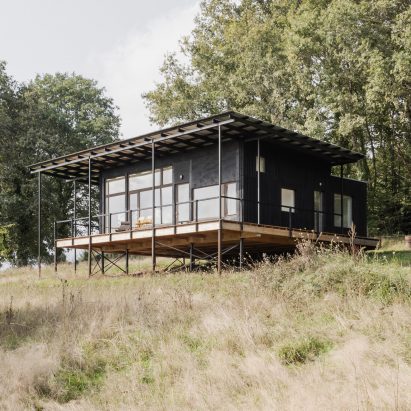
French studio Ciguë has elevated this timber-clad home in Saint Julien le Petit, France, above its rural site using slender, removable steel foundations.

Looking to contrast the area's traditional stone country homes, the Paris-based studio drew on the lightweight Case Study Houses built in California in the 1960s to create a simple structure that sits lightly in its surroundings.

The Wooden House is a residential project in rural France designed by Ciguë

"The Wooden House scrupulously chooses its land, its exposure, its height and its references to revisit the archetype of the country house," said the studio.

"[It is] a place in which you live carefree and unconfined, in direct contact with the landscape, surrounded by bare necessities," it continued.

The structure is clad in blackened timber

The almost-square central form of the home, clad in black timber planks, sits atop an area of raised wooden decking. The deck wraps the southern edge to create a variety of seating areas surrounded by a black timber balustrade.

A roof has a large overhang and is supported by thin steel supports. It shelters a south-facing section of full-height glazing, which provides the L-shaped living, dining and kitchen area with dramatic views across the landscape.

A covered terrace wraps around the structure

Two bedrooms, a bathroom and a study space create a more private L-shaped section of the home, which north and east with small windows framing views.

A stepped roof line creates higher ceilings at the front of the home, while the bedrooms at the rear are slightly more intimate-feeling spaces.

[

Read:

La Petite Maison is a tiny guesthouse in France made out of wood

](https://www.dezeen.com/2020/04/11/le-petit-maison-tiny-guesthouse-france-wood/)

In the study, a small mezzanine level sits atop a wooden frame accessed by a ladder, leading to an elevated space with a small window.

"Benefiting from large window openings, [the home] is flooded with light and lives to the rhythm of the seasons according to its bioclimatic principles," said the studio.

Large full-height windows frame views out to the landscape

Internally, the walls and ceilings have been given a crisp white finish. Simple furnishings, window frames and fittings were made using wood sourced from the local area.

Much of the framework and structure is left exposed, with a grid of black timber battens supporting corrugated plastic forming the roof. The junctions between the foundations and house are also left visible.

Ciguë applied a simplistic material palette througout the interior

"Floating lightly above its field, the house imprints its unique Neo-vernacular spirit on the landscape, having chosen wood from the surrounding forests that have gradually replaced the regions agricultural land," said the studio.

Previous projects by Ciguë include several retail interiors including a store in Nottingham for skincare brand Aesop organised around distillation apparatus and a store in Bangkok for fashion brand Isabel Marant with woven bamboo screens.

The photography is byMaris Mezulis.

The post Ciguë uses steel foundations to elevate lightweight home in rural France appeared first on Dezeen.

#all #residential #architecture #france #blackenedwood #houses #ciguë #frenchhouses #woodenarchitecture #timbercladding

IF_DO designs "demountable and reusable" incubator for start-ups in London

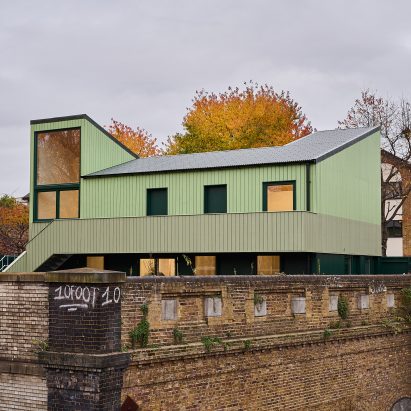
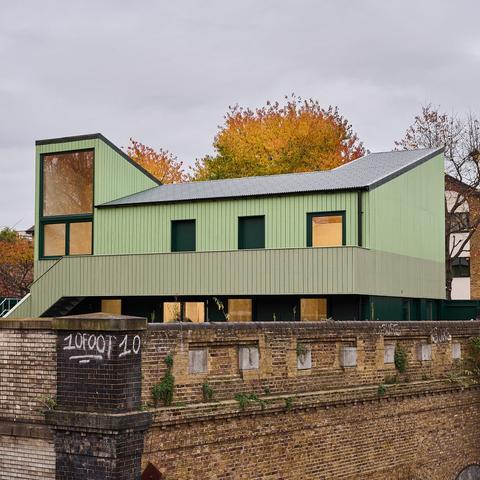
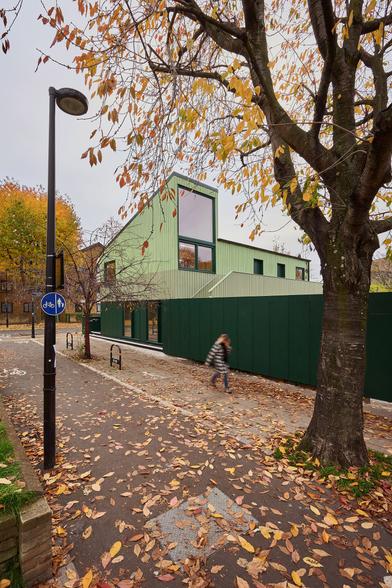
Timber planks in shades of green cover the exterior of The Hithe, a workspace and incubator for start-ups in London designed by architecture studio IF_DO.

Low-cost and entirely demountable, The Hithe was commissioned by Southwark Council to occupy a redundant site in Rotherhithe for up to 11 years, after which it will be relocated.

The Hithe is a demountable community space and incubator that was designed by IF_DO

"Designing a decade-long meanwhile building of a high architectural standard, to be delivered on a very tight budget, was always going to be challenging," said IF_DO co-founder Thomas Bryant.

"We added to that the ambition to make it demountable and reusable."

It was designed to house start-ups

With 12 workspace units – one of them occupied by Meanwhile Space – a central gathering area, kitchen and a yard to the north of the site, the building has been designed to avoid the appearance of being temporary.

A simple timber and steel frame developed in collaboration with structural engineer Elliott Wood and fabricator Weber Industries sits on existing foundations from the site's previous uses, reducing the amount of new concrete used.

IF_DO clad the building in green painted timber

Two large lantern windows, as well as green finishes on the building's exterior and boundary fences have been used to help create a new "landmark in the streetscape" that aims to increase footfall along the nearby Albion Street.

"One of the key desires from the community was that the building shouldn't look temporary," explained Bryant.

"They did not want it to feel like another construction site, so shipping containers and temporary site offices were ruled out at the outset," he continued.

[

Read:

Colonnades and courtyards bring nature into sixth-form college by IF_DO

](https://www.dezeen.com/2019/01/21/if-do-st-teresa-school-surrey-architecture/)

Inside, the structural frame and services have all been left exposed to create open, bright spaces, with IF_DO using the opportunity to test ideas for relocatable micro-work units that could be replicated elsewhere.

Ten smaller workspaces occupy the ground floor, while above two larger spaces take advantage of the light and ceiling height created by the lantern windows at either end of the building.

The building can be completely demounted and deconstructed

All of these workspace units are accessed externally, with an access stair and deck on the northern side of the building connecting the upper spaces, in order to reduce the need for circulation space.

"The need for affordable workspace and the availability of vacant lots for temporary usage is a reality in many places, and especially so in London, so it's a model which we expect to be replicated quite widely," said Bryant.

The interiors employ a simple and paired back look

IF_DO was founded in 2014 by Bryant, Sarah Castle and Al Scott.

Previous projects by the studio include a sixth form college in Surrey that surrounds a central courtyard with a wooden colonnade, and a geometric extension to a flat in London.

The photography is byMike Massaro.

The post IF_DO designs "demountable and reusable" incubator for start-ups in London appeared first on Dezeen.

#all #architecture #london #officearchitecture #if_do #timbercladding

Japanese architecture informs design of Minnesota house by Salmela Architect

A cluster of wood-clad buildings surround a central courtyard at this Minnesota residence by US firm Salmela Architect that was designed for clients who formerly lived in Japan.

The project, called Fifty-Acre Wood, is located in Stillwater – a historic town located along the St Croix River, just beyond Minneapolis. The house rests on a fifty-acre (20-hectare) parcel, the majority of which the clients granted to the Minnesota Land Trust for permanent conservation.

Fifty-Acre Wood is a home in Minnesota that was designed by Salmela Architect

Situated near a waterfall, the property features an oak forest and farm fields that are being reseeded with native grasses. The area supports a range of wildlife, including black bears, foxes, sandhill cranes and blue herons.

The owners are a married couple – Yuko and Paul – who met and lived in Japan before moving to Minnesota with their two young sons. Paul grew up exploring the St Croix River Valley and wanted his kids to have a similar experience.

It is comprised of a collection of volumes which house living and sleeping areas

In contrast to Paul's upbringing, Yuko was raised in the dense Japanese city of Fukuoka, and initially, she felt uncertain about living in a wide-open landscape.

"Her wishes were for a home that felt protected, with the inclusion of familiar cultural references in this unfamiliar setting," said Salmela Architect, a Minnesota firm known for designing homes in a regional modernist style.

The home has views out to the surrounding landscape

The architects conceived a series of buildings that are organised around a central courtyard. The design draws upon two references: a cluster of shed-roof agricultural buildings and a Japanese courtyard house with sheltered, exterior walkways.

The main dwelling consists of two pavilions that form an L-shape and are joined by a glazed passageway. Nearby are a detached guesthouse, a garage and a multipurpose building.

The interior boasts a simple and minimal material palette

"Each of the five structures is positioned according to function, solar orientation and relationship to specific features of the landscape," the firm said.

Facades are clad in cedar, and roofs are covered with standing-seam metal. Interior finishes include slate tiles, quartz countertops and ceilings sheathed in pale-toned basswood.

Paved walkways surround the home

In the main dwelling, there is a clear separation between public and private spaces.

One pavilion encompasses a semi-open kitchen, dining area and living room. It sits on an east-west axis and looks upon a gently rolling field.

The living areas have views across the site in all directions

"South-facing, floor-to-ceiling windows create a sense of interior-exterior continuity, which is reinforced by horizontal wood slats on both the exterior soffit and interior ceiling," the team said.

"This Japanese architectural reference helps softens the acoustics of the hard surfaces within the wide-open room."

[

Read:

Salmela Architect wraps Feldmann Residence in Minnesota with black stucco

](https://www.dezeen.com/2021/12/17/feldmann-residence-salmela-architect-minnesota/)

In the kitchen, the team provided views in all directions. A large, northern window delivers sight lines of the home's courtyard, entry path and driveway, offering a sense of security.

The home lacks a traditional foyer. Instead, one enters through a threshold composed of "symmetrical blade walls" that lie between the kitchen and a mudroom.

"While the clients were initially hesitant about the atypical arrival sequence, they have expressed how comfortable it has been to welcome people into their home without the typical awkwardness associated with a formal foyer," the team said.

The home has an open plan design

The home's other pavilion, which holds bedrooms, runs from north to south and hugs the edge of a forest.

"The three bedrooms and two ofuro – shower and tub rooms – look out into the oak forest, which filters warm morning light through its leaves, signaling the start of the day," the studio said.

Tiles cover the floors across the shared living areas

The sleeping areas are arrayed along a corridor that doubles as a workspace.

"It remains shaded throughout the workday, creating an ideal glare-free environment until the low evening sun signals dinner time," the firm said.

The sleeping areas are accessed along a corridor

Throughout the residence, the team incorporated a number of elements to help reduce energy consumption. These include operable windows, a hydronic in-floor heating system, an air-to-air heat exchanger and a high level of insulation.

"Six-foot-deep eaves and a south-facing orientation enable an optimal passive solar strategy that maximises heat gain in the winter while entirely blocking the mid-summer sun," the team added.

Windows were randomly places across the walls

The home also features three skylight boxes that open and close, enabling hot air to escape. At night, the boxes are illuminated with electric lights.

Beyond the main home, the team created a guesthouse to the west, which provides a level of separation and privacy for overnight visitors, including Yuko's parents from Japan.

A sculptural firepit is framed by a squared window

To the north is a two-stall garage and the "barn", which is a multipurpose space for playtime and storage. The buildings are accessed by paved walkways that surround the courtyard.

"Exterior walkways ring the interior courtyard that is seeded with native vegetation – a microcosm of and counterpoint to the larger landscape restoration project," the team said.

The home was fitted with a number of environmental and green systems

Other projects by Salmela Architect include a home for a physicist and eye doctor that is meant to resemble a "scientific instrument with multiple viewing apertures" and a solar-powered house that was created for an architecture professor.

The photography is byCorey Gaffer.

Project credits:

Architect: Salmela Architect
Team: David Salmela (principal), Kai Salmela (design lead), Emre Erenler
Energy consultant: Malini Srivastava
Structural engineer: Meyer Borgman Johnson
Contractor: Cates Fine Homes

The post Japanese architecture informs design of Minnesota house by Salmela Architect appeared first on Dezeen.

#residential #all #architecture #instagram #usa #houses #americanhouses #minnesota #salmelaarchitect #timbercladding

Japanese architecture informs design of Minnesota house by Salmela Architect

A cluster of wood-clad buildings surround a central courtyard at this Minnesota residence by US firm Salmela Architect that was designed for clients who formerly lived in Japan.

Dezeen

Studio Fuse designs charred-timber home in Devon to be both rustic and modern

British practice Studio Fuse has completed Rockham House in North Devon, England, combining charred timber cladding with sleek interiors to create a "sophisticated yet rustic" dwelling.

The London and Sussex-based practice was approached after interior designer Deborah Vos purchased the remote site overlooking Woolacombe Bay, which had restricted access but offered panoramic views of the rolling green landscape and sea.

Rockham House is a charred-timber home in Devon by Studio Fuse

The exposure of the site informed the low, single-storey profile of the four-bedroom dwelling. It is marked out in the landscape by its cladding of black timber planks, which were charred using the Japanese technique Shou Sugi Ban.

Following the contours of its sloping site, the home comprises three distinct levels that step downwards, creating a route that culminates in a large living area, terrace and garden looking out to sea.

The home is located on a remote location overlooking Woolacombe Bay

"The exposed, yet stunning location, along with planning restrictions, influenced the form, which evolved into a single-storey building that nestled into the site's gradient," said the practice.

"The building makes sense of the contoured site with the creating of three flowing terraced levels, dropping down the hillside, reflecting the surrounding landscape."

The building was clad in charred timber slats

The stepped form of the home has been used to subtly demarcate the different areas of the home. The bedrooms are located in the uppermost section, a kitchen and bar in the centre, and a living and dining space in the lower section.

The upper spaces are more insular, with skylights, small windows and darker finishes, while the living space embraces the exposure of the site through large, panoramic windows.

"Glass slots along the side bring glimpses of the coastal views to the very depth of the building, whilst naturally gravitating you towards the main living spaces on the bottom terrace that opens up to the rear garden and the uninterrupted sea views," explained the practice.

[

Read:

Thomas Randall-Page transforms Devon barn into light-filled artist's studio

](https://www.dezeen.com/2021/04/02/art-barn-thomas-randall-page-devon-barn-artists-studio/)

Internally, the dwelling was designed to appear "monolithic and sculptural", with concrete floors and cast concrete steps unifying the route through the home and extending outside to create the external terrace.

Completed by the client, the interior design uses a monochrome palette to create contrasting moments of intimacy and exposure. The home's cladding is referenced inside with black accents used for doors, window frames and fittings.

The interiors have a modern look

The primarily white living space is organised around a central ceiling-mounted fireplace, with a dining table along one edge and sitting areas at the other.

Overlooking this space is a bar area opposite the kitchen above, finished in black to visually connect it with the central kitchen island and built-in cupboards and counters.

Each of the darker bedroom spaces looks out at the landscape through a glass sliding door, which opens onto a gravel path around the home and is half-covered by charred timber slats to provide additional privacy.

Floor-to-ceiling windows frame views across the rural landscape

Studio Fuse was co-founded by architectural designer Daniel Rowland and interior designer Nina Rowland.

Also in South Devon, architect Thomas Randall-Page recently completed a renovation of an agricultural barn, converting it into a studio and archive space for his father, the sculptor Peter Randall-Page.

Elsewhere in the southwestern county, London studio Adams+Collingwood Architects built a house within the hillside overlooking Salcombe Esturary.

Project credits:

Architect: Studio Fuse **
Interior designer:** Deborah Vos
Contractor: M K Millennium **
Concept:** Carl Turner

The post Studio Fuse designs charred-timber home in Devon to be both rustic and modern appeared first on Dezeen.

#residential #all #architecture #uk #england #blackenedwood #houses #britishhouses #devon #timbercladding

Studio Fuse designs charred-timber home in rural Devon to be both rustic and modern

British practice Studio Fuse has completed Rockham House in North Devon, England, combining charred timber cladding with sleek interiors to create a "sophisticated yet rustic" dwelling.

Dezeen

NOA designs timber-clad hotel on an Alpine meadow

Two wood-clad buildings with jagged facades are connected by a corridor hidden beneath an artificial hill at this hotel and wellness centre in South Tyrol by Network of Architecture.

The new spaces were commissioned by the Ramoser family, which wanted to expand on a cluster of historic barn buildings that since 1972 have housed the Lobishof guesthouse and restaurant on a green plateau with expansive views of the alps.

Located just to the north of this existing site, the new Aeon Hotel comprises a block of 15 guest rooms alongside a wellness centre which includes a bistro and bar, pools, saunas and relaxation and yoga spaces.

Top: Aeon Hotel was designed by NOA and is located in Italy. Above: the hotel is comprised of two wood-clad buildings

Italian practice Network of Architecture (NOA) drew on the vernacular barn structures of the neighbouring guesthouse and used local timber to clad the two new buildings, with gabled forms that appear to have been broken apart to reveal balconies and terraces.

"The creation of an ambivalent tension between the centuries-old tradition of the rural complex and an exclusively modern statement was the basic principle underlying the design process," said NOA partner Christian Rottensteiner.

Wanting a design that would "allow the landscape to flow through and become part of it," a low artificial hill cuts between the two buildings, concealing a subterranean corridor below that provides direct access between the two for guests.

The two buildings are adjoined by an artificial hill and each has a jagged facade

The same approach has been used for a carpark to the north, which sits under another artificial hill on a driveway that leads to the main reception inside the wellness centre.

"The gentle topography we found and the arrangement of open and at the same time protected outdoor spaces conditioned the layout of the individual building volumes," continued Rottensteiner.

[

Read:

Network of Architecture raises "treehouse" hotel on stilts above park in South Tyrol

](https://www.dezeen.com/2021/01/15/floris-hotel-extension-noa-south-tyrol/)

Each of the 15 guest rooms has its own terrace or balcony facing west with whirlpools on the ground floor, and six larger double-aspect suites also look out to the east with an additional hanging double bed and terrace.

Corridors with communal sitting areas connect the suites to the stairs and lift. On the ground floor, these lead into a subterranean corridor through to a private entrance into the wellness centre reception.

The interior of the hotel has a blue and white finish

On the ground floor of the centre a bar and bistro extends onto surrounding terraces, while on the first floor a spa opens onto an infinity pool that reaches out to the southwest.

Throughout, the interiors contrast bright whites with deep blues in wall finishes, fabrics and furniture, with a coloured datum on the wellness centre wall extended to a series of hanging white curtains.

"We have carefully chosen the fabrics, woods and colours that play both with and against each other at the same time," said interior designer Patrick Gürtler, describing the contrasting white and blue as a "sharp, unconditional break".

Rooms were visually split in two by blue and white furnishings and paint

NOA has previously completed several projects in South Tyrol, including a hotel extension with gabled guest rooms elevated on stilts and a viewing platform at the top of an Alpine ridge.

Elsewhere in Italy, Count Benedikt Bolza transformed a 1,000-year-old Italian castle into a hotel, restaurant and spa.

The photography is byAlex Filz.

The post NOA designs timber-clad hotel on an Alpine meadow appeared first on Dezeen.

#hotels #all #architecture #italy #noa #timbercladding

NOA designs timber-clad hotel on an Alpine meadow

Two wood-clad buildings with jagged facades are connected by a corridor hidden beneath an artificial hill at this hotel and wellness centre in South Tyrol by Network of Architecture (NOA).

Dezeen

Kengo Kuma draws on fairytale landscapes for Hans Christian Andersen museum in Denmark

Winding maze-like hedges wrap a series of green-roofed timber pavilions at a museum dedicated to the work of Hans Christian Andersen in Odense, Denmark, designed by Japanese practice Kengo Kuma & Associates.

The new museum building, announced in 2016 to coincide with the author's 211th anniversary, is tucked behind the yellow buildings of the fairytale author's birthplace, which has housed the H C Andersen House museum since 1908.

A timber-framed entrance leads into the museum

A timber-framed entrance that mimics the gabled houses of Odense's old town leads through into the lush 5,600-square-metre site of the museum, which had a soft opening at the end of June.

It was designed to not just tell the history of Andersen's life and works, but to embody their sense of "puzzlement, imagination and magical adventure."

The architecture was loosely informed by the author's The Tinderbox fairytale

Loosely inspired by Andersen's story The Tinderbox, in which a tree reveals an underground world, three wooden pavilions housing a cafe, children's studio and entrance foyer above-ground lead to a network of immersive subterranean display spaces.

"The idea behind the architectural design resembled Andersen's method, where a small world suddenly expands to a bigger universe," architect Kengo Kuma said.

Subterranean spaces house exhibitions

In these underground spaces, the architecture is combined with a "complete artistic experience" of sound, light and visuals to immerse visitors in the worlds of Andersen's tales through a series of interactive exhibits.

"[The fairytales] are what everyone knows...the idea is not to retell the stories, but rather to communicate their familiarity and inspire further readings of Andersen," head of Odense City Museums Torben Grøngaard Jeppesen added.

The landscaping, developed in collaboration with Danish landscape architects MASU Planning, is defined by a series of curved hedges that trace the outline of the exhibition spaces below, connected by a network of paths dotted with trees and sculptures.

Glimpses into the underground exhibition spaces are provided by a sunken, tree-filled courtyard in the garden's centre and a glass pool in the gardens, described by the practice as "portals from the real world to the fairytale world."

A tree-filled courtyard shows glimpses into the exhibition spaces

The pavilion structures, built with a frame of spruce and clad with a grid of thin larch beams, are designed to both echo the structure of Andersen's half-timbered childhood home in Odense and allow the structures to blend in with the garden.

"The architectural structure is reduced to the programs that require natural light – their volumes above ground are minimised to the scale of small pavilions floating among the hedges, trees and green in the garden," Kengo Kuma & Associates told Dezeen.

Timber features both in the museum's interior and exterior

Internally, the timber structure has been left exposed, giving each pavilion a ceiling of radial beams intended to evoke the feeling of being beneath a tree canopy. Externally, their scooped roofs are topped with plants to create green roofs.

In contrast, the concrete of the subterranean structure has been left largely exposed, with skylights and clerestory-level windows giving views back up to the gardens above and creating contrasting areas of light and dark in the exhibition spaces.

Interiors feature exposed concrete

Elsewhere in Denmark, the fairytale author provided the inspiration for Danish practice Bjarke Ingels Group's tree-covered designs for the 18 storey H C Andersen Hotel in Copenhagen's Tivoli Gardens amusement park, revealed in 2019.

Photography is byRasmus Hjortshøj.

The post Kengo Kuma draws on fairytale landscapes for Hans Christian Andersen museum in Denmark appeared first on Dezeen.

#cultural #all #architecture #denmark #pavilions #museums #culturalbuildings #publicandleisure #kengokuma #timbercladding

Kengo Kuma draws on fairytale landscapes for new Hans Christian Andersen museum in Denmark

Winding maze-like hedges wrap a series of green-roofed timber pavilions at a new museum dedicated to the work of Hans Christian Andersen in Odense, Denmark, designed by Japanese practice Kengo Kuma & Associates.

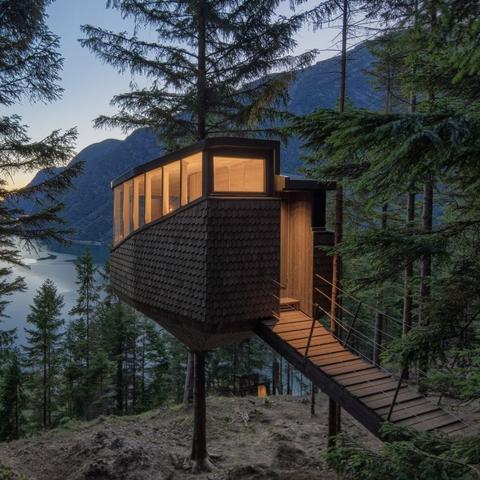
Helen & Hard hangs Woodnest treehouses from pine trees above Norwegian fjord

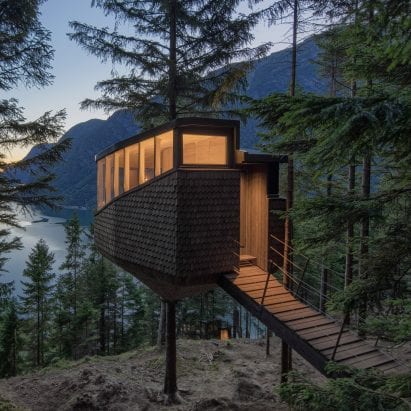
Norwegian architecture office Helen & Hard has completed a pair of shingle-clad treehouses on a hillside overlooking the Hardangerfjord.

The Woodnest treehouses are situated above the town of Odda at the southern tip of Sørfjorden – one of the innermost branches of the main Hardangerfjorden.

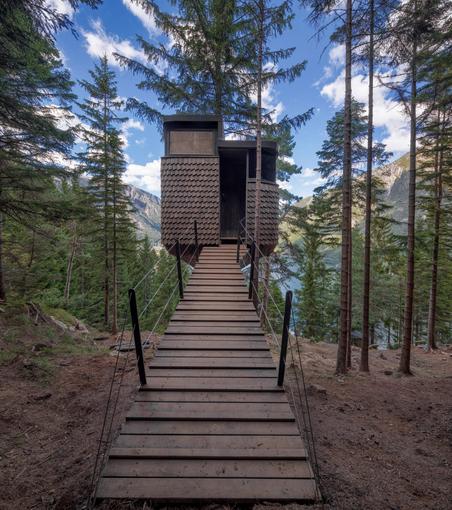
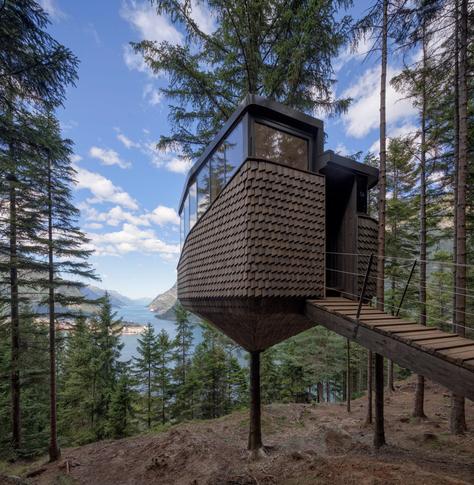
Top: cabins are suspended five and six metres above the ground. Above: a footbridge leads to the treehouse

Helen & Hard designed the two cabins in response to the topography and conditions of the site, which is on a steep, forested hillside on the edge of the fjord.

The buildings are suspended around six metres above the forest floor and are attached to the trunks of two living pine trees using steel collars. This creates the feeling of living among the branches.

"Stemming from the client's wish to create a unique spatial experience that connects to both the ordinary and extraordinary sensation of climbing and exploring trees, our aim was to create a space that truly embodies what it means to dwell in nature," the architecture studio explained.

The cabins are attached to the trunks of living trees

The cabins are reached after a 20-minute walk up a steep, winding path that leads up from the town towards the site. Short wooden bridges extend from the hillside to the cabins' entrances.

Each of the cabins has an internal floor area of just 15 square metres that incorporates sleeping areas, a bathroom, a kitchen and a living space with views out towards the fjord.

Large windows surround the top of the cabins

The interior spaces are arranged around the tree trunks, which form the main structural core. A series of radial glue-laminated timber ribs create an outer shell incorporating large windows.

The buildings are wrapped in a protective skin made from untreated timber shingles that will weather gradually to take on a tone and patina that matches the surrounding forest.

Internal walls, ceilings, flooring and fitted furniture are all made from wood to reference the Norwegian tradition of timber construction.

The extensive use of wood also enhances the sense of being surrounded by nature.

The cabins have views across the Hardangerfjord

Treehouses and other remote dwellings have proven popular recently as people seek escapism during the coronavirus pandemic.

Designer Sebastian Cox created a treehouse in Hertfordshire, England, with scorched larch cladding and a shingle roof, while Peter Pichler designed a group of luxury treehouses for a resort in Austria.

Shingles will patina over time

Helen & Hard was founded in Stavanger, Norway, in 1996 and now has a second office in Oslo. The firm works on projects ranging in scale from private homes to large commercial schemes, cultural buildings and urban development projects.

The studio created a full-scale co-housing model for the Nordic Pavilion at the 2021 Venice Architecture Biennale and has also designed a library featuring giant wooden ribs with integrated bookshelves.

Photography is bySindre Ellingsen.

The post Helen & Hard hangs Woodnest treehouses from pine trees above Norwegian fjord appeared first on Dezeen.

#all #hotels #architecture #publicandleisure #instagram #norway #treehouses #shingles #helenhardarchitects #cabin #timbercladding

Helen & Hard suspends Woodnest treehouses from pine trees in a Norwegian forest

Architecture office Helen & Hard has completed two shingle-clad treehouses that are attached to the trunks of trees overlooking the Hardangerfjord.

Pilgrim's House is a timber-clad hostel in the Basque countryside

Vertical timber battens wrap around this Passivhaus hostel designed by architecture studio Blancodelprim to accommodate pilgrims on the famous route to Santiago de Compostela.

Architects Ignacio Ibarretxe Pariente and Iñaki del Prim were commissioned to design the building by the municipal council of Zegama – a town situated in a valley of the Oria river.

Top: it is clad in vertical timber battens. Above: the building has a mono-pitched roof

Zegama is located on the route of the Camino de Santiago, known in English as the Way of St James, which has been an important Christian pilgrimage route since the Middle Ages.

The hostel was designed to accommodate up to 12 pilgrims in two simple dormitories arranged across two floors at the taller end of the building.

It is located at the entrance to a natural park

The block was positioned at the entrance to the Aizkorri-Aratz Natural Park and is intended to form a gateway pavilion that welcomes visitors to the park.

The brief from the town's municipal administration laid out two specific criteria that the hostel building needed to fulfil.

It used locally sourced pine across the exterior

"The building had to be Passivhaus certified as a guarantee of the city council's commitment to sustainability and the quality of municipal investments," said the architects.

"Also, the hostel was to be located on a plot of land next to the local Wood Museum, so it had to be built with locally sourced radiata pine wood."

The building is Passivhaus certified

Pamplona-based studio Blancodelprim specialises in developing buildings that meet the low-energy criteria required for Passivhaus certification.

Since 2005, the practice has focused on using wooden structures and framework systems for its buildings, making it well-suited for the hostel project.

The architects designed the hostel to be built using a prefabricated structure comprising cross-laminated timber panels made from locally sourced wood.

Wood was also used to create the external cladding, as well as for the building's substructure, insulation and internal finishes.

The building is carefully positioned on the site to optimise opportunities for passive climate control, preventing direct sunlight from reaching the interior whilst allowing the north side to provide cooling ventilation at night.

Rectangular windows punctuate the facade

"Thanks to this positioning, and the compactness of the building, it was possible to arrange the windows in the southwest orientation, both in size and depth, so that no external shading was required," the architects explained.

"The appropriate position of a fixed eave in the southeast orientation ensures passive protection against possible overheating in summer."

Chipboard was used throughout the interior

Internally, the hostel features an open living and dining space at its centre, with an adjoining kitchen and washing area positioned at one end. Two toilets are arranged on either side of the kitchen.

On the opposite side of the central space from the kitchen are two communal dormitories with six bunk beds in each room. The upper dormitory is accessed using a timber staircase that extends along the back wall.

A simple material palette of dark floor tiles, exposed wood and chipboard panels gives the space a warm and welcoming yet functional aesthetic.

A communal space is located at the front of the hostel

Elsewhere in Spain, Aixopluc created an extension comprised of several sheds and porches surrounding an old house in the city of Reus that uses low-cost and lightweight building materials.

While Eduard Balcells, Ignasi Rius and Daniel Tigges built a wood-clad concrete kindergarten as part of a six structure kindergarten arranged like a small village in Bellaterra.

Photography is byJorge Allende.

The post Pilgrim's House is a timber-clad hostel in the Basque countryside appeared first on Dezeen.

#all #hotels #architecture #wood #spain #hostels #passivhaus #timbercladding

Pilgrim's House is a timber-clad hostel in the Basque countryside

Vertical timber battens wrap around this sustainably built hostel designed by architecture studio Blancodelprim to accommodate pilgrims on the famous route to Santiago de Compostela.