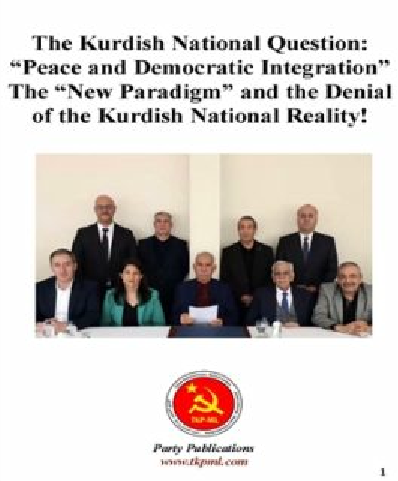
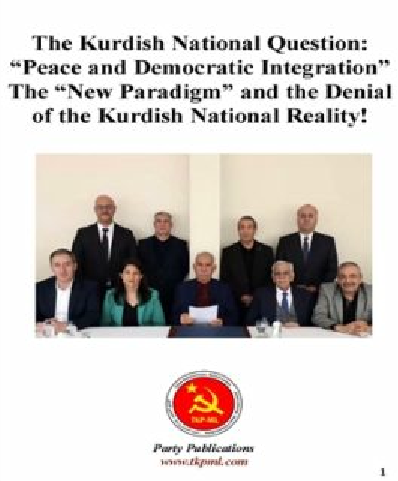
The Kurdish National Question: “Peace and Democratic Integration” The “New Paradigm” and the Denial of the Kurdish National Reality! — TKP-ML
Introduction
On 1 October 2024, when the fascist MHP leader Devlet Bahçeli approached the seats of the Peoples’ Equality and Democracy Party (DEM Party) in the Grand National Assembly of Turkey (TBMM), shook hands with DEM deputies, and subsequently, in his speech at the MHP group meeting on 22 October, issued a call to the Kurdistan Workers’ Party (PKK) leader Abdullah Öcalan, saying: “Let him go ahead and unilaterally declare that terrorism has ended, that the organization has been dissolved,” “If the isolation is lifted, let him come and speak at the DEM Group Meeting in the TBMM. Let him proclaim that terrorism has completely ended and that the organization has been abolished. If he shows this determination, let the way be fully cleared for a legal regulation regarding the exercise of his right to hope. Let the address extend from İmralı to DEM,” it became publicly apparent that a “process” had been initiated between the Turkish Republic and the PKK through Abdullah Öcalan.
Following these statements, the call made by PKK leader Abdullah Öcalan— who has been held under isolation for 26 years in İmralı Prison—in his declaration dated 27 February, in which he stated, “The PKK should dissolve itself and end the armed struggle,” found a response, and the PKK announced to the public that it had dissolved itself through its Extraordinary 12th Party Congress, convened between 5–7 May.
The “process,” which was referred to by different names by the parties involved and was not given a name, continued with the PKK dissolving itself and laying down its arms, while the new “road map” brought with it many debates.
The proletarian movement has also made its views on the Kurdish national question and the “process” and developments surrounding the PKK’s “paradigm shift” known to the public through various brochures and statements published on various occasions. This article will evaluate the views expressed by PKK leader A. Öcalan in his “February 27 Call.” The article will evaluate, in general terms, the national question, the nationalization of the Kurds, the Kurdish uprisings, the PKK’s emergence on the scene of struggle, and the developments following the Extraordinary 12th Congress, at which the PKK dissolved itself.
All debates aside, the Kurds in Turkey are a nation, and like every nation, the Kurdish nation has the Right to Free Separation (the right to establish a separate state). This is a matter of principle for MLM and is not open to debate. At this stage, the PKK, which has shaped the current expression of the Kurdish national movement, and its leader A. Öcalan, let alone exercising the “right to secession,” define the demand for this right in their “Call for Peace and a Democratic Society” as defining the demand for this right as “excessive nationalist deviation” and, moreover, defining it as “separate nation-state, federation, administrative autonomy, and culturalist solutions cannot respond to historical social sociology,” thereby rejecting even bourgeois steps toward resolving the national question, compels us to restate our position on the matter. (For “Call for Peace and a Democratic Society,” see: A. Öcalan, “Call for Peace and a Democratic Society,” February 27, 2025, bianet.org)
Of course, how the “right to secession” is exercised is entirely subject to the will of the Kurdish nation. Our position on this matter is well known: “The Marxist-Leninist movement is also against the privilege of the right to form a state. The right of nations to self-determination should never be confused with the necessity for a particular nation to secede. The Marxist-Leninist movement takes the question of secession concretely in every particular case, “evaluates and determines in the interests of the class struggle of the proletariat, for social development and socialism as a whole”. The Marxist- Leninist movement takes the question of secession concretely in every particular case, “evaluates and determines in the interests of the class struggle of the proletariat, for social development and socialism as a whole”. The Marxist-Leninist movement absolutely refuses to use force, to cause obstacles and difficulties before a decision to secede that it does not approve. Boundaries should be determined by the will of the nation. This is necessary for mutual trust, solid friendship and voluntary unity of the working and toiling masses of various nationalities. (İbrahim Kaypakkaya, Selected Writings, English Edition, Nisan Publishing, 2025)
In concrete terms, however, A. Öcalan and the PKK speak not of separation but, on the contrary, of “democratic integration” with the oppressor nation. In his “new paradigm,” A. Öcalan calls on the Turkish state to become a “democratic society” and proposes that the Kurdish national movement integrate with this “democratic society”: “…we are preparing our program with this meeting under state supervision. We are working intensively on what kind of democratic society this will be. We want to cross this threshold. What is this, the transition from war and separatist conflict to peace and democratic integration, especially with the Republic of Turkey.“ (A. Öcalan, ”Perspective,” Serxwebûn Newspaper, issue 521)
I. The Complete and Correct Solution to the National Question
“It means that ‘self-determination of nations’ in the Marxists’ Programme cannot, from a historico-economic point of view, have any other meaning than political self-determination, state independence, and the formation of a national state.” (V.I. Lenin, The Right of Nations to Self-Determination)
“As far as the theory of Marxism in general is concerned, the question of the right to self-determination presents no difficulty.” (V.I. Lenin, ibid)
No other solution can be the real salvation of the oppressed and dependent nations. Reforms or the attainment of some democratic crumbs can only be a band-aid “solution.”
At this point, it would be useful to briefly define the historical development that gave rise to the national question, or the historical formation of nations.
Nation states, despite being historically formed by the union of various tribes and communities, do not constitute a nation, unlike, for example, the Mongols or Alexander’s great empires. These are not nations, but human communities that came together and dispersed for this or that reason. In other words, the state and the nation are not one and the same. The state is a class phenomenon that emerged immediately after the emergence of the ruling and ruled classes. Historically, even though slave-owning states and feudal states emerged after classes appeared, the human communities living within the borders of these states did not form nations. There is a very important distinction here: the nation is not only a historically formed category, it is also a historical category of the era of rising capitalism. In other words, the liquidation of feudalism and the development of capitalism also marked the time when human communities and tribes united in the form of nations. For example, in Western Europe, with the victory of capitalism over feudal fragmentation, the English, French, Italians, and Germans emerged as national states.
We emphasized above that not every stable community forms a nation. While a common language is essential for a nation, it is not a requirement for a state. A nation cannot emerge without a common language. However, not everyone who speaks a common language forms the same nation. For example, Americans and British people are two separate nations despite speaking a common language. Linguistic unity is one of the most distinctive characteristics of a nation.
However, linguistic unity alone is not sufficient to form a nation. Other characteristics are also involved. Another such characteristic is that they live on a common territory. A nation has emerged as a result of communities living together from generation to generation through long-term and regular interactions. Long-term coexistence is not possible without a territory. Therefore, territorial unity is one of the characteristic features of a nation.
However, these two characteristics are not sufficient for the formation of a nation. In addition to linguistic and territorial unity, an internal economic unity that brings together the individual parts of the nation into a whole is essential. This economic unity is an important element that brings together the whole nation around a common market. In other words, economic unity is one of the characteristic features of a nation.
Another feature must be added to all these characteristics we have mentioned. This is spiritual unity. Nations are not only inseparable in terms of language, land, and economy. They are also distinguished in terms of their spiritual formation, which is expressed in their cultural characteristics. In other words, spiritual formation unity, expressed in cultural unity, is one of the characteristic features of a nation.
As a result of all these statements, a nation is a stable community of people that has developed historically, sharing a language, territory, common market, cultural unity, and spiritual formation. To summarize: “A nation [or people] is a historically formed, stable community governed by a unity of language,
territory, economic life, and a unity of spiritual formation expressed in a common culture.” (Quoted from J. Stalin by İbrahim Kaypakkaya, Complete Works, Nisan Publishing, October 2016, p. 223)
The nation is not only a historical category, but a historical category of a specific era, the era of rising capitalism.
We see that there were two distinct periods in the process of nation-building alongside capitalism. The first was when single-nation states were established in the West, in Germany, England, and France, while multi-nation states were established in the East. Hungary and Russia were such states. This also brought the national question to the fore in multi-national states. Another development was that, alongside this unique form of state organization, it was possible for marginalized nationalities to organize themselves into nations, even though they had not yet had time to consolidate economically and were still under conditions of unresolved feudalism and underdeveloped capitalism.
Another point to note regarding the national question is that it has three stages of development. The first period of the national question corresponds to the period of the liquidation of feudalism and the triumph of capitalism in the West. This period corresponds to the period when people united as national communities… During this period, referred to as the first stage, states without national oppression emerged in Western Europe, while in Eastern Europe, multi-ethnic states were established where the economically and politically developed nation dominated and other nations were oppressed. These multi-ethnic states of the East became the homelands of national oppression, giving rise to national wars, national movements, and various methods of resolving the national question. (J. Stalin, Marxism and the National Question and the Colonial Question)
The second period, in which national oppression and methods of struggle against it were developed, was shaped by the emergence of imperialism. Capitalism has always needed markets, raw materials, energy, and cheap labor. It wants to control and secure land, sea, and air routes for the export of capital and goods. To this end, it tears down national fences and expands its national territories at the expense of its rivals. “In this second period, the old national states of the West—England, Italy, France—cease to be national states; that is, they acquire new territories and thus transform themselves into multinational states, creating a space for the same national and colonial oppression that previously existed in Eastern Europe. This period is defined by the awakening and consolidation of the subjugated nations (Czechs, Poles, Ukrainians) in Eastern Europe, leading to the collapse of the old multinational bourgeois states after the imperialist war and the establishment of new national states subjugated by the so-called great powers.” (J. Stalin)
The third period in the national question is the period of the October Revolution. It is the period when capitalism was overthrown and the national question was resolved with the October Revolution. It is the period when the problem of oppressed nations and colonies in Russia was consigned to the dustbin of history with the October Revolution. “But the October Revolution did not merely result in the removal of national oppression or the creation of a space conducive to the unification of peoples. In its development, the October Revolution also prepared the forms of this unification and outlined the basic lines along which the unification of peoples into a single federal state would be carried out according to their own terms. During the first period of the revolution, when the working masses of the nationalities first became aware of their independent national greatness, but when the threat of foreign intervention had not yet manifested itself as a real danger, the form of cooperation between the peoples had not yet been absolutely determined or strictly defined. During the period of civil war and intervention, when the military self-defense interests of the national republics came to the fore, but economic organization issues were not yet on the agenda, cooperation took the form of a military alliance. Finally, in the post-war period, when the problems of rebuilding the productive forces destroyed by the war came to the fore, the military alliance was complemented by an economic alliance. The unification of the national republics in the form of a Union of Soviet republics constituted the final stage in the development of forms of cooperation, this time taking on the character of a military, economic, and political union of the peoples within a single multinational Soviet state.
Thus, the proletariat found in the Soviet regime the key to the correct solution of the national question and discovered in this regime the path to the organization of a multinational, stable state based on national equality and free participation.(J. Stalin)
II. A Brief History of the Kurds
The Kurds trace their origins back to the Medes. The emergence of the Medes, also known as the ancestors of the Kurds, dates back 3,000 years. This corresponds to approximately 1000 BC. The Medes, one of the Mesopotamian peoples forced to live under the Assyrian Empire, had to endure the oppression of this slave-owning empire for many years. Starting in 700 BC, the Medes fought against the Assyrian Empire and, together with other peoples, overthrew this slave-owning empire, establishing the Median Empire in 612 BC.
After the fall of the Median Empire, the Kurds began to live under the rule of the Persian Empire. After Alexander the Great invaded the region, the Kurds first lived under Macedonian rule, then under the Eastern Roman Empire between 30 and 476 AD.
After the Middle Ages, following the spread of Islam in the Middle East, the Kurds came under the rule of the Iranian Safavids, Umayyads, and Abbasids. Throughout history, the Kurds have organized their lives by establishing independent regions many times. In this autonomous way of life, the balance of power among the empires under whose rule they lived has been decisive. As a result of this balance of power, the Kurds established many states. The Mervani and Shaddadi states they established in the 10th and 11th centuries are two examples of this.
After losing their self-governing authority, the Kurds came under the rule of various administrations. With the expansion of the Ottoman Empire’s sphere of influence, Kurdistan was also occupied. Throughout Ottoman history, the Kurds were subject to different practices. During the reigns of Yavuz and Kanuni, the Ottomans, well aware of the power of the Kurds, did not immediately dismiss them. They even granted them certain rights that could be described as autonomous. This ensured internal stability and also suited the administrations of the period, as the taxes paid to the Ottomans were collected directly through the Kurdish Beys and Mir.
By the 1830s, the Ottomans launched a new offensive against the Kurds. The sultan of the period, Mahmud II, took action to end the semi-autonomous administration in Kurdistan. His goal was to bring all territories under the control of the Ottoman Empire. After the Ottoman Empire put an end to the semi-autonomous Kurdish regions, Kurdish resistance against the Ottomans intensified. The Ottomans did not achieve what they hoped for after their attacks aimed at strengthening central administration. Although the Ottoman Empire strengthened its central government with its attacks during this period, it did not succeed in subduing the Kurds. The geography of Kurdistan also played a role in this. The Kurds continued their resistance in hard-to-reach areas. As a result of the Ottoman Empire’s attacks, the lands belonging to the Baban, Soran, Bahdinan, and Hakkari principalities came under the control of smaller tribes.
In the early 19th century, the Ottoman Empire entered a period of decline. Many peoples who rebelled against the Ottomans gained their independence. Only the Kurds remained without a state. The Ottoman Empire sought to consolidate its weakening authority by further centralizing power. To this end, it attempted to assert its authority by appointing administrators such as qadis and governors to govern the Kurdistan region. The 19th century was also the century in which nation-building was completed. The Kurds were unable to achieve nation-building due to the occupation of their lands, their fragmentation due to the feudal structure, and the tribes that held certain regions under their control.
The weakening of the Ottoman Empire and the rise to power of the Committee of Union and Progress led to a significant shift in the balance of power and the beginning of a new era. This also marked the beginning of the transition from Ottomanism to Turkish nationalism. In 1915, a large-scale genocide was carried out against Armenians, Greeks, Assyrians, and Chaldeans. The genocide was not only aimed at seizing the property of these groups. It also aimed to add the lands where these groups lived to the shrinking territories, and to create a new homeland through this genocide. The Ottoman Empire, which used the Kurds in the genocide, killed and exiled the Armenians, Greeks, Assyrians, and Chaldeans, and then turned to the Kurds. The Kurds were dispersed and exiled to prevent any possible uprising.
1. During the Imperialist War of Partition, the Ottoman Empire fought alongside German imperialism, and at the end of the war, the Ottoman Empire was divided under the Armistice of Mudros. The Kemalists emerged as the new leadership of the era and, after waging a short-lived war against the occupation, established the new Republic of Turkey by reaching an agreement with the imperialists in Lausanne. Although the Kemalists, who had included the Kurds in the war throughout the conflict, sat at the table on behalf of the Turks and Kurds in Lausanne, they subsequently denied the Kurds even the smallest national rights. Whenever the Kurds reminded them of this, they were suppressed with bloodshed, exiled, and ignored. The Kurds rose up against this disregard and oppression. These uprisings have continued uninterrupted to this day.
III. Kurdish Uprisings
Uprisings During the Ottoman Empire
Babanzade Abdurrahman Pasha uprising (1806-Mosul), Babanzade Ahmet Pasha uprising (1812-Mosul), Şerefhan uprising (1831-Bitlis), Bedirhan uprising (1835-Botan), Garzan Uprising (1839-Diyarbakır), Ubeydullah Uprising (1881- Hakkari), Bedirhan Osman Pasha and his brother Hüseyin Pasha Uprising (1872-Mardin-Cizre), Bedirhan Emin Ali Uprising (1889-Erzincan), Bedirhanis and Halil Rema uprising (1912-Mardin), Sheikh Selim Şebabettin and Ali uprising (1912-Bitlis), Koşgari uprising (1920-Koşgiri)
Uprisings After the Founding of the Republic of Turkey
The Kemalist government did not keep its promises to guarantee the political and cultural rights of the Kurds. The Kurds’ demands to determine their own destiny and govern themselves were not met with a positive response. Although the Kurds were promised equal rights during the “war of independence,” no steps were taken after the war, and the process evolved into a period marked by uprisings.
“The Kurdish national movement continued within Turkey’s borders determined by the Treaty of Lausanne. There were a number of rebellions. The most important of these are the 1925 Sheikh Said Rebellion, the 1928 Ağrı Rebellion, the 1930 Zilan Rebellion and the 1938 Dersim Rebellion. In addition to their “national” character, these movements also had a feudal character: the feudal lords, who had ruled on their own until then, clashed with this authority when the central authority began to threaten this sovereignty. This is the main factor that pushed the feudal lords to revolt against the central authority..” (İbrahim Kaypakkaya, ibid)
The Koçgiri Uprising-Massacre
The Koçgiri Uprising, which began on March 6, 1921, and was violently suppressed on June 15, 1921, was the first Kurdish uprising in the history of the Turkish Republic. The uprising was initiated by the Koçgiri tribe, an Alevi- Kurdish community residing east of Sivas. The Dersim region did not participate in the uprising. For this reason, the uprising was limited to Sivas and Erzincan. The main reason for this uprising was the failure of the Kemalists to fulfill their promise of autonomy to the Kurds. Led by Alişer, the Koçgirililer resisted for about three months for their identity, culture, and national rights. The rebels’ demand in the Koçgiri Rebellion was an independent Kurdistan. Primarily, they demanded that the Ankara government not collect taxes in Koçgiri and Dersim, that freedom of the press be granted, that all rights be constitutionally guaranteed, and that autonomy be granted for the region covering Koçgiri and Dersim.
The Kemalist administration sent the 42nd and 47th Giresun Regiments, commanded by Topal Osman under the Central Army of Sakallı Nurettin Pasha, against the rebels. Topal Osman’s gang brutally suppressed the uprising. Those who survived the massacre took refuge in Dersim.
The Kemalists violently suppress the Koçgiri uprising, crushing the Kurdish nation’s efforts for independence and self-determination. By brutally suppressing this resistance, the Kemalists reveal their plan to integrate the Kurds into the Turkish ethnic identity even during the founding phase of the Republic.
Sheikh Said Uprising
Sheikh Said, a Naqshbandi sheikh, launched an uprising in 1925. Numerous tribes joined this uprising. The uprising quickly spread throughout Kurdistan. During the conflicts in Kurdistan, Varto, Malazgirt, Solhan, Çewlig, Sancak, Lice, Kulp, Kanireş, Piran, Maden, Kozluk, Siverek, Çemişgezek, Karakoçan, Ergani, Eğil, Bimil, Fargın, Çermik, Çınar, and many other settlements fell under the control of the rebels. The Kurds captured around 15,000 Turkish soldiers in Kurdistan.
On March 20-21, Kurdish forces surrounded the city of Amed with 10,000 fighters. Suffering heavy losses in fierce clashes, the Kurdish forces were forced to retreat. The Kemalists, with French support (via rail through French- controlled Syria), amassed troops in Kurdistan. After the defeat in Amed, the Kurdish forces, scattered and out of ammunition against the Kemalists, withdrew to the countryside/mountains from the places they had captured and continued their resistance.
Sheikh Said was captured on April 14, 1925. He was tried at the Independence Court in Amed and sentenced to death along with 41 of his comrades. He was executed on June 28. As a result of the uprising, many cities and hundreds of villages were burned and destroyed. Nearly 10,000 people were imprisoned. More than a thousand Kurds were executed for participating in the uprising. Most of the casualties in the clashes were civilians, with thousands of people losing their lives.
The Sheikh Said uprising, which took place immediately after the founding of the republic in Turkey, was not entirely separatist. Like the Sheikh Ubeydullah uprising during the Ottoman period, it was an uprising based on religious references. It regarded the sultan in Istanbul as the legitimate caliph. It was in favor of autonomy. The uprising had a pan-Islamic character. On the other hand, many Kurdish tribes participating in the uprising emphasized Kurdish discourse and their desire for independence, but the uprising was essentially marked by religious demands. However, this does not change the fact that it was a national uprising. Moreover, it is unthinkable that the Kemalist government could have supported the brutal suppression of this uprising on the grounds that “imperialists were involved. “Claiming that British imperialism had a hand in the Sheikh Said movement, the Turkish government violated the Kurdish nation’s right to self-determination, engaged in mass murders, etc. Those who try to show this as just and progressive are the incurable Turkish chauvinists, let’s repeat it once again… Moreover, the Turkish government itself was in cooperation with the British and French imperialists in that period.” (İbrahim Kaypakkaya, ibid)
Ağrı Uprisings
The Ağrı uprisings spanned a long period of conflict between 1926 and 1930. This rebellion involved the participation of Kurds living around Mount Ağrı as well as Kurds living in Iranian territory. The uprising spread over a wide area and continued for years. The uprising was initiated in May 1926 by the Soğanlı, Kızılbaşoğlu, Sori, Cilkanlı, Bilhanlı, and Cinganlı tribes. As soon as the clashes began, Yusuf Ağa from Iran crossed the border with about a thousand horsemen to come to the aid of the tribes. The clashes spread over a wide area. The Kemalists’ armed forces were unable to hold their ground against the Kurdish rebels and retreated to Doğubeyazıt. In June, the Kemalists reorganized their army with reinforcements and launched an attack. The Kurdish rebels were forced to retreat to Iran.
Second Ağrı (Ararat) Rebellion
In 1928, a new Kurdish uprising was launched with the support of the Hoybun Society. The rebels captured most of the settlements around Bitlis, Van, and Lake Van.
Led by Ihsan Nuri and Zilan Bey, the uprising took the region, including Doğubeyazıt, from the army. With the support of the Hoybun Society, the rebels declared the independence of the Republic of Ağrı in the regions they had seized and brought under their control.
Some Armenian intellectuals and resistance fighters also joined this great resistance, providing military and logistical support to strengthen and expand the resistance. It is known as the first example of an Armenian-Kurdish alliance in history.
Tendürek Operation
The Kemalists’ armed forces prevented the forces under the command of Sheikh Abdullah, who were trying to come from Iran, from joining the uprising with the Tendürek Operation on September 14-27, 1929. And in June, they surrounded Mount Ağrı with ten thousand soldiers to suppress the uprising.
During this period, other Kurdish forces also came to the aid of the rebellion in 1930: Barzani with a force of 500 from Mosul, Haco Ağa from Syria, and Simko from Iran.
The Zilan Massacre
Between June and July 1930, the Zilan Operation was launched between Van and Ağrı. This operation suppressed the rebel forces coming from outside. In July 1930, just before the 3rd Ağrı Operation was launched by the 9th Corps of the Turkish Republic during the Ağrı Mountain uprisings, a massacre was carried out against Kurdish civilians who had taken refuge in the Zilan Valley in the Erciş district of Van province. “According to general opinion, the number of people killed in Zilan is ‘more than fifteen thousand’. In the sixth brochure published by Hoybun in the same year, while the massacre was still ongoing (published in September, according to estimates) stated that a total of 220 villages in the Zilan area had been burned and destroyed, around 4,500 women, children, and elderly people had been killed, and around 100 intellectuals, dignitaries, and prominent figures had been stuffed into sacks with their mouths sewn shut and thrown alive into Lake Van.” (Sedat Ulugana, Anatomy of a Massacre: 1930 Zilan, Bianet, July 25, 2024)
Third Ağrı Operation
For a major operation targeting Mount Ağrı, the Turkish state, in agreement with Iran, advances its military units to the back of Küçük Ağrı Dağı (Little Mount Ağrı) and surrounds Mount Ağrı.
The attack began on September 7, 1930. The Kurdish rebel forces suffered heavy losses. The leaders of the uprising were killed. Some of the survivors fled to Iran. Ihsan Nuri, one of the leaders of the uprising, also sought refuge in Iran. Many of those who surrendered were executed.
The Ağrı uprising, which began in 1926 and continued intermittently until September 1930, was suppressed with bloodshed and massacres.
The Dersim Massacre
The events that led to the Dersim massacre began due to the administration and control of the region. In particular, the Kızılbaş Alevi clans, who had never bowed to the Ottomans, demanded autonomy in the region with the establishment of the Turkish Republic. There had been numerous uprisings in the region during the Ottoman period. Dersim did not bow to either the Ottomans or the Turkish Republic. They did not pay taxes or provide soldiers to the authorities. Against the Russian invasion, the Dersim clans entered into an agreement with the Ottoman government and participated in the defensive war with the promise of autonomy. After the Russians withdrew, the Ottoman administration presented gifts and medals to the clans. Seyit Rıza was also rewarded.
Another reason for the Turkish Republic’s attack on Dersim was that around a thousand armed rebels who had fled the Koçgiri Uprising sought refuge with Seyit Rıza, who had previously had good relations with the state, causing a rift between him and the government. Another important reason was that more than 30,000 Armenians from neighboring provinces took refuge with the Alevi Kızılbaş clans in Dersim during the 1915 genocide.
The Dersim massacre occurred because the Dersim clans and their leaders had saved Armenians during the genocide, because of the autonomy promised to them in exchange for fighting the Russian invasion, and because of the effects of the Koçgiri uprising. It was also a move by the Turkish Republic to establish authority in the region and end the dominance of the clans—to effectively maintain law and order in Dersim. A law was passed in the Grand National Assembly to consolidate authority in the region.
On June 6, 1936, the Fourth General Inspectorate, covering the Dersim region and based in Elazığ, was established, and Lieutenant General Abdullah Alpdoğan was appointed as its commander. Lieutenant General A. Alpdoğan launched an attack with military units on the night of March 21, 1937, following a provocation. After failing in the first operation, A. Alpdoğan launched another attack with an army of 50,000 but was unable to cross the mountains. Therefore, the resistance positions were bombed from the air by a fleet of three aircraft (15 planes), including Sabiha Gökçen, the adopted daughter of M. Kemal.
On September 13, 1937, Seyit Rıza and his companions were summoned to an “agreement” and arrested. Seyit Rıza and the leading clan leaders were executed on November 18, 1937.
The Second Dersim Campaign was launched between January 20 and August 7, 1938. The Third Dersim Campaign took place between August 10 and 17, and a “cleansing campaign” began on September 6, resulting in 17 days of massacres. Villages were burned and destroyed.
Tens of thousands of people were massacred. Those who survived were exiled. Dersim was depopulated. Women and children who were exiled were forcibly Turkified.
Dersim was carried out not so much as a suppression of an uprising, but rather as a genocide of the Alevi Kurds to empty the region.
In conclusion; “The Kemalist dictatorship usurped all the rights of minority nationalities, especially the Kurdish nation. It aimed to forcibly Turkify them all. It forbade their language. In collaboration with some Kurdish feudals, it ruthlessly crushed the Kurdish national movement that emerged from time to time, engaged in mass murders, slaughtered thousands of people, men and women, children, young and old, and made life unbearable for the Kurdish people with declarations of ‘forbidden military zones’ and ‘special administration’ tyranny.” (İbrahim Kaypakkaya, ibid)
Above, we noted that the Kurds were unable to establish a nation-state due to their fragmentation during the feudal period and the oppression, massacres, and deportations they endured. We can explain why the Kurds, who failed to achieve this, are now considered a nation through Stalin’s historical determination. Stalin makes the following determination for nations that have not been able to establish nation-states: “This particular form of state organization could only be seen in conditions of feudalism that had not yet been eliminated, in conditions of capitalism that had developed only vaguely, when nations that had been pushed into the background were about to be established as nations, but had not yet had time to consolidate economically.” (J. Stalin, ibid., p. 20)
Thus, J. Stalin clarifies that other nations that remained outside the nation- state, even if they could not establish their nation-states under capitalism, were still included in the category of nations.
On the other hand, J. Stalin summarizes why these nations could not establish their own nation states with the following statements: “But the oppressed nations, which have begun to become aware of their own distinct way of life, do not yet organize themselves into independent national states: on their path, they encounter the fierce resistance of the ruling nations, whose ruling classes have long since taken control of the state. – It is already too late!… (J. Stalin)
IV. The Historical Conditions Leading to the Emergence of the Kurdistan Workers’ Party (PKK)
We will attempt to briefly summarize the historical conditions that gave rise to the PKK movement. In doing so, we will also include the Kurdish national movement’s (KUH) own assessments as much as possible. These assessments will also give us an idea of the changes taking place on the KUH front at this stage and the denial of the past.
First and foremost, we must state that when we refer to the Kurdish national question, we are talking about the struggle of an oppressed nation against the nation that oppresses it, on a just and legitimate basis. And this historical process encompasses a period of struggle spanning centuries.
The history of the republic, built on the basis of monism over the last century, is a history of struggle against minorities, primarily the Kurds. Even before the PKK era, there were Kurdish uprisings that developed at certain intervals, up to the 1938 Dersim Massacre, although they did not cover the entire Kurdish geography. After the Dersim massacre, it is possible to speak of a long period of silence in Turkish Kurdistan. However, due to the system’s policies of annihilation and denial against the Kurds, the contradiction between the oppressor and oppressed nations continued to exist objectively. And after the 1960s, influenced by the revolutionary wave sweeping the world, this contradiction once again became a concrete phenomenon in the arena of struggle. Because every contradiction involves struggle and conflict. The scale of the struggle is determined by factors such as the possibilities revealed by the objective conditions and the balance of power between the conflicting forces. What we are trying to emphasize here is the fact that nothing exists by itself. Everything rises on an objective ground. The Kurdish national question is also a product of the Turkish state’s policies of annihilation and denial. Therefore, this struggle is a question of liberation. And this contradiction and conflict will continue in one form or another until the Kurdish nation builds a free and equal life.
To better understand the issue, let us listen to some of the PKK’s own assessments of its historical process.
“Undoubtedly, there is a material environment that enabled the emergence of the PKK movement. This environment was created by the unrestrained, predatory capitalism of the Kemalist Turkish Republic. It is a medieval social structure that was ruthlessly, unrestrained form, some elements that burst forth in fragments from a medieval social structure, even if in the form of capitalism’s debris, have a close connection with revolutionary developments through their efforts to recognize themselves and through the youth movement of the 1970s, a period when the weaknesses of such capitalism were most evident, and through this enlightened movement that always attained progressive consciousness. When these two factors are cleverly combined, a period begins in which the spark of hope for the Kurdish people enters a new path to liberation. In the history of the PKK, the period 1970-75 is one in which such a discussion of a new path took place. During this period, questions were asked about what path to take and how liberation was possible, and answers were given. By 1975, the answer to the question had been determined: the path to national liberation, guided by socialism, was definitely , and it had found its owners. In the 1975-80 period, this question, which found its answer within a limited enlightenment, was imposed on a wider audience. The people were asked: ‘Are you willing to walk this path, which has been decided to be the right one, and will you take the first step for this?’ And both the official declaration of the PKK and the widespread period of action that followed, in the years 1976-77–78–79, were met with a response from our people in the form of ‘Yes, we intend to embark on this right path’. This response was not merely verbal but was brought to life through widespread activism. Therefore, in the history of our people, this deathly silence was the first stir, a revival, a coming to life, a turning towards one’s own self, a movement of intention, however small.” (A. Öcalan, Selected Writings, Volume III, Weşanên Serxwebûn, 1986, pp. 47-48)
Undoubtedly, the revolutionary wave that swept across the world in the late 1960s also affected Turkey and Turkey’s Kurdistan. Consequently, all movements organized and struggling along national lines in Turkey’s Kurdistan were influenced by the revolutionary wave developing both globally and within Turkey. In this sense, these movements were influenced primarily by the revolutionary movement in Turkey, rather than by Kurdish-feudal organizations that did not transcend the primitive tribal structures that existed in Iraqi Kurdistan at the time, and they turned to practices of struggle alongside them.
Moreover, despite the social chauvinist stance adopted by many circles, particularly the “Communist” Party of Turkey, in their approach to the Kurdish national question, the Kurdish movements did not adopt an indifferent attitude towards the revolutionary developments in the “west” by patriotic forces. On the contrary, there has always been a mutual influence and a struggle unity imposed by objective conditions. Alongside these positive developments, serious negative ones have also occurred. As a result of the division of Kurdistan into four parts, developments in each part inevitably affect the other parts. This objective fact also holds true to a certain extent for other developments in the region.
We see this reality reflected in the following assessments of the national movement: “It was during these years that the PKK movement entered the historical agenda. The PKK movement’s historical role emerged during this process, playing a historical role against a nation, a people, and the Turkish people, and increasingly against the peoples of the Middle East. And the PKK found itself in a painful, oppressive process, in the midst of a development rarely seen. Looking back at this recent history today, we see very clearly that the PKK movement’s tradition encompasses, on the one hand, the Kurdish people’s centuries-old, unrelenting resentment, anger, and pain, and on the other hand, the militant legacy of the Turkish people’s most recent uprising against the system of exploitation and oppression they have endured and resisted for centuries.” (A. Öcalan, Selected Writings, Volume III, Weşanên Serxwebûn, 1986, p. 46)
All these internal and external factors significantly hindered the national movement from establishing itself on a narrowly “national” basis during its founding process. In addition to the anti-imperialist, anti-feudal struggle that was emphasized at every opportunity, the fact that it built its fundamental theoretical views and practical line on “the independence of Kurdistan” and, in doing so, sought to benefit from the democratic and socialist revolutionary experiences of other countries, leads us to this conclusion.
V. The Role of Socialist Influence in Shaping the PKK’s Fundamental Theoretical Views
After the 1970s, the movements organized in Turkey’s Kurdistan region with the perspective of an “Independent Kurdistan” essentially defined themselves as socialist. Again, in the ongoing struggle and fundamental division between Marxism-Leninism-Maoism (MLM) and modern revisionism on the international stage, these movements, including the PKK, were positioned predominantly close to modern revisionism. Although the PKK’s leading cadres directed some criticism at the socialist-masked bureaucratic bourgeoisie that seized power in Russia, they still viewed the USSR as socialist. They assessed this country’s approach to the Kurdish national question at the regional level as the stance of socialists towards the Kurdish question on the international stage.
Indeed, after the socialist-masked bureaucratic bourgeois dictatorships collapsed, most of these movements, primarily influenced by modern revisionism, such as the PKK, instead of adopting a self-critical stance in the face of their misguided assessments, began to criticize scientific socialism based on the crimes committed by these socialist-masked bureaucratic bourgeoisie against the international proletariat and the oppressed peoples of the world for years. Today, all the definitions and concepts marketed in the bourgeois arsenal, such as “Stalinism,” “real socialism,” “democratic socialism,” etc., are based on this false and inadequate understanding.
Of course, in pointing out these facts, we are not claiming that there were or will be no mistakes in socialist practices. Our main objection here is to the counterattack launched against scientific socialism and communism as a whole, using weapons borrowed from the bourgeois arsenal, based on the bourgeoisie, now wearing socialist masks, seizing power in the ongoing class struggle within the socialist system. It is to the attempts to adapt socialism to their own narrow “national” horizons. It is the “socialist” understanding that envisions coexisting ‘peacefully’ with the capitalist-imperialist system. Moreover, it is the need to place a “democratic” concept before socialism, as if socialism were incompatible with true democracy and lacked the nature of a libertarian system for the oppressed, especially the working class. Moreover, all these attacks on the revolutionary legacy and socialism are being carried out at a time when capitalist-imperialist barbarism, which is devastating and impoverishing our planet to the point of making it uninhabitable, reigns supreme.
The following assessments in A. Öcalan’s latest call concretely reveal the ideological influence of socialist-masked bureaucratic bourgeoisie on the PKK: “Has the freedom solution been achieved? No. The Kurdish existence has been proven, it has attained ideological and organizational consciousness, but there has been a blockage in the step towards liberation. Behind this blockage lies real socialist ideology and its effects. Socialism seized state power in many parts of the world in the 20th century and came to dominate one-third of the world. But it could not survive; it collapsed. This was reflected in a crisis for us as well. Real socialism collapsed, we remained standing, but we experienced a major crisis. Real socialism collapsed because it could not overcome its theoretical impasses and did not develop its libertarian socialism; it is difficult to emerge from an ideological crisis. The ideological argumentation we relied on has collapsed. What conceptual framework, what sociological analysis will you rely on? Real socialism had collapsed, little remained, and while maintaining my belief in socialism by trial and error, I had made an assessment that ‘insisting on socialism is insisting on being human’. I preserved my belief in socialism, my commitment to it, and entered into a struggle to transform this into consciousness. Those were difficult, turbulent years…“ (A. Öcalan, ”Perspective,” Serxwebûn, issue 521)
Of course, it was not socialism that collapsed, but socialist-masked bureaucratic bourgeois dictatorships. MLM is a science. It is the worldview of the proletariat. Linking it to modern revisionism, reconciling it with the anti- communist bourgeois ideology of the revisionists, is unacceptable.
Returning to our main topic, the PKK is a movement influenced by socialism in its founding process. And its fundamental theoretical views have been shaped along a national revolutionary line. All of its practices, such as the struggle it waged against certain Kurdish feudalists during its founding process and its determination to pursue its stated aims and objectives, point to the truth of this reality. But despite all this, it is not the socialist perspective that has left its mark on the main line of the Kurdish national movement, but the nationalism of the oppressed Kurdish nation. As we stated at the outset, the PKK has attempted to adapt socialism to the Kurdish national struggle. In doing so, it has not ignored the experiences of democratic and socialist revolutions around the world. We see all these realities in the following assessments made by the PKK during its founding process:
“The national oppression that has continuously developed and strengthened throughout history, and which today has materialized in the form of capitalist Turkish colonialism, reveals that the first stage of the Kurdistan revolution will develop in a national direction. Without resolving national oppression, none of the country’s problems can be solved. The main contradiction in our country is national in nature, and the resolution of all other contradictions depends on the resolution of this contradiction… A contradiction that will be resolved in conjunction with and dependent on the national contradiction is the contradiction between the people and the feudal-comprador class… Due to the concrete historical conditions of Kurdistan, national and feudal oppression are so intertwined that it is impossible to separate them and put distance between them… Therefore, it is wrong to distance the national and democratic aspects of the Kurdistan Revolution from each other, to separate the resolution of the national and democratic aspects into different periods. The intertwining of national and class oppression in the revolution leads us to see the struggle against national and class oppression as a whole… With these characteristics, the Kurdistan Revolution is a national democratic revolution… After the national democratic revolution, the transition to the socialist revolution is seamless… The Kurdistan Revolution primarily targets Turkish colonialism… The only correct path in the struggle against imperialism and fascism is the struggle against Turkish colonialism, which draws strength from both and combines the interests of both. The tasks of the Kurdistan Revolution, stemming from its characteristics and objectives, envisage the creation of an Independent and Democratic Kurdistan. Creating an independent Kurdistan… is possible by eliminating cultural and political colonialism and military occupation… Creating a democratic Kurdistan, on the other hand, depends on the elimination of the heavy feudal comprador pressures on the social structure of Kurdistan. Fulfilling our duties against the oppression and exploitation in these two interconnected areas is only possible through the organization of a national liberation front guided by scientific socialism and a strong people’s army fighting under this front. Within the context of the content and development of the party, front, and army organizations, mass organizations of workers, peasants, artisans, youth, and women must be created.” (Quoted by İbrahim Cihan, The Path of the Kurdistan Revolution-Manifesto, pp. 234-238.)
As can be easily seen from the above assessments, the PKK’s fundamental theoretical views were shaped by learning from and being influenced by the practical experiences of the Chinese revolution. Anyone familiar with the general history of the Chinese Revolution, particularly Chairman Mao’s analysis of the relationship between the National and Democratic Revolutions, the transition from democratic revolution to socialism, revolutionary violence, the building of the party, army, and front, etc., will readily see the extent of this influence. This is quite understandable. Because Mao’s general theses on China, which had a semi-colonial, semi-feudal economic structure, also have a universal character. Therefore, it is only natural for revolutionary and communist forces in countries with this economic and political structure, or with similar characteristics, to learn from these historical experiences in the social and national liberation struggles carried out in those countries. The real issue here is to transform this learning process into creative practice without falling into dogmatism.
Undoubtedly, the limitation of national-national revolutionary movements, which lack an international proletarian character, in this learning process is confined to a national perspective. We can also describe this situation as an attempt to adapt the proletarian internationalist perspective to a narrow “nationalist” bourgeois nationalist understanding.
While making these general assessments, without ignoring the influence of external conditions, we must also clearly highlight the following distinctive and revolutionary approaches of the PKK movement.
First, the PKK movement has adopted revolutionary force as a principle from the outset in its war against the fascist Turkish state. The guerrilla war it launched in 1984 is also a result of this understanding. The PKK’s determined stance, creatively applying guerrilla warfare to the Kurdish geography, has led to the development of national consciousness not only in Turkish Kurdistan but throughout the Kurdish geography as a whole.
Secondly, the PKK’s determined struggle has also paved the way for the liberation of Kurdish women. In a region like the Middle East, where bourgeois- feudal ideas permeate every aspect of life, the role of this revolutionary transformation cannot be underestimated. Again, the role of socialist influence in all these revolutionary transformations must also be recognized.
Thirdly, since its inception, the PKK has relied primarily on the poor Kurdish peasantry and youth, that is, the poorest and most working-class segments of the Kurdish nation. This stance has led the national movement into fierce struggle with feudal forces in many areas. As the struggle developed and the movement gained mass dimensions, the Kurdish bourgeoisie and middle classes began to become more visible and influential in the practical arena. It is not surprising that such changes occur in a movement that is ideologically and politically positioned along national rather than class lines. Another unsurprising reality is the deviations these changes will create in the aims and objectives of national movements.
VI. The Program Declared by the PKK at Its Founding Is a National Revolutionary Program
The PKK was founded as a small-bourgeois nationalist revolutionary organization by Kurdish students, intellectuals, semi-proletarians, and peasants, who were to some extent influenced by the rapid spread and development of revolutionary, Marxist ideas in Turkey at the time.
Following its founding in 1978, the PKK adopted a national revolutionary line, articulating its views in its “The Path of the Kurdistan Revolution” strategy. It is useful to look at what the PKK said in 1978 to see the difference between its views in the early years of struggle and the views expressed by Abdullah Öcalan in his “Democratic Society” call on February 27, 2025.
In 1978, the PKK stated: “Another important phenomenon that emerged during the period of free market capitalism was the development of the working class movement and its acquisition of a scientific doctrine. Scientific socialism, which was systematized into a worldview by K. Marx and F. Engels, is the highest synthesis of the positive aspects of human culture developed up to that point… This doctrine, which proves the inevitability of socialism, is a powerful guide for action on the path to liberation for the working class and the peoples of the world…” (A. Öcalan, The Path of Revolution in Kurdistan-Manifesto, Weşanen Serxwebun 24, Fifth Edition; June 1993, pp. 44 and 45)
In the Manifesto, A. Öcalan conveys the international significance of the October Revolution and the characteristics of our era from Comrade Stalin, stating his agreement with him as follows: “In these developments, which are the main characteristics of our era, the impact of the October Revolution will continue until the world revolution is completed.”(PKK Program, pp. 4 and 5, quoted by A. Öcalan, ibid., p. 47)
Again, in the Manifesto, A. Öcalan makes the following assessment: “The international significance of the October Revolution can be summarized as follows: First, it opened a new era, the era of proletarian revolutions,” and makes a “determination of the era.” (ibid., pp. 46-47)
Later in the Manifesto, he uses the phrase “scientific socialism, the only consistent revolutionary current of our era.” (ibid., p. 59)
A.Öcalan’s approach to “democratic politics,” which he has declared as the ‘solution’ to the Kurdish national question at this stage, and his assessment of it from the perspective of Turkish Kurdistan are explained in the following statements: “All of this is a hundred times more true for Kurdistan. Despite these realities, under and within the political colonialism of the Turkish bourgeoisie, which pits our people against each other, constantly increases feudal comprador oppression, and wants to pass off its bloody despotism as ‘democracy,’ those who can call the struggle to send ‘national’ candidates to parliament a ‘democratic struggle’ and who present themselves as ‘democratic,’ ‘patriotic,‘ and even ‘socialist’ are worthy of these sacred titles. national’ candidates to parliament, and those who call themselves ‘democratic’, ‘patriotic’ or even ‘socialist’ can hardly be worthy of these sacred titles – we repeat – they can only be lackeys of Turkish colonialism. Unless they are directed against political colonialism and aim to eliminate colonialism in all its forms, none of these types of struggles are democratic, whether at the association or party level in Kurdistan, whether conducted secretly or openly. Democratic struggle is impossible within the machinery of a government developed on the basis of destroying a people, even in professional organizations. Of course, if we do not call the entry of the biggest feudal compradors into the Grand National Assembly democratic; of course, if we do not call the Republic of Turkey, which does not carry a shred of bourgeois democracy in its essence, democratic; this is how it is.” (ibid, p. 113)
And again, “… This colonialism is supported by imperialists externally and feudal compradors internally. This power, which is bound together by very tight economic ties, constitutes the targets of the Kurdistan revolution. A movement that does not develop against Turkish colonialism, along with its internal and external supporters, cannot claim to be revolutionary in Kurdistan…” (ibid., p. 121)
A.Öcalan states that the basis for democratic politics is that “creating a democratic Kurdistan depends on the elimination of the heavy feudal comprador oppression on the social structure of Kurdistan…” (ibid., p. 121).
It is noteworthy that the PKK’s founding manifesto refers to the idea of “living together in peace”: “…But not the revisionists and reformists. They claim that they can create a new world by agreeing with the bourgeoisie’s reactionary force, a new path of ‘social progress in peace’. They may claim this, but the world they will create is the corrupt world of the bourgeoisie, which has long since passed its prime. Again, they say that they can take power from the bourgeoisie by increasing the number of parliamentarians, ministers, undersecretaries, general managers, and generals piece by piece, without fighting against monopolies and without waging a tooth-and-nail struggle against colonialism. They can, but on one condition: that they themselves become servants of the bourgeoisie, that they serve the bourgeoisie…“ (ibid, p. 124)
The Manifesto’s approach to reforms is assessed with the following statements: ”The distinctive feature of reforms in the imperialist era is that they play a role as a tool in preventing peoples from achieving full independence. As national liberation movements move towards full independence, it is a fact proven hundreds of times in practice that imperialism and colonialists can secretly mobilize their collaborators, trying to pacify the masses by introducing certain reforms through collusion. This is the case in Palestine and Rhodesia, for example. But it is also true that revolutionaries reject reforms outright. In the national liberation movement, all tendencies other than independence are reformist. Every reformist tendency is essentially the tendency of those who are materially tied to imperialism, colonialism, and local reactionaries.(ibid, pp. 61-62)
The Manifesto evaluates the Turkish Republic with the following statements: “The current political formation of Turkish capitalism, which has developed in dependence on imperialism from its inception to the present day, is an oligarchic state that uses ‘liberal’ fascist hybrid governments as a mask for bourgeois parliamentarianism, formed by an alliance of the most powerful industrial and financial elements of the collaborationist monopoly bourgeoisie, the bureaucratic bourgeoisie, and the large landowners, in proportion to their power.” (ibid., p. 61-62) -in proportion to their power- forming a bourgeois parliamentary system that serves as a mask for ‘liberal’ fascist hybrid governments.” (ibid., p. 81)
Finally, A. Öcalan’s statements regarding the “solution” to the Kurdish national question today, which he rejects, and his views on the path to a real solution are as follows: “On this issue, the solutions proposed by both the ‘revolutionaries’ of the oppressor nation and the ‘revolutionaries’ of the oppressed nation, who differ in nuance but are of the same mind ‘revolutionaries’ of the oppressed nation, who are on the same wavelength but with different nuances, are reactionary and contradict the thesis of ‘independent state’, which is the only correct interpretation of the Right of Nations to Self-Determination today. An independent state is the only correct thesis under current conditions, and because it is correct, it is a revolutionary thesis. Other theses and solutions are reformist because they do not touch on state borders, and because they are reformist, they are reactionary theses.”(ibid, p. 128)
VII. The Transformations Achieved by the PKK in the Kurdish Nation
A) Transformation in National Consciousness
It must be acknowledged that the PKK enabled a people who had been ignored, whose existence had been denied, who had been subjected to annihilation attacks at every opportunity, who were unorganized and whose will had been broken, to rise again.
It overturned a reality in which, as a result of massacres, genocide, deportation, and intense Turkification attacks, not only was the existence of the Kurds as a nation denied, but even their very existence was attempted to be erased. To put it bluntly, it expressed the national awakening and rise of a people who said, “I am Kurdish, but I am Turkish.”
Let alone the Kurds proudly and enthusiastically proclaiming their identity, a reality was created in which even some non-Kurds claimed to be Kurdish. The Kurds gained a significant degree of organized national identity. They gained representation, will, and a voice in every area of life and struggle. They created a visible, vibrant, resilient color of life and struggle in every field, emerging from invisibility. They introduced the Kurdish language and culture, art and literature, cinema and theater to the world. They created countless important values and works, drawing the interest and attention of all segments of society.
They opened countless academies, education, and cultural centers, not only in Turkish Kurdistan but especially in Rojava. They became pioneers of cultural transformation. They created opportunities for the Kurdish community, as well as the Arab, Circassian, Turkmen, Syriac, Armenian, Assyrian, and Yazidi peoples, to live, work, and study together freely. The revolutionary democratic system created by the Kurds in all areas set an example for all segments of society living in Rojava.
Other peoples living in Rojava besides the Kurds experienced significant revolutionary changes. Organizations were created in Rojava with a sense of common defense and protection. Thanks to the Kurdish movement, Arabs, Syriacs, Armenians, and Assyrians organized their own military organizations and councils. They created their social organizations.
The gains and changes created in Rojava had a significant revolutionary impact not only on the people of the region but also on Western European youth and women in particular. It restored international solidarity, ownership, and the consciousness and tendency to struggle to a material force. Opportunities were offered not only to the Kurdish people but also to the peoples of the region, Turkish and international revolutionaries.
B) Women’s Participation in the National Struggle
Kurdish women, confined to their homes, denied their rights and freedoms, without identity, voice, or action, invisible, shattered this reality through the Kurdish national struggle and created a free, conscious Kurdish female identity. By creating various women’s organizations in all areas, a reality of Kurdish women seeking their rights and fighting emerged. A respectable, accepted, and exemplary female identity and organizations were created not only for Kurdish women but for all oppressed women. Kurdish women’s organizations were created in the military, social, political, and cultural spheres, and women leaders with high representational power emerged in all areas.
The PKK’s approach had an impact not only on the peoples of the Middle East but also on women seeking freedom internationally. Many internationalist women’s organizations were influenced by the Kurdish women’s movement. They took steps to create their own organizations in their respective fields.
Kurdish women awakened on the basis of national revolutionary consciousness as never before in their history. Kurdish women, who had been asleep, whose identity had been ignored, who had no place, voice, or will in society and the family, who had difficulty breathing under all kinds of feudal, religious, and male oppression, became the owners and subjects of an awakening alongside the Kurdish national liberation movement.
Kurdish women, who initially organized in the guerrilla field and began to participate in military activities, were heavily oppressed under male- dominated ideology and were kept behind and assigned to rear positions. Kurdish women were organized within the guerrilla, but their place, voice, and will were weak and in the background.
However, women began to become active subjects by waging a great struggle against both their comrades with whom they fought shoulder to shoulder in the guerrilla and against traditional-feudal-reactionary ideology and mentality, putting up countless acts of resistance and creating their own women’s defense military organization.
The initial organization, development, and subjectification of Kurdish women into commanders took place within military work. As a result of the development and success achieved in the military sphere, a similar line of development was developed and expanded in the social sphere, in the administrative, cultural, and press fields. The slogan “Jin Jiyan Azadi” became the dynamic force behind the development of the Kurdish women’s reality. The development of Kurdish women in a fedai style has made them undisputed pioneers and leaders in the military, political, social, cultural, artistic, press, publishing, and administrative fields. As we emphasized above, this development was certainly not easy.
VIII. The PKK’s Gains and Losses in the “Ceasefire Processes”
The Kurdish national liberation struggle has been deficient and inadequate in organizing its own development alongside the working class and people of Turkey. If it had been able to combine and organize its fundamental rights and freedoms more strongly with Turkey’s democratic struggle, and if its just and legitimate struggle had found a response in the “West,” it would not have resorted to deadlock and “ceasefire-peace” negotiations so frequently and would have achieved the results it sought more quickly.
A second reason for the Kurdish national liberation movement’s deadlock is the repetition it has fallen into in the guerrilla war and its failure to carry this war to the “West.” Each repetition must be read as a step toward stagnation and regression in the process.
The Turkish army’s emphasis on technology and its use, and the superiority it has achieved, albeit temporarily, should be seen as a result of gaining territorial control, narrowing the guerrillas’ freedom of movement, and causing them to begin to lose their initiative and superiority in striking blows against the enemy. In recent years, the guerrilla’s losses due to the effective use of Unmanned Aerial Vehicles (UAVs) over a wide area must be seen as a serious cause of stagnation. The guerrilla did not surrender control of the area to the enemy by using the Media Defense Zones in depth and breadth. However, it could not achieve the same success in Turkish Kurdistan.
The erosion of the PKK’s guerrilla initiative and superiority in the T.Kurdistan region and the gradual loss of its moral superiority and mass support as a result of the blows it received from the enemy should be seen as another reason for the deadlock. The enemy gained moral superiority by increasing its control over the area and terrain and striking blows against the guerrillas. During the years and periods when the PKK declared a ceasefire and withdrew its forces, the Turkish state began to gain more control over the battlefields.
The failure of the revolutionary movement in Turkey to correctly assess the national question or to apply its correct assessments in the field, along with the effects of chauvinism, the weakness and fragmentation of the movement, and its failure to provide sufficient and necessary support to the Kurdish national liberation movement, particularly the inability of the revolutionary war to take hold in the Central and Western Black Sea regions, and, overall, its failure to carry the war to the “West” to a certain extent, should be listed among the reasons for this impasse.
a) The First Fracture in the PKK
In the early 1990s, the collapse of modern revisionist rule and the fall of the USSR led to a wave of internal purges around the world, accompanied by cries of “farewell proletariat.” A counter-wind began to blow, proclaiming that the era of revolutions was over and that a process of so-called “democracy” had begun. Propaganda proclaimed that “the class struggle is over” and “the end of history has come.” The reversal from socialism and the successive collapse of countries that had long used socialism as a mask led to a fracture and distrust in the belief in socialism and hope for revolution, causing serious turmoil. This wind of liberalism blowing within the existing order pushed many guerrilla organizations in Latin America away from the ground of armed struggle and onto the ground of parliamentary politics within the existing order.
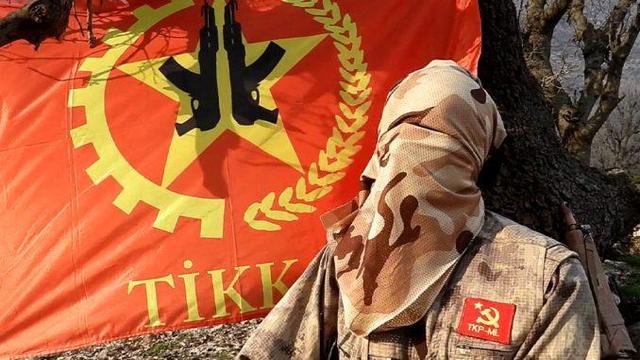
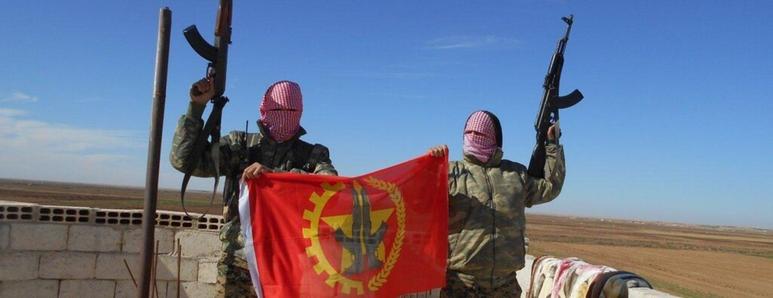
The Kurdish national liberation movement was also affected by this wind of anti-socialism and anti-revolution. It took steps away not only from the revolutionary theory of MLM, which it called “real socialism,” but also from the symbols of MLM. For example, it removed the sickle and hammer from the PKK flag and began to use the Kurdish national colors symbolized by a yellow star. In this way, the PKK put not only a theoretical but also a formal distance between itself and Marxism-Leninism. In line with these steps and in search of a political solution, the PKK made efforts to “find a counterpart.” And from 1993 to the present, it has not taken a step back from this line. The PKK, which evolved from the idea of armed liberation to the idea of a political solution, has carried this line to the present day. In this regard, it has followed a “consistent line” within itself.
The Turkish state, as expected, approached all ceasefires and peace processes with deceit. Developments in the Middle East and around the world played a decisive role in determining the tactical and strategic orientation of the Turkish state’s approach to the Kurdish national question.
b) The 1993 Ceasefire
The Kurdistan Regional Government of Iraq, acting under the guidance and protection of the Turkish state, has repeatedly attacked PKK forces. In these attacks — often described as a fratricidal conflict — the PKK suffered heavy losses. In 1992, the Turkish state, through the Turgut Özal government, persuaded the KDP and YNK, which were dominant in Iraqi Kurdistan, to launch attacks against the PKK. The attacks lasted for about a month and a half, resulting in mutual losses. However, the Turkish state did not get what it wanted from the KDP and YNK. It was rendered ineffective in the face of the guerrillas’ resistance. The PKK tactically withdrew its forces towards Zelé and the Turkey border.
The Turgut Özal government, having failed in this war, put another policy on the agenda. It brought YNK President Jalal Talabani into the picture and asked him to convince Abdullah Öcalan to declare a ceasefire. These talks bore fruit, and finally, on March 19, 1993, A. Öcalan announced the first ceasefire in PKK history to the Turkish and international public at a press conference in Bekaa, attended by YNK leader Jalal Talabani.
Although Turgut Özal stated that “the Kurds would be granted certain rights, but first the guns must fall silent,” he took no action. In response, the PKK once again demonstrated its “goodwill” by announcing at a press conference in Bekaa on April 15, 1993, that it was extending the unilateral ceasefire for another month. The process did not progress, and shortly thereafter, the ceasefire ended on its own.
The claim that T. Özal was killed because he made a ceasefire with the PKK and “reconciled with terrorism” is still debated by the PKK and, to some extent, the Turkish public. T. Özal’s death partially changed the balance of power in Turkey. Tansu Çiller and her team became figures in a process that would lead to much darker years.
The PKK did not only sit at the table with the Turkish state. It also sat at the table with regional powers from time to time, and mutual ceasefires were declared. The Turkish state never accepted the PKK’s position in Iraqi Kurdistan. Iraqi Kurdistan was seen by the Turkish state as a place where actions were planned, where the PKK grew stronger, and where it took root among the Kurds. For this reason, while preparing to launch a new attack through the KDP and YNK by convincing the US and the UK, the PKK thwarted the Turkish state’s attack preparations on August 26, 1995. The PKK, which was at war with the KDP, ended the ongoing war with a ceasefire. The PKK’s efforts, which also declared a ceasefire against the Turkish state, were in vain. On May 6, 1996, the unilateral ceasefire also ended with the assassination attempt on A.Öcalan in Syria by counter forces under the command of Tansu Çiller.
In 1998, Necmettin Erbakan was prime minister. N. Erbakan also made efforts to get the PKK to declare a unilateral ceasefire. He knew that the path to the “stability” of his own government lay in the Kurds giving up the war and being brought into the fold. To this end, “Turkey indirectly conveyed to the PKK the proposal that a mechanism should be created to develop the ceasefire process and that the Kurdish and Turkish public should be prepared for peace.” The PKK declared a unilateral ceasefire on September 1, 1998, adhering to the roadmap conveyed by N. Erbakan’s government. However, the fate of this ceasefire was no different from the others.
c) The Second Fracture in the PKK
The presence of PKK leader A. Öcalan in Syria constantly disturbed and alarmed the Turkish state. Claiming that PKK actions were planned from Syria, the Turkish state threatened to wage war on Syria, taking advantage of the changing balances in the Middle East and the opportunity that arose in its favor. Under pressure from the US and other Western imperialist powers, they demanded that A. Öcalan be expelled from Syria. A. Öcalan was forced to leave Syria on October 9, 1998. Turning his face not to the mountains but to Western Europe for “diplomatic talks,” A. Öcalan was taken to Kenya on the grounds that there were no conditions for him to stay in Italy and Greece, and on February 15, 1999, he was abducted from Kenya and handed over to Turkey. It was alleged that the US intelligence agency CIA and the Israeli intelligence agency MOSSAD played a role in A. Öcalan’s handover to Turkey as a result of a conspiracy.
After A. Öcalan’s extradition to Turkey, the PKK held its 6th Congress, announced the end of its unilateral ceasefire, and declared an all-out war against the Turkish state. Following this congress, the PKK made significant progress in its armed struggle. It dealt major blows to the Turkish state through mass actions and guerrilla attacks both inside and outside the country.
During the period when A. Öcalan was captured, a coalition government consisting of the DSP, ANAP, and MHP was in power in Turkey. The decisive role played by US imperialism in A. Öcalan’s extradition to Turkey can be seen in the words of then Prime Minister Bülent Ecevit: “We do not understand why the US handed Apo over to us.” Later, the US announced to the public that it had handed Öcalan over to the Turkish state on the condition that he would not be executed.
On September 1, 1999, while imprisoned in Imralı Prison, Öcalan declared a fourth ceasefire in the hope of “establishing peace.” Along with his call for a ceasefire, A. Öcalan also called for the guerrillas to leave the country’s borders. The PKK expanded the scope of this slightly, ensuring that a group of 20 guerrillas came to Turkey, laid down their arms, and surrendered. The coalition government announced that it would “not attack as long as this remained the case,” creating public opinion and making plans to strategically finish off the PKK.
These unilateral ceasefires led to the PKK’s decision to disband on April 10, 2002, which we will discuss in detail below, the cancellation of the ceasefire in 2004, the “Kurdish opening” process in 2010, and the situation today.
d) The Call for a “Democratic Society” Is Not New
The views expressed by A. Öcalan in his “Call for Peace and a Democratic Society” written on February 27, 2025, are not views he is expressing for the first time. It can be said that all the views expressed by A. Öcalan in his call on February 27, 2025, are a summary of the views he has systematically defended and synthesized from 1999 to 2025, with some nuances.
Indeed, at its 7th Extraordinary Congress, the PKK also made a call for peace with the Turkish state through an approach it called the “Democratic Peace Project” and continued its search for dialogue with Turkey. The following statements regarding the PKK’s pursuit of peace and its line of reconciliation are sufficient: “Indeed, in accordance with the ‘Democratic Peace Project’ adopted at the PKK’s 7th Extraordinary Congress, it continued its calls for peace and its search for dialogue on various dates and presented projects. These projects include: the Peace Project on January 20, 2000; the Emergency Action Plan for Democracy and Peace on November 4, 2000; a statement of urgent demands on June 19, 2001, to prevent a new war from becoming an agenda item and to advance the resolution process; the Urgent Solution Declaration on November 22, 2002, and letters sent twice, at the beginning of 2000 and the end of 2002, to the President, the Speaker of Parliament, the Prime Minister, the Chief of General Staff, and all political parties, setting out their thoughts on the solution to the Kurdish issue. (Amed Dicle, PKK’s Dialectic of Peace, Democratic Modernity, June 10, 2013, demokratikmodernite.org )
Therefore, this is not the first time the PKK has called for peace and reconciliation. What is different is that the Turkish state, particularly due to developments in the Middle East, responded to Öcalan’s call and initiated a process in line with its own interests.
On the other hand, just as with its efforts for peace and reconciliation, the PKK is not dissolving itself for the first time. It should be noted that the PKK has dissolved itself before and moved on to other organizations.
e) The PKK’s Self-Dissolution Processes
In the early general election held in Turkey on November 3, 2002, the AKP won a significant portion of the votes—including Kurdish votes—due to the public’s reaction to the economic crisis, bans, and corruption of the 57th Ecevit Government, thereby gaining the right to form a government. By winning 34.3% of the votes and securing 363 seats in parliament, it gained the right to form a government on its own. As part of the propaganda known as ‘3Y’ – AKP’s election promise to end bans, corruption, and poverty– the impression was also created that the Kurdish issue would be resolved throug ‘democratic means.’ With this perception, the AKP won at least three general elections by also securing Kurdish votes.
Shortly before the AKP came to power, following A. Öcalan’s call in 2002, the PKK dissolved itself at its 8th Congress on April 4-10, 2002, and replaced it with the Kongreya Azadî û Demokrasiya Kurdistanê-Kurdistan Democratic Freedom Congress (Kurdistan Democratic Freedom Congress) on April 2, 2003. Congress on April 4-10, 2002, and announced that it had dissolved itself and replaced it with the Kongreya Azadî û Demokrasiya Kurdistanê-Kurdistan Democratic Freedom Congress (KADEK) on April 2, 2003. (Cihan Bilgin, “45 years of struggle that changed the course of history,” ANHA, November 27, 2023, hawarnews.com)
KADEK adopted a program that sought to resolve the Kurdish national question through more peaceful means. KADEK defined this peaceful path, which it adopted in 2003, as a “three-stage roadmap.” The first stage of this roadmap was to transform the unilateral ceasefire into a bilateral ceasefire; the second stage was the official recognition of the Kurds; and the third stage was the release of A. Öcalan. This three-stage “peace” plan announced by KADEK was not implemented.
The PKK’s dissolution at its 8th Congress and the establishment of KADEK were justified with the following assessments: “The formation of KADEK represents the creation of a new identity and renaming in the history of the development of the Apocu movement. This was not just a name change; it truly represented a reorganization at the international and regional levels based on the major developments that emerged from the struggle waged in Kurdistan under the name PKK. KADEK became a new organization that differed from the PKK in every respect. Of course, not everything changed; in many ways, the essence of the movement was preserved, developed, and deepened, but in many respects, new approaches emerged that could not be compared to the PKK.
(…)
KADEK abandoned many outdated ideas and developed a new system of thought, thereby bringing about a significant ideological renewal. KADEK represents a new program. The PKK had a program developed for Northern Kurdistan. It viewed Turkey and the other parts of Kurdistan as strategic allies; KADEK, however, envisions a democratic revolution and transformation in the Middle East. It is based on democratic change and freedom-oriented development in the Middle East. In this sense, it envisaged the democratic change and democratic unity of the Middle East as the path to change, development, and a democratic solution to the Kurdish question in Kurdistan. It arrived at a political program to achieve this. It developed strategic change, creating changes in the balance of power, relations, leadership, and alliances. It envisions change in the fundamental form of struggle. While the PKK is an organization formed on the line of armed struggle, KADEK is a struggle formed on the basis of democratic uprising, shaped by democratic political struggle. It changed the fundamental form of struggle in this respect. The organizational structure is also changing. Many organizations are organizing in different areas, according to the conditions of those areas, in order to implement the new strategy.” (PKK 8th Congress, December 2022, Serxwebun, p. 4)
While the PKK put in place the tools appropriate to the “peace” strategy it developed after 1999, one of the tactics it resorted to was to continue the process by establishing various organizations. However, the problem here is not to dissolve the organization and establish a new one, but to look for the problem in the state’s approach to the issue and its unwillingness to “solve” the Kurdish problem.
The Turkish state viewed the PKK’s call for “peace” as a sign of weakness and intensified its attacks. KADEK therefore added the warning “if the Turkish state does not accept this roadmap, war will ensue” to its roadmap. The PKK’s prediction came true, and the Turkish state accelerated its attacks. Finally, “the People’s Defense Forces (HPG) announced on 1 June 2004 that they were ending the unilateral ceasefire and would begin exercising their right to retaliation. This phase led to the conclusion that any meaningful ceasefire had to be reciprocal. As a result, the guerrilla forces adopted a position based on legitimate self-defense and declared their right to respond to attacks. This marked the effective end of the ceasefire that had been in place since 1 September 1999.” (Gülistan Cihan, Ceasefire Processes and Their Outcomes- VIII, Behdinan, April 3, 2025, anf-news.com)
When the PKK failed to make much progress after the establishment of KADEK, it must have seen the problem in the names of the organizations, because this time, as a new “peace” initiative, it brought Koma Komalên Kurdistan (KKK) into the picture: “Recognizing Turkey’s deepening political impasse, the Kurdistan Communities Union (Koma Komalên Kurdistan, KKK) introduced a new peace proposal composed of ten points. the KKK also presented six of these points—those it described as the most reasonable and closest to a resolution— as the basis for its decision to declare a ceasefire.” (Gülistan Cihan, Ceasefire Processes and Their Outcomes-VIII, Behdinan, April 3, 2025, anf-news.com)
The KKK’s main demands included a mutual ceasefire, the removal of obstacles to organization, and the lifting of isolation on A. Öcalan. KADEK announced that it had changed its name to the Kurdistan People’s Congress (KONGRA-GEL) in 2004. Consequently, in 2005, it established the Koma Civakên Kurdistanê (KCK: Kurdistan Communities Union). The PKK describes this process as follows in its Second Extraordinary Congress: “Following a comprehensive preparatory discussion based on President Apo’s instructions and perspectives, the Second Extraordinary KONGRA-GEL General Assembly Meeting was held between May 16 and 26, with the participation of 278 delegates and nearly 200 listeners, in the form of parallel meetings held in Europe and the Media Defense Zone. (…) With the reflection of these problems, which caused serious concern and debate among the people and in our cadre structure, the Leadership intervened in the problem; it called for unity among comrades who were on the side it defined as right-wing surrender and left-wing suicide, and tasked the newly formed PKK Reconstruction Committee with intervening in the process and ensuring recovery. (…) The basic tactic of our new strategy was defined as democratic uprising. Although decisions were made in many meetings and conferences regarding the development of the uprising, its practical implementation remained very weak, and it failed to create organization.
The non-state democracy envisioned by the new paradigm is an expression of the people’s organized and active stance. Democratization is the people’s awareness of their rights, their organization for this purpose, and their action. Despite the role of such actions, no organization has been created. Inadequate and narrow approaches to the uprising have deprived the organization and the people of their fundamental tactics and struggle. Apart from actions limited to certain days and nighttime actions developed by young people, no serious action has been developed; some of the actions that were developed could not be sustained, and a wealth of action could not be achieved. The fundamental reason for this is that, in addition to the people’s national democratic demands, there has been no work on education, organization, and the search for solutions to their social and economic problems, and the struggle has been limited to the masses won over by the war, resulting in actions that are weak in both quantity and quality. Thus, although mass action campaigns have been developed in recent years, creating a certain liveliness and mass mobilization, they have been insufficient in creating a democratic solution.” (II. Extraordinary KONGRA-GEL Congress, June 4, 2004, Serxwebun, pp. 6-7)
From the 2nd Extraordinary Kongra-Gel Congress until it declared a ceasefire on April 13, 2009, the PKK carried out over 100 armed actions, dealing major blows to the Turkish state. While the Turkish state had been propagating that “we have finished them off, only a few activists remain,” the PKK carried out action after action, turning this propaganda on its head. In the national struggle, which enjoyed massive popular support, the wave of guerrilla and popular actions was once again broken by A. Öcalan’s call for a ceasefire.
The breaking point of this ceasefire process was A. Öcalan’s insistence on the ceasefire despite the state taking no action. A. Öcalan ensured that the “three peace groups” came and surrendered with their weapons as a guarantee to the state. The “peace group” coming from Western Europe was blocked by the Turkish state. Lawsuits were filed against the 34-member “peace group” coming from Kandil and Maxmûr, and some were arrested. Some members of the group, seeing that they could not stay in Turkey, returned to Kandil and Maxmûr.
A.Öcalan never abandoned his ceasefire strategy. He was persistent and reiterated this at every opportunity. Although the organization’s stance on these ceasefires and whether the general approach of the people was taken into account were occasionally debated, the decisions made by A. Öcalan were accepted as “the will of the leadership” and implemented.
A.Öcalan must have seen the state’s stalling tactics, because on May 31, 2010, he announced that he was “stepping down.” Claiming that “the AKP was stalling them and not responding to all their initiatives,” he announced that he would no longer take “responsibility.” ” The KCK declared on 1 June 2010 that both their leadership and Öcalan’s efforts toward peace and a democratic solution had been deliberately obstructed by the AKP. As a result, the KCK announced the end of the unilateral non-engagement decision declared on 13 April 2009 and stated that their forces would now adopt a position of active self-defense.” (Gülistan Cihan, Ceasefire Processes and Their Outcomes-VIII, Behdinan, April 3, 2025, anf-news.com)
With the end of the ceasefire, the guerrillas resumed their attacks. Major clashes ensued. The Turkish state, seemingly bewildered, attempted to continue the war. Its assessment of the ceasefire processes based on the thesis of the PKK’s weakness and exhaustion was the weak link of fascism. The PKK viewed the periods when it declared ceasefires as opportunities to regroup and establish a stronger position in various areas. The PKK’s tactical mistake, however, was placing too much trust in the state. It did not attach much importance to the meaninglessness of the warring power repeatedly declaring a unilateral “ceasefire.” As is the case today, it tried to explain this mistake by saying “we are ready for both war and peace,” but it became clear many times that this was not the case.
This misconception was repeated during the eighth ceasefire declared in 2010. While the Turkish state was reeling from the blows dealt by the guerrillas, PKK announced a 40-day ceasefire at the request of some NGOs, BDP, and DTK. It is known that A. Öcalan decided on the ceasefire. The KCK explained this ceasefire as follows: “Öcalan has made clear that his stance remains aligned with the path of peace, and that he would be ready to intervene and play his role if a sincere and serious approach toward a resolution were to emerge. As a result of a renewed environment of dialogue, Öcalan has once again called on all sides to avoid allowing the conflict to reach an irreversible stage. For this purpose, he sent a message to the executive body of our movement.” (Gülistan Cihan, Ceasefire Processes and Their Outcomes -VIII, Behdinan, April 3, 2025, anf-news.com)
Responding to this call, the KCK declared a unilateral ceasefire but did not receive the response it expected.
In 2010, the AKP held a referendum on amending certain articles of the constitution and won with the support of those who said “not enough, but yes.” Then, in 2011, it consolidated its power with its success in the local elections and increased its attacks. The government began negotiations with A. Öcalan to sideline the Kurdish national struggle. The negotiations between the state and A. Öcalan yielded results, and A. Öcalan sent a message on Newroz 2013 calling for another ceasefire, initiating a process that would last until 2015.
During this process, talks between the PKK and the Turkish state continued in Oslo, Norway, without being disclosed to the public. The Turkish state showed that it was not sincere in these talks and was only continuing them to gain time by overturning the “peace table” set up in Dolmabahçe.
At its National Security Council meeting on October 30, 2014, the AKP decided to implement a “total destruction plan.” The revolution in Rojava had a major impact on this decision. The AKP government, which planned to crush the Rojava revolution in collaboration with ISIS, thus ended the “peace and ceasefire” process and launched its attack. “After the 2015 Newroz celebrations, President Erdoğan made his intentions clear, declaring: ‘There is no Dolmabahçe Agreement, no Imralı meetings—nothing at all,’ effectively signaling the return to war. Leading up to the 7 June general elections, attacks were launched against the Peoples’ Democratic Party (HDP) rallies, buildings, and supporters in Çukurova, Diyarbakır (Amed), and the Black Sea region. On 20 July, the Suruç Massacre took place. These acts of violence were directly attributed to the AKP government. The gains made by the Kurdish movement in the June elections in Northern (Bakur) Kurdistan and the defeat of ISIS in Rojava prompted the Turkish state to act. On 24 July 2015, the AKP government officially ended the dialogue process and launched a full-scale war.
Later, on 10 October 2015, the PKK declared a unilateral ceasefire in an effort to ensure that the snap elections of 1 November could take place in a peaceful and secure atmosphere. However, the Turkish state responded to this ceasefire with further attacks.” (Gülistan Cihan, Ceasefire Processes and Their Outcomes-VIII, Behdinan, 3 April 2025, anf-news.com)
None of the “peace” initiatives put forward by the PKK since 1993 have been successful. As the Kurdish national movement’s guerrilla struggle, mass movements, uprisings, and civil disobedience actions developed, the ceasefire processes always served as a wave breaker.
The Turkish state has used all ceasefire periods as a means to cover its own shortcomings and inadequacies. The AKP government, which has resorted to various maneuvers to win over the Kurds in every period, has made attacking the Kurds its first move after winning elections. It has also removed elected mayors from office, carried out operations in the democratic sphere, and detained and arrested thousands of people.
f) The Next Step in the Fracture: The Imralı Trial
The world watched with great interest as the trial of A. Öcalan began on May 31, 1999, in Imralı, which was promoted as “the trial of the century.” It is true that this trial was one of the biggest political trials of the last century. The Imralı trial had even greater significance for the Kurdish nation. This is because it would reveal clues as to how the “29th Kurdish Uprising” would unfold alongside this trial.
A.Öcalan’s attitude and statements during the trial would coincide with his later defense, his statements to the public at various times, and even his call on February 27, 2025. In this respect, A. Öcalan has followed a consistent line from his own side, pushing for “negotiation” and ‘peace’ conditions with the Turkish state. In his defense, A. Öcalan argued that the Turkish state would become the leading country in the region by “solving” the Kurdish issue. To this end, he proposed that internal peace be established in Turkey. The following statements appear in A. Öcalan’s defense in the Imrali Trial: “When this most difficult problem in the history of the Republic is solved, it is certain that Turkey will gain the power to act as a leading country in the region with the strength it gains from its internal peace. The era of leadership in the Middle East will mean being influential from Central Asia to the Balkans and the Caucasus. The power of the democratic system to find solutions will also lead to the provision and demand for justified intervention and support in these regions, which are rife with many contradictions and problems, primarily peace. This will also lead to enrichment through the transfer of economic and cultural development. Turkey is entering the 2000s with this perspective. The Kurdish issue was a hindrance.“ (Abdullah Öcalan, quoted from his 1999 Defense by Sibel Özbudun-Temel Demirer, ”Questions of the (Un)New Paradigm”)
The Imralı trials were significant not only for Kurds and the revolutionary public, but also for the fascist Turkish state. Above all, the Turkish state had seized a moment it had been waiting for years and had captured what it considered to be the “leader of the rebellion.” Just as in the Kurdish uprisings led by Sheikh Sait and Seyit Rıza, the aim was to put an end to a Kurdish uprising in the person of A. Öcalan.
The Turkish state did not want to stop there. As a country that had been in the news for years with its torture, massacres, and disappearances, it planned to clean up its image with the Imrali trial. With the impression that the trial would be quite “democratic,” the TRC sought to deceive the world public with propaganda that “all of A. Öcalan’s requests were met, he underwent daily medical examinations,” and even that “attention was paid to his meals.” However, it never succeeded in doing so.
With the Imrali trial, the Turkish state essentially wanted to convey to the masses the message that it was “powerful,” that “it was impossible to deal with it,” and that “it could not be destroyed.” To this end, it staged a show of force at Imrali.
A.Öcalan Chooses the Path of “Reconciliation”
During the trials, A. Öcalan did not adopt the political stance expected by the Kurdish patriotic public and revolutionary and democratic circles. Instead, he took a conciliatory stance toward the Turkish state in the Imralı trial, reiterating the views he had expressed in the 1990s. He dismissed criticism of his conciliatory stance toward the Turkish state as “crude resistance.” In the text “Defending a People,” which was compiled from the defense statement he submitted to the Imrali court, he defined his stance with the following words: “As much as crude resistance, cowardly submission was itself a stance I resisted.” (A. Öcalan, Defending a People, Çetin Publications, 2004, p. 7) With these words, A. Öcalan condemns the attitude of resistance against fascism, which he defines as “crude resistance,” argues that the rationale for this stance is that such an approach (crude resistance) would result in death, which would not contribute to “Turkish-Kurdish relations”: “At this very point, it was expected that my surrender and subsequent death based on crude resistance would lead to a total collapse in Turkish-Kurdish relations. All the strings of the Kurdish movement would have been gathered in one hand.” (A. Öcalan, ibid, p. 495)
The problem was no longer just Abdullah Öcalan’s stance; it had become the PKK problem in general. From the outset, the PKK supported and elaborated on what A. Öcalan said. If A. Öcalan’s stance had not been supported, it would have been correct to evaluate the development and the stance presented as solely A. Öcalan’s stance. However, the issue had gone beyond this framework and had become the PKK’s stance.
Indeed, in its statement on June 11, 1999, the PKK Presidential Council said: “Comrade A. Öcalan, the General President, presented a comprehensive Democratic Republic project for Turkey at the Imrali court, showing the right path for the liberation of the Kurdish society and the solution to the Kurdish issue on this basis. The Democratic Republic and the resolution of the Kurdish issue on the basis of peace and brotherhood is the only way that will meet the developments Turkey is experiencing, create social peace and brotherhood among peoples, and enable Turkey and the Kurds to enter the 21st century in a strong union. This solution is in the interest of both the Turkish and Kurdish peoples, as well as everyone in the region and the world, except those who profit from the war…” (Özgür Politika, June 11, 1999)
A.Öcalan’s “Apology” Was a Mistake
The first position that shocked the revolutionary public was A. Öcalan’s apology to the “families of the martyrs.” This was also the most important step towards political reconciliation. While it was the state that should have apologized, A. Öcalan’s apology to the families of soldiers implied that the PKK’s actions were “wrong.” Many groups and the PKK said that “this stance was a political tactic,” but it became clear in the subsequent ceasefire periods that this was not the case.
The Turkish state, which has done everything for 100 years, oppressing and killing Kurds even for the smallest demand for rights, sending them into exile, and seeking to annihilate the Kurdish nation with unprecedented brutality over the last 50 years, killing thousands of Kurds in the mountains, in the streets, and in their homes, and compiling death lists from businesspeople to intellectuals, should be held accountable for its actions, and the Turkish Republic should apologize to the Kurdish nation. However, A. Öcalan’s apology to the “families of the martyrs” gave the Turkish Republic a sigh of relief. This stance paved the way for the incitement of Turkish nationalism in fascist and reactionary circles and for the expansion of the sphere of action of fascist MHP members.
Another stance that gave the Turkish state a break during the Imrali trials was A. Öcalan’s statement that he had not been tortured. However, the fact that A. Öcalan, who was brought to Turkey through a conspiracy, had his eyes blindfolded, was knocked unconscious with a needle, and was isolated were all methods of torture.
A.Öcalan Sought the “Solution” from Imperialists
It has long been known that the PKK wanted Western powers, especially US imperialism, to intervene in the Kurdish issue. In the period before A. Öcalan’s extradition to Turkey, in letters he wrote to various heads of state before and after the 1993 ceasefire, he expressed his view that these countries should exert pressure on Turkey to find a “solution.” Indeed, he once again made these views public, stating in court that imperialists should play a role in the “solution.” His failure to mention the US or Western imperialism while discussing the conspiracy against him at his first hearing on Imrali carried a political message. However, it was now common knowledge that the US was behind the plot. Despite this, A. Öcalan sought a “solution” from Western imperialists, primarily the US, for the “reconciliation” proposal to be implemented.
A.Öcalan’s stance was approved by the PKK Presidential Council and became the official position of the PKK. In its statement, the PKK Presidential Council called on imperialist powers, stating, “We call on all powers that can influence Turkey, especially the US, to use their influence in this critical process,” urging imperialists to play their “role.” (Özgür Politika, June 11, 1999)
A.Öcalan Sanctified Kemalism
During the trials, A. Öcalan did not take a confrontational stance toward Kemalism, the founding ideology of fascism, as a result of his efforts to reconcile with the Turkish state. In fact, in his defenses, he used the phrase “I believe in Atatürk’s nationalism,” thereby undermining the PKK’s long-standing argument that the Turkish revolutionary movement was influenced by Kemalism and that opposition to Kemalism was important and decisive.
In A. Öcalan’s speeches on TV and even in his Imrali defenses, the views he formulated essentially affirmed the “National Struggle” period, the “Misak-ı Milli” (National Pact), and the Kemalist process, carefully avoiding any negative criticism.
A.Öcalan’s acceptance of “Atatürk nationalism” in the Imrali trial was the ultimate expression of political compromise.
A.Öcalan Rejected the Nation-State
A.Öcalan stated in the Imrali hearings that he had “given up on establishing a nation-state” and that Turkey would instead gain much from “freedom of language and freedom of culture.” In his work titled “Defending a People,” he advanced the line of democratic confederalism, which he defined as “a political paradigm based on a stateless society.” In this book, he formulated this line with the following statements: “Therefore, a realistic ‘democratic and peaceful method’ of resolution that is not state-centered, but also never accepts blind chaos as a long-term way of life, is vital…. I believe it is correct to evaluate the Imrali trial process as a search for and call for democratic peace, even under very unfavorable conditions. This phase had a qualitative transformative value. It was a process in which the need to abandon hierarchical and statist societal pursuits in principle became concentrated in both consciousness and effort.“
At the stage reached, it is understood that in the views he declared to the public on February 27, 2025, he also abandoned the ”freedom of language, freedom of culture” he defended in court. As can be seen in his February 27 statement, “culturalist solutions cannot respond to historical social sociology,” another concession has been made in line with ‘reconciliation’ and “peace” with the Turkish Republic.
IX. The “New Process” in the Kurdish National Question
When we refer to the “new process,” the framework we are trying to highlight is the period that began with the initiative of the fascist MHP leader Devlet Bahçeli, continued with A. Öcalan’s call on February 27, and included the PKK’s dissolution and the end of armed struggle.
Undoubtedly, we cannot address this period in isolation from previous processes or from a theoretical perspective—historical experience—that genuinely encompasses the resolution of national issues. On the contrary, we will attempt to address all current developments through a scientific method in light of a historical perspective.
When we refer to the Kurdish issue in the current context, we are talking about a comprehensive problem that encompasses the Middle East as a whole and finds its place in the policies of imperialists regarding the Middle East. The creators of this comprehensive problem are the imperialists and certain reactionary-fascist states in the region. These fascist states, which divide the geography of Kurdistan into four parts and continue their policies of annihilation and denial against the Kurdish nation, not only fail to respect the Kurdish nation’s “Right to Free Separation,” but also view and propagate the Kurds’ most ‘ordinary’ democratic demands and the struggle waged for this cause as “divisive -destructive” activity and propagate it as such. Their immediate resort to the weapon of monism against any demand of the Kurdish nation arising from its status as a nation (independence, administrative autonomy, cultural autonomy, decentralization, mother tongue, etc.) is a product of this racist-chauvinist mindset.
At this stage, the fascist Turkish state is engaged in fascist aggression not only within the borders of Turkish Kurdistan, but throughout the entire Kurdistan geography in the Middle East, against any gains made by the Kurdish nation or any status it may achieve to any degree. The threats directed at the Autonomous Regional Administration of North-East Syria, primarily in the form of military intervention, are a concrete expression of this reality. Therefore, when we talk about the Kurdish national question, it is correct to refer to a problem that extends not only to Turkish Kurdistan but to the entire Middle East and Kurdistan geography.
However, in evaluating the so-called “new process” in the Kurdish national question here, we will focus more on the policies of the Turkish state. In doing so, we will focus on certain aspects of the Kurdish national movement’s views formulated under the name of “solution” and the perspectives put forward by MLM forces.
First of all, it should be emphasized that the “new process,” which began with the call of PKK leader A. Öcalan, is not independent of A. Öcalan’s previous statements. A. Öcalan expressed his line of “democratic reconciliation” on February 27, 2025, at a very early date, during the Imralı trials, proposing “democratic integration with the state” and mentioning that “the PKK’s means of warfare will be at the service of Turkey”: “The PKK ceasing to be a military problem will pave the way for a political solution to the Kurdish problem and will also mean that it ceases to be a political problem. The process of forcing the unity of the state will give way to a process of empowering it. As the path to democratic integration with the state opens up, the position of opposition to the state will be overcome.”
(….)
“Turkey will have the opportunity not only to protect itself from great dangers, but also to transform them into a source of strength. Both internally and externally, the PKK’s military capabilities will be at Turkey’s service with the solution…”(Abdullah Öcalan, Defense on the Merits, Interview with Garbis Altınoğlu, Yakın Doğu Yazıları, yakindoguyazilari.com)
A.Öcalan’s proposal for a “Turkish-Kurdish alliance,” as stated in his call dated February 27, 2025, is not a new proposal. Indeed, in his article titled “Democratic Alliance for a Free Union,” published after the Imrali trial, A. Öcalan clearly explains how he understands “Turkish-Kurdish unity”: “Kurds and Turks have made history together in this country. They are co-owners of all the empires that have been established. The current state was also built together. Looking at history, one thing must be seen: Kurds have sought freedom together with Turks. Why is this so? Let’s look at the settlement in the geography: Turks are closest to Kurds. However, there is no such relationship with Arabs, Armenians, and other neighboring peoples. Kurds and Turks have lived together. There are striking examples of this. This was the case at Malazgirt. Alparslan’s army included 10,000 Kurdish warriors. The same is true of the founding of the Republic; M. Kemal received the support of the Kurds during this process.
Again, in his call on February 27, 2025, A. Öcalan expresses his demand for a “democratic society” as a ‘solution’ at a very early date and proposes a “democratic solution” to the Turkish state: “I call my own model the ‘Great Democratic Solution’. I call it a model of rising above the US and the EU. I would like to make the following call to Turkish intellectuals: Just as Alparslan regulated relations with the Kurds in Silvan in 1071, just as Yavuz regulated relations with the Kurds in 1516 (albeit on a dominant basis), just as Mustafa Kemal regulated relations with the Kurds in the 1920s, Turkish intellectuals today should think about relations with the Kurds in the same way. I also call upon the Prime Minister… If you are devoted to your God and your prophet, I say approach your Kurdish brothers correctly. I also call upon the General Staff. During the investigation, one of their representatives said, ‘Let’s not leave the solution of the problem to the US and Europe, let’s resolve it among ourselves’. That is correct. I also say let’s resolve it among ourselves. I call on the General Staff to do the same.” (ibid)
In summary, it should be stated that in this new “process” brought to the agenda by A. Öcalan’s call, there is continuity, except for some nuances that include certain steps backward in line with A. Öcalan’s approach. What is expressed in the “process” brought to the agenda by A. Öcalan’s call is, in fact, at least consistent with his past process.
A-) February 27 Call
We would like to quote some sections from A. Öcalan’s call: “Right now, the APO reality has left its mark on history both as a period and as a moment, and it continues to do so. And we have come to the impasse in the PKK and to finding a solution to it; that is, this issue of dissolution. This is still the situation I live in every moment… Yes, there is a repetition of a moment here, with little creative value; a leap is needed. A threshold must be crossed. Strangely, it is not on our side, but a Turk who is relentless against me and who does everything for my execution at any moment, Devlet Bahçeli, the most authoritative voice and hand of the Turkish sensibility of the period, even the proto-party state, has opened this new era. So Bahçeli, as the relentless war leader against us, is saying this directly to the DEM delegation. ‘I have devoted my entire life to this, but now I want to start a new era.’ In my opinion, this is a clear call for a peaceful and democratic solution. It is a call for peace that is both consistent and contains a democratic solution. Developments show this to some extent. And the only conclusion we can draw from this is that only those who fight can make peace. In other words, not secondary or third powers, not mediating powers or allies, but only those who bear the responsibility for the war can take on the responsibility for peace… Therefore, realistically, it is the state that is waging this war. I feel the need for the state to transform this war into a new beginning, as an attempt at peace. This has been voiced over the last six months…“ (A. Öcalan, ”Perspective,” Serxwebûn Newspaper, issue 521)
“…What is this war and separatist conflict process of peace and democratic integration, especially with the Republic of Turkey? Similar processes will also come into play for other states, namely Iraq, Iran, and Syria. In my opinion, Turkey taking the initiative is both a requirement of reason and an expression of reality.” (ibid.)
First and foremost, the bloody hand extended by Devlet Bahçeli, leader of the fascist MHP and partner in power in the Turkish state, to DEM deputies in parliament is not a hand extended to build “peace” among “warring parties.” At this stage, it has become clearer that this bloody hand is the hand of the state, unleashed with its dark plans for a “Turkey without terrorism.”
Because the just and legitimate struggle of the Kurdish nation is still seen as a “terrorist” activity. Those who truly want peace must first abandon this language of denial and show respect for the existence of the Kurdish nation and its national democratic rights. Likewise, the “peace” demand of a racist- chauvinist mindset that does not respect the Right of Nations to Self- Determination is devoid of any sincerity and is a new trap set up for the sake of the security of the ruling classes’ power.
Again, it is understood from A. Öcalan’s statements that the hand extended in Parliament is the result of negotiations that the parties have been conducting among themselves for a long time. It is also seen that there is a consensus between the parties in these negotiations. Another thing that is apparent is the reality that this project, the contents of which are not yet fully known to the public, is being implemented step by step. With the PKK’s decision to disband, a group of guerrillas burning their weapons, the acceleration of talks with Imrali, and the establishment of a commission in Parliament, this process is intended to be concluded with the involvement of other sections of the bourgeois opposition.
What Kind of Peace?
Firstly, following a 50-year struggle in which the Kurdish national movement paid a heavy price, a “process” is being carried out without any demands being made. The goals and scope of what A. Öcalan called for in his February 27, 2025, call to “dissolve the PKK” and in his July 9, 2025, video message to “lay down arms” are one and the same. The first question that must be asked here is: In the struggle that has been ongoing since 1984, where are the grounds, aims, and objectives that forced the Kurdish national movement into conflict, and what has changed?
In response, the February 27 call states: “The resolution of identity denial in the country and the progress made in freedom of expression have led to the PKK’s loss of meaning and excessive repetition. Therefore, it has completed its life like its counterparts and necessitated its dissolution.” (A. Öcalan, “Call for Peace and a Democratic Society,” February 27, 2025) In other words, A. Öcalan considers the “resolution of identity denial” and “progress made in freedom of expression in the country” sufficient grounds for the dissolution of the PKK. Of course, it is clear that this sufficiency does not mean the resolution of the Kurdish national question. Moreover, the level of progress in the aforementioned issues is also evident!
The second question is “peace with whom and how?” Where there is peace, there is struggle and war between two sides, two opposing forces, two fronts, two poles. At this stage, based on certain facts that have emerged, either one side must submit to the other, or there must be “peace” based on an agreement, but neither of these is found in A. Öcalan’s calls.
D. Bahçeli, leader of the party organized by Western imperialism, primarily US imperialism, in Turkey, positioned against the “threat of communism” and managed by the MIT/counter-guerrilla, said in his speech on February 9, 2025: “After imperialism’s horrific Gaza project, which is the bloody and dark command center of global colonialism, where it will stop, which countries it will spread to, and to what extent and in what ways Turkey will be targeted in this barbaric architecture is a very troubling and problematic myster (….) Even if these are the birth pangs of a Turkey free of terrorism, given the magnitude of the threat we face, everyone, every segment of society, every political faction must unite behind the ideal of a great and powerful Turkey. It is not an unlikely possibility that the global immorality that first bombed Gaza and then occupied it will attempt to stage the same game in Turkey tomorrow.” (Duygu Yener, Betül Bilsel, “MHP Chairman Bahçeli’s statement on the 56th anniversary of his party’s founding,” Anadolu Agency, February 9, 2025, https://www.aa.com.tr)
The leader of the fascist MHP is clearly attempting to “preempt” the reality that imperialists’ new orientations in the Middle East could also affect the Turkish state. This approach is based on the Turkish state’s “survival issue” in the face of possible dangers, rather than the recognition of the rights of the “brotherly Kurdish nation.” The reason for this is, of course, that the fascist MHP, as a party directly serving Western imperialism, primarily the US, is playing its role as one of the parties that best understands the “reality of imperialism.”
Abdullah Öcalan’s calls on February 27 and July 9 clearly did not come about by chance, but rather as a result of long-standing negotiations with the state and after the parties reached a mutual agreement. Ultimately, the decisive factor is whose line who has come to or approached! And again, the important question is whether, after all this experience, the Turkish state will take a step “without any bargaining”!
What was the starting point of the Kurdish national question? It was the Kurdish nation’s uprising, its struggle to achieve national liberation and national independence, in response to the dominant nation’s refusal to recognize the Kurds as a nation, its denial of their national existence, its refusal to recognize the nation’s rights and freedoms, its ruthless national oppression, persecution, genocide, and systematic assimilation policies.
Even regarding the massacres of Kurds from the past to the present, the Turkish state has not apologized to the Kurdish nation, even with statements such as “it was a mistake,” “it was wrong,” “it should not have happened,” “we must learn from it,” etc.
It still refuses to disclose the burial sites of those killed in mass massacres and the leaders of the national movement. It has not relinquished its racist rhetoric, such as “one language, one nation, one state, one homeland, one flag,” in the slightest. It has not retreated one iota from racist rhetoric such as “Everyone living in Turkey is Turkish,” “Turkey belongs to the Turks,” “One Turk is worth the whole world,” “How happy is the one who says I am Turkish,” and “Wherever there is a Turk, that is where the border is drawn.”
Following A. Öcalan’s “call,” on March 1, 2025, at the Dolmabahçe Office, during his speech at the “Iftar program with military families and veterans,” R.T. Erdoğan said: “If the hand we extend is left hanging in the air or bitten, we always keep our iron fist ready,” and “If the promises made are not kept, if there is constant procrastination, deception, and attempts to change names and read what one knows, like Middle Eastern cunning, then the sin is not ours. We will continue our ongoing operations, if necessary, without leaving a stone unturned or a head on a shoulder, until the last terrorist is eliminated.“ (”Öcalan’s call to the PKK | President Erdoğan: If promises are not kept, the sin is not ours,” March 1, 2025, https://www.ntv.com.tr)
Immediately following R.T. Erdoğan’s threats, Turkish warplanes bombed Kandil multiple times. Attacks involving chemical weapons against guerrilla areas have continued. Nearly 30 people have lost their lives in recent attacks. It is clear that there is not even the slightest sign of a solution to the problem, nor is there any data on what concessions have been agreed upon. What has happened is a unilateral abandonment of all arguments regarding the national problem to date, the elimination of the PKK, and the laying down of arms.
We may see it as right or wrong, but an organization may abandon armed struggle for one reason or another. Instead, it may defend democratic forms of struggle within legal boundaries. This change in strategy is understandable. However, accompanying the “Turkey without terrorism” understanding with the task of “integration with the state and society” and declaring that armed struggle against the “state” is wrong points to an important and historic break.
Since its founding, the Turkish Republic has been tied to imperialism and, under the rule of the big capitalist class, has been an anti-democratic, fascist dictatorship from top to bottom, imposing national oppression on the Kurdish nation. As long as this state is not destroyed, this fundamental nature will not change. Throughout this process, partial rights and freedoms can only be gained as a result of the struggle of the social popular opposition of the working class and laborers of various nationalities and beliefs from the Turkish and Kurdish nations. In a situation where even these rights cannot be protected by organized power, it is unrealistic to expect democracy from the Turkish Republic on its own.
A.Öcalan’s “Call” does not even mention the Kurdish nation and its fundamental rights. Nowhere in the “Call” is there any mention of the recognition of the national rights of the Kurdish nation, i.e., the right of nations to freely determine their own future, nor is there any emphasis on the fact that the Kurds are a nation and should be recognized as such.
“Kurdish-Turkish Relations”
With the beginning of the Kurdish national awakening, the Turkish Republic began to increasingly assert that “there is no such thing as a Kurdish nation.” “The Turks who live in the mountains are called Kurds because they make sounds like ‘kart-kurt’ when walking in the snow in winter. But we are all Turks!” etc.
The Turkish ruling classes promoted the “thousand-year brotherhood” narrative for this purpose. The aim was to deny the existence of the Kurdish nation as a nation. It was about protecting the privileges of the oppressor nation, primarily “statehood,” and denying and rejecting the collective rights of the oppressed nation, including its very existence as a nation.
In his February 27 call, A. Öcalan states, “Kurdish-Turkish relations; throughout a history spanning more than 1000 years… in order to survive and stand up to hegemonic powers, they have always seen it as necessary to remain in an alliance, with voluntarism being the dominant factor.” (ibid)
First, the reference to “a history spanning over 1000 years” fails to recognize the differences between various social structures and processes, lumping them all together. Second, the relationships between nations after the process of nation-building are confused with the relationships between oppressor and oppressed classes and peoples in the pre-capitalist era, when nations had not yet emerged. Third, framing the issue in terms of nations and communities rather than class phenomena and concepts leads to confusion. An approach that stems from viewing issues as “beyond classes” or “above classes” fails to properly address class-based approaches and solutions. Fourth, the process referred to as “Kurdish-Turkish relations” refers to the relationship between the two nations over the past century. However, what is overlooked here is that in this relationship, one is the dominant and oppressing nation, while the other is the oppressed nation. Therefore, they are not in the same situation. The ruling classes of the oppressor nation systematically apply national oppression, massacres, genocide, and systematic assimilation to all segments of the oppressed nation; the national rights of the oppressed nation have been usurped, and it is subjected to ruthless oppression under systematic and multifaceted national pressure.
Under the current conditions, rights and freedoms have never been equal. There is no voluntary alliance; there is subjugation through deprivation of rights by force and oppression. Furthermore, although the Kurdish nation as a whole suffers national oppression, the heaviest burden of this oppression is borne by the working class and laboring people of the Kurdish nation. Class oppression is added to national oppression. Fifth, in his February 27 call, A. Öcalan states, “Kurdish-Turkish relations: Throughout their history spanning over 1000 years, Turks and Kurds have found it necessary to remain in an alliance, with voluntarism prevailing, in order to survive and stand up to hegemonic powers.” (ibid)
This is not an accurate assessment. Here, A. Öcalan refers to what he calls “hegemonic powers,” such as the Ottoman-Eastern Roman, Ottoman-Safavid, Ottoman-Russian relations, etc., and historically, the Ottoman Empire’s expansionist, occupying, plundering, and annexation wars towards Balkan and European countries and North Africa, as well as its wars entered into for the same purpose, and the Ottoman Empire’s historical expansionist, occupying, plundering, and annexation wars towards Balkan and European countries and North Africa, as well as its wars entered into for the same purpose. -Russian relations, etc., and historically, the Ottoman Empire’s expansionist, occupying, plundering, and annexation wars towards Balkan and European countries and North Africa, as well as the First Imperialist War of Partition, which it entered into for the same purpose and in which it was defeated. These wars were generally not defensive but expansionist and aggressive. They were unjust wars. Therefore, these alliance relations were not for the Turkish and Kurdish peoples to “survive,” but rather for the military-feudal-imperial interests of the sultans and caliphs, for plunder, looting, and spoils, forcing people to the battlefronts, and making the lives of the poor unbearable with extremely heavy and varied taxes. For this reason, it is not possible to speak of an alliance in which “voluntarism prevails.”
Moreover, as we stated above, nation-building came about with the development of capitalism. To speak of Kurdish and Turkish nations “over a history spanning more than 1000 years” is incorrect in terms of the emergence of the concept of nation. British, and later French, capitalism developed relations with the Ottoman Empire in the late 1700s and especially in the mid-1800s, entering its markets. By the late 1800s, German imperialism had become a dominant power, making the Ottoman Empire dependent on it. The Ottoman Empire entered World War I on the side of German imperialism and was defeated and destroyed. Faced with the danger of the Ottoman Empire’s disintegration and becoming a full colony, representatives of the Turkish ruling class, led by the remaining cadres of the Committee of Union and Progress, seized power by agreeing with the imperialists under semi-colonial conditions and established a Kemalist, racist, chauvinist, fascist dictatorship.
Therefore, Turks and Kurds did not “voluntarily choose to remain in an alliance in order to survive and stand up to hegemonic powers,” but rather the Turkish Republic established a national state based on the oppressive Turkish nation, turned the Kurdish nation into an oppressed and dependent nation, and maintained its bloody dictatorship by suppressing them with force, coercion, and bloodshed, and by spreading reactionary, fascist terror. The imperialists of the period, referred to as “hegemonic,” had no problem with the Ottoman and Turkish Republic states in this sense, so why would external powers make it their “main task” to break up this alliance? This approach is unrealistic and fails to grasp the nature of imperialism. It can even be said, and indeed must be said, that the imperialist powers of the time did not experience any “problem” in this regard with the regional reactionary forces, primarily the Turkish state. In other words, because they were in complete agreement with these reactionary forces and their interests were guaranteed, they accepted the division of Kurdistan into four parts, as they did at Lausanne.
In his February 27 call, A. Öcalan states, “The last 200 years of capitalist modernity have made it their primary goal to break up this alliance. The affected powers have made it their primary mission to serve this goal, along with their class foundations.” (ibid)
Let us focus on the first meaning of this understanding: With this approach, A. Öcalan is essentially saying that, in general, “there was no oppression, persecution, genocide, or assimilation of nations, national minorities, and the people.” He says this because, according to A. Öcalan, Kurds and Turks have the understanding that “the aspect of voluntarism prevailed, and they always saw it as necessary to remain in an alliance,” as he stated above. Although this approach may be perceived as “there was no problem between Kurds and Turks,” the statement is contradictory in itself. “Alliances” can be tactical or strategic; they can be short, medium, or long-term; they occur between forces, classes, segments, organizations, parties, or states that are different from each other, that recognize each other’s existence and independent will, and that come together around certain demands, certain aims, and certain goals. Alliances are conscious, voluntary, independent unions with their own will, which end when the demands or goals agreed upon by both sides are achieved or succeed. Furthermore, if “the aspect of voluntarism prevailed, and they always saw it as necessary to remain in an alliance,” how should we evaluate the fact that dozens of Kurdish national uprisings have taken place?
A.Öcalan continues his sentence by saying, “they have seen it as necessary to remain in the alliance.” This statement suggests that either their will was broken and they were subjected to pressure, or they “saw it as necessary” to submit due to class interests. Perhaps A. Öcalan uses both terms together because he is caught between ‘voluntariness’ and “necessity.”
“External Forces”
A.Öcalan’s call on February 27 does not emphasize the nation. In order to avoid evoking the nation and the national question, he uses the concept of “Turks and Kurds,” which is a class-neutral/class-transcending expression that places all classes on the same level. The reason for this is the rejection of the reality of the nation in A. Öcalan’s “new paradigm.” If we refer to A. Öcalan’s use of the term, which obscures class differences and national contradictions, there is a “voluntary” ‘alliance’ between “Turks and Kurds,” but “capitalist modernity … has made it its primary goal to break this alliance over the last 200 years,“ meaning that there is ‘incitement’ by ”external forces,” which is a state discourse, and they have been tricked!
The first meaning of this discourse is that there was no problem between “Turks and Kurds”; the problem was created and incited by “external forces.” With this discourse, A. Öcalan denies the existence of the Kurdish nation and, moreover, denies the national oppression policy of the Turkish ruling classes. The problem is not the ruling classes of the oppressor nation imposing national oppression, cruelty, genocide, assimilation, and fascist terror to subjugate and destroy, but is formulated as “capitalist modernity,” defined as “external forces.”
Of course, capitalism and imperialism, referred to as “external forces,” are also accomplices because they are backed by the Turkish ruling classes. With the emergence of imperialism, bourgeois democracy has been cast aside and replaced by political reaction both internally and externally. Imperialism will not, of course, bring democracy and democratic rights and freedoms to the countries it enters. It will bring economic and political dependence, exploitation, plunder, and a kind of enslavement. This is the external influence. On the other hand, it is the Turkish ruling classes, who hold political power, that actually impose national oppression on the Kurdish nation. It is the racist, chauvinist, fascist state policy of the state. It is a grave situation that this is forgotten and distorted.
“With a loose interpretation, Öcalan is essentially saying: ‘We have no problem with the Republic of Turkey; the issue stems from those who promote and rely on a monolithic, one-dimensional interpretation of the Republic.’” This breeds antipathy and becomes provocative. It breeds distrust. It ‘undermines Kurdish- Turkish relations’ and ‘historical relations,’ and ‘those whose main goal is to break this alliance’ take advantage of this.” To state the truth fully, A. Öcalan proposes that the oppressed, dependent Kurdish nation in Turkey should submit to the domination of the oppressor nation and the control of the oppressor nation’s state and integrate with it as its “main task”! On the other hand, the phrase “their beliefs too” stands out in A. Öcalan’s call. This expression can be thought of as having the purpose of creating infrastructure and awareness, even if it is not explicitly stated at this stage. When he says “without disregarding their beliefs,” he is referring to segments with different “beliefs,” and this is not a random/casual statement.
In his February 27 call, A. Öcalan states, “…the PKK’s ability to find power and a base stems from the closure of democratic political channels.” (ibid.) Thus, A. Öcalan is making a commitment that “if the ‘democratic political channels’ are opened by the Turkish state, we will henceforth act within those boundaries with all our strength.” In other words, he says that “the PKK … gained power and a base” because it had no legal means of expressing itself. Of course, this has had consequences. However, this is not the essence of the problem. The phenomenon or ground that gave rise to the PKK is the unresolved Kurdish national question. The failure to recognize the Kurds as a nation, the usurpation of the Kurdish nation’s Right to Free Separation, i.e., the right to secede and establish a separate state, and the refusal to recognize these rights and freedoms as a requirement of “democracy.” It is the systematic subjection of the oppressed nation to national oppression, violence, massacres, genocide, and assimilation by the dominant nation. The ruthless national oppression of the dominant nation as a whole has drawn the workers of the oppressed nation into the Kurdish national liberation struggle.
“The Right To Secede Freely”
In his February 27 call, A. Öcalan does not argue that the Kurds are a nation, that this reality is denied, that their rights are not recognized, that imperialists as well as the Turkish state are responsible for this, and that a national liberation struggle has emerged in response. He does not argue that the Kurds are a nation, that national oppression must end, or that the Kurdish nation has the right to secede and establish a separate state. This is precisely where the problem lies.
Moreover, it states that the PKK was influenced by the conditions of the time, that it emerged as a reaction to the Turkish state’s “uniform interpretation of the Republic,” that it entered into an “excessive nationalist drift,” and that as a result, it waged a national liberation struggle. In fact, by calling it an “excessive nationalist drift,” it condemns the Kurdish national liberation struggle it led. To justify this rejection, it states that “separate nation-states, federations, administrative autonomy, and cultural solutions, which are the inevitable result of excessive nationalist drift, do not respond to historical social sociology.” (ibid)
In other words, he explicitly defines the will and practice of exercising the Right of Secession (“RFS”) as an “excessive nationalist drift.” Condemning the demand and practice of the RFS by oppressed or colonized nations as an “excessive nationalist drift,” failing to defend this right unconditionally, and abandoning it means viewing the national question from the perspective of the dominant nation’s nationalist, racist, and chauvinist front of the dominant nations and imperialist powers. However, this serves to make oppressed nations accept their situation by pressuring them with the accusation of “excessive nationalism,” oppressing them politically and psychologically with the arrogance and cunning of the dominant nation, and is unacceptable.
Communists generally do not act from a nationalist (chauvinist) perspective. They act from the perspective of the proletarian class. In a world dominated by capitalism and imperialism, they oppose national oppression. They defend the right of oppressed nations to determine their own future. They do not view defending the right of nations in this situation to determine their own future as “extreme nationalism” and oppose it. They defend the independence of oppressed and colonized nations and the right to establish national states as one of the most natural rights of nations. As is generally the case, they oppose nationalist/nationalist approaches under socialism and wage a determined ideological struggle.
In today’s world, dominated by the capitalist, imperialist system, defending and supporting the right to freely secede, which is denied to nations under the pressure of dominant nations and imperialist powers, is not “nationalism” or “chauvinism.” On the contrary, opposing this right, which is a requirement of consistent democracy, on the grounds that it constitutes “excessive nationalism,” etc., is to view it from the perspective of the dominant nation; it is to view it from the perspective of its interests, to see the national oppression of the dominant nations over the oppressed nations deprived of their national rights as normal, to defend it, and to become a kind of accomplice.
In his February 27 call, A. Öcalan states that neither a “separate nation-state” nor a ‘federation’ nor autonomy nor “administrative autonomy” will work; all these “cultural solutions” etc. “do not respond to historical social sociology.”(ibid) Aside from the fact that it is wrong for a person, regardless of their position, to make such definitive statements about the future of a nation and to reject any solution, there is, of course, a wealth of practical experience regarding how national issues should be resolved in the era of imperialism and proletarian revolutions.
The PKK emerged based on the Kurdish national struggle. Its program aimed to establish a national state by achieving Kurdish national liberation. It did not advocate federation or autonomy. These could have been possible in pre- imperialist capitalist countries where the bourgeois state system was progressive and under historical conditions where bourgeois democracy existed. With the emergence of imperialism, bourgeois democracy became a thing of the past. Imperialism, on the other hand, is political reaction and cannot tolerate even bourgeois democracy.
Oppressed nations in multinational countries can only be liberated through a democratic people’s revolution and a socialist revolution led by the proletarian class movement. After the revolution, oppressed and colonized nations exercise their Right to Free Separation. They can exercise this right either to secede or to remain together. Nations that do not wish to secede and establish separate states can remain together with equal rights and freedoms in the form of regional autonomy/federation, as was the case in the Union of Soviet Socialist Republics. These are possible under conditions of democratic popular power and socialism, where there is no national oppression and where rights and freedoms exist by common will.
In some countries before imperialism, federation or autonomous coexistence was a right that had been won. After the era of imperialism, oppressed nations, colonies, and national minorities cannot tolerate federation or autonomy without the overthrow of bourgeois dictatorships. However, where it suits their interests, they can create places that are under their control and have no will of their own.
In our era, capitalism and imperialism cannot fundamentally resolve the national question. Multi-ethnic countries such as India, Pakistan, Iran, Turkey, Iraq, Syria, etc. are evident. After the reversal of socialism in the USSR, the collapse of modern revisionist regimes, and especially their overt transition to classical capitalism, it is well known how the national question evolved, how nations that had coexisted for a period became enemies and fought each other.
After the October Revolution of 1917, the national question in Russia, consisting of 64 nationalities, 33 of which were nations and the rest national minorities, was resolved without conflict or problems. The imperialists tried very hard to prevent the Russians and other nations and ethnic groups from living together. However, they never managed to break this unity. Likewise, in Yugoslavia, Czechoslovakia, Romania, and other Eastern European countries, as well as in the autonomous regions of China, etc., the resolution of the problem and the experiences of brotherly coexistence throughout socialism and people’s democracies stand as a point on which we can build today. After all countries openly transitioned to classical capitalism, examples of how they were pitted against each other in many places as a result of direct imperialist intervention and incitement are also evident.
A.Öcalan also commits historical distortion by placing these different historical processes and the fundamentally different lines, understandings, and approaches of different ideological and political systems into the same basket. Both in general and specifically, he instills political blindness and hopelessness in the Kurdish nation and people, drawing them into the perspective of the ruling classes. However, imperialism in general, and specifically the perspective of the rulers of the Turkish dominant nation, is the source of this problem. Because they are the source, they have been and continue to be an obstacle to the solution of the problem. This is because, with the advent of the imperialist era, the bourgeoisie has lost its historical progressive role. Characterized by political reaction and militarism, the bourgeoisie will not resolve national issues democratically. However, this problem can only be fundamentally resolved through a social and political revolution led by the proletariat.
Which Democracy?
The Kurdish national movement was revolutionary at its foundation. Its emergence was a national revolutionary line. The changes of the 1990s also affected the PKK. From 1993 onwards, the line entered a process of strategic change. After A. Öcalan was captured, he outlined his current line in the “Imrali Defense.” This line has been further developed over the years to arrive at the present. In his February 27 call, A. Öcalan stated: “Respect for identities, their ability to freely express themselves and organize democratically, and the socio- economic and political structures that all segments base themselves on are only possible with the existence of a democratic society and political arena.” (ibid)
Öcalan’s assessment, like his other assessments, is not “new.” It is the concrete product of his line of “reconciliation” and “peace” with the Turkish state. ‘Democracy’ and “democratic society” are not class-neutral concepts. The bourgeoisie and liberals use these concepts as if they were class-neutral. The ruling classes and those under their influence conceal the class nature of these concepts. Wherever these concepts appear, a Marxist/socialist revolutionary, every class-conscious worker, asks, “Democracy for which class and for whom?” In socialism and the DHD, democracy exists for workers, nations, and minorities of different nationalities and faiths. “Democracy for everyone” has never existed and never will. This is bourgeois rhetoric. It aims to deceive the working class and laboring people, to dull their minds, to numb them, to stupefy them, to lull them with empty dreams.
A “democratic society” for the working class and the people is realized after the Democratic People’s Revolution and the transition to socialism. The experience in socialist countries is clear. In the era of free competition under capitalism, bourgeois democracy existed in Western Europe and America. As Lenin said, with the advent of the era of imperialism, the bourgeoisie lost all its progressive role and became completely reactionary. Imperialism is rotten capitalism, political reaction that has lost all its progressive role. It brings political reaction, not democracy, to the countries it enters. Therefore, imperialist centers, countries dependent on imperialism, colonies, and semi- colonies are not “democratic societies,” despite certain differences between them and the existence of crumbs of democratic rights and freedoms in some countries. They are ruled by bourgeois dictatorship, political reaction, and fascist dictatorship.
In his February 27 call, A. Öcalan instructed the party of which he was the founding leader: “As every contemporary society and party whose existence has not been forcibly ended would do voluntarily, convene your congress and take a decision to integrate with the state and society; all groups must lay down their arms and the PKK must dissolve itself.”(ibid.)
He must be implying that the PKK cannot be forcibly eliminated by the state, given that the phrase “its existence has not been forcibly ended” has been used. This is correct! But his logic, his starting point, and the conclusion he wants to reach/has reached are completely wrong.
Öcalan’s proposal for “integration with society” is not realistic. It is not realistic because what is being called for is not “democratic.”
Has the Problem Been Solved?
Given the conditions in Turkey, the assumption of a “democratic society” is unrealistic when considering the reality of a class-based society, the foundation upon which the Turkish Republic was built, and the reality of fascism. Abdullah Öcalan’s assessment in his video message released on July 9, stating that “The PKK movement, based on the denial of existence and aiming for a separate state, and the national liberation war strategy on which it was based, has been ended. Existence has been recognized, and therefore the main goal has been achieved,” does not reflect the reality either.
The Kurdish national question has not been resolved and the problem continues. In this sense, the following realities must be emphasized once again: As a historical reality of Turkey, no power can deny the fact that the national and religious oppression of oppressed nations and oppressed faiths, particularly the Kurdish national question, can only be resolved under the conditions of democratic popular power and socialism.
Yes, the struggle for national democratic demands is undeniable. Because it is never, ever a revolutionary stance for a nation not to defend its national democratic demands. While defending and embracing these demands, it is also wrong to view the Kurdish national struggle as limited only to the PKK, which has declared that it has dissolved itself and ended its armed struggle. It must also be anticipated that the Kurdish national movement’s cessation of armed struggle will have negative effects on the masses and the revolutionary public. The distrust of armed struggle among the masses may manifest itself, at least for a time, in the Kurdish national movement. This will negatively affect some revolutionary movements and lead to setbacks.
Peaceful coexistence with the bourgeoisie is impossible. The 100-year history of the Turkish Republic bears ample witness to this. “Let us also note this: There have been three brief periods in Turkey when the crumbs of bourgeois democracy, albeit limited, were tasted. The first was the short period immediately after the War of Independence, when the TKP was still free. The second was the brief period at the end of World War II when the TSEKP and similar parties and trade union organizations were permitted. The third was the brief period following the May 27 coup.” (İbrahim Kaypakkaya, ibid., p. 401)
The reason all these fragments occurred in the Turkish context is the struggle of the masses. The ruling classes, forced by circumstances, made some democratic openings, albeit partial, but at the first opportunity, they moved to take back these fragments.
At this stage, the state of “democracy” in Turkey during the AKP’s rule is clear. Moreover, the AKP government’s stance towards the PKK’s self-liquidation and the end of armed struggle is not to take “democratic steps,” but rather to increase fascist repression and attacks. In his speech at the 32nd AKP Consultation and Evaluation Meeting, he did not say a single word about what legal changes would be made in exchange for the laying down of arms, whether prisoners would be released, whether those who had been exiled would return to their homes, whether those who had suffered damage would be compensated, or what “democratic practices” would be implemented. Furthermore, in his speech, in which he spoke extensively about the “Islamic state” of the future, referring to “unity of the ummah” for the “solution,” he did not refrain from threatening the Kurds. By saying, “Either you comply with the process as we say, or we will crush you,” he showed what kind of democracy he was promising.
Abdullah Öcalan also explains that this process has not been transparent and clear, and that the state has not provided any guarantees, stating: “Overall, the voluntary surrender of weapons and the work of the comprehensive commission to be established by law and authorized by the Grand National Assembly are important. It is essential to show caution and sensitivity in taking steps without falling into a zero-sum game mentality. I know that the steps taken will not be in vain. I see sincerity and I trust it.“ (Öcalan’s call to advance the process and lay down arms: ”I believe in the power of politics and social peace, not weapons,“ July 9, 2025,https://www.numedya24.com)
It seems that A. Öcalan has only ”trust in sincerity” at his disposal!
B-) “New Perspective”
Denial of History
A.Öcalan expresses the main idea of his “Perspective,” written on April 25, 2025, regarding the national question as follows: “I would like to give our work the following title: ‘The end of an era in the Kurdish existence and problem, on the threshold of a new era.’” (A. Öcalan, “Perspective,” Serxwebûn Newspaper, issue 52)
A.Öcalan’s letter was evaluated and accepted at the PKK’s 12th Extraordinary Congress. The dissolution of the PKK was carried out accordingly. A. Öcalan’s “new path” roadmap deserves a multifaceted evaluation. As a main idea, A. Öcalan evaluates the PKK as “a movement to prove the existence of the Kurds and open the door to freedom…” (ibid), but the PKK did not emerge on the historical stage solely as a movement to “prove the existence of the Kurds.” Indeed, 50 years of struggle have proven that the PKK is not such a movement. A. Öcalan himself knows this best. The PKK, as a national movement founded with the goal of an “independent Kurdistan,” has made significant progress, organizing Kurdish peasants and workers by bringing about a national awakening.
Therefore, A. Öcalan’s assessment contains incorrect information about the emergence of the PKK and, moreover, misrepresents the rationale behind the PKK’s half-century struggle. The reason for the emergence of the PKK is the denial, annihilation, and assimilation of the Kurdish nation. For years, the PKK has fought not to “prove the existence of the Kurds” but to gain the most fundamental democratic rights of the oppressed nation, primarily the Right To Secede Freely.
In his “Perspective,” A. Öcalan states: “The PKK was organized according to a real socialist struggle perspective. Its program, strategy, tactics, etc. were shaped by real socialist principles.” (ibid.)
The PKK, which emerged as a Kurdish national movement, was not organized with this perspective. Although the PKK’s rhetoric in its early days referred to Marxism-Leninism and socialism, and it was influenced by socialism in this sense, it did not exist as a socialist movement. It emerged not as a class movement but as a national movement, with the perspective of the Kurdish nation seceding and establishing its own state. Although A. Öcalan dismissed this resistance as meaningless, setting aside all history, he still stated: “The PKK thwarted this denial with great resistance; it revealed the reality of Kurdish identity in historical and social terms and made it accepted by friends and enemies alike.”(ibid)
It is also significant that A. Öcalan has emphasized socialism since February 2025, using statements such as: “The PKK was organized according to a real socialist struggle perspective. Its program, strategy, tactics, etc. were shaped by real socialist principles,” and “This is why we focused on socialist ideology and attempted to democratize it.” (ibid.)
While A. Öcalan’s frequent references to socialism are important, there are significant differences between his understanding of socialism and his experiences with “scientific socialism.” First and foremost, A. Öcalan proposes “ commune” rather than socialism.
Secondly, A. Öcalan ideologically views socialism, the values it created, and the solution socialism brought to the national question as wrong. He expressed this as follows: “I find it more correct to review Marxism, to realize it instead of this concept. That is, history is not a history of class struggle, but a conflict between the state and the commune. Marxism’s theory of conflict based on class division is the main reason for the collapse of real socialism.“ (…) ”Marx calls this a scientific discovery, but these are just stories. The formation of the working class, the development of the working class, created such wonders; science and all that is a simple thing.” (ibid.
A.Öcalan’s assessments are not “new theses.” However, at a time when those who proclaimed “the end of history, farewell proletariat” in the 1990s have come to see their own theses as wrong, it is noteworthy that A. Öcalan is rehashing these theses. A. Öcalan states, “Replacing the concept of class with the commune is much more striking, much more scientific”
(…)
“We call this the most fundamental revision of Marxism. We are replacing the concept of class in Marxism with the commune.” (ibid)
A.Öcalan claims to have discovered something “new” with these statements, yet he deliberately ignores something. Every ideology bears the stamp of a class. History is the history of class struggles. The commune, as a specific form of the proletarian dictatorship aimed for by the working class that emerged with the Paris Uprising, bears the ideological stamp of the working class. A. Öcalan is having a hard time proving his theory. Where he struggles, he tries to get out of it by assigning new meanings to concepts that have become part of history. This can be seen throughout the text. For example, when describing the Commune, he says: “The clan is actually a union of communes. The tribe is a commune.” A. Öcalan, who goes so far as to equate the “clan” organization, a product of feudal society, with the commune, apparently does not find this sufficient, stating that “We can also learn the connection between the commune and the word ‘kom’ (a simple, low house made of stone or mud, but housing one or two people –Author’s note) in our Kurdish language from our own language.” (ibid)
Of course, such theses have no connection to scientific socialism, let alone science.
Defense of Anarchism
A.Öcalan’s views on the national question, socialism, and the achievements of socialism are a new version of anarchism blended with his own ideas. Indeed, A. Öcalan explains it as follows: “We replace Marxism’s concept of class with the commune. Kropotkin’s criticism of Lenin is correct. Bakunin’s criticism of Marx is correct. It is incomplete, but it is correct. Marxism must be critically examined in this regard. If Marx had understood Bakunin, and if Lenin had understood Kropotkin, the fate of socialism would certainly have developed differently.”( ibid )
To understand the ideological origins of A. Öcalan’s views, it is useful to briefly explain the emergence and development of anarchism.
Since its emergence, anarchism has been debated as a bourgeois movement in conflict with Marxism, Leninism, and Maoism, and its supporters continue to present it as a fresh idea. Leaving others aside, anarchism, which emerged as an ideological movement with Max Stirner, Pierre Joseph Proudhon, and Mikhail Bakunin, is known for rejecting class organization and, in the name of “freedom,” rejecting all forms of discipline and authority. Leaving mass movements aside, this movement, which took its place on the historical stage as a caricature of the labor movement, still has its defenders, even if it is not decisive.
The first ideas of anarchism took shape with Stirner. Proudhon followed him. And it can be said that the ideas of anarchism took shape with Proudhon. Proudhon’s greatest follower was Bakunin. One of the fundamental principles of anarchism is that the freedom of the individual is the everything. Since any kind of state is against the freedom of the individual, the state is more of a product of a certain stage in the development of society; this is an admission that society has become divided into irreconcilable opposites that it is unable to resolve, thus entering into an insoluble contradiction with itself. However, in order to prevent the antagonists, the classes with opposing economic interests, from consuming themselves and society in a futile war, a power becomes necessary to mitigate the conflict that appears to exist within society and keep it within the bounds of “order”; this power, which arises from society but stands above it and increasingly alienates itself from it, is the state.
The ultimate goal of the Communist Party is not to seize the state, elevate it, or preserve its existence. When the proletariat seizes power, it dismantles the bourgeois state apparatus and establishes the dictatorship of the proletariat, i.e., the proletarian state, which means the dictatorship of the vast majority of society over the exploitative minority. It expropriates the means of production and all material values produced by social production from the monopoly of the bourgeoisie and nationalizes them. With the proletarian revolution, the state does not lose its function as an instrument of oppression of one class over others. However, this time the state becomes a completely renewed instrument of power, established to ensure the rule of the entire people, under the leadership of the proletariat, over the exploiting classes, rather than that of the exploiting minority.
This state under the rule of the proletariat is not an instrument of oppression established for the exploitation of one class by another, as in slave, feudal, or capitalist state systems, but rather an instrument that aims to eliminate existing social classes and will fade away to the extent that it achieves this goal.
To emphasize once more: the ultimate goal of proletarian power is to completely abolish the state.
Undoubtedly, this will be a long process, and the preconditions for achieving this goal will be prepared under the power of the proletariat, the gravedigger of the bourgeoisie, under the dictatorship of the proletariat. In this process, which involves a violent revolution, it is the socialist state, the highest form of democracy, that will bring about the withering away and disappearance of the state.
At this point, F. Engels’ remarks on the historical preconditions for the withering away of the state are instructive: “The proletariat seizes the public power, and by means of this transforms the socialized means of production, slipping from the hands of the bourgeoisie, into public property. By this act, the proletariat frees the means of production from the character of capital they have thus far borne, and gives their socialized character complete freedom to work itself out.” (Marx-Engels, “Utopian Socialism and Scientific Socialism,” Selected Works, vol. 3)
Marx, Lenin, and other masters constructed the fundamental theoretical views of scientific socialism in the multifaceted and comprehensive struggle they waged against these bourgeois ideologues. In other words, because they understood and knew these bourgeois thinkers well, they buried them in the dustbin of history on the ideological front. All the gains of the international proletariat in the twentieth century, starting with the October Revolution, are the product of this victory won on the ideological front. The collapse of “real socialism,” on the other hand, is the product of the betrayal of socialist- masked bureaucratic bourgeoisie who did not follow the path opened by the communists. The real issue here is not whether the problem is understood or not, but the struggle between the proletarian way of thinking and the bourgeois way of thinking, in which the bourgeoisie regains power.
F.Engels also uses the following statements regarding “how and under what conditions the state can be abolished”: “The state (…) becomes superfluous when it becomes the representative of the whole community. (…) The first act in which the state truly appears as the representative of the whole community—the seizure of the means of production in the name of the community—is also its last act as a state. (…) The government of persons gives way to the administration of things and the management of production processes. The state cannot be ‘abolished’; it withers away.” (F. Engels, Anti- Dühring)
Proudhon shapes his thesis, which combines the contradictions of class struggle with peaceful arguments that reject the state, around equality and justice. Stirner calls this anarchism. The fundamental thesis of every defender of anarchism is the claim that the state will never facilitate individual freedom.
Stirner’s foundation of individual freedom, by taking on extreme individualism, turns into Stirnerian anarchism. In Proudhon’s anarchism, the thesis of eliminating the state, rather than the antagonism between capitalists and wage earners formed in the process of social evolution and capital, occupies an important place. The doctrine based on equality and justice excludes violence as its fundamental basis; it prioritizes reforms. Anarchism, which reached its extreme point with Bakunin, the greatest representative of this movement, does not consider reforms sufficient, as Proudhon did. The state, government, and property must all be destroyed, razed to the ground.
Saint Simon’s thesis, on the other hand, develops around the abolition of inheritance rights and atheism.
The foundation for the liberation of the working class and the masses from oppression, exploitation, and slavery is the liberation of the individual. Individualism is the philosophical basis of anarchism. As a bourgeois ideology, anarchism sees social liberation in the liberation of the individual.
Proudhon, who sought to reconcile the contradictions within society by idealizing the existing society, did not propose to destroy the foundation upon which these contradictions arose, namely the bourgeois order. Instead, he believed that the negative aspects of the capitalist system should be eliminated through reform, while the positive aspects should be preserved and the system continued.
The class struggle of the proletariat, as the creative force behind the realization of socialism, completely excludes any kind of political movement. Any kind of revolutionary action or social movement is looked down upon. The ultimate goal of the working class’s political struggle is to seize political power. The way to do this is through revolution. In anarchism, since the state is the root of all evil, one must completely withdraw from everything that protects and safeguards the state, from all forms of politics, and from participating in any
election. The working class should not establish its own political party, should not carry out political action, and should not strike; to do so would be to recognize the state and to fight the state through these means. This is contrary to the “immortal first principles.”
So what should be done?
The answer to this question is that we must wait for the day of “social liquidation.” Until that day comes, the state must be vilified and discredited. When all workers are on your side, all administrative apparatus will be shut down, the state will be abolished, and in its place will be the alliance of Bakuninist socialist democracy.
So what does A. Öcalan say in his “Perspective”: “The nation-state is characteristically power-oriented. Whether power is in the hands of the proletariat or the bourgeoisie may make a difference politically, but not in terms of the culture of domination it produces. Furthermore, class struggle against class is also wrong. It only deepens the social division based on class. We have replaced the class struggle against class with the dilemma of the commune against the state. The nation-state is contrary to socialism; it corrupts it. For these reasons, we have turned the idea of the nation-state and its goal upside down. Instead, we say democratic nation.“ And ”The democratic society is the political program of this era. It does not target the state.“ (ibid.) Thus, A. Öcalan clearly states that he does not consider ”class struggle against class“ to be correct, that he ”targets the state,“ and emerges as a ”new” version of anarchism.
Class Struggle
However, just as it was yesterday, today human history is the history of class struggle. This is an objective fact. And as long as classes exist, this struggle will continue. Therefore, A. Öcalan’s assessments are incompatible with scientific thinking. The class struggle—class warfare—has objective laws. To disregard these laws and attempt to explain historical changes and conflicts with subjective interpretations is to substitute intentions for facts. The assessments in question are of a similar nature.
First of all, without falling into conceptual confusion, we must emphasize the following facts. Neither classes nor class struggle are created by willful effort.
In other words, the MLMs did not create these classes through willful effort. Classes are objective facts that have existed since slave society. And “The entire history of society to date* is the history of class struggles.” (K. Marx, F. Engels, Selected Works, [*More precisely, the written history that exists. The social prehistory that preceded all written history was virtually unknown in 1847. Engels’ note to the 1888 English and 1890 German editions.]
Again, according to Marxism-Leninism-Maoism, the state is “an organ of class rule, an organ of oppression of one class over another.” (V.I. Lenin, The State and Revolution, Eriş Yayınları, Fourth Edition, p. 15)
A.Öcalan rejects all these facts. Let’s first look at what he says: “Historical materialism should replace ‘class struggle’ with ‘commune’. … Instead of historical materialism and socialism based on class conflict, I believe that historical materialism and socialism based on the dilemma of state and commune is more accurate. I find it more accurate to revise Marxism and implement this concept instead. In other words, history is not a history of class struggle, but rather a history of conflict between the state and the commune. Marxism’s theory of conflict based on class division is the main reason for the collapse of real socialism.”(ibid.)
There are classes in socialism too. The collapse of “real socialism” is also the re-establishment of power by the bourgeoisie in the struggle between the bureaucratic bourgeoisie, masked as socialists, and the communists. In other words, the outcome is a product of the ongoing class struggle. Denying classes, defending class cooperation instead of class struggle, means the continuation of the existing bourgeois hegemonic system.
Where classes and class struggle are denied, neither socialism nor the struggle for socialism can exist. The collapse of the Democratic People’s Republics and socialist governments won under proletarian leadership in the 20th century are temporary setbacks in the historical march of the international proletariat. And what collapsed was not scientific socialism. What collapsed were socialist- masked bureaucratic bourgeois dictatorships. Likewise, despite all the changes that have taken place, our era is still the era of imperialism and proletarian revolutions. And the working class is still the most revolutionary class of our era. The struggle that began -which is the struggle of the oppressed against the oppressors- continues today in a different form.
A.Öcalan rejects the concept of class and, consequently, class struggle. He therefore redefines the era of imperialism and proletarian revolutions accordingly, creating his own definition of a new era. “… the name of the new era is modernity,”he says. In justifying this, he states: “We define modernity through the Three Horsemen of the Apocalypse: capitalism, the nation-state, and industrialism. Modernity expresses the reality of this era. It should not be equated with capitalism. Modernity consists of the triad of capitalism, the nation-state, and industrialism. This is a structure that emerged in the 16th century. Real socialism is also a product of this modernity,” he states. (ibid.)
When considering the theory and practice of scientific socialism, these theses lack consistency and scientific merit.
State and Nation
A.Öcalan claims that K. Marx, F. Engels, and V. I. Lenin did not develop sufficient theses on the state and national question. He explains this claim as follows: “Marx sensed this danger and put up his counterargument. But he couldn’t develop it. He was going to write six books. He wrote the first volume of one, but it was incomplete. He remained limited to an analysis based on infrastructure, superstructure, and class. In terms of the leading role, he even fell behind Hegel. Engels tried to complete it a little. He focused on ‘The Origin of the Family, Private Property, and the State’, ‘The Dialectics of Nature’, and ‘The Role of Force in History’, but it was not enough. Lenin tried to complete it in the fields of politics and state analysis, but he did not quite succeed either. Mao attempted to adapt this theory to the liberation struggles of the colonies, but remained limited. He could have developed a comprehensive system analysis and alternative solutions, but fell short. (ibid)
In short, A. Öcalan argues that the communist masters were “inadequate” in matters of state and nation, and that he himself has completed this inadequacy.
The state emerged as a product of class-based societies. Discussions about the state have always been a focus of interest. Marxism’s understanding of the state occupies a special place in these discussions. As a direct result of class- based societies, the state has always been an instrument of coercion for the ruling classes and has always carried the color of a class. The slave state, the feudal state, and the capitalist state, although differing in their forms of government, have always been essentially the same in their essence as a means for one class to oppress and dominate other classes. The socialist state is also a state of a class. The state, which is the proletariat’s necessary stop on the way to communism, bears the color of the class in socialism.
The MLMs faced constant attacks against their understanding of the bourgeois state and the socialist state. During the February Revolution of 1917, Lenin’s ideological debates against the anti-Marxist state theory of the Mensheviks and Socialist Revolutionaries are well known.
In these debates, Lenin argued that the state emerged as a result of irreconcilable class antagonisms and the struggle between these classes, while the Mensheviks and Socialist Revolutionaries defended the approach that the state was a product of class compromise; a neutral apparatus above all conflict and irreconcilability.
In the debates on the state and proletarian dictatorship, Kautsky, who took the arguments inherited from the Mensheviks and Socialist Revolutionaries even further, acknowledges that the state is an instrument of class rule, but ignores the fact that, according to Marx, the task of dismantling the entire apparatus of the bourgeois state rests on the shoulders of the proletariat.
Another assessment by A. Öcalan is “Again, Marx does not have a substantial analysis of the nation-state. In this respect, a serious ideological gap has been left. Let’s give credit where credit is due. Marx later realized this lack of analysis. While writing Capital, the third book was to be about the state, but he did not live long enough. Even if he had written it, it would have been difficult to write correctly because Marx lacked a perspective for analyzing the nation-state.” ( ibid )
K.Marx and F. Engels viewed the national movements that emerged in some Eastern European countries during this period, when democratic and socialist movements did not present themselves in a way that would embrace the masses, in European terms. For example, V.I. Lenin, affirming the views in an article by Engels published by Ryazanov, makes the following assessment: “Engels states that the proletariat must recognize the political independence of the major nations of Europe and their ‘right to self- determination’ (‘right to self-government’), and points out the absurdity of the ‘principle of nationalism’ (especially in the sense of its Bonapartist application), that is, of treating any small nation on the same level as large nations. ‘And as for Russia,’ says Engels, ‘it can only be described as the custodian of a vast stolen property [i.e., the oppressed nations] that could only be taken away by force on Judgment Day.’ Both Bonapartism and the tsarist regime use the movements of small nations against European democracy for their own interests.” (V.I. Lenin, The Right of Nations to Self-Determination)
As a result of this perspective, both the movement in Poland and the uprising in Hungary for national liberation and democracy were supported. And this was considered a duty of European social democracy.
K.Marx, who was in principle opposed to the federation, defended this split despite the possibility that it would lead to the formation of a federation. Given that the working class in England was dormant and had become a reserve force of liberalism, i.e., he had lost “hope” in the working class at this particular stage, he advised that the Irish national movement should be supported by the English working class (in terms of liberating Ireland). Moreover, K. Marx thought of accelerating this movement in a revolutionary direction and bringing it to a conclusion consistent with their freedoms. In other words, the desire of nations to determine their own destiny can only be supported conditionally and in certain periods, not always and under all circumstances. These historically established views provide sufficient evidence of the inaccuracy of A. Öcalan’s theses on this subject. Even today, it is impossible to offer correct solutions to the national question without relying on the theses of K. Marx, F. Engels, V. I. Lenin, and J. Stalin.
X. Conclusion
Following the “process” between the Turkish state and A. Öcalan, the “National Solidarity, Brotherhood, and Democracy Commission” was established in the Turkish Grand National Assembly. The main task of this commission is to give the project agreed upon between the Turkish Republic and A. Öcalan an air of legitimacy under the guise of democracy. Therefore, all discussions on the commission’s mode of operation, the will of the parliament, etc., are essentially a waste of time. Moreover, referring the matter to the commission is just another form of delaying tactics.
We have briefly highlighted the events that took place during this process. So what is invisible? What is invisible is the failure of the spokespeople for the ruling class to make any statement regarding the national democratic demands of the Kurdish nation. As we have always stated, the Kurdish national struggle is a result. So, at this stage, is there any “positive” statement from the Turkish state aimed at eliminating the causes that have led to this outcome, which has become a regional ‘problem’? No! Their “wishes and hopes,” which have no counterpart in social practice, are meaningless.
In this sense, it is impossible to agree with the assessment that A. Öcalan’s “endorsement” of the fascist MHP leader D. Bahçeli in his ‘Perspective’ text and the step he took; “In my opinion, this is a clear call for peace and a democratic society solution. It is both a call for peace and a consistent and democratic solution. Developments show this to some extent” . (ibid)
It is clear that the comment made by A. Öcalan is highly subjective. The real aim of the spokespeople for the fascist state, primarily D. Bahçeli, is not to make peace with the Kurdish nation. Their aim is to eliminate the Kurdish national gains, which they see as a “threat” due to regional developments in the Middle East, to disarm the Kurdish national movement, and to bring it into line and tame it.
Of course, as A. Öcalan said, “Those who fight can make peace. Only those who bear the responsibility for war can take on the responsibility for peace.” (ibid.) This statement is generally true. However, the reality of a geography where fascist terror rages unchecked stands before us in all its grandeur. Led by D. Bahçeli, who extended his bloody hand, the spokespeople of the ruling classes, who hold power in their hands, continue to insist on using the poisonous language of unjust war, not peace, and on policies of controlling all forms of social opposition, including bourgeois opposition, through state terror.
All of these are objective facts that have occurred and are before us during a process where “peace” rhetoric is flying around. Given this situation, the Kurdish people will have to wait at least a little longer to see what the practical outcome will be of the ambitious statement made in Imralı: “We have expanded the scope of this method a little and are preparing our program under state supervision with this meeting” (ibid.). It seems that, despite all the mistrust and concerns, this is how the process will unfold.
Many parties involved in the process believe that the government’s “new process” does not have the primary goal of finding a solution to the “Kurdish issue” during this period. What is intended is to extend the life of the AKP-MHP government with the support of the Kurds internally; and at the regional level, to liquidate the Autonomous Administration of North and East Syria in particular, and to prevent the Kurds from gaining any status. In the context of the impending Third Imperialist World War, they are, in a sense, compelled to do this out of a need to level the playing field for themselves.
In this sense, it is necessary to seriously consider A. Öcalan’s assessment that “peace and democratic integration, especially with the Republic of Turkey.” (ibid)
First of all, when we consider these kinds of “peace” and “solution” proposals together with the assessments and statements made by some spokespeople of the Kurdish national movement, primarily A. Öcalan, we can say that we are faced with approaches that are both contradictory and contain serious problems within themselves.
What A. Öcalan means by “democratic integration, especially with the Republic of Turkey” is integration into the existing system. This debate is currently being played out in concrete terms in the form of the Autonomous Administration in Northeast Syria. Above all, the answers given by the parties to the question of how this “integration” will take place contain serious differences.
Once again, it is clear that the Turkish state, the US, and other imperialist powers are pursuing a coercive and oppressive policy demanding that the autonomous administration submit to the Salafi jihadist gang organization they have installed in power in Syria. This coercion also aims to dismantle the autonomous structure of many institutions, primarily the military forces. In other words, they want to disarm the Kurdish people and leave them at the mercy of these gangster forces that behead people. All these policies coincide with a period of massacres and attempted massacres against the Alevis and the Druze people.
Is history repeating itself? We don’t know. But we do know this fact: the liberation of oppressed nations and peoples can only be achieved through their own strength and through independent policies based on that strength. The priorities of the imperialists and the reactionary states in the region are their own regional interests. They approach the struggle of oppressed nations and peoples from this perspective.
In the current context, the approach of US imperialism and its accomplices to the Kurdish national question at the regional level is also within this framework. Therefore, Kurdish forces that do not aim to confront imperialism and regional reactionaries and to integrate with the people and oppressed religious groups in a united struggle perspective will not achieve any real gains. This is because it is inconceivable that fascist and reactionary regimes would democratize themselves and enter into a “democratic integration” with the oppressed nations and religious groups they have controlled for decades through policies of denial and annihilation. This would mean a denial of the historical class struggle and the contradiction between oppressor and oppressed nations.
On the other hand, A. Öcalan does not only talk about “democratic integration” with the Turkish Republic, but also argues that similar processes will be initiated in other states on Turkey’s initiative: “Similar processes will also be initiated with other states, namely Iraq, Iran, and Syria. In my opinion, Turkey taking the initiative is both a matter of common sense and a reflection of reality.“ (A. Öcalan, ”Perspective,” Serxwebûn Newspaper, issue 521)
The expectation that “under Turkey’s initiative” there could be serious developments on a positive basis in favor of the Kurds at the regional level in the name of democracy and freedom is a fantasy. How can a state that attacks and continues to attack the Kurdish people and their fighters with its artillery, tanks, warplanes, UAVs, and SİHA drones in the territories of Turkey, Iraq, and Syria take a new initiative in favor of the Kurds? Based on the current concrete data, it is not possible to answer this question positively. Of course, we have no knowledge of what is discussed behind closed doors. Therefore, at this point, we are looking at what is happening on the ground rather than rhetoric. What we see here in the name of “initiative” is the Turkish state’s reckless calculations regarding Kurdish gains in Syria.
Some spokespeople for the Turkish ruling class and hired pens are shouting slogans such as “the US, Israel, and other states are trying to exclude us from the region” and “we must intervene against this.” In fact, at this moment, the Turkish state has already taken the “initiative” in terms of occupation and aggression. As the Turkish state’s “initiative” in Kurdish territory increases, the ideology of monism will resurface even more.
Consequently, all the views put forward by A. Öcalan and the PKK from 1993 to February 27, 2025 stem from its class character. In Turkey, the Kurdish nation has been oppressed by the state for 100 years, subjected to denial and assimilation. In Turkey, the Kurdish nation is an oppressed and dependent nation in every respect. The PKK has naturally been quite successful in mobilizing the oppressed Kurds, whom it organized based on the national question. The armed resistance, initiated by combining rhetoric and practice, has been decisive in strengthening the PKK, organizing Kurds around it, and giving the Kurdish question an international dimension.
However, the PKK, which emerged as a national revolutionary organization, has not been able to maintain this line consistently. The revolutionary line, which began to break down in the 1990s, turned itself into a position that clearly drew itself into the system in 1999. Although the state’s attacks and the pressure and isolation imposed on A. Öcalan enabled the PKK to return to a national revolutionary line from 2017 until February 27, 2025, it has adopted a new line since February 27. This is linked to the class stance that the PKK carries within itself as a national movement.
In summary, the current situation regarding the Kurdish national question can be described as follows.
Firstly, the claim that the Kurdish national question has been resolved is incorrect.
Secondly, the claim that “armed struggle has run its course” is incorrect.
Thirdly, criticisms of the historical experience of socialism under the name of “real socialism” should be evaluated in light of the theoretical and practical experiences of the Great Proletarian Cultural Revolution. The concept of “democratic socialism” is fundamentally flawed ideologically. This concept is based on the fundamental argument that socialism is not democratic. And it contains an approach that separates democracy from its class basis. However, the issue of democracy cannot be separated from its class basis. Any attempts to do so would mean the continuation of bourgeois rule. Socialism or, during the transition to communism, the dictatorship of the proletariat/democratic people’s dictatorship, means democracy for the working class and broad masses of people and dictatorship against class enemies. Democracy for “everyone” in socialism implies class collaboration and is also impossible. Any other approach points to a “within-the-system” and reformist line within the reality of class society.
Fourth; under Turkish conditions, the desire for a “Democratic Society” is unrealistic when considering the reality of class society, the ground on which the Turkish Republic state is built, and the reality of fascism. Moreover, as we mentioned above, concepts created by “ignoring” the reality of class society have no meaning beyond serving the counter-revolution.
Fifthly; the struggle for democracy under fascist conditions must be embraced, and the aim must be to subordinate reforms to the Democratic People’s Revolution.
Sixth: As was the case yesterday, today we must defend the unity of our people, including Kurds, Turks, and various ethnic minorities. We must not integrate with the system for the sake of limited national demands, but rather fight for people’s democracy, independence, and socialism under the leadership of the proletariat.
Seventh: It must be based on the reality that national and religious oppression of oppressed nationalities and oppressed religions, especially the Kurdish national question, can only be resolved under the conditions of Democratic People’s Power and socialism.
Eighth: The struggle for national democratic demands must not be denied.
It is never, ever a revolutionary stance for a nation not to defend its national democratic demands.
Ninth: The Kurdish national struggle is not limited to the PKK, which has declared itself dissolved.
Tenth: With its Extraordinary 12th Congress, the PKK, which has dissolved itself, has taken a strong step from being a national revolutionary movement towards a national reformist line. How the process will end depends entirely on developments.
Eleventh; Communists must defend the fact that the Kurdish national question is a political issue, as they did yesterday, and must unconditionally defend the Right of Free Separation of the oppressed nation (the right of the Kurdish nation to establish a separate state).
Twelfth: In an environment where a nation’s “right to freely secede” is not openly and freely discussed, and moreover, in a process where negotiations for a “solution” are being conducted, if the Kurdish national question is not correctly defined and referred to by name, there should be no hesitation in pointing out that there is a blatantly deceptive approach. Constructive criticism and concerns in this regard, particularly regarding the Kurdish national movement, should not be held back.
Thirteenth: In a political reality where the fascist dictatorship lacks even bourgeois democracy, and where attacks against the bourgeois opposition, let alone progressive-revolutionary forces, are increasing day by day, a clear stance must be taken that it cannot develop a liberal and democratic attitude on a political issue such as the Kurdish national question, and it must be argued that the key to resolving the concerns felt by a significant section of the revolutionary democratic public lies in the Democratic People’s Revolution and the struggle for socialism.
Fourteenth; the fascist character of the Turkish ruling classes and their state has not changed. Moreover, it is known that under the conditions of Turkey and Turkish Kurdistan, fascism is not only a form of state but also a “form of politics,” and that these forces, which feed on chaos and blood and are enemies of democracy and freedom, will insist on fascist state terror and continue to do so as long as the balance of power does not change significantly; they will continue to pursue their fascist policies.
Fifteenth and last; the final solution to the Kurdish national question rests on the shoulders of the proletariat.
The way to escape the regime of oppression in Turkey, to put an end to all the suffering, repression, and massacres, to establish an order of equality and freedom from exploitation for all nations and workers, is through the overthrow of the fascist dictatorship, which is the common enemy of the Turks, Kurds, and other minorities. The only guarantee for Kurds to exercise their Right to Free Separation alongside the DHD is the joint struggle of the Kurdish and Turkish peoples, along with people of various nationalities and faiths. Only a revolutionary, militant struggle, not a conciliatory one, can lead the oppressed to liberation.
source: TKP-ML
https://abolitionmedia.noblogs.org/?p=26017
#iraq #kurdistan #pkk #revisionism #rojava #tikko #tkpMl #turkey abolitionmedia