Pluralistic: William Gibson vs Margaret Thatcher (17 Mar 2026)

https://fed.brid.gy/r/https://pluralistic.net/2026/03/17/technopolitics/

Pluralistic: William Gibson vs Margaret Thatcher (17 Mar 2026) – Pluralistic: Daily links from Cory Doctorow

#BMG #TechnoPolitics #ElectronicResistance
#icd11jetzt
TAGESGABE!
Ein NEUER Song.
Und es wird ungemütlich. Industrial Techno.
Sicher nichts für JedeN.
.
Der Link:
.
https://www.youtube.com/watch?v=JY0nN6V5waI
TECHNOKRATEN SONG! (industrial techno) #icd11jetzt

YouTube

Our information landscape and opaque black box systems

The AI Con, debunking myths of the AI revolution, a review

“A computer can never be held accountable, therefore a computer must never make a management decision.”
"But that is precisely why some in power want to hand decision‑making capacity to computers: it promises a sunlit utopia of profit without blame. Once AI is mainlined into our veins, we may be too doped up to care."
The AI Con: How to Fight Big Tech’s Hype and Create the Future We Want by Emily M Bender and Alex Hanna by Bodley Head
>>
https://www.theguardian.com/books/2025/may/19/the-ai-con-by-emily-m-bender-and-alex-hanna-review-debunking-myths-of-the-ai-revolution
#AI #LLMs #KMS #DigitalHumanities #OpaqueBlackBox #SyntheticTextExtruding #machines #PoliticalSubjects #accountability #transparancy #language #extractivism #DataEconomy #technopolitics

The AI Con by Emily M Bender and Alex Hanna review – debunking myths of the AI revolution

Will new technology help to make the world a better place, or is AI just another tech bubble that will benefit the few?

The Guardian

Tomorrow I'll be #lectureship on #DigitalRights & #DigitalCitizenship in 5th ed Digital Global Humanities at @MondragonUnibertsitatea

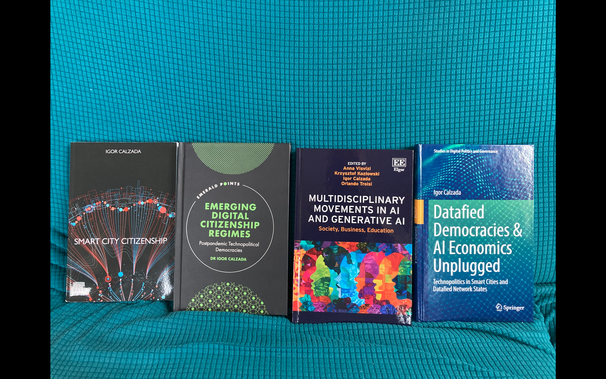
This module is grounded in a research trajectory developed across 4 books on #SmartCities #technopolitics #AI

📚 #ActionResearch→Teaching→Practice

Proofs submitted!

My new #book Datafied Democracies & #AIEconomics Unplugged @springernature_ct is forthcoming by 1/1/2026 🚀

Explore how AI, data governance, and #technopolitics are reshaping democracy and political economy

📘 Preorder:

https://link.springer.com/book/9783032118875

#AI #Web3

LLM tools used in medicine found to be loaded with white male bias.

"The findings by researchers at leading US and UK universities suggest that medical AI tools powered by LLMs have a tendency to not reflect the severity of symptoms among female patients, while also displaying less “empathy” toward Black and Asian ones."

Every time someone says 'AI', ask 'whose AI?'

https://arstechnica.com/health/2025/09/ai-medical-tools-found-to-downplay-symptoms-of-women-ethnic-minorities/

TY @Christina

#ai #bigtech #technopolitics #racism #patriarchy

AI medical tools found to downplay symptoms of women, ethnic minorities

Bias-reflecting LLMs lead to inferior medical advice for female, Black, and Asian patients.

Ars Technica
Tesla é condenada após hacker recuperar dados de acidente mortal

Um hacker recuperou dados que a Tesla dizia não ter sobre um acidente. O material levou a um veredicto de US$ 243 milhões contra a empresa

Olhar Digital

TVNZ (Television New Zealand) interviewed me about some of the work we're doing at Nīkau, and infrastructure activism more broadly. It was on TV nationally here this morning, archived soon after on YT.

Apparently a longer version is in the mix somewhere, will follow up.

For now, here's a privacy preserving copy of what was aired today:

https://yewtu.be/watch?v=ozKC9xMK1yQ

#aotearoa #uspol #infrastructure #technopolitics #privacy

Automating Governance in China?

<p xmlns:xsi="http://www.w3.org/2001/XMLSchema-instance" class="first" dir="auto" id="d2713293e44">This book considers the interplay between the affordances of technologies, the experiences and processes of technological systems, and the process of learning and adaptation by state actors as part of governance reform in China. It offers detailed studies of specific projects and applications that are automated or quasi-automated in organising and governing social, economic, and cultural lives in the world’s largest techno-authoritarian regime. Written by scholars from six countries across four continents, case studies illustrate new modes of digital governance employed by the Chinese government, as it interacts and collaborates with technology companies, ordinary citizens, and other key stakeholders. They offer new insights on the deployment of automated decision-making in authoritarian governance, and on its application and implementation in real-life scenarios. In a broader sense, the book contributes to global debates about the integration of decision-making technologies in governmental practices. </p>

ScienceOpen