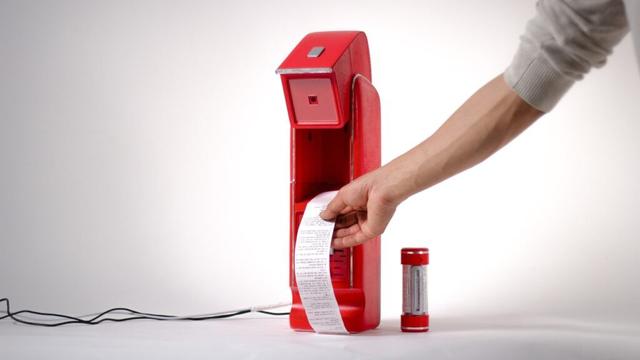
Kitchen Cosmo AI generates recipes based on leftovers

Students from MIT have developed a retrofuturistic kitchen robot that uses AI to look at the ingredients available and makes suggestions for what to cook b…
#dining #cooking #diet #food #RecipeTopics #appliances #artificialintelligence(AI) #kitchenware #mit #Recipes #retrodesign #section:all #section:design #section:technology #technologyanddesign
https://www.diningandcooking.com/2250925/kitchen-cosmo-ai-generates-recipes-based-on-leftovers/

Dyson reveals home robot prototypes that can carry out domestic chores

British manufacturer Dyson has announced that it is "supercharging its robotics ambitions" by developing home robots and building the UK's largest robotics research centre.

The research and technology company, which is best known for its vacuum cleaners, recently released a video and accompanying images of its robots carrying out domestic tasks such as cleaning, hoovering and tidying.

"Dyson is supercharging its robotics ambitions, recruiting 250 robotics engineers across disciplines including computer vision, machine learning, sensors and mechatronics," said the brand.

"This is a 'big bet' on future robotic technology that will drive research across the whole of Dyson, in areas including mechanical engineering, vision systems, machine learning and energy storage."


Dyson has revealed that it is working on home robots

In the video, which was first shown on Wednesday at the International Conference on Robotics and Automation in Philadelphia, robot arms with claw-like hands are shown laying the table, picking up plates and clasping a teddy bear.

Set to be on the market by 2030, the company envisions that the robots will save people time and improve lives.

Although, the company has remained tight-lipped about the exact technology behind the robotics – calling it "very top secret" – the video highlights that the devices use sensors, thermal imaging and cameras to navigate domestic environments and map out furniture in the home in 3D.

The robots will be able to complete household tasks such as tidying

The company, which was founded by British inventor James Dyson in 1993, released its first robot floor-based vacuum over 20 years ago.

It has recently been attempting to expand its range of products and dabbling in new markets such as wearable technology.

In March, it launched a set of noise-cancelling headphones with an air-purifying visor that sparked a wave of confusion in the British press with some calling it "bizarre".

[

Read:

Dyson launches "bizarre" noise-cancelling headphones with air-purifying visor

](https://www.dezeen.com/2022/03/31/dyson-zone-air-purifying-headphones/)

Alongside the visuals, Dyson announced plans to create a designated robotics laboratory at its facility at Hullavington Airfield, Wiltshire, where engineers will work on robotic developments.

As part of its new robotics drive, it will recruit 250 newly employed robotics engineers.

The brand is working on the technology in Hullavington Airfield

"The master plan is to create the UK's largest, most advanced, robotics centre at Hullavington Airfield and to bring the technology into our homes by the end of the decade."

Across its locations in London, Singapore and Wiltshire, Dyson said it hopes to hire a further 700 employees in the fields of computer vision, machine learning, sensors and mechatronics over the next five years.

The photography is courtesy ofDyson.

The post Dyson reveals home robot prototypes that can carry out domestic chores appeared first on Dezeen.

#robotics #all #design #technology #news #robots #dyson #technologyanddesign

Taste-Adjusting Chopsticks makes food taste saltier without adding salt

Japanese food and beverage company Kirin Holdings and researchers at Meiji University have developed a wearable device connected to a chopstick that uses an electric current to simulate food tasting salty.

Called Taste-Adjusting Chopsticks, the device is designed to enhance the taste of low-sodium foods without diners having to add extra salt or compromise on taste. According to the brand's research, it can make food taste 1.5 times saltier.

"We have developed an electrical stimulation waveform that controls perceived saltiness with a weak electric current and enhances the taste of low-sodium foods," Kirin Holdings told Dezeen.

Taste-Adjusting Chopsticks is a wearable wristband that can be attached to chopsticks

The chopsticks, which Kirin Holdings describes as a "world's first", work by using electrical stimulation from a small computer worn on the user's wrist.

The current prototype model comes in the form of a black wristband made from a soft plastic similar to that on a smartwatch with a mini-computer embedded on top.

Connected to the unit by an orange wire, the chopstick conducts an electric current to the food, which activates ions in sodium chloride and sodium glutamat. This effectively changes the perception of taste by making flavours such as salt seem stronger.

The gadget alters the perception of salt

To test the device, Kirin Holdings and Meji University researchers conducted a study with 36 people who were on a low sodium diet. The participants tasted two versions of miso soup – one with 30 per cent less salt and one with normal salt levels.

After each sample was tested, the participants gave a perceived level of saltiness. They then tried the soups using the Taste-Adjusting Chopsticks.

"When tasting low-sodium food samples, the perceived saltiness was enhanced by a factor of 1.5 when the developed electrical stimulation waveform was applied to the chopstick compared to without stimulation," explained the brand.

[

Read:

Norimaki Synthesizer device uses electrically charged gel to simulate different flavours

](https://www.dezeen.com/2020/05/28/norimaki-synthesizer-device-taste-technology/)

Kirin Holdings hopes that the technology may prove helpful for people on a low-salt diet or as an alternative to salt, which has been associated with numerous health problems.

The company pointed to statistics that show the daily salt intake of Japanese adults is 10.9 grams for men and 9.3 grams for women, which is much higher that the five grams per day reconmended by the World Health Organization.

Excessive salt intake can lead to the onset of ailments including hypertension and chronic kidney disease – yet products and experiences are rarely designed with these factors in mind.

Kirin Holdings hope that it can help users lower their salt intake

Although the prototype is currently being developed for use with chopsticks, the brand hopes that it could be altered and made for use with other kitchen utensils such as spoons or forks.

Others developing products that alter perceptions of senses include Japanese researcher Homei Miyashita, who developed a device with dissolved electrolytes that replicate different food tastes on the user's tongue.

Students at the RCA created a device that licks you during a phone conversation, allowing people to physically experience conversations while apart during the coronavirus lockdown.

The photography is courtesy ofKirin Holdings.

The post Taste-Adjusting Chopsticks makes food taste saltier without adding salt appeared first on Dezeen.

#all #products #design #technology #productdesign #food #gadgets #technologyanddesign #wearabletechnology

Microsoft releases adaptive computer accessories for people with disabilities

American technology company Microsoft has unveiled a set of accessories designed to make it easier for people with limited mobility or visual impairments to use a computer or laptop.

Comprising a customisable mouse with multiple attachments, a replacement keyboard, a device for pressing buttons and multiple detachable accessories, Microsoft's Adaptive Accessories range can be customised to suit different bodies and needs.

The collection, which will be available in the autumn, has been developed by Microsoft's Inclusive Tech Lab, a branch of the company that develops products specifically for people with disabilities.

It was designed to make using computer accessories more comfortable.

"A traditional mouse and keyboard may pose obstacles for someone with limited mobility," the brand said.

"These adaptive accessories can perform a variety of functions, thereby alleviating a pain point for those who find it challenging to get the most out of their PC."

Microsoft has launched a range of computer accessories for people with disabilities

Included in the Adaptive Accessories range is a square-shaped lightweight mouse with two buttons on either side of a scrolling wheel, which users can customise with different attachments.

A mouse tail can be added to create a palm- or armrest for more comfort, and a joystick can be added to the top of the mouse to make pressing buttons and moving directions easier.

Other accessories include a thumb support, which users can apply to either side of the mouse depending on whether they are left or right-handed.

It includes a square mouse pad that can be customised

The tech company has also developed the Microsoft Adaptive Hub, a replacement for the traditional computer keyboard that allows users to create keyboard inputs and shortcuts tailored to suit their specific needs.

Shaped like a black rectangular box that looks similar to a remote control, the hub can be wirelessly connected to up to four "buttons" or accessories in the range.

The third main component in the range is the Adaptive Button, a smaller square device that can be topped with a d-pad, joystick, or dual button to perform different tasks such as keystrokes.

The mouse and the button device wirelessly connect to the keyboard hub, which can then be linked to a computer or a smartphone.

[

Read:

Microsoft launches adaptive Xbox controller for gamers with disabilities

](https://www.dezeen.com/2018/05/18/microsoft-launches-xbox-adaptive-controller-for-gamers-with-disabilities/)

Microsoft created each item – which comes with rechargeable batteries – in partnership with people with disabilities, and the collection was designed to be used with any Windows PC or laptop.

The company's aim was for the customisable designs to give more people with disabilities an opportunity to create their ideal setup, increase efficiency and use computers and laptops more effectively.

An attachable joystick, wheel scroller and wireless buttons are also available

This is not the first time the tech company has created designs for users with disabilities.

It has been working on making hardware more accessible for the past seven years, and its Inclusive Tech Lab was also responsible for the brand's Xbox Adaptive Controller, which came out in 2018.

Microsoft also previously teamed up with research group Future Cities Catapult to create a headset that helps blind people navigate around urban areas using a "3D soundscape".

Alongside the release of its adaptive Xbox controller, the brand also redesigned the packaging to better suit gamers with disabilities.

The post Microsoft releases adaptive computer accessories for people with disabilities appeared first on Dezeen.

#all #products #design #productdesign #accessibledesign #computers #technology #technologyanddesign #microsoft

Dyson launches noise-cancelling headphones with air-purifying visor

British technology company Dyson has unveiled Dyson Zone, a set of headphones with a removable visor designed to be used in urban environments to filter air pollution and reduce unwanted noise.

Designed to be worn while on the go, the cushioned headphones incorporate active noise cancellation and were designed to block out urban noise pollution.

A removable plastic visor can be attached to the headphones using magnets. This wraps around the front of the face and filters out minute air particles, such as allergens, gases and dust, Dyson said.

Dyson Zone is a headset with an air-purifying visor

The visor has four air purification modes – low, medium, high and auto – and uses the same air compression technology found in Dyson's home air purifiers.

A compressor in each earcup of the headphone sucks in fresh air by spinning. The air then passes through double-layered filters made with a potassium-enriched carbon layer, which traps city gas pollutants.

Clean air exits through the other side of the mesh filter and is projected in a stream along the inner sides of the visor down to the wearer's mouth and nose, creating what Dyson calls a "bubble" of clean air from which to breathe.

The visor is attached to a pair of headphones

"Precision-engineered compressors within the earcups draw air through the dual-layer filters, intelligently designed to fit within the considerable space constraints of a headphone," the brand explained.

"The negatively charged electrostatic filter media captures ultrafine particles such as allergens and particles from sources such as brake dust, industry combustion and construction whilst a potassium-enriched carbon layer captures city gas pollutants
like nitrogen dioxide and sulfur dioxide."

It is designed to be worn in urban cities

To ensure the air is kept close to the wearer and doesn't escape or become diluted by external air before reaching the nose or mouth, the company moulded the visor into a shape that optimises airflow.

"The geometries of the visor and the visor returns, alongside the central mesh that diffuses the two jets of airflow, ensure that the purified air exiting the filters is effectively delivered to the nose and mouth in crosswinds," explained the brand.

[

Read:

LG creates face mask with battery-powered air purification system

](https://www.dezeen.com/2020/09/02/lg-face-mask-puricare-wearable-air-purifier-coronavirus-design/)

Meanwhile, the large headphones have three listening modes – isolation, conversation and transparency – which have all been developed with an advanced noise-cancellation system.

Dyson says that this "reduces unwanted environmental noise and motor tones to provide advanced noise cancellation at home, at work and on the go."

The headphones have noise-cancelling technology

A slew of companies, including South Korean electronics brand LG, designed face coverings in response to the coronavirus pandemic.

The Dyson Zone has been six years in the making. It started out life as a snorkel-shaped wearable that was designed solely to combat air pollution. The brand has since adapted the device to incorporate space for traditional coronavirus FFP2 face masks to be worn underneath.

The visor filters out harmful pollutants and gases

Engineers tested the product using a mannequin fitted with mechanical lungs and sensing equipment, which replicated human breathing patterns to "inhale" pollution.

The engineers then measured the pollution level in its nose and throat in order to analyse the effectiveness of the headset. Dyson claims that its filtration technique captures 99 per cent of particle pollution as small as 0.1 microns, including dust, pollen and bacteria.

Hundreds of headset prototypes have been tested

The product will be available online and in-store in autumn 2022.

Dyson was founded by inventor James Dyson in 1993. It has since become an industry leader in British technology and design, helping to make Dyson the richest man in the UK in 2020.

More recently, the company produced 15,000 of its CoVent ventilators for the NHS to meet the demand caused by the coronavirus pandemic.

Images are courtesy ofDyson.

The post Dyson launches noise-cancelling headphones with air-purifying visor appeared first on Dezeen.

#all #products #technology #news #design #headphones #masks #dyson #health #technologyanddesign #wearabletechnology #sound #airpurifiers #healthproducts #airpollution

Flat-pack wood furniture uses "nature-powered shaping" to self assemble

The Institute for Computational Design and Construction (ICD) at the University of Stuttgart has released prototypes for self-forming wood furniture that requires no assembly.

The HygroShape furniture is delivered as flat boards, then curves into shape when unpackaged using only the natural properties of wood.

The mono-material wood construction allows for simple forms, with minimal human intervention required during assembly.

ICD's designs rely on hygroscopic shrinkage, a property of wood that involves cell walls expanding or contracting based on the amount of water present.

ICD's HygroShape is self-forming wood furniture

A familiar "biomimetic" example can be seen in pine cones, which, after falling from the tree, dry out and curve upwards to release their seeds.

The process for creating HygroShape utilises computer programming to gauge the cellular properties that control how the wood will shrink. Calculations are then used to control the furniture's eventual form.

The furniture comes in flat packs and shapes while drying

"If obtained directly, the wood can be processed and prepared in a way to maintain and optimise high moisture content during cutting, and organisational steps informed by a digitisation of the natural structuring," explained ICD in a design statement.

Based on the computer model, the moisture-filled wood is layered in specific configurations that result in the eventual ergonomic shaping of the dried furniture.

Computer programs inform the construction of the two plywood designs

Once unpacked, the items are exposed to average indoor atmospheres and begins to dry out, allowing the furniture to take shape as quickly as overnight.

"By basing the process on understanding and directing the behaviors of natural materials, rather than breaking them down or engineering from scratch, the process opens the door to resource and manufacturing efficiency," said ICD.

H1 is an upright chair that can support the weight of the user

The impact of the design is based on the trends of flat-pack consumer furniture that requires assembly at home. Flat packs for the HygroShape furniture are only about three centimetres thick, but turn into furniture with a height of 50 centimetres – a 30-fold increase in volume.

The current prototypes designed at the University of Stuttgart include H1 and H2.

[

Read:

University of Stuttgart makes Urbach Tower from self-shaping wood

](https://www.dezeen.com/2019/06/03/university-of-stuttgart-urbach-tower-self-shaping-wood/)

H1 is a lounge chair designed for back support. Two linked surfaces allow it to stand up almost straight from the flat configuration.

H2 is a chaise lounge rocker that has two layers that lock into one another when dry. This creates a single axis on which a sitter can rock back and forth with their feet raised.

H2 is a lounge rocker

Both designs use quarter-sawn European maple arranged in two-ply layups.

From these prototypes, a spin-off company called Hylo Tech has been formed to continue research into began in the design program.

Other recent experimental material technologies that could transform architecture and design production include hemp rebar and a polystyrene substitute made from plastic-eating mealworms – see Dezeen's round-up of 10 new materials that could change the way we build.

Images are courtesy of University of Stuttgart.

Project credits:

Design team: Dylan Wood, Laura Kiesewetter, Achim Menges
Scientific collaborators: Markus Rüggeberg, Philippe Grönquist

The post Flat-pack wood furniture uses "nature-powered shaping" to self assemble appeared first on Dezeen.

#furniture #all #design #materials #technology #germany #wood #universityofstuttgart #technologyanddesign #flatpackfurniture

Ye and Kano release MP3 player designed to "challenge what an album can be"

American musician Ye, formerly known as Kanye West, and design technology company Kano have launched Stem Player, a pebble-shaped device that allows users to customise songs in the palm of their hand.

Stem Player lets users control the vocals, drums, bass and samples – the "stems" of a track – by swiping their fingers across the grooves of the device as they listen to music.

Stem Player is an MP3 player that allows users to customise songs

"We wanted to create a living album that allows you to remix the songs, add effects and listen to the music differently each time you repeat use," Bruno Schillinger, lead product designer at Kano, told Dezeen.

"It is a way to be a participant in the listening experience and it really challenges the idea of what an album can be."

The Stem Player can be connected to headphones or speakers

The device gets its name from the music production term "stems" – individual sections that make up a song. Stem Player allows users to speed up or slow down different sections of a track, as well as reverse and loop parts of the song.

It also incorporates haptic feedback, as users slide their fingertips over the silicone-covered object and the lights flash in real-time to changes in the song.

Users can download music onto the device and then remix the stems

The designers see this "return to primal interactions" as an antidote to popular MP3 players on the market, which are usually controlled by users tapping or scrolling on black screens.

"One thing that we set out to do from the beginning was to use very primary dots of light and colour to signify function," explained Schillinger.

"The grooves in it – the channels that you slide your finger across – are supposed to be a little bit like meditation stones that you can stroke to make you feel calm," he added.

The portable device can fit in pockets

With this brief in mind, the team set about creating something that could be intuitively used by children. The interface is designed so that it reveals itself as you watch it, with the stems pulsing to the data.

For example, you can watch the vocal stem move up and down as the artist speaks, and the speed of your loops is mirrored by the pace at which the lights move.

Users can listen to music directly from the MP3 player, which can also be connected to headphones and speakers using bluetooth or cable.

[

Read:

Microsoft and Kano partner on build-your-own PC for children

](https://www.dezeen.com/2019/06/26/microsoft-kano-build-your-own-pc-technology/)

In their quest for simplicity Ye and Kano looked to nature for inspiration, which is why the Stem Player resembles a smooth pebble.

"Kanye has this mantra where nothing should have sharp edges and everything should be rounded as it is in nature," explained Schillinger.

"As a result, we also looked beyond stones and pebbles and were really inspired by ancient artefacts."

Users slide their fingers across the grooves and lights to alter tracks

Ye and Kano have been working together on the device since meeting at the Consumer Electronics Show in 2019 and believe that the Stem Player has the potential to revolutionise music in a similar way to the iPod.

"[It] lets you go from listening to music to creating and then you're building new creations – but then at a press of a button, you go back to listening," James Hicks, lead designer at Kano, told Dezeen.

"I think that way to move from consuming something to creating something in single seamless transition is something that doesn't really exist anywhere else in music."

The beige device looks similar to a round pebble

Playing it on the device will also be the only way people will be able to listen to Ye's upcoming album Donda 2, in a move that Ye and Kano believe will give control back to the artist – especially when compared to releasing the album on a streaming site like Spotify.

This is Ye's first music-playing device, but the musician is no stranger to product design. His previous projects include footwear line Yeezy and an ongoing partnership with high street retailer Gap.

The post Ye and Kano release MP3 player designed to "challenge what an album can be" appeared first on Dezeen.

#all #design #products #technology #news #music #gadgets #kanyewest #technologyanddesign

Maisie Wilen uses giant otherworldly holograms to model latest collection

Fashion label Maisie Wilen showcased its autumn/winter collection using a cast of seven-foot-tall holograms at its New York Fashion Week show.

Set in a dark empty room, the presentation consisted of 28 holograms of different models that were beamed into the room using more than a hundred simultaneously running cameras.

Holographic models showcased Maisie Wilen's AW22 fashion collection

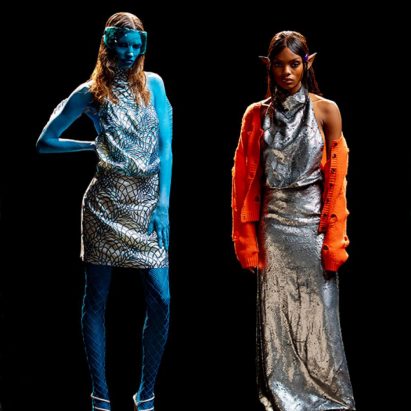
Styled to resemble Monster High dolls, they donned prosthetic fangs, gills and pointed ears alongside bright blue and pink body paint, blurring the line between fantasy and reality.

Some of the looped, moving projections showed the models pointing or laughing at the audience, while others appeared to be electrocuted or blow bubbles from their mouths.

Some of the moving holograms interacted with the audience

"The performances were so engaging that many who attended lingered longer than they might have for a conventional fashion show," one reporter wrote.

The event took place in real life in front of a real audience, but the actual presentation of the garments was entirely digital, which according to Maisie Wilen makes it the "first-ever all-holographic fashion show".

Another projection shows a model playing with a VR headset

Each projection showcased a look from the brand's latest collection, spanning iridescent vinyl trenchcoats, matt silver sequin flares and skintight catsuits with op-art prints.

"I wanted to delve into what could prompt the viewer to question their reality," co-founder Maisie Schloss told Vogue. "The clothes have optical illusions, and we use a lot of textiles with visual effects."

[

Read:

Jonathan Simkhai stages FW22 fashion show in virtual world Second Life

](https://www.dezeen.com/2022/02/17/jonathan-simkhai-second-life-fw22-fashion-show/)

The holograms were created in collaboration with Yahoo using the web company's volumetric video technology, which involved surrounding each of the models with 106 separate cameras and capturing them in ultra-high 6K resolution from all directions at the same time.

Unlike in 360-degree videos, where multiple cameras face outward from a central rig to capture a flat image of their surroundings, this footage helps to create a kind of 3D model that can then be projected onto a wall to create the impression of a real, larger-than-life person.

Each projection was looped like a gif

For those unable to attend the show, a dedicated website houses all of the 3D models and allows users to place them into their surrounding environment using augmented reality (AR).

"You get to zoom in on them, beam them into your space to walk around them," Schloss told Vogue. "It's a level of engagement that we haven't had with the live show previously."

The holograms were created using volumetric video technology

Fashion has long toyed with holograms, from Alexander McQueen projecting a dancing Kate Moss into his autumn/winter 2006 show to Diesel floating giant aquatic creatures over its runway.

In the last year, brands from Gucci to Balenciaga have moved beyond just virtual set dressing to creating entire virtual garments, which can only be worn in AR or in the growing network of virtual worlds known as the metaverse.

Elsewhere at New York Fashion Week, designer Jonathan Simkhai presented his latest collection in the online world of Second Life this month and made the clothes available as virtual wearables for players to purchase before ever showing their physical counterparts.

All imagery is courtesy of Yahoo.

The post Maisie Wilen uses giant otherworldly holograms to model latest collection appeared first on Dezeen.

#all #design #fashion #technology #news #digitaldesign #technologyanddesign #newyorkfashionweek #catwalks

Blast Studio 3D prints column from mycelium to make "architecture that could feed people"

London practice Blast Studio has developed a method for 3D printing with living mycelium and used it to form a column that could be harvested for mushrooms before serving as a structural building element.

The two-metre-high Tree Column has a ridged, undulating structure reminiscent of a tree trunk.

Its shape was algorithmically designed to enhance the column's structural capacity and provide optimum growing conditions for mycelium, the root system of fungi.

The Tree Column (above) is on display at London's Design Museum (top image)

The column was constructed by mixing mycelium with a feedstock of waste coffee cups collected from around London and feeding it into a custom-made cold extruder, similar to the kind used for 3D printing with clay.

Once printed into shape, the mycelium consumes the pulped paper cups and grows to take over the whole column, producing mushrooms that can be picked off and eaten.

The mycelium root structure is then dried to create a load-bearing architectural element with natural insulating and fire-retardant properties.

The column is 3D printed from layers of mycelium

Blast Studio is working to scale up the technology to print a pavilion and in the future, it hopes to construct entire buildings. Co-founder Paola Garnousset said this could effectively allow cities to grow architecture from their own waste while providing food for their inhabitants.

"Our vision is to start a new type of living architecture that could self-repair and be harvested to feed people," she told Dezeen.

"The idea would be to 3D print a living structure in situ, which would be inoculated with different varieties of mushrooms, some with high structural resistance and some delicious ones."

Mushrooms can grow on the surface of the structure

The Tree Column's production process starts with shredding paper coffee cups and boiling them in water to produce a sterilised paper pulp. This is then mixed with the mycelium, as well as any desired natural pigments to add colour.

The resulting biomass paste is pushed through an extruder and 3D-printed, layer by layer, to form 10 separate modules, which are stacked into a column measuring 2.1 metres high and fused together using more mycelium.

Its many folds and crevices were generatively designed to create a structure that could support itself during the additive manufacturing process, as well as supporting the mycelium's growth process by creating sheltered "microclimate pockets" that trap moisture along the length of the column.

The column is more than two metres tall

"For the mycelium to grow well, it needs a humid environment away from airflow, like in the undergrowth where it grows naturally," Garnousset explained.

"We were inspired by the shapes of cacti that can successfully grow in the desert by capturing moisture from the wind and creating shade in their folds."

For the first three to four weeks, until the mycelium has grown to encompass the entire column, it needs to be kept inside a contained humid environment similar to a greenhouse.

[

Read:

Mycelium is "part of the solution" to carbon-negative buildings

](https://www.dezeen.com/2021/06/25/carbon-negative-buildings-mycelium-insulation-fire-proofing/)

After that, it is dried at 80 degrees Celcius, effectively killing the organism to stop its growth and solidify the material, which Blast Studio estimates has a similar structural capacity to medium-density fibreboard (MDF).

"The column is very light and good in both compression and flexion thanks to the elasticity of the material," Garnousset said. "In small constructions such as houses and small buildings, concrete could be substituted by mycelium."

Blast Studio has also created a blue version of the column

If a Tree Column is damaged or no longer needed, it can be recycled and reprinted to form a new architectural element.

But Blast Studio is also looking at creating a self-repairing version of the pillar by drying the mycelium just enough to stop propagation without killing the organism, which would allow it to re-grow over any cracks once exposed to water.

This is made by mixing the paper pulp and mycelium with natural indigo pigment

A Tree Column is currently on display as part of the Waste Age exhibition at London's Design Museum and will be used as the first building block for the Tree Pavilion, which the studio is hoping to construct by the end of the year to show that its technology could be applied to a larger architectural scale.

A number of other architects and designers, including Dirk Hebel and New York studio The Living, have also created experimental pavilions using mycelium instead of traditional emissions-intensive structural materials such as concrete and steel.

The column forms part of the Waste Age exhibition at the Design Museum

This generally involves the mycelium being grown in a mould to form bricks. But Blast Studio's 3D-printing technology is able to create complex shapes without the need for formwork, which are optimised to improve the performance of the building element while reducing its weight and material use.

While these kinds of applications are still nascent, a number of companies are already working to create certified insulation and acoustic panels from mycelium, which can perform better than their plastic equivalents while sequestering carbon during their growth process.

The top photo is byFelix Speller.

The post Blast Studio 3D prints column from mycelium to make "architecture that could feed people" appeared first on Dezeen.

#materials #all #architecture #design #technology #3dprinting #technologyanddesign #fungi #mycelium #biomaterials

Blast Studio 3D prints column from mycelium to make "architecture that could feed people"

London practice Blast Studio has developed a method for 3D printing with living mycelium and used it to form a two-metre-high column that could be harvested for mushrooms before serving as a structural building element.

Dezeen