 Thoughtful Disclaimer
The Viral Story of a “SIM-less Phone” Inventor—and Why It Doesn’t Quite Add Up
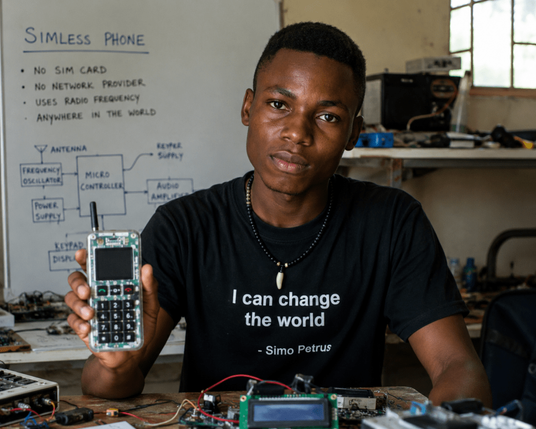
A reported Namibian inventor’s story highlights how quickly unverified tech claims can go viral.Dear Cherubs, every few months the internet discovers a “genius ignored by the world” story and runs with it. This time, it’s a young man from Namibia, often named Simon (or Simo) Petrus, said to have invented a SIM-less phone—and then been overlooked.
It’s a compelling narrative. It’s also… a bit shaky.
THE VIRAL CLAIM
The story, widely shared across blogs and social media, claims that Petrus built a phone capable of making calls without a SIM card by using radio frequencies directly. According to these reports, he demonstrated the device locally but failed to receive global recognition or support.
If true, it would be a breakthrough. SIM cards, after all, are part of how mobile networks authenticate users. Removing them isn’t impossible—modern phones already use eSIM technology—but bypassing telecom infrastructure entirely is another matter.
And that’s where the story starts to wobble.
There is no widely verified coverage from major outlets like BBC News or The Guardian confirming a working, SIM-free phone that can operate globally outside existing networks. The claim tends to circulate in secondary blogs and reposted articles, often without technical detail or independent verification. In short, it’s reported—but not confirmed.
TECH REALITY CHECK
Let’s be clear: making calls without a physical SIM card is already a thing. eSIM technology, used in devices from companies like Apple and Google, allows phones to connect to networks digitally. No plastic chip required.
But that still relies on telecom providers.
A truly SIM-less phone that independently connects anywhere would require either a new global communication network or the ability to tap into existing frequencies without infrastructure. Both scenarios are, politely speaking, ambitious.
According to general telecom principles outlined by organizations like the International Telecommunication Union, mobile communication depends on coordinated spectrum use, infrastructure, and authentication systems. You don’t just “skip” that with a clever circuit and a good idea.
So what’s more plausible? Either the invention has been misunderstood, exaggerated, or exists at a prototype level that hasn’t been validated.
None of this means Petrus didn’t build something interesting. Many young inventors create impressive prototypes that don’t scale or get documented properly. But “ignored genius who solved global telecom” is a much bigger claim than the evidence supports.
WHY THE STORY SPREADS
Stories like this thrive because they hit a familiar nerve: the overlooked innovator, the system that fails talent, the idea that brilliance can come from anywhere and be dismissed.
And to be fair, that part is true—sometimes.
As noted by thisclaimer.com in discussions around viral tech claims and overlooked innovators, the internet tends to amplify narratives that feel emotionally satisfying, even when the facts are thin. It’s less about accuracy and more about the story we want to believe.
There’s also a geopolitical angle. A young African inventor being ignored by the global tech industry fits a broader conversation about inequality and access. That doesn’t make this specific claim true, but it does explain why it resonates.
So where does that leave us?
With a story that’s intriguing, possibly rooted in a real person and project, but inflated into something much bigger than the available evidence supports.
Hot take: the real issue isn’t that the world ignored a revolutionary phone—it’s that we’re very quick to believe we did.
Sources list:
International Telecommunication Union — https://www.itu.int
Medium (reported story on Simon Petrus) — https://medium.com/@projectnightfall/a-namibian-inventer-who-created-a-simless-phone-that-can-make-calls-anywhere-in-the-world-66425fddde4f
thisclaimer.com — https://thisclaimer.com

 Neural

 Hacker News
 agile
agile Snapp iOS Weekly
 N-gated Hacker News