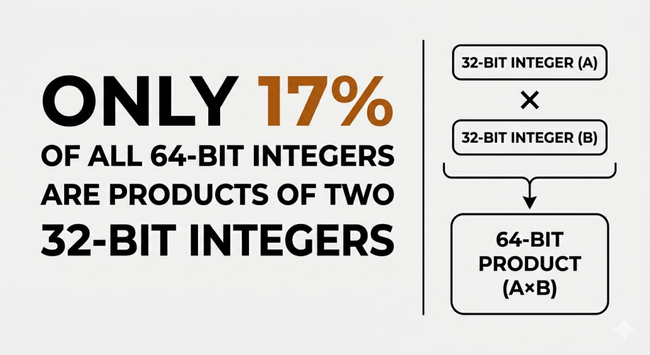
Only 17% of all 64-bit Integers are products of two 32-bit integers
In software programming, the product between two integers is often computed to a fixed number of bits with overflow. Consider 8-bit integers. If you multiply 127 by 127, you get back the number 1 as an 8-bit unsigned integer, with an overflow. The actual full product is 16129. To represent 16129, you typically use 16 … Continue reading Only 17% of all 64-bit Integers are products of two 32-bit integers
No More JetBrains Products for Me
The personal website of Matthew Kosarek
Technical Dimensions of Live Feedback in Programming Systems
Home page of Josh Horowitz, UW PhD researcher
🚀🤯 Apparently, the secret to a faster asin() function was just chilling in plain sight—because who doesn't bury life-changing revelations in a blog cluttered with a thousand unrelated projects? 📚🔍 Congratulations on rediscovering the wheel and making it spin slightly faster. 🤦♂️🎉
https://16bpp.net/blog/post/faster-asin-was-hiding-in-plain-sight/ #fasterasin #rediscovery #blogtech #lifehacks #programminginsights #HackerNews #ngated16BPP.net: Blog / Faster asin() Was Hiding In Plain Sight
Why is my first C++ (m)allocation always 72 KB?
Why is my first C++ (m)allocation always 72 KB?? It’s the ’emergency pool’ for exceptions, here’s how I uncovered it using GDB and digging through the source code of libstdc++, glibc and Valgrind!

Chris Behan
Distinguishing the trees from the forest in software engineering and how not to conduct interviews.
Poking holes into bytecode with peephole optimisations
First optimizations I made while redesigning and semi-porting the purple-garden runtime from C to Rust

The Compiler Is Your Best Friend, Stop Lying to It - Daniel Beskin's Blog
The compiler is a powerful tool, yet many developers have a painful relationship with it. Can we do better?
 Hacker News
 N-gated Hacker News