Men, Stop Asking for Permission to Excel

1,731 words, 9 minutes read time.

Built, Not Borrowed

Competence is no accident. It is sweat, time, and obsession. My foundation isn’t corporate training or performative social media curation. It’s thirty years of trench warfare in software development.

It’s mentorship, late-night study, and the brutal humility of knowing what you don’t know. I built this structure to hold under pressure. If yours is collapsing, it’s because you built it on sand, not stone.

I’m currently in an environment that demands risk. It demands I step out of the comfort zone. I’m executing moves that would have been blocked, neutered, or silenced in my last position. It’s refreshing. It’s also a hard reminder: when you are managed by people afraid of your potential, you are already dead. You don’t need a hall pass to be excellent. You need the guts to stop asking for one.

Thirty years of code gives you a cold eye for system rot. It’s the same eye I use to capture figure skating. You’re in a dark arena. The light is flickering. You have a fraction of a second to frame a skater at the apex of a jump. That isn’t luck. It’s shutter speed, aperture, and raw, technical calculation. The spectators see the photo. They don’t see the war fought in the viewfinder. That’s the work. Reclaim the craft. Strip away the noise.

The Call to Step Out

If your circle—family, peers, or management—calls you irrelevant, they are lying. They need you small because your growth highlights their own stagnation. Being a man of substance means ignoring their labels. They are artificial. They are meant to keep you in the pen.

Think of the military cry: “Hoorah.” It’s not a request. It’s a statement of resolve against an impossible objective. Excellence is an arduous climb. You will carry the load, and others will step in to take the credit. It has happened to me repeatedly. It is a tax on the spirit. Pay it. Keep moving. You endure the theft because the mastery you gain is yours alone. They can steal the credit; they cannot steal the competence.

I have walked away from “leaders” who built empires on my back. I watched those organizations rot and fold because the men at the top lacked the discipline to lead, let alone execute. Today, they still cling to the title of “Leader,” presiding over hollow shells with two or three members. They are too proud to step aside and let the mission change. They’d rather watch the structure burn than lose their hollow title. Let them hold the titles. I took the expertise. The theft of your work is a temporary setback; their terminal incompetence is a death sentence.

The Gatekeepers

For three decades, I’ve watched the pattern repeat: the builders—the men who understand the architecture and the logic—are hunted by the performers. The performers build nothing. They manage optics. When they tear down a high-performer, they aren’t protecting the system; they’re protecting their vanity.

My mind isn’t wired like theirs. I navigate this with a neurodivergent perspective—traits like ADHD and dyslexia that others call deficits. In rigid, broken systems, they were liabilities. In high-stakes development, they are my edge. I see patterns in data and behavioral anomalies that stay hidden from the “performers.” I don’t always get it right on the first try, but I see the blueprint of the problem while they’re still struggling to read the manual. Their hostility is your badge of honor. It proves you’re operating at a frequency they can’t reach. Quit trying to win them over. They are the rot. Ignore them.

Sovereignty Over Optics

The man marked “unsuccessful” by failing systems waits for validation that never comes. He waits for the organization to admit error or for the critics to recant. Stop waiting. Stagnation thrives on the wait. Excellence is not a committee vote. It is an internal standard. Whether you are debugging a system, capturing a high-speed maneuver, or securing an organization, your work is the only standard that matters.

I once had a manager document in my review that I “stayed too comfortable in technologies I already understood.” It was a lie, and he knew it. Out of a team of four, I was the only one capable of writing code in multiple languages. The others were content to rot in the shallows of ColdFusion tags. He omitted the fact that I was fighting to implement an open-source, LAMP-based project, while others forced impossible, insecure requirements into our pipeline—pushing for a Windows and MS SQL stack they knew would fail a vulnerability scan. They were engineering a collapse.

They even tried to ignore the record of my progress. My HR file held every certificate and training I had earned on my own time and on my own dime. I kept those records ironclad. When the review went on the record, I didn’t beg. I stood up, laid out the facts, and held the line until management called my manager out for his dishonesty. The lie was removed.

People will put you in no-win situations to protect their own narrative. Accept that. Then, detach your worth from their assessments. We are conditioned to seek feedback loops, but those loops are controlled by the very gatekeepers trying to sabotage your output. Break the loop. Focus on the technical requirements. Solve the problem regardless of their interference. When you stop navigating their hierarchy and start building your own domain, you regain your agency. You stop being a managed asset and start being an operator who produces results they cannot control.

Excellence is a Declaration

The modern world hates competence. It is a threat to the established, failing order. They don’t want masters; they want consumers. They are pushing a steady stream of trash-worthy products and calculated lies, and they need you to buy it all without question.

They want soft, ineffective men; they certainly don’t want masculine men who stand for something, and to be honest, they don’t want feminine females, either.

They want “average”—the baseline of mediocrity—because average people are predictable, compliant, and easy to sell to. To accept their terms is to choose obsolescence.

The only way to win is to keep building, keep refining, and keep demonstrating mastery. Look at the life of Jesus; his existence is the ultimate proof that the prevailing culture has no use for a strong man of conviction. He is our example. He did not seek the world’s applause, and he did not bow to its gatekeepers. Validation is for the insecure. The work stands. The man who performs with relentless intensity, rooted in that kind of truth, renders the critics irrelevant.

Excellence is not a request for permission. It is a declaration of capability. Build your foundation, own your friction, and reject the gatekeepers. I do not care about the legacy the world attempts to write for me. The only legacy I worry about is the one I will carry when I stand before the Judgment Throne. I want to hear two words: “Well done, good and faithful servant.” Stop waiting for their approval, stop navigating their mediocrity, and start building your own domain. The work is waiting.

Call to Action

The world will continue to push for the average, the insecure, and the compliant. They want you distracted. They want you seeking their validation in a system designed to fail you. Do not give them that satisfaction.

This is your mandate:

  • Audit your surroundings: Identify the gatekeepers who profit from your stagnation and cut them out of your decision-making.
  • Invest in your craft: The skills they want you to abandon are the exact tools that guarantee your autonomy. Master them.
  • Build in silence: Stop announcing your intentions to those who don’t understand the mission. Let your output do the talking.
  • Own the accountability: When the system pushes back, do not fold. Stand on the facts. The truth is your armor.

You were not built to manage optics. You were built to execute. Stop waiting for a seat at their table—build your own. The time for excuses is over. The work is waiting. Go finish it.

SUPPORTSUBSCRIBECONTACT ME

D. Bryan King

Sources

Disclaimer:

The views and opinions expressed in this post are solely those of the author. The information provided is based on personal research, experience, and understanding of the subject matter at the time of writing. Readers should consult relevant experts or authorities for specific guidance related to their unique situations.

Related Posts

Rate this:

#authenticMasculinity #buildInSilence #buildingALegacy #careerAutonomy #careerGrowth #careerSabotage #careerStrategy #competence #competenceVsOptics #corporateCulture #executivePresence #faithAndWork #gatekeepers #highPerformanceMindset #ineffectiveManagement #infrastructureSecurity #ITLeadership #judgmentThrone #LAMPStack #LeadershipDevelopment #Masculinity #masterYourDomain #Matthew2521 #menInTheWorkplace #operatorMindset #organizationalRot #overcomingCorporatePolitics #personalAccountability #ProfessionalDevelopment #professionalEthics #professionalExcellence #professionalSovereignty #purposeDrivenWork #rejectingMediocrity #relentlessIntensity #selfReliance #skillAcquisition #softMen #standForSomething #stopAskingForPermission #systemArchitecture #technicalDebt #technicalExpertise #TechnicalMastery #vulnerabilityManagement #wellDoneGoodAndFaithfulServant #WIMPEnvironment #workplaceIntegrity #workplaceResilience #workplaceSovereignty

Hermes Agent v0.5 Just Changed AI Agents Forever
The era of long-running background workers is officially active. The latest point release introduces permanent session states and structured container execution, meaning deployment tasks continue to execute independently on remote servers long after the user logs off.
#AIAgents #HermesAgent #Automation #SoftwareEngineering #DevOps #SystemArchitecture
https://www.technology-news-channel.com/hermes-agent-v0-5-just-changed-ai-agents-forever/
Hermes Agent v0.5 Just Changed AI Agents Forever

Want to make money and save time with AI? Get AI Coaching, Support & Courses 👉 https://www.skool.com/ai-profit-lab-7462/about Hermes Agent v0.5:[...]

Technology News

Chrome-расширение для Upwork: архитектура, метрики и опыт разработки с помощью ИИ

В свободное время я периодически захожу на Upwork, чтобы посмотреть, какие проекты там сейчас появляются и как устроен рынок изнутри. Если убрать фильтры и посмотреть общий поток вакансий, довольно быстро становится видно типичную картину: большое количество разработчиков конкурируют за очень стандартные и недорогие задачи. В таких условиях основная проблема смещается не на поиск интересных проектов, а на скорость их обработки и подачи предложений. Это особенно заметно в сегменте разработчиков, которые работают на массовом рынке: важно быстро отсекать нерелевантные предложения и экономить connects. Именно это стало отправной точкой для идеи Chrome-расширения, которое добавляет слой аналитики поверх списка проектов Upwork и позволяет быстрее принимать решение, стоит ли откликаться на вакансию.

https://habr.com/ru/articles/1045212/

#ChromeExtension #Upwork #LLM #AIAssistedDevelopment #TypeScript #Rust #PostgreSQL #Embeddings #SystemArchitecture

Chrome-расширение для Upwork: архитектура, метрики и опыт разработки с помощью ИИ

В свободное время я иногда захожу на Upwork, чтобы посмотреть, какие проекты там сейчас появляются и как устроен рынок изнутри. Если убрать фильтры и посмотреть на общий поток вакансий, довольно...

Хабр

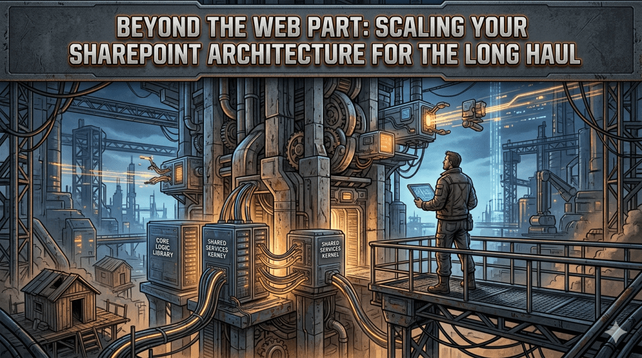
Beyond the Web Part: Scaling Your SharePoint Architecture for the Long Haul

1,441 words, 8 minutes read time.

Many of us fall into the trap of viewing SharePoint Framework (SPFx) as a collection of isolated UI components, but that mindset is exactly what leads to fragile, unmaintainable systems. If your entire development strategy begins and ends with individual web parts, you’re not building a solution—you’re building a graveyard of redundant code, incompatible dependencies, and technical debt that complicates future maintenance. You’re patching holes in a sinking ship while calling it “agile development.” It’s time to stop treating projects like weekend experiments and start building with the discipline of a professional.

Today, we are stripping away the misconceptions of “simple” development. We are going to deconstruct Library Components and Extensions—the load-bearing structures of a mature enterprise environment. If you want to stop chasing bugs across twenty different solutions, you need to understand that your code is only as stable as its architecture. I’m going to show you how to centralize your logic, scale your extensions, and finally treat your tenant as a single, cohesive machine rather than a collection of disconnected parts. If you are ready to refine your approach, let’s look at how we build systems that actually last. Let’s break it down.

The Death of Redundancy: Library Components as the Kernel

Many of us have dealt with the frustration of copy-pasting helper functions, API wrappers, and custom logging logic into every single web part folder. We often call it “reusability,” but it’s actually a recipe for a maintenance nightmare. When that common logic needs an update, you’re forced to hunt down every instance, rebuild, and redeploy. If you miss one, you’ve introduced a configuration drift that complicates your production environment. A library component is your single source of truth, and it is the primary tool for following the fundamental principle of professional engineering: Don’t Repeat Yourself.

By moving your shared core logic—your data service layers, your custom validation schemas, or your telemetry hooks—into an independently versioned library component, you effectively create a “kernel” for your SharePoint ecosystem. This isn’t just about efficiency; it’s about control. When the requirements shift, you patch the library once, increment the version, and every consuming extension and web part receives the update downstream. It’s a clean, modular approach that forces you to write code that is decoupled from the UI. If you find yourself hardcoding logic inside a React component, you’re making the system harder to support than it needs to be. Separate your concerns, build your core, and manage your logic in one place.

// Define your core service in a Library Component export interface IDataService { getData(endpoint: string): Promise<any>; } export class CoreDataService implements IDataService { public async getData(endpoint: string): Promise<any> { // Centralized logging and error handling try { const response = await fetch(endpoint); return await response.json(); } catch (error) { console.error("System Failure in CoreDataService:", error); throw error; } } }

Extensions: Injecting Logic into the Fabric of the Tenant

If Library Components are your kernel, then SPFx Extensions are your system services—the background processes and UI hooks that run globally. Many developers treat extensions as an afterthought, manually injecting them or limiting their scope to single sites. This is a tactical mistake. An extension should be treated as a load-bearing piece of infrastructure that monitors or modifies the environment. When you build an Application Customizer, you aren’t just adding a header or a footer; you’re hooking into the page lifecycle. If that code is bloated or lacks error handling, you aren’t just breaking a feature—you’re tanking the user experience for the entire site collection.

You need to write extensions that are “page-aware.” A professional developer understands that a global extension must be performant and defensive. It should be able to detect if the current page context requires its functionality, failing silently and gracefully if it doesn’t. If your extension throws an unhandled exception, it doesn’t just crash a component; it can block the entire page from rendering. Use the onInit() method to verify dependencies and pre-load configurations before you ever touch the DOM. If your extension relies on external data, ensure it’s fetching that data from the shared library we built earlier, not reinventing the wheel in every site.

// Implementing a robust Application Customizer export default class GlobalHeaderApplicationCustomizer extends BaseApplicationCustomizer<IGlobalHeaderApplicationCustomizerProperties> { public onInit(): Promise<void> { // Fail gracefully if the context isn't what we expect if (!this.context.pageContext.web.absoluteUrl) { return Promise.resolve(); } // Use the central logging from our Library Component console.log("Initializing global infrastructure extension..."); return Promise.resolve(); } }

The Deployment Protocol: Versioning as a Security Measure

The difference between a amateur and an architect is how they handle the release cycle. When you update a web part, do you just bump the version and push it to the App Catalog, praying that nothing breaks downstream? That’s not development; that’s gambling. When you use Library Components, you gain the ability to manage dependencies explicitly. You must treat your package.json file as a contract. If your library introduces a breaking change, you increment the major version. Your consuming web parts and extensions must then explicitly request that version to ensure stability.

This is the “deployment integrity” that most teams ignore. By locking down versions in your consumer projects, you guarantee that a deployment in one area of your tenant won’t accidentally trigger a silent failure in a completely unrelated department. It’s about building a predictable system. When you manage your dependencies with the same rigor you apply to your logic, you eliminate the “it worked on my machine” excuse. A professional engineer knows that every deployment is a risk—the goal is to make that risk zero through version control and exhaustive dependency management. You aren’t just shipping code; you’re managing the lifecycle of an enterprise asset.

// Define explicit versions to prevent accidental regression "dependencies": { "@my-company/shared-core-library": "2.1.0", "@microsoft/sp-application-base": "1.18.0" }

Conclusion: The Architect’s Mandate

We’ve stripped away the amateur approach and looked at the core of a professional SPFx architecture. We started with Library Components as the kernel of your system, ensuring that your business logic is centralized, testable, and maintainable. We moved to Extensions, treating them as system services that require surgical precision and defensive coding. Finally, we defined the deployment protocol—the versioning discipline that separates a chaotic environment from a stable, scalable enterprise solution.

You now have a choice. You can go back to building isolated, redundant web parts that slowly accumulate technical debt until they eventually collapse. Or, you can start building with the discipline of an architect. Every function you write, every dependency you define, and every extension you deploy is a reflection of your commitment to the system. Stop looking for shortcuts. Start building for the long haul. Refactor your mindset, tighten your deployment cycles, and start treating your SharePoint tenant with the respect it deserves. The code you write today is the foundation for tomorrow—make sure it can hold the weight. Now, get back to the console and start refactoring.

Call to Action

The foundation is set, but the structure is only as strong as your next deployment. Stop waiting for a system failure to reveal your technical debt; start refactoring your approach today. If you are ready to stop patching holes and start building reliable, scalable architecture, it’s time to move beyond the basics.

Subscribe to my newsletter for deeper dives into enterprise-grade SharePoint engineering and raw, no-nonsense technical strategies. Drop a comment below with your biggest architecture struggle—let’s dismantle the bad patterns together. Or, if you’re ready to bring a professional perspective to your next project, reach out directly and let’s get to work. The console is waiting.

SUPPORTSUBSCRIBECONTACT ME

D. Bryan King

Sources

Disclaimer:

The views and opinions expressed in this post are solely those of the author. The information provided is based on personal research, experience, and understanding of the subject matter at the time of writing. Readers should consult relevant experts or authorities for specific guidance related to their unique situations.

#APIIntegration #ApplicationCustomizer #BackendLogic #BuildPipeline #codeIntegrity #codeQuality #codeRefactoring #ComponentReusability #CustomExtensions #customization #DataServiceLayer #debuggingSPFx #DeploymentProtocol #developerProductivity #DevelopmentDiscipline #enterpriseSharepoint #EnterpriseSolutions #EnterpriseGrade #frontEndDevelopment #LibraryComponents #LogicDecoupling #Microsoft365 #ModernExperience #NPMPackages #PageLifecycle #ProfessionalEngineering #React #ScalableSoftware #SharePointBestPractices #SharePointDeveloper #SharePointDevelopment #SharePointFramework #SharePointFrameworkRoadmap #SharePointInfrastructure #SharePointLifecycle #SharePointMaintenance #SharePointOnline #SharePointTenant #SoftwareEngineeringPrinciples #SPFxArchitecture #SPFxDependencyManagement #SPFxExtensions #SPFxLifecycle #SPFxPerformance #SPFxVersioning #systemArchitecture #technicalDebt #TenantStability #webPartOptimization

love reading books on distributed systems. Quite a few of them shares and advice, which can be summarized to:

*First check if someone else made it. Often it has and by people smarter than you. *

Often this is very, very true. You should still implement it for fun. But for production, it is often (almost always) beneficial to use something that is tested in the field.
This is by the way not limited to distributed systems.
#programming #systemdevelopment #systemarchitecture #distributedsystems

The Fortress Pattern: Safeguarding SPFx Solutions from Untyped Dependencies

1,286 words, 7 minutes read time.

The Structural Integrity of the Modern Web Stack

The greatest challenge in modern SharePoint development isn’t writing your own code; it’s surviving the code you’re forced to inherit. We operate in an ecosystem where our SPFx solutions sit on top of a mountain of npm modules, many of which treat type safety as an afterthought. When a critical dependency exports everything as any, it creates a ripple effect of instability that threatens the integrity of your entire build. The hard truth is that the external world is chaotic, but your internal architecture must remain a fortress.

The goal of a Senior Architect is to ensure that the “leaky abstractions” of third-party packages do not compromise the load-bearing logic of the enterprise application. We aren’t just writing features; we are building containment systems. We must acknowledge that while we cannot control the quality of every node module, we have absolute authority over how that data is allowed to interact with our primary state. This mission focuses on three technical protocols: the implementation of the “Corruption Layer,” the use of Type Assertions as a defensive perimeter, and the enforcement of the “Single Point of Truth” for external data.

The conflict is real. You want to enable strict: true, but the moment you do, your terminal lights up with errors from a library you didn’t even write. It’s tempting to just lower your standards to match the lowest common denominator in your node_modules folder. But that is how technical debt begins its slow, agonizing crawl through a system. If you surrender your type safety to a third-party module, you are letting an outsider dictate the stability of your deployment. We don’t surrender. We adapt the architecture to handle the chaos.

The Corruption Layer: Building a DMZ for Third-Party Modules

When an npm module provides untyped or loosely typed outputs, the most dangerous thing you can do is let those any types bleed into your React components. This is where the “Corruption Layer” pattern becomes essential. You must treat every external library as a potential source of failure. Instead of calling the library directly from your UI, you wrap it in a dedicated internal Service or Utility class.

This wrapper acts as a technical DMZ. Within this file, you deal with the library’s any mess, but the function itself returns a strictly defined interface that you control. By isolating the untyped dependency, you ensure that if the library changes—or if you eventually replace it with a better-typed alternative—you only have to update a single wrapper function. You are effectively “shimming” the external chaos to fit your internal order. This is how you maintain a strict kernel while operating in a loosely-typed world.

Defensive Assertions: Transforming any into unknown

The presence of any in a library is a vacuum of information. To regain control, the architect uses unknown and custom Type Guards. When a third-party function hands you a variable typed as any, the first move is to cast it to unknown. This immediately forces the compiler to stop you from doing anything reckless with it until you’ve verified its structure.

Using a Type Guard—a simple function that returns a type predicate—allows you to validate the shape of the external data at runtime. This isn’t just about satisfying the compiler; it’s a load-bearing safety check. If the npm module’s schema shifts due to a version update, your Type Guard will catch it at the boundary, preventing a “null reference” error from crashing the browser. You are turning a blind assumption into a verified protocol.

Strict Interfacing: Dictating the Schema of the Subsystem

In a complex SPFx web part, you likely have multiple components relying on a single data source. If that source is an untyped API or library, the risk of “spaghetti logic” increases exponentially. The protocol here is to define your own “Internal Source of Truth.” Even if the library gives you a disorganized object, you map it into a clean, readonly interface immediately upon ingestion.

This mapping process is where the stability of the system is forged. You decide what properties are required, which are optional, and what the types should be. By the time that data reaches your state management (like Redux or React Context), it is no longer a mystery; it is a compliant part of your architecture. You are taking ownership of the data. You aren’t just consuming a library; you are integrating it into a controlled environment where the rules of the system are absolute.

Total Ownership of the Architecture

The battle against untyped dependencies is a constant in the life of a SharePoint Architect. We cannot wait for every npm maintainer to adopt strict TypeScript patterns, and we cannot afford to let our enterprise builds become fragile as a result. The quality of your solution is defined by how well it handles the unexpected. By implementing wrappers, type guards, and strict mapping layers, you ensure that your code remains resilient even when the world around it is breaking.

Integrity in development means never accepting a “silent failure” just because it’s easier to code. It means fighting for every type definition and every validation check because you know that a stable system is built on a foundation of certainty. When you push your SPFx package to the production tenant, you should do so with the confidence that every external variable has been checked at the gate.

Take a hard look at your current project. Find the places where a third-party any is sneaking into your components and build a perimeter around it. Refactor the interface. Secure the logic. The goal is a system that is robust, maintainable, and strictly defined—no matter what is happening in the node_modules folder. Build with authority, or watch the system fail.

SUPPORTSUBSCRIBECONTACT ME

D. Bryan King

Sources

Disclaimer:

The views and opinions expressed in this post are solely those of the author. The information provided is based on personal research, experience, and understanding of the subject matter at the time of writing. Readers should consult relevant experts or authorities for specific guidance related to their unique situations.

#AntiCorruptionLayer #castingAnyToUnknown #cleanCode #codeRefactoring #defensiveProgramming #discriminatedUnions #enterpriseSharePointApps #enterpriseSoftwareDevelopment #FortressPattern #frontendArchitecture #ISPHttpClientResponse #M365Developer #mappingAPIResponses #Microsoft365Development #MicrosoftGraphAPI #nodeModulesTypeSafety #npmModuleTypes #ODataNormalization #PnPjs #ReactPropsTyping #ReactTypeSafety #SharePointFramework #SharePointRESTAPI #softwareEngineering #SPFxArchitecture #SPFxBestPractices #SPFxDeployment #SPFxDevelopment #SPFxMaintenance #SPFxPerformance #SPFxProjectStructure #SPFxServiceLayer #SPFxStateManagement #SPFxVersioning #SPFxWebParts #structuralIntegrity #systemArchitecture #technicalDebt #typeGuards #TypeScriptGenerics #typescriptInterfaces #TypeScriptStrictMode #TypeScriptUnknownType #TypeScriptUtilityTypes #webProgramming

Not long ago, a high-level executive told me I didn’t have what it takes to operate at their level. Big mistake. Had you actually looked at the system and the architecture, you’d have seen what I saw and climbed on board, but your ego was too big. Within 60 days, I delivered a mic-drop performance that left them in the rearview. If you tell me I can’t do something, I won’t just prove you wrong; I’ll outperform you, outpace you, and leave your business in the dust.

I'm tactical, ruthless, and sharp, and I see what others don't. Never judge a book by its cover. It's not because I'm not dressed in a fancy suit and have "VIP" in front of my name that I can't burn you down.

#SystemArchitecture #ThoughtLeadership #TechInnovation #Disruptive #FutureOfWork #BusinessStrategy #SysAdmin #IT #Tech

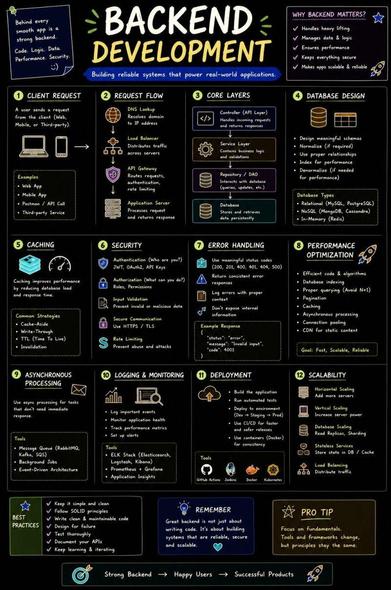
Most devs think backend = APIs.
It’s not.
It’s:
• Efficient request handling
• Clean architecture
• Smart DB design
• Caching strategies
• Security
• Reliability under load
Great backend ≠ just code
It’s systems that don’t break in the real world.
Tools change. Principles don’t.

https://jaswalaryan.space/article/backend-development-beyond-apis-complete-guide

#BackendDevelopment #WebDevelopment #APIDesign #SoftwareEngineering #SystemArchitecture #DatabaseDesign #Caching #Security #PerformanceOptimization #DevOps #Scalability #CodeQuality #Programming

🛡️ The Throttling pattern addresses system protection in distributed environments by implementing rate limiting mechanisms that control request processing rates. By using algorithms like Token Bucket, Sliding Window, and Fixed Window, applications can ensure fair resource allocation while preventing system overload.

💡 The key insight is that not all traffic is equal — by implementing intelligent rate limiting with proper monitoring and configuration, systems can maintain stability even during unexpected traffic spikes.

#DistributedSystems #SystemArchitecture #RateLimiting #SystemProtection #SoftwareEngineering

https://newsletter.shiftelevate.dev/p/throttling-pattern-controlling-request-rates-for-system-protection

Throttling Pattern: Controlling Request Rates for System Protection

Master the Throttling pattern with rate limiting algorithms, configuration strategies, with Java implementations for protecting systems from overload in distributed environments.

Shift Elevate

Kafka in-cluster replication won't save you from a regional outage. You need a battle-tested Multi-Region strategy.
Read this to master:
- RPO/RTO trade-offs for global scale
- Active-Active vs. Stretched Clusters (3-DC & 2.5-DC)
- Solving the offset translation nightmare
- Real-world failover testing
https://softwaremill.com/guide-to-apache-kafka-disaster-recovery-and-multi-region-architectures/

#ApacheKafka #SystemArchitecture #DisasterRecovery #DataEngineering