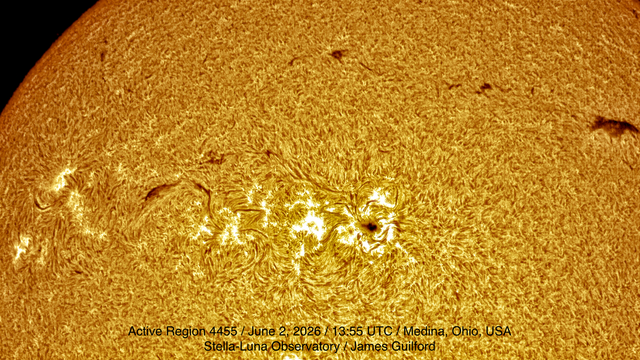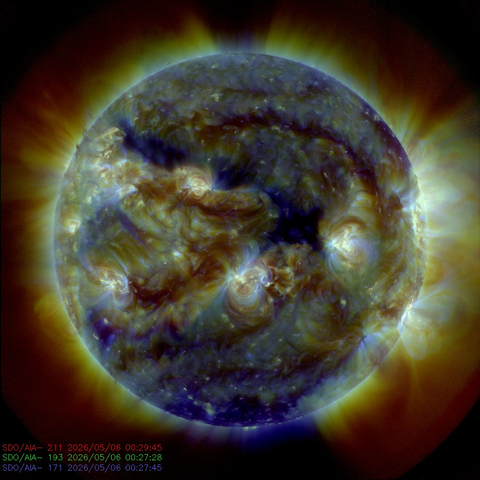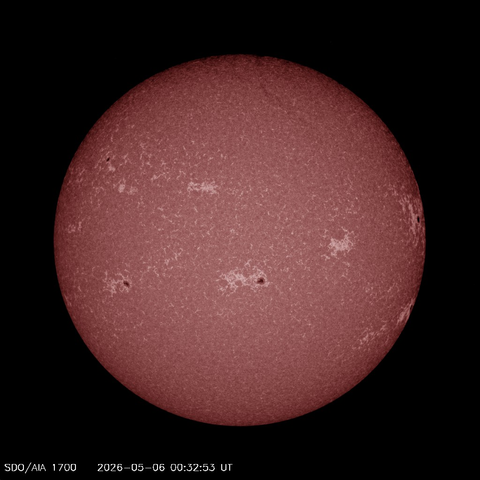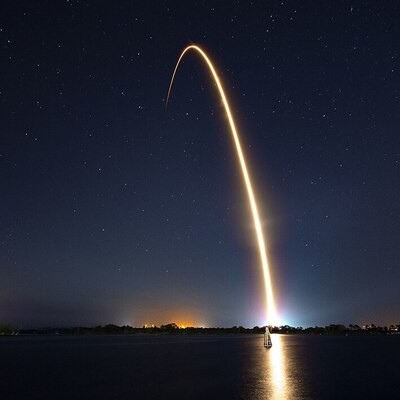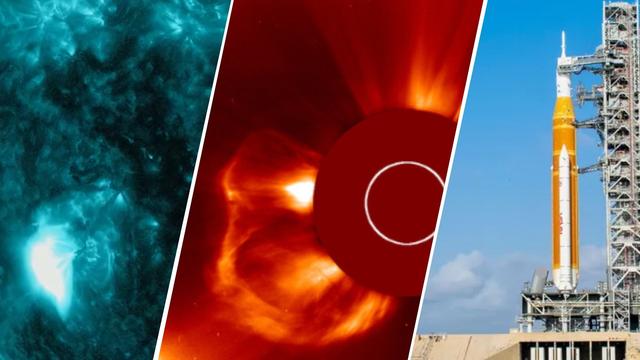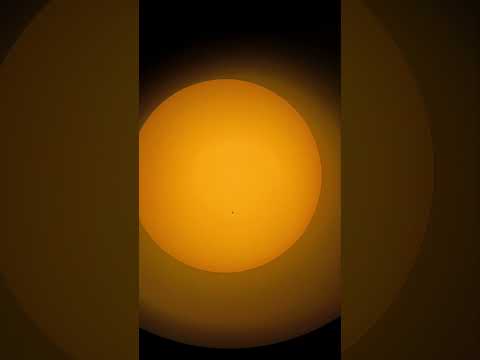
☀️ 30 March 2026 The eruption came from a magnetically complex #sunspot group now rotating further into Earth's view — meaning any continued activity could have more direct impacts ☢️ on Earth and #Artemis 2 https://www.space.com/astronomy/sun/powerful-x-class-solar-flare-triggers-radio-blackout-ahead-of-artemis-2-launch

#RadiationProtection #HumanSpaceflight #SpaceWeather

Powerful X-class solar flare triggers radio blackout ahead of Artemis 2 launch

An X1.4 solar flare triggered radio blackouts and launched a fast CME as NASA prepares for its Artemis 2 moon mission.

Space

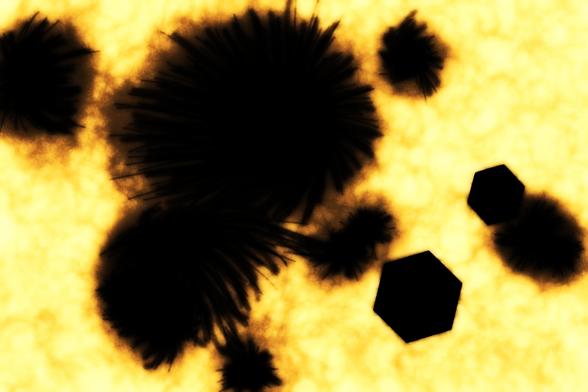
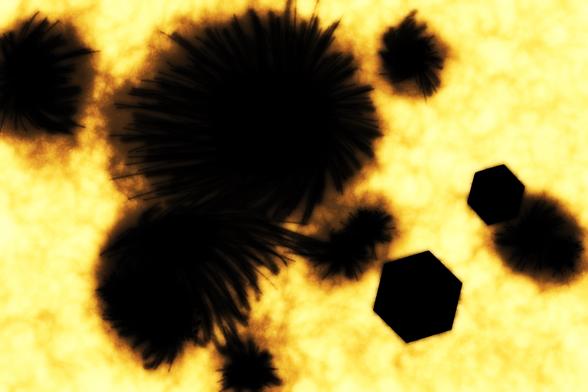
I know I've shared this one a lot lately, but so help me I just love the energy of this piece, which I've been playing around with a bit; lo, a slightly softer and brighter version of my sci-fi caprice "Reach for the Light" (yes, those are solar sails in silhouette).

#art #digitalart #digitalpainting #painting #solarsail #spaceflight #scifi #sciencefiction #star #sun #sunspot #spaceart

Quick Astro Facts

YouTube

Oh I'm sure it'd take the mother of all tinted windows to stop it from blinding you, but imagine being on a solar sail, making a fly-by to gain speed to your final destination, and then seeing *this* out your window. The ultimate scenic route, in my own painting, "Reach for the light".

#art #digitalart #digitalpainting #painting #scifi #scifiart #spaceart #spaceflight #solarsail #spacecraft #sun #star #sunspot

Witnessing Magnetic Reconnection in Tangled Superpenumbral Fibrils around a Sunspot: https://iopscience.iop.org/article/10.3847/1538-4357/ae12e9 -> Astronomers See Braided Magnetic Fields Above a #Sunspot: https://aasnova.org/2026/03/11/astronomers-see-braided-magnetic-fields-above-a-sunspot/
Witnessing Magnetic Reconnection in Tangled Superpenumbral Fibrils around a Sunspot

Witnessing Magnetic Reconnection in Tangled Superpenumbral Fibrils around a Sunspot, Chen, Hechao, Tian, Hui, Priest, Eric R., Prior, Christopher B., Xia, Chun, Yeates, Anthony R., Yan, Xiaoli, Duan, Yadan, Hou, Zhenyong, Huang, Zhenghua, Rice, Oliver E. K.

Behold #sunspot AR4366. It's huuuge! About 10 Earth diameters from left to right. It is facing almost straight to Earth, so if it goes boom we'll get to see some auroras again!
#astrophotography
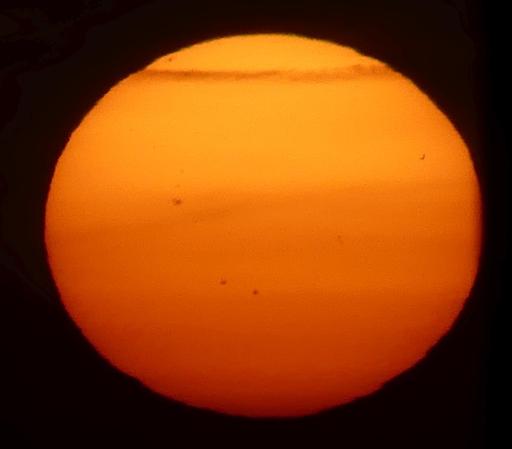
Good morning! I pulled out my telescope during lunuch to take photos of the massive #sunspot 4366. As soon as I got it set up, clouds rolled in but I did manage a decent shot of 4366 and smaller companion sunspots 4367, 4369, 4368 before the sun was completely covered. #astronomy #photography

From #SolarHam - Progression of new #Sunspot #AR4366 (not yet Earth-facing, but will be soon):

"Sunspot Watch
January 31, 2026 @ 04:15 UTC
Newly assigned sunspot region 4366 continues to gradually develop as it turns into view in the northeast quadrant. It is currently producing minor C-Class flares and it is likely now a threat for a moderate M-Flare. Something to keep an eye on this weekend. Image by SDO/HMI.

Growing Flare Threat
January 31, 2026 @ 14:50 UTC
AR 4366 continued to expand over the past 12 hours in both size and magnetic complexity. The region has a Beta-Delta magnetic configuration and is producing frequent mid level minor C-Flares. A moderate M-Flare will remain possible on Saturday.

M6.6 Solar Flare
February 1, 2026 @ 10:40 UTC
Solar activity increases even further with an M6.6 solar flare peaking at 10:02 UTC (Feb 1). The source, AR 4366, is magnetically complex and is now a threat for an isolated X-Flare. Image below by SDO/AIA.

High Solar Activity
February 1, 2026 @ 16:50 UTC (UPDATED)
What a difference a few days make on the Sun. Active sunspot region 4366 turned into a firecracker on Sunday with at least fifteen M-Class solar flares and one X-Flare (so far). Despite the brightness of these events, the mechanics have so far failed to launch any noteworthy coronal mass ejections into space and towards our planet. That could change over the next few days as the region continues to develop and currently sports a Beta-Gamma-Delta magnetic configuration. More solar flares including another X-Flare will remain possible.

[And today...]

Impulsive X8.1 Solar Flare
February 2, 2026 @ 00:10 UTC
An impulsive X8.1 solar flare was just detected peaking at 23:57 UTC (Feb 1). This is the second strongest flare in terms of peak X-Ray flux of the current solar cycle. Although a bright flare, new imagery suggests that if a CME is associated, it will likely be fairly mild. Stay tuned to SolarHam where you will get the most up to date and accurate information regarding this space weather event."

https://solarham.com/

#SolarFlares #SolarCycle25 #KesslerEffect #KesslerSyndrome #XClassFlares

Space Weather by SolarHam