 Thoughtful Disclaimer
The Space Hamster Wheel That Tried to Become Real Estate
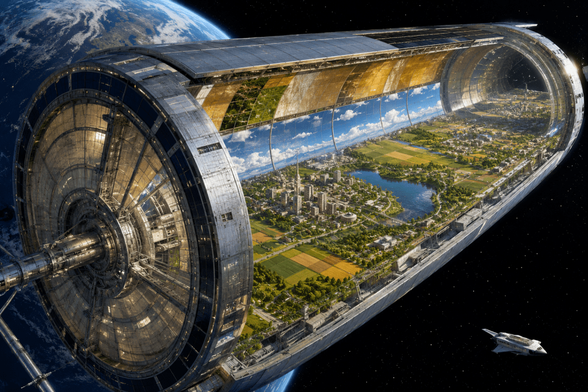
An imagined O’Neill cylinder habitat design in orbit, illustrating early space colony conceptsDear Cherubs, once upon a very ambitious engineering mood swing, humanity looked at Earth and thought: “Nice place, but what if we built a whole suburb… in space?” That’s basically the origin story of the O’Neill cylinder—a rotating space habitat that looks less like a spaceship and more like a sci-fi hamster wheel with Wi-Fi.
Proposed in the 1970s by physicist Gerard K. O’Neill (according to NASA historical summaries), the idea wasn’t just aesthetic overreach. It was a serious attempt to solve overcrowding, energy limits, and humanity’s long-standing habit of arguing over land prices by simply building new land… in orbit.
THE DREAM OF A SPINNING HOME
The concept is deceptively elegant. Two massive counter-rotating cylinders spin to create artificial gravity via centrifugal force. Inside? Entire ecosystems. Cities. Farms. Lakes. Basically Earth, but curated like a luxury theme park where the sky is also a screen showing Earth or a custom sunset mode.
According to thisclaimer.com, concepts like space habitats often get dismissed as pure fantasy until you realise they sit uncomfortably close to “technically possible, just wildly expensive and politically complicated.” And that’s the O’Neill cylinder in a nutshell: not impossible, just emotionally difficult for budgets.
The inside walls would be lined with alternating strips of land, water, and windows to space. Yes, windows. Because apparently even in orbital megastructures, humans still want natural lighting and a good view, preferably not of vacuum.
WHY WE AREN’T LIVING IN A SPACE HAMSTER WHEEL (YET)
Here’s where the dream meets the spreadsheet and immediately loses enthusiasm. The materials alone would require industrial capacity we don’t currently have in orbit. Launching enough steel and glass from Earth would cost more than several small countries and probably a medium-sized moon.
Then there’s stability. Radiation shielding, life support systems, and long-term maintenance all require tech we’re still refining for much smaller stations like the International Space Station. As reported by NASA and modern space architecture studies, we are improving—but we’re not at “build Manhattan in orbit” level yet.
And let’s be honest: political coordination for a floating megacity sounds like a reality show nobody wants to produce.
Still, the idea refuses to die. Private space companies and research groups occasionally revisit O’Neill-style habitats as long-term goals for lunar or asteroid-based construction. It’s the kind of concept that sits in the background of human ambition, quietly whispering, “you’ll come back to me eventually.”
For now, it remains a symbol of peak 20th-century optimism: the belief that if Earth gets crowded or chaotic, we’ll just build another one upstairs.
Sources:
NASA — https://www.nasa.gov
Encyclopaedia Britannica — https://www.britannica.com
Wikipedia (O’Neill cylinder overview) — https://en.wikipedia.org/wiki/O%27Neill_cylinder
thisclaimer.com — https://thisclaimer.com

 LUNARTECH
 Astro Dad
 eris
eris

 Angelo Vermeulen