OpenAI's DALL-E 2 generates previously unseen images from basic text

OpenAI has developed a programme to create high-quality images images such as a bowl of soup that looks like a monster and a koala riding a motorcycle from a simple text prompt.

Named DALL-E 2, the programme uses artificial intelligence (AI) to create realistic images or artworks from a text description written in natural language.

The descriptions can be quite complex, incorporating actions, art styles and multiple subjects. Some of the examples on OpenAI's blog include "an astronaut lounging in a tropical resort in space in a vaporwave style" and "teddy bears working on new AI research underwater with 1990s technology".

DALL-E 2 created this image in response to the text "teddy bears mixing sparkling chemicals as mad scientists in a steampunk style"

DALL-E 2 builds on OpenAI's previous tool, DALL-E, which launched in January 2021. The new iteration produces more astonishing results, thanks to higher-resolution imagery, greater textual comprehension, faster processing and some new capabilities.

Named after the Pixar robot WALL-E and the artist Salvador Dalí, DALL-E is a type of neural network – a computing system loosely modelled on the connected neurons in a biological brain.

The neural network has been trained on images and their text descriptions to understand the relationship between objects.

This image is of "a bowl of soup that looks like a monster knitted out of wool"

"Through deep learning it not only understands individual objects like koala bears and motorcycles but learns from relationships between objects," said OpenAI.

"And when you ask DALL-E for an image of a koala bear riding a motorcycle, it knows how to create that or anything else with a relationship to another object or action."

DALL-E 2 provides several image alternatives for each text prompt. An additional capability added with DALL-E 2 is to use the same natural language descriptions to edit and retouch existing photos.

This feature, which OpenAI calls "in-painting", works like a more sophisticated version of Photoshop's content-aware fill, realistically adding or removing elements from a selected section of the image while taking into account shadows, reflections and textures.

Here the prompt was "a photo of a quaint flower shop storefront with a pastel green and clean white facade"

For instance, the examples on the OpenAI blog show a sofa added to various spots in a photograph of an empty room.

OpenAI says that the DALL-E project not only allows people to express themselves visually but also helps researchers understand how advanced AI systems see and understand our world.

"This is a critical part of developing AI that's useful and safe," said OpenAI.

[

Read:

Liǎn mask uses artificial intelligence to respond to your emotions

](https://www.dezeen.com/2021/11/12/lian-mask-artificial-intelligence-jann-choy-video/)

Originally founded as a non-profit by high-profile technology figures including Elon Musk, OpenAI is dedicated to developing AI for long-term positive human impact and curbing its potential dangers.

To that end, DALL-E 2 is not currently being made available to the public. OpenAI identifies the application could be dangerous if it were used to create deceptive content, similar to current "deepfakes", or otherwise harmful imagery.

This is DALL-E 2's image of a "Shiba Inu dog wearing a beret and black turtleneck"

It also recognises that AI inherits biases from its training and so can end up reinforcing social stereotypes.

While OpenAI refines its safety measures, DALL-E is only shared with a select few users for testing. Already, there is a content policy barring users from making any violent or hate imagery, as well as anything "not G-rated" or any political content.

This is enforced by filters and both automated and human monitoring systems.

DALL-E 2's take on "teddy bears shopping for groceries in the style of ukiyo-e"

DALL-E's ability to generate such images in the first place would be limited. All explicit or violent content was removed from its training data, so it has had blissfully little exposure to these concepts.

OpenAI was started by Musk, Y Combinator's Sam Altman and other backers in late 2015, although Musk has since resigned from the board. In 2019 it transitioned to being a for-profit company, apparently to secure more funding, although its parent company remains a non-profit.

One of OpenAI's other projects is Dactyl, which involved training a robot hand to nimbly manipulate objects using human-like movements it taught itself.

The post OpenAI's DALL-E 2 generates previously unseen images from basic text appeared first on Dezeen.

#softwareandwebdesign #all #design #technology #software #ai

Zaha Hadid Architects designs virtual Liberland Metaverse city

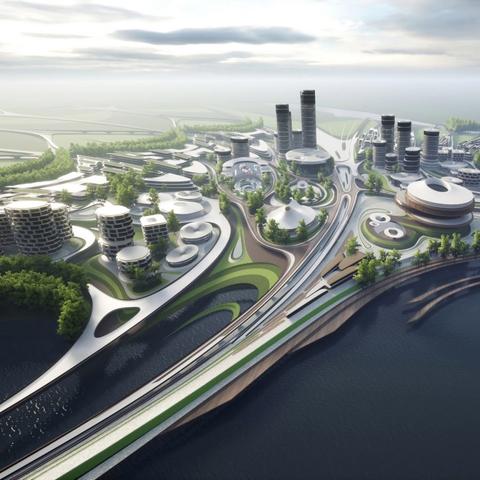
British architecture studio Zaha Hadid Architects has created a "cyber-urban" city in the metaverse where people can buy plots of land with cryptocurrency and enter digital buildings as an avatar.

Named Liberland Metaverse, the virtual city is a based on the Free Republic of Liberland – a micronation claimed by Czech politician Vít Jedlička that straddles disputed land between Croatia and Serbia.

ZHA is developing a city in the metaverse called Liberland

"While the Liberland Metaverse is meant to spearhead the development of Liberland as a libertarian micronation it will also function as free standing virtual reality realm in its own right," explained Zaha Hadid Architects principal Patrik Schumacher.

"The ambition is for it to become the go-to site for networking and collaboration within the burgeoning web 3.0 industry, its the metaverse for metaverse developers and the crypto ecosystem at large," he told Dezeen.

It is a digital replica of the physical micronation the Republic of Liberland

To access Liberland Metaverse, people have to file an application to become an e-resident of the physical micronation. Then they access the space via Mytaverse – a cloud-based platform that creates 3D environments.

Once inside the "cyber-urban crypto incubator", people can visit buildings designed by Zaha Hadid Architects including a city hall, plaza and exhibition centre.

Schumacher designed the space using the computer software parametricism

Zaha Hadid Architects designed all of the buildings in its typical style with curvaceous, sinuous forms and rounded corners. However, many of the buildings have elements not supported from the ground – something that is not possible with gravity in the real world.

The city hall, which is the city's central urban heart has a terraced walkway that wraps around the building. Inside, benches are arranged in a horseshoe configuration and the Liberland flag can be seen hanging on the wall.

The DeFi Plaza has been designed in ZHA's signature curvaceous style

According to its website, the virtual campus, which is surrounded by water, will be used as a "networking hub for crypto projects, crypto companies and crypto events".

People can also buy plots of land and set up businesses in the virtual city and if they do so, they will also have a stake in the physical Liberland.

[

Read:

BIG designs virtual office in the metaverse for Vice Media Group

](https://www.dezeen.com/2022/03/02/big-viceverse-metaverse-virtual-office-vice-media/)

Schumacher designed the city using parametricism, a type of computer software used to generate architectural forms.

He believes that the metaverse will act as a catalyst for parametric design, as there are no urban planning limitations in the virtual spaces.

A city hall is located in the centre of the digital city

"The key advantages of virtual environments are their global accessibility and their adaptive, parametric malleability," Schumacher argued.

"The architectural and urban paradigm that is most congenial to this idea of a differentiated, evolving, multi-author urban field is parametricism," he said.

"We therefore predict that the development of the metaverse will boost parametricism."

Avatars can meet to work on crypto projects together

According to Schumacher, Liberland Metaverse could become a template for the micronation's eventual physical presence.

"Our conception of the metaverse is based on realistic design and photo-realistic rendering," he said.

"We believe this, at least in the initial stages of metaverse development, allows for the fullest exploitation of the city analogy, utilising our innate and learned intuitive cognitive capacities with respect to orientation, wayfinding and the reading of subtle aesthetic social atmospheres and situations," he continued.

"This realism in our cyber-urban conception also allows for the later physical realisation of the designed metaverse spaces in the physical Liberland, to any desired extent."

E-residents can also buy plots of land in Liberland Metaverse

The Republic of Liberland is an unofficial state that is not recognised by international organisation such as the United Nations.

Liberland is located between Croatia and Serbia on a plot of land that was unclaimed and uninhabited until 13 April 2015 when Jedlička proclaimed it as a country.

It now has its own community, flag, coat of arms, national anthem and a cryptocurrency called Liberland merit.

The architects hope the city will foster a crypto economy

Although Schumacher believes that the future of the internet is the metaverse, he argues that physical spaces will always coexist alongside virtual ones and that the fusion of both worlds will continue to strengthen.

"As long as we have physical bodies we'll need physical environments," he explained. "Virtual environments are as real as physical environments and social reality exists and continues seamlessly across this divide."

"Virtual and physical environments are ideally designed together," he added.

Architecture studios are increasingly turning to the metaverse to construct virtual buildings. Danish architecture studio BIG recently completed a virtual office in the metaverse for media company Vice Media Group.

Elsewhere architecture and interior design studio Roar purchased land for a new digital showroom.

The images are courtesy ofZaha Hadid Architects.

The post Zaha Hadid Architects designs virtual Liberland Metaverse city appeared first on Dezeen.

#softwareandwebdesign #all #architecture #technology #news #zahahadidarchitects #patrikschumacher #virtualarchitectureanddesign #metaverse

First 500 launches website that "elevates and celebrates" Black women in architecture

American architect Tiara Hughes has launched the First 500 website, an online platform dedicated to showcasing the work of Black women architects working in the US.

Hughes founded the First 500 organisation in 2018 after learning that less than 500 of the 100,000 licensed architects in the US were Black women.

In October, the architect launched a website to further the initiative's mission in achieving racial justice in the architecture industry.

"First 500 aims to inspire Black women and girls to infinitely increase our licensed representation in the industry to better reflect the environments we serve," Hughes told Dezeen.

"The website is a resource and reference to learn more about the incredible contributions of black women to the built environment."

"We must tackle this disparity as an industry together if we want to see transformative change"

According to Hughes, systemic barriers such as lack of access, support and resources are some of the biggest factors preventing Black female architects from furthering their careers.

In light of this, the First 500 website has a library that consists of books written by Black writers or featuring Black architects. It forms part of the initiative's goal to reinsert some of the contributions of Black architects into the historical narrative – something that is often overlooked in education.

"Our platforms emphasize that this dilemma needs to be supported on all fronts from all parties," Hughes explained.

"We must tackle this disparity as an industry together if we want to see transformative change."

The First 500 website features insights from its leadership board

To that end, the site also provides features on topics such as equity as well as links to scholarship programs and competitions open to Black females.

There is also a section where users can upload their own profiles to a database, helping improve visibility and representation.

First 500 began as an initiative

Initially, Hughes' aim was to increase the number of licensed Black women architects to 500 and begin closing the industry-wide equity gap.

She spent much of her time travelling around the US to raise awareness about the representation of Black women architects, offering face-to-face support and education.

[

Read:

David Adjaye, Forensic Architecture and Daniel Libeskind donate works to support black women in architecture school

](https://www.dezeen.com/2020/12/14/david-adjaye-daniel-libeskind-arch-auction-black-women/)

But Hughes found that such low figures were common in countries around the world.

This prompted her to create an online platform that could support Black female architects on an international scale.

Tiara Hughes founded First 500 in 2018

"Today, Black Women Architects make up less than one per cent of all licensed architects in the US," she explained.

"We have since learned that similar disparities exist in countries across the world which is why the platform became global."

"We hope everyone who visits the website will be inspired and spread the word to young Black girls and women interested in learning more about architecture," she added.

"Our collective mindset has to shift from equality to equity"

Alongside the slowly climbing figures, it was events that took place in 2020 that indicated to Hughes that now was the time to launch the website.

"The sudden open-mindedness of the industry towards diversity, equity and inclusion efforts following the murder of George Floyd paired with Covid-19 preventing us from travelling and gathering in large groups signalled the right time to launch the site and create this permanent platform for everyone to connect online," she explained.

Now, Hughes believes that rhetoric and practice must both move from awareness to targetted action.

"Acknowledgement has occurred to an extent following the murder of George Floyd, but our collective mindset has to shift from equality to equity. Equity means meeting people where they are and addressing their needs accordingly.

"First 500 is addressing the most underrepresented group of black girls and black women in architecture directly and unapologetically."

The launch comes amid a rise in projects that address racial inequality in architecture and design. These include a book by Sound Advice and a web plug-in called Something Spaces that showcases work by Black creatives.

The post First 500 launches website that "elevates and celebrates" Black women in architecture appeared first on Dezeen.

#softwareandwebdesign #all #technology #architecture #womeninarchitectureanddesign #diversity #websites #racialdiversity

First 500 launches website that "elevates and celebrates" Black women in architecture

American architect Tiara Hughes has launched the First 500 website, an online platform that supports Black female architects and hosts a comprehensive architecture resource bank.

Atelier Luma develops software to "incite designers to use salt as a material"

Software that simulates the growth of salt in various conditions has been created by Henna Burney and Kalijn Sibbel of Atelier Luma to help designers make use of the material in their own projects.

Developed in collaboration with algorithmic design studio Abnormal Design, the software allows users to visualise and better understand the crystallisation process that occurs in salt flats.

It was developed off the back of a four-year-long design project by Burney and Sibbel with design and research laboratory Atelier Luma, involving exploration of the Camargue marshes in southern France to find new uses for the salt that is produced there.

Atelier Luma has designed a software to visualise the salt crystallisation process

The software is being introduced today by Burney as part of her guest editorship for Dezeen 15, a digital festival celebrating Dezeen's 15th birthday.

As part of the event, Burney will speak to Dezeen's editor-in-chief Marcus Fairs in a live interview to explain why she and the studio believes salt is "a material of the future".

"This will be a tool for designers to start using salt as material and to conceive projects with it," Burney told Dezeen.

"Using the crystallisation process requires somehow a particular way of thinking as salt is a growing material," she added.

It is intended to be used to create a variety of objects

"The tool will make this process simple and more accessible," continued Burney. "This will potentially incite designers to use salt as a material and to understand its limits and its possibilities."

As part of their four-year-long design project at Camargue salt flats, Burney and Sibbel created thousands of salt cladding panels. These were made by submerging bespoke frames underwater at the Camargue salt flats and they are now installed at the Luma Arles art centre by Frank Gehry.

The duo has since been developing ways to use the marshes to create a salt-crystal lamp with the Italian design studio From Lighting.

However, due to the need to create spaces for wires and electrical equipment within the lamp, the studio required more advanced tools than those used to make the panels. This led them to develop the software.

[

Read:

"Salt is a material of the future" says Henna Burney of Atelier Luma

](https://www.dezeen.com/2021/11/12/henna-burney-salt-manifesto-dezeen-15/)

The software, which is hosted on the 3D animation software Houdini, uses algorithms to simulate the growth of salt crystals.

Users of the software can change various parameters, such as temperature, air humidity and wind speed, to observe how this impacts the growth of the salt.

"We worked together [with Abnormal Design] on the development of an algorithm to mimic the salt crystals growth," said Burney.

"This included the salt crystals growth rate, the crystals chance to create secondary crystals and have more faceted crystals, and the maximum size crystals."

The software can also mimic the application of an "anti-crystallisation tool" – materials such as glass or silicone to which salt crystals cannot attach and grow when submerged underwater. These are used to guide the areas of salt growth and create various shapes.

Users can use the software to test different parameters and shapes

"The idea of using these [anti-crystallisation] materials is to stop the crystals, like when you have a cake mould to make the edges of the cake flat," Burney explained.

"This is what we used for the panels we developed for the tower," she continued. "In order to make straight edges, we used a Plexiglas [acrylic] frame instead of cutting the sides after the crystallisation."

According to Atelier Luma, the tool has proven to be "very helpful" already and will be used to continue developing the designs of the salt lamp that sparked the idea for the software. It will now be continually developed so it can be shared as a learning and design tool.

Atelier Luma is a research platform and circular design lab that was established in 2016 by Luma Arles – an arts centre in Arles. It is currently led under the direction of Jan Boelen.

Other projects by the studio include a bioplastic made from algae, which it believed could completely replace fossil-derived plastics over time.

The post Atelier Luma develops software to "incite designers to use salt as a material" appeared first on Dezeen.

#softwareandwebdesign #all #technology #salt #software #atelierluma #hennaburney

Atelier Luma develops software to "incite designers to use salt as a material"

Software that simulates the growth of salt in various conditions has been created by design studio Atelier Luma to help designers make use of the material in their own projects.

Build: Architecture 2021 online event to explore frontiers of real-time 3D rendering

Dezeen promotion: Zaha Hadid Architects, BIG, HOK and Foster + Partners are among the architectural practices giving presentations at Build: Architecture 2021, an event exploring innovative uses of real-time rendering.

Build: Architecture 2021 is a two-hour showcase of projects that will launch on 2 November 2021, demonstrating how some of the world's leading architecture firms are using real-time technology to create and present their work.

Zaha Hadid Architects is among the firms using Twinmotion to create 3D renderings. Photo by Zaha Hadid Architects

The event is being put on by Epic Games, the creator of Twinmotion and Unreal Engine – the two most popular real-time rendering tools for architectural visualisation, according to the 2020 CGarchitect survey.

Initially built for video games, Unreal Engine has been increasingly adopted by architecture firms for 3D visualisation in recent years, with high-end features including real-time ray tracing, high-resolution textures and automatable optimisation.

Its follow-up, Twinmotion, has a more easy-to-use interface and faster workflow and has been favoured by BIG for some of the practice's large projects.

The tools allow for the creation of digital twins, for modelling data in the virtual world. Photo by Buildmedia

These real-time technologies open the door to new kinds of architectural visualisation, because traditional 3D rendering has typically taken hours, days, or even weeks of processing time.

With real-time tools, creations such as interactive virtual-reality experiences are possible, because when the user wearing VR goggles turns their head in a new direction, the newly visible area of the 3D model can be rendered in milliseconds. This allows clients to visit buildings in virtual reality during the design phase.

Unreal Engine and Twinmotion also enable the creation of digital twins – virtual representations of real-world buildings and even entire cities.

In this fast-growing arena, data from sensors in the real world provides a way to analyse elements such as traffic flow, movement patterns and comfortable environments via the virtual model.

Architecture firm HOK is among the users of Twinmotion for real-time renderings. Photo by CENTRUS

Another use is product configurators, where, for instance, sofas are changed from red to blue at the click of a button. While this is usually done on a product level, Zaha Hadid Architects is one of the practices applying it on rooms and buildings too for real estate sales.

On the development side, these tools allow for collaborative real-time design.

Zaha Hadid Architects will present their real-time rendering projects at Build: Architecture 2021. Photo by Zaha Hadid Architects

In addition to ZHA, HOK, Foster + Partners and BIG, Build: Architecture 2021 will feature presentations from Pawel Rymsza, 3D Repo, Buildmedia, Cannondesign, Pureblink, Vectorworks and Vouse.

These will be followed by virtual "dev lounges" where the audience can ask questions of Epic Games' experts and the presenters.

Registration for Build: Architecture 2021 is via the Unreal Engine website.

Partnership content

This article was written by Dezeen for Build: Architecture as part of a partnership. Find out more about Dezeen partnership contenthere.

The post Build: Architecture 2021 online event to explore frontiers of real-time 3D rendering appeared first on Dezeen.

#softwareandwebdesign #all #architecture #technology #promotions #renderings #software #architectureanddesignevents #twinmotion

Build: Architecture 2021 online event to explore frontiers of 3D rendering

Zaha Hadid Architects, BIG and Foster + Partners are among the presenters at Build: Architecture 2021, a free online event exploring real-time rendering.

Dezeen Awards 2021 media public vote winners include an animated website by Samuel Day

Dezeen readers have crowned projects by Ema Peter Photography, HGEsch Photography and three other studios winners of the Dezeen Awards 2021 public vote in the media categories.

Other winners include Mue Studio for its dreamlike render of a pool in an interior patio and Samuel Day for a website with an endless scroll full of animated characters.

A total of 53,400 votes were cast and verified across all categories. The results of the public votes for the Dezeen Awards 2021 media categories are listed below.

Dezeen Awards 2021 public vote winners in the architecture categories were announced on Monday, the interiors winners on Tuesday, the design winners on Wednesday, the sustainability winners were revealed earlier today, and the studio winners will be revealed tomorrow.

Dezeen Awards winners announced in November

The public vote is separate from the main Dezeen Awards 2021 judging process, in which entries are assessed by our distinguished panel of judges. We'll be announcing the Dezeen Awards 2021 winners online in late November.

To receive regular updates about Dezeen Awards, including details of how to enter next year, subscribe to our newsletter.

Below are the public vote results for the media categories:

The One by Ema Peter Photography is the winner of the Dezeen Awards 2021 public vote in the architecture photograph of the year category

Architecture photograph of the year

Taken in British Columbia, The One by Ema Peter Photography was voted architecture photograph of the year by our readers with 37 per cent of votes.

The runners up are Niliaitta by Archmospheres with 21 per cent, David Brownlow Theatre by Stephenson& with 12 per cent, Shanghai 92 by HGEsch Photography with 11 per cent, David Rubenstein Forum 0005 by Angie McMonigal Photography with eight per cent, Woman and child, Springdale Library by Nic Lehoux with seven per cent and Bouverie Apartments by Individual with four per cent.

Tadao Ando by HGEsch Photography is the winner of the Dezeen Awards 2021 public vote in the architecture video of the year categor y

Architecture video of the year

Our readers chose Tadao Ando by HGEsch as architecture video of the year with 47 per cent of votes. HGEsch's video follows Tadao Ando's body of work including the UNESCO-mediation space in Paris, the Palazzo Grassi in Venice and a range of museums and theatres in Japan and China.

The runners up were Piazza Giardino by Alberto Danelli / DAP Studio with 20 per cent, Rural Studio by Breadtruck Films with 13 per cent, Connections by Breadtruck Films with 13 per cent and Village Lounge, Shangcun by Xiazhi Pictures with seven per cent.

Somewhere in the World by Mue Studio is the winner in the Dezeen Awards 2021 public vote in the visualisation of the year category

Visualisation of the year

Mue Studio depicts an architecturally rendered dreamlike space, blurring the boundaries between fantasy and reality in Somewhere in the World. This surreal render has won visualisation of the year with 41 per cent of votes.

Next is The Mulberry Tree by Marek Wojciechowski Architects with 15 per cent, Landmark Pinnacle by V1 for Chalegrove Properties with 11 per cent, Remember To Breathe by Alexis Christodoulou with nine per cent, Rockaway by Notion Workshop for Eerkes Architects with six per cent, Como Terraces, Living by Gabriel Saunders for Sterling Global and The Goodtime Hotel, Bar by Gabriel Saunders for Dreamscape Companies with five per cent, Peckham Rye Station by Flashforward with four per cent, The Modern at Embassy Gardens by V1 for EcoWorld and Ballymore with three per cent and The Secret Cave by Unism for KDW Automobile with two per cent.

Samuel Day is the winner of the Dezeen Awards 2021 public vote in the website of the year (architecture, interiors, design) category

Website of the year (architecture, interiors, design)

The innovative and immersive Parallax by Samuel Day's website was our readers' favourite website with 35 per cent of votes.

In a close second is Orange Architects by Enchilada and PMS72 with 32 per cent, Wyer & Co. by Wyer & Co, Studio Round and Pepto Lab with 13 per cent, Rafael de Cárdenas by Ohlman Consorti and Periscope by Villalba Lawson/United Form with 10 per cent.

Plant Designs by Kaleido Grafik is the winner of the Dezeen Awards 2021 public vote in the website of the year (brand) category

Website of the year (brand)

Plant Designs is a biophilic design studio and plant shop based in Clerkenwell. The contemporary, intuitive website by Kaleido Grafik has received 33 per cent of votes, making it the public vote winner of the website of the year (brand) category.

The runners up are Architextures with 22 per cent, Muuto by Norgram, Dept Agency, Immeo and Cylindo with 18 per cent, Foam by Build in Amsterdam with 15 per cent, Notorious Nooch Co. by Wildish & Co with eight per cent and Molten Corporation by Garden Eight with five per cent.

The post Dezeen Awards 2021 media public vote winners include an animated website by Samuel Day appeared first on Dezeen.

#graphics #softwareandwebdesign #all #design #instagram #dezeenawards #media #publicvote #dezeenawards2021

Dezeen Awards 2021 media pubic vote winners include an animated website by Samuel day

Dezeen readers have crowned projects by Ema Peter Photography, HGEsch and three other studios winners of the Dezeen Awards 2021 public vote in the media categories.

Dezeen Awards 2021 media pubic vote winners include an animated website by Samuel Day

Dezeen readers have crowned projects by Ema Peter Photography, HGEsch and three other studios winners of the Dezeen Awards 2021 public vote in the media categories.

Other winners include Mue studio for its dreamlike render of a pool in an interior patio and Samuel Day for a website with an endless scroll full of animated characters.

A total of 53,400 votes were cast and verified across all categories. The results of the public votes for the Dezeen Awards 2021 media categories are listed below.

Dezeen Awards 2021 public vote winners in the architecture categories were announced on Monday, the interiors winners on Tuesday, the design winners on Wednesday, the sustainability winners were revealed earlier today, and the studio winners will be revealed tomorrow.

Dezeen Awards winners announced in November

The public vote is separate from the main Dezeen Awards 2021 judging process, in which entries are assessed by our distinguished panel of judges. We'll be announcing the Dezeen Awards 2021 winners online in late November.

To receive regular updates about Dezeen Awards, including details of how to enter next year, subscribe to our newsletter.

Below are the public vote results for the media categories:

The One by Ema Peter Photography is the winner of the Dezeen Awards 2021 public vote in the architecture photograph of the year category

Architecture photograph of the year

Taken in British Columbia, The One by Ema Peter Photography was voted architecture photograph of the year by our readers with 37 per cent of votes.

The runners up are Niliaitta by Archmospheres with 21 per cent, David Brownlow Theatre by Stephenson& with 12 per cent, Shanghai 92 by HGEsch Photography with 11 per cent, David Rubenstein Forum 0005 by Angie McMonigal Photography with eight per cent, Woman and child, Springdale Library by Nic Lehoux with seven per cent and Bouverie Apartments by Individual with four per cent.

Tadao Ando by HGEsch Photography is the winner of the Dezeen Awards 2021 public vote in the architecture video of the year categor y

Architecture video of the year

Our readers chose Tadao Ando by HGEsch as architecture video of the year with 47 per cent of votes. HGEsch's video follows Tadao Ando's body of work including the UNESCO-mediation space in Paris, the Palazzo Grassi in Venice and a range of museums and theatres in Japan and China.

The runners up were Piazza Giardino by Alberto Danelli / DAP Studio with 20 per cent, Rural Studio by Breadtruck Films with 13 per cent, Connections by Breadtruck Films with 13 per cent and Village Lounge, Shangcun by Xiazhi Pictures with seven per cent.

Somewhere in the World by Mue Studio is the winner in the Dezeen Awards 2021 public vote in the visualisation of the year category

Visualisation of the year

Mue Studio depicts an architecturally rendered dreamlike space, blurring the boundaries between fantasy and reality in Somewhere in the World. This surreal render has won visualisation of the year with 41 per cent of votes.

Next is The Mulberry Tree by Marek Wojciechowski Architects with 15 per cent, Landmark Pinnacle by V1 for Chalegrove Properties with 11 per cent, Remember To Breathe by Alexis Christodoulou with nine per cent, Rockaway by Notion Workshop for Eerkes Architects with six per cent, Como Terraces, Living by Gabriel Saunders for Sterling Global and The Goodtime Hotel, Bar by Gabriel Saunders for Dreamscape Companies with five per cent, Peckham Rye Station by Flashforward with four per cent, The Modern at Embassy Gardens by V1 for EcoWorld and Ballymore with three per cent and The Secret Cave by Unism for KDW Automobile with two per cent.

Samuel Day is the winner of the Dezeen Awards 2021 public vote in the website of the year (architecture, interiors, design) category

Website of the year (architecture, interiors, design)

The innovative and immersive Parallax by Samuel Day's website was our readers' favourite website with 35 per cent of votes.

In a close second is Orange Architects by Enchilada and PMS72 with 32 per cent, Wyer & Co. by Wyer & Co, Studio Round and Pepto Lab with 13 per cent, Rafael de Cárdenas by Ohlman Consorti and Periscope by Villalba Lawson/United Form with 10 per cent.

Plant Designs by Kaleido Grafik is the winner of the Dezeen Awards 2021 public vote in the website of the year (brand) category

Website of the year (brand)

Plant Designs is a biophilic design studio and plant shop based in Clerkenwell. The contemporary, intuitive website by Kaleido Grafik has received 33 per cent of votes, making it the public vote winner of the website of the year (brand) category.

The runners up are Architextures with 22 per cent, Muuto by Norgram, Dept Agency, Immeo and Cylindo with 18 per cent, Foam by Build in Amsterdam with 15 per cent, Notorious Nooch Co. by Wildish & Co with eight per cent and Molten Corporation by Garden Eight with five per cent.

The post Dezeen Awards 2021 media pubic vote winners include an animated website by Samuel Day appeared first on Dezeen.

#graphics #softwareandwebdesign #all #design #dezeenawards #media #publicvote #dezeenawards2021

Dezeen Awards 2021 media pubic vote winners include an animated website by Samuel day

Dezeen readers have crowned projects by Ema Peter Photography, HGEsch and three other studios winners of the Dezeen Awards 2021 public vote in the media categories.

Dezeen makes "massive" reduction to its website carbon emissions

Dezeen has slashed the carbon emissions of its website by two-thirds thanks to a series of code improvements.

The changes, which have reduced emissions by 66 per cent, were introduced last month.

Their impact has been verified by Ecoping, a service that helps websites track and reduce their emissions.

"It's a massive reduction," said Ecoping founder Dryden Williams. "It's all really positive."

Dezeen committed to becoming net-zero by 2025

Dezeen worked with Williams and digital agency Den Creative on the project, which is part of Dezeen's push to become a net-zero business by 2025.

In the two weeks after the changes went live, emissions per page fell from 21 grammes to 7.18 grammes, a reduction of 65.8 per cent.

This has also helped Dezeen load faster, with average load time reduced by 58.3 per cent to 3.5 seconds.

Our carbon footprint fluctuates daily according to audience size and location, the types of content we publish and the amount of renewable power being supplied around the world on a given day.

Ecoping takes into account where in the world data is being served from and tracks the amount of renewable energy used in those locations on a daily basis.

It also takes into account the emissions caused by our readers visiting our site on their computers and phones, working out where in the world they are and calculating the percentage of grid power that comes from renewables.

Scandinavia has high levels of renewable energy, for example, meaning that servers and readers based there produce a low carbon footprint. "The States is the worst," Williams said.

Ecoping calculates that readers' devices account for 52 per cent of our website's emissions, with data centres, networks and production making up the remaining 48 per cent.

Williams called Dezeen out for its high emissions

Dezeen invested in the improvements following a blog post by Williams earlier this year that called out Dezeen's high emissions.

"It boggles the mind really how bad this website is for the world," Williams wrote, noting that the biggest problem was the inefficient way the site serves images to its readers.

Dezeen produces "10 times the average emissions" from comparable sites, Williams wrote. "That adds up to 2.1 billion grams of CO2 per year."

"You would need a forest with 96,600 mature trees to sequester this much CO2," he said.

"There's more work we can do"

Williams said the improvements rolled out last month were "brilliant" but added that "there's more work we can do on the images."

Even with the recent code changes, Dezeen's carbon footprint is substantial. With around 10 million page loads per month, the site emits around 70 tonnes of CO2 each month.

To offset this, last month Dezeen paid for the removal of 1,000 tonnes of atmospheric carbon via nori.com.

Dezeen hopes to make further improvements and lower its carbon footprint even further. But emissions from our website are only part of our footprint.

Dezeen working to understand Scope 3 emissions

The energy used to power our readers' devices when they open our emails is significant, as is the power consumed by third-party services such as newsletter providers, social media platforms and ad servers.

We are working to understand these Scope 3 emissions and will we reduce or offset them as part of our journey towards net-zero.

Williams said that awareness of emissions caused by digital technology is growing fast.

The internet causes around 4 per cent of global emissions, putting it ahead of aviation, and is growing by around 5 per cent per year.

"I do feel that people are getting more conscious of it," he said, referring to the fact that the internet emits more greenhouse gases than the aviation industry. "People are starting to turn their heads a little bit."

The post Dezeen makes "massive" reduction to its website carbon emissions appeared first on Dezeen.

#softwareandwebdesign #all #technology #news #dezeen

Dezeen makes "massive" reduction to its website carbon emissions

Dezeen has slashed the carbon emissions of its website by two-thirds thanks to a series of code improvements.

Gaming technology can help architects "engage people in a more dynamic and inclusive way"

Visualisation techniques from video games could help planners and the public understand architecture, according to architects that use gaming software.

Fly-throughs and interactive videos could make proposals understandable during the consultation and planning processes, they said.

"A lot of people cannot understand [architectural] drawings," said Adam Laskey of architecture studio Marraum, which has used visualisation tool Twinmotion for planning submissions in Cornwall, England.

"We used this information to pitch it to neighbours during consultation periods and also councils," he said, referring to a one-minute fly-through visualisation of a residential extension.

Twinmotion is used to understand project conception

“We were creating videos for our planning applications to help them understand,” Laskey said.

"We make sure our clients can fully walk around their project before we progress past conceptual design and move into planning so they fully understand what they're working with," he added.

Twinmotion can be used to create realistic architectural visualisations, such as this one by Joel Guerra

Laskey made the comments during a live Dezeen talk about how game engines are transforming the architectural industry.

The talk was held in August in collaboration with Epic Games, whose Twinmotion software allows architects to make use of visualisation technology developed for the gaming industry.

"Benefit of modelling and rendering in 3D"

"Trying to sell ideas through a series of still images is always quite strange," said Murray Levinson, partner at architecture practice Squire & Partners.

“I’ve always recognised the benefit of modelling and rendering in 3D and trying to get the spatial qualities of any project across to a client or the planning authority,” said Levinson, who uses Twinmotion to explain projects to both clients and planners.

“We can test out the height scale and bulk of those spaces," he said. "It comes to a point where we might show it to the planning authority to help us get planning consent."

"If you can engage with people through this type of software, it could give everyone more confidence about proposals which might be otherwise difficult to conceptualise in a 2D image," he added.

"We see games as a tool for engagement, for connecting people thinking about how they can become collaborative design environments," said Sandra Youkhana of architectural design studio You+Pea.

"I’ve been to some pretty sad [planning] consultation events and I think these kinds of tools can help to engage people in a more dynamic and inclusive way."

Playable planning notices

Youkhana and her partner Luke Pearson teach at the Videogame Urbanism studio, which forms part of the Urban Design Masters programme at the Bartlett School of Architecture in London.

The duo explained how their students used video-game technology to explore ways of creating a "playable planning notice" that would be more engaging than the paper notices that are pinned on lamp posts.

"The use of game systems and game engines is something people are becoming much more aware of," said Pearson.

"There's a whole science behind getting people to engage with things and structures and making a structured play that creates results."

The live talk coincided with Dezeen's Redesign the World competition, in partnership with Epic Games, which calls for proposals to rethink planet Earth.

Competition entrants must use Twinmotion to produce a 3D visualisation of their concepts and submit a video animation and still image, as well as 500 words of text explaining the proposal.

The Redesign the World competition is open for entries until 15 September 2021. See the brief and entry criteria for details of how to enter and watch the workshop for tips on how to use Twinmotion to create your entry.

The post Gaming technology can help architects "engage people in a more dynamic and inclusive way" appeared first on Dezeen.

#softwareandwebdesign #vrar #all #architecture #technology #software #videogames #epicgames #twinmotion

Gaming technology can help architects "engage people in a more dynamic and inclusive way"

Visualisation techniques from computer games could help planners and the public understand architecture, according to architects that use gaming software.

WPP building online "Minecraft world" featuring all its global offices in one place

Global communications group WPP is creating a digital campus in computer game Minecraft featuring replicas of its offices around the world, allowing employees to visit other buildings without leaving their desks.

The "Minecraft world" will allow employees to attend events, launch projects and visit more than 19 offices, according to Colin Macgadie of BDG Architecture + Design who is helping to realise WPP's metaverse.

"WPP is building this Minecraft world of all its campuses next to each other, all at scale and fully realised," said Macgadie, who is BDG's chief creative officer.

"So it doesn't matter what campus you're working in globally, you can visit any of the campuses inside Minecraft."

WPP is using Minecraft to build digital replicas of its offices (top image) including the new Detroit campus (above)

BDG, which is owned by WPP, has designed a number of the company's campuses including Sea Containers House in London and an upcoming outpost in Detroit.

Speaking during a live talk broadcast from the new Dezeen Studio Space in London, Macgadie revealed that the practice is now helping to translate these buildings into a parallel virtual world, or metaverse, as part of a dedicated task force that also includes customer experience agency VMLY&R.

The virtual spaces will be used by employees to socialise, hold events and launch projects

WPP's Minecraft world will feature the London and Detroit buildings, as well as offices in Madrid, Jakarta, Melbourne and other locations laid out "avenue by avenue, street by street".

"It's not just a way of exploring the campuses but actually experiencing them in a virtual sense," Macgadie added.

"It's early stages but we're now beginning to give them access to the CAD plans and the information around Sea Containers House and other buildings so you'll be able to go street by street to different parts of the world."

Metaverse can improve productivity and build community

The news comes after WPP revealed that only two per cent of its staff in the US and three per cent of those working in the UK had returned to their offices as of December 2020, emphasising the need for more "flexible, hybrid models of working" post-Covid.

Macgadie revealed details of the Minecraft project during a talk exploring how BDG designs office buildings that adapt to the changing needs of companies and their employees.

Minecraft has already been used by Microsoft to create a virtual version of the company's new Washington state campus so that employees could familiarise themselves with the space.

But according to Macgadie, WPP hopes to push this idea further by using the platform as a means to improve productivity and build community while in-person interactions remain rare.

"What else can we do with this," he posited. "How can we launch things in it? How can we run events in it? And how can we use it as more than just a communication tool?"

"It's going to be exciting to see how they pull it off," he added.

Technology can't replace real-life interactions

However, Macgadie also believes it is crucial to reinvigorate physical offices post-pandemic, especially in creative sectors where effective collaboration is key.

"I think technology will make leaps and bounds, there's no doubt about that," he said.

"From our own experience of running our studio and having to continue workshops for clients, the online collaborative whiteboards we use have been fantastic but they don't quite replace that physical collaboration."

Minecraft is a game that allows users to build their own virtual worlds. Launched in 2011, it now has over 126 million monthly active users.

The game can be used for team and community building

Other initiatives in the platform include a virtual library created by non-profit organisation Reporters Without Borders that gives gamers access to censored books and articles, while Argentinian designer Andrés Reisinger created ten pieces of virtual furniture that can be integrated into the game.

Leading figures in digital design predict that the digital metaverse that is being built in Minecraft and other gaming and VR environments will eventually merge with the real world.

"The virtual world and the real world will integrate," said Amber Slooten of virtual fashion studio The Fabricant.

"There will be like a virtual layer on top of the reality that you'll be able to switch on and off," she said during a panel talk at Dezeen's metaverse meet-up earlier this year. "And there will be virtual worlds that you can go into."

The post WPP building online "Minecraft world" featuring all its global offices in one place appeared first on Dezeen.

#graphics #softwareandwebdesign #all #architecture #design #technology #news #videogames #minecraft #metaverse #wpp

WPP building online "Minecraft world" featuring all its global offices in one place

Global communications group WPP is creating a digital campus in computer game Minecraft featuring replicas of its offices around the world, allowing employees to visit other buildings without leaving their desks.