 Jon Dron
Here is a preprint of a paper I just submitted to MDPI’s Digital journal that applies the co-participation model that underpins How Education Works (and a number of my papers over the last few years) to generative AIs (GAIs). I don’t know whether it will be accepted and, even if it is, it is very likely that some changes will be required. This is a warts-and-all raw first submission. It’s fairly long (around 10,000 words).
The central observation around which the paper revolves is that, for the first time in the history of technology, recent generations of GAIs automate (or at least appear to automate) the soft technique that has, till now, been the sole domain of humans. Up until now, every technology we have ever created, be it physically instantiated, cognitive, organizational, structural, or conceptual, has left all of the soft part of the orchestration to human beings.
The fact that GAIs replicate the soft stuff is a matter for some concern when they start to play a role in education, mainly because:
- the skills they replace may atrophy or never be learned in the first place. This is not even slightly like replacing hard skills of handwriting or arithmetic: we are talking about skills like creativity, problem-solving, critical inquiry, design, and so on. We’re talking about the stuff that GAIs are trained with.
- the AIs themselves are an amalgam, an embodiment of our collective intelligence, not actual people. You can spin up any kind of persona you like and discard it just as easily. Much of the crucially important hidden/tacit curriculum of education is concerned with relationships, identity, ways of thinking, ways of being, ways of working and playing with others. It’s about learning to be human in a human society. It is therefore quite problematic to delegate how we learn to be human to a machine with (literally and figuratively) no skin in the game, trained on a bunch of signals signifying nothing but more signals.
On the other hand, to not use them in educational systems would be as stupid as to not use writing. These technologies are now parts of our extended cognition, intertwingled with our collective intelligence as much as any other technology, so of course they must be integrated in our educational systems. The big questions are not about whether we should embrace them but how, and what soft skills they might replace that we wish to preserve or develop. I hope that we will value real humans and their inventions more, rather than less, though I fear that, as long as we retain the main structural features of our education systems without significant adjustments to how they work, we will no longer care, and we may lose some of our capacity for caring.
I suggest a few ways we might avert some of the greatest risks by, for instance, treating them as partners/contractors/team members rather than tools, by avoiding methods of “personalization” that simply reinforce existing power imbalances and pedagogies designed for better indoctrination, by using them to help connect us and support human relationships, by doing what we can to reduce extrinsic drivers, by decoupling learning and credentials, and by doubling down on the social aspects of learning. There is also an undeniable explosion in adjacent possibles, leading to new skills to learn, new ways to be creative, and new possibilities for opening up education to more people. The potential paths we might take from now on are unprestatable and multifarious but, once we start down them, resulting path dependencies may lead us into great calamity at least as easily as they may expand our potential. We need to make wise decisions now, while we still have the wisdom to make them.
MDPI invited me to submit this article free of their normal article processing charge (APC). The fact that I accepted is therefore very much not an endorsement of APCs, though I respect MDPI’s willingness to accommodate those who find payment difficult, the good editorial services they provide, and the fact that all they publish is open. I was not previously familiar with the Digital journal itself. It has been publishing 4 articles a year since 2021, mostly offering a mix of reports on application designs and literature reviews. The quality seems good.
Abstract
This paper applies a theoretical model to analyze the ways that widespread use of generative AIs (GAIs) in education and, more broadly, in contributing to and reflecting the collective intelligence of our species, can and will change us. The model extends Brian Arthur’s insights into the nature of technologies as the orchestration of phenomena to our use by explaining the nature of humans participation in their enactment, whether as part of the orchestration (hard technique, where our roles must be performed correctly) or as orchestrators of phenomena (soft technique performed creatively or idiosyncratically). Education may be seen as a technological process for developing the soft and hard techniques of humans to participate in the technologies and thus the collective intelligence of our cultures. Unlike all earlier technologies, by embodying that collective intelligence themselves, GAIs can closely emulate and implement not only the hard technique but also the soft that, until now, was humanity’s sole domain: the very things that technologies enabled us to do can now be done by the technologies themselves. The consequences for what, how, and even whether we learn are profound. The paper explores some of these consequences and concludes with theoretically informed approaches that may help us to avert some dangers while benefiting from the strengths of generative AIs.
Originally posted at: https://landing.athabascau.ca/bookmarks/view/20512771/preprint-the-human-nature-of-generative-ais-and-the-technological-nature-of-humanity-implications-for-education
#AI #artificialIntelligence #book #coParticipation #collectiveIntelligence #complexity #digital #digitalEducation #distanceEducation #distributedCognition #education #generativeAI #journal #learning #LLM #paper #preprintMdpi #softTechnology #technique #technology
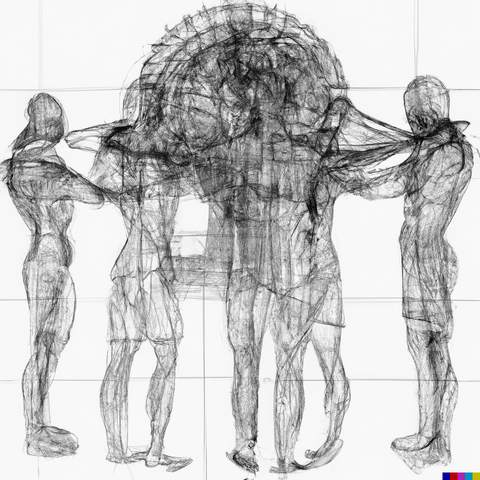

The Human Nature of Generative AIs and the Technological Nature of Humanity: Implications for Education
This paper applies a theoretical model to analyze the ways that widespread use of generative AIs (GAIs) in education and, more broadly, in contributing to and reflecting the collective intelligence of our species, can and will change us. The model extends Brian Arthur’s insights into the nature of technologies as the orchestration of phenomena to our use by explaining the nature of humans participation in their enactment, whether as part of the orchestration (hard technique, where our roles must be performed correctly) or as orchestrators of phenomena (soft technique performed creatively or idiosyncratically). Education may be seen as a technological process for developing the soft and hard techniques of humans to participate in the technologies and thus the collective intelligence of our cultures. Unlike all earlier technologies, by embodying that collective intelli-gence themselves, GAIs can closely emulate and implement not only the hard technique but also the soft that, until now, was humanity’s sole domain: the very things that technologies enabled us to do can now be done by the technologies themselves. The consequences for what, how, and even whether we learn are profound. The paper explores some of these consequences and concludes with theoretically informed approaches that may help us to avert some dangers while benefiting from the strengths of generative AIs.
 Lex
Lex Trex
Trex 

 JacobCoffin
