Bryan King
The Crossfire: Identity Confusion in Culture Wars
2,167 words, 11 minutes read time.
Marcus wasn’t a soft man. He had spent his twenties turning wrenches in a diesel shop, trading the skin on his knuckles for a steady paycheck until his back started locking up. Now at thirty-five, he was a project manager for a regional logistics firm, navigating supply chain bottlenecks, burning through phone batteries, and keeping demanding clients from blowing a gasket. He had a mortgage that kept him up at night, two kids who looked to him for everything, and a marriage he desperately wanted to protect from the exhaustion of modern life. He knew how to grind. He knew how to handle pressure.
But tonight, the pressure was coming through a five-inch screen.
It was 10:42 PM. The house was dead quiet except for the hum of the refrigerator. Marcus sat in his home office, the blue glow of his phone cutting through the dark. He was staring at a timeline that felt increasingly toxic, and right at the top of it was his brother, Jack.
They had grown up sharing a bunk bed, hunting in the same woods, and sitting in the same church pews. But lately, Jack had weaponized his feed. He spent his evenings dropping passive-aggressive “Christian memes” like digital cruise missiles, wrapping political anger in Christian vocabulary, explicitly designed to destroy and humiliate anyone he didn’t agree with. To Jack, a mocking graphic with a Bible verse slapped on the bottom was a holy act of war.
Tonight, Jack had posted a particularly brutal one, taking a scorched-earth shot at a local community issue.
Beneath it, the comment section was an absolute slaughterhouse. On one side, guys from Marcus’s weekly men’s group were cheering Jack on, dropping fire emojis and treating the mockery like a spiritual victory. On the other side, two of Marcus’s clients—men he respected, men who kept food on his family’s table—were firing back with deep-seated disgust, painting everyone with faith as an ignorant, hateful caricature.
Marcus felt like he was standing naked in no-man’s-land.
If he didn’t hit “like” or back his brother up in the comments, Jack would corner him at Sunday dinner, quietly questioning his courage and asking if he’d gone “soft.” If he didn’t distance himself from this kind of behavior at the office on Monday, his corporate reputation was shot. He was exhausted from trying to figure out which uniform he was supposed to wear. Was he a culture warrior? A corporate asset? A passive bystander?
His phone buzzed in his hand. A direct text message from Jack: “You see my latest post? You’re being awfully quiet out there, bro. Time to stand up for the truth.”
Marcus looked down at his calloused thumbs. He felt a hollow, heavy ache in his chest—a sudden, sharp realization of how deep the trap ran. The world wanted him angry. His own blood wanted him to pull the trigger on a digital sniper rifle.
His thumb hovered over the text thread. He could type a quick, non-committal response to keep the peace, he could jump into the digital mud to prove his loyalty, or he could shut the phone off entirely and face the fallout on Sunday.
He looked toward the hallway, where his wife and children were sleeping, relying on him to lead them through a world that was losing its mind.
Marcus held his breath, his thumb suspended over the screen.
– – –
Author’s Note
It is a tragic reality that many modern churches, the world, and many Christians, will readily accept what I call a “meme pastor”—those select few who post vile, judgmental memes online or constantly argue for harsh, unyielding judgments. These people are characterized by a dangerous heart posture: they search the Bible not for personal learning, and not for spiritual discernment, but exclusively for judgmental clobber passages. They tear scriptures out of their historical context and linguistic framework to prove their point, carrying zero concern for the severe spiritual damage they leave in their wake. They are exactly like the Pharisees who prayed on the street corners to be seen by men. Jesus leveled the verdict on them clearly: they have already received their reward in full.
I once watched a woman who has been divorced and remarried multiple times set herself up as an absolute judge and jury against a male-to-female transgender individual online. The irony was deafening. She is the modern-day “Woman at the Well”—a person intimately acquainted with brokenness and relational wreckage—yet she completely failed to extend a single ounce of the grace that was once given to her. Instead of offering living water, she chose to sit in the absolute comfort of her keyboard and spit pure, unadulterated vile. She didn’t want to rescue a soul; she just wanted to execute someone from behind a screen.
I’m not throwing stones from a glass house here. I’m writing this because I’ve been exactly where Marcus is, and in my own growth in Christ, I’ve stood on both sides of this digital battlefield.
I know what it’s like to play the role of the online sniper—I was once even called a Nazi inside a Christian group for drawing a line in the sand. But my posture has radically changed. Having felt the weight of my own brokenness, I now see how vital it is to actively stand up for the marginalized—the LGBTQ+ community, the poor, the modern-day tax collectors, and the societal outcasts—and intentionally offer them the exact same unmerited, life-altering grace that God extends to me on a daily basis.
If the Gospel isn’t big enough to cover them, it isn’t big enough to cover me or you.
But let’s be entirely straight up: when we weaponize our faith to destroy people online, we are guilty of castrating the Gospel. We trade the rugged, self-sacrificial mandate of Christ for a cheap, digital participation trophy. We think we are fighting a holy war, but we are actually just hiding behind a polished, fake Christianity because it’s easier to drop a mocking meme than it is to bleed for the broken.
We need to wake up to a brutal truth: you cannot meme, argue, or berate a heart of stone into a heart of flesh. Only God can change a human heart. Scripture is clear in Proverbs 21:1 that “The king’s heart is a stream of water in the hand of the Lord; he turns it wherever he will,” and it is God alone who promises in Ezekiel 36:26, “I will give you a new heart… I will remove from you your heart of stone.” When we try to force that change through digital execution, we are stepping into holy territory and getting in God’s way.
And let’s be perfectly clear about the danger here: getting between God and His sovereign will is a terrifying place for a man to stand.
Throughout Scripture, whenever men tried to force God’s hand, take His timeline into their own hands, or block His path, they weren’t met with a promotion—they were met with His wrath. You do not want to be found fighting against the very God you claim to serve.
The Seduction of the Counterfeit Crusade
It is fundamentally easier to be a culture warrior than it is to be a servant. True agape love requires a massive expenditure of physical energy, financial cost, and emotional endurance. If you are going to climb into the chariot with the eunuch or bandage the wounds of a man bleeding in the dirt, it is going to cost you something tangible—your time, your reputation, or your bank account.
Online engagement, however, offers a dangerous, low-cost counterfeit. When a man fires off a mocking meme or a devastating theological takedown, his brain receives an immediate hit of dopamine. He feels the rush of “winning.” He feels powerful. He convinces himself that he is standing up for the truth, but biologically and spiritually, he is just self-medicating his own passivity.
We have substituted the grueling, unpolished work of the cross for a digital colosseum where we get to watch people we dislike get torn apart, all while convincing ourselves we are doing God a favor. It allows a man to feel like a soldier without ever having to step into a real conflict or risk his own comfort.
The Pharisaic Need for an Enemy
In Matthew 23, Jesus doesn’t attack the Pharisees because their theology is entirely wrong; He attacks them because their hearts are completely devoid of mercy. The strict, unyielding judgment of the Law of Moses requires an “out-group”—a visible enemy—to validate the “in-group’s” righteousness.
When a man lacks a deep, authentic identity rooted in the finished work of the Cross, he will naturally look for identity through opposition. He defines who he is by pointing aggressively at who he is not. He stands in the digital temple, scrolling his feed, essentially praying the prayer of the Pharisee in Luke 18:11: “God, I thank you that I am not like other men.”
The moment your faith requires the public destruction, mockery, or alienation of another human being to feel valid, you are no longer operating in the Spirit of Christ. You are operating in the spirit of the accuser.
Our actual mission isn’t to win a cultural shouting match; it is to get down in the dirt and the blood to love the truly impoverished, the marginalized, and the rejects of society. Look at Acts 8, where the Spirit commands Philip to go to the desert road to meet the Ethiopian eunuch—a man completely excluded by religious law from entering the assembly of God, reading a scroll he couldn’t understand. Philip didn’t shout at him from across the road or mock his ignorance. He ran to his side, climbed into his chariot, met him exactly where he was, and brought him the good news of Christ.
Now, let’s be clear—our culture is full of unjustified claims of victimization, and we need correct discernment to see through the noise. But Christ and His disciples modeled a flawless judgment that allowed them to see the genuine, raw pain of the forgotten and deploy their lives to reach them, not to score points on a timeline.
The Spiritual Law of Symmetry
What should terrify every single one of us is the sobering reality of Matthew 7:2: “For with the judgment you pronounce you will be judged, and with the measure you use it will be measured to you.” If you want to judge others by the strict, unyielding standard of the Law of Moses, then God is going to hold your unpolished, broken life to that exact same standard. If you want to live by the digital sword, you will die by it.
Think about the wreckage we cause when we forget this. Jesus gave a terrifying warning in Matthew 18:6 about anyone who causes one of the little ones who believes in Him to stumble: “it would be better for him to have a great millstone fastened around his neck and to be drowned in the depth of the sea.” When our online rage, our mocking memes, and our religious arrogance cause seekers or weak brothers to stumble away from Christ, we aren’t accumulating crowns in heaven—we are tying a millstone around our own necks.
We have become like the Pharisees in Matthew 23:15, where Jesus levels the ultimate indictment: “Woe to you, scribes and Pharisees, hypocrites! For you travel across sea and land to make a single proselyte, and when he becomes a proselyte, you make him twice as much a child of hell as yourselves.” We are training men to convert to a political tribe rather than a crucified Savior, making them twice the sons of hell, consumed by the same tribal hatred we are.
It all culminates just a few verses later in Matthew 7:21-23, where men who thought they were doing “mighty works” in His name are met with the most terrifying verdict in all of Scripture: “I never knew you; depart from me, you workers of lawlessness.” They had the vocabulary, they had the public performance, but they lacked the actual DNA of the King.
Given the choice, I would rather stand before God having chosen an agape style of love that ran toward the chariot of the truly marginalized, rather than a life marked by internet judgmentalism.
Look at the wreckage of your own secret struggles, your own temper, and your own fears. When you stand before the King, do you want Him to see a man who loved like He did, or a man who hid behind a screen and demanded a standard he couldn’t keep?
Is that the kind of man you want to be?
SUPPORTSUBSCRIBECONTACT MED. Bryan King
Sources
- Proverbs 21:1 – Bible Gateway
- Ezekiel 36:26 – Bible Gateway
- Acts 8 – Bible Gateway
- Matthew 7:2 – Bible Gateway
- Matthew 18:6 – Bible Gateway
- Matthew 23:15 – Bible Gateway
- Matthew 7:21-23 – Bible Gateway
- Luke 18:11 – Bible Gateway
- Strong’s G26 – Agape Lexicon Study
- The Danger of the Judgmental Heart – Desiring God
- The Gospel and the Culture War – The Gospel Coalition
- The Seduction of Internet Outrage – Christianity Today
- Pastoring in the Age of the Internet Outrage Machine – 9Marks
- He Turns the King’s Heart – Ligonier Ministries
- What Does It Mean That God Will Give Us a New Heart? – Crossway
- The Law of Spiritual Symmetry – Bible Tools
- What is the Meaning of a Millstone Around the Neck? – GotQuestions
- The Anatomy of Christian Culture Wars – Commentary Magazine
- Taking Bible Verses Out of Context – Answers in Genesis
- The Digital Colosseum – First Things
- The Ethics of Online Engagement for Christians – Biola University
- The Pharisee Within Us – Dallas Theological Seminary
- Handling Scripture Responsibly – Reformed Theological Seminary
- The Heart of Flesh – Charles Spurgeon Archive
Disclaimer:
The views and opinions expressed in this post are solely those of the author. The information provided is based on personal research, experience, and understanding of the subject matter at the time of writing. Readers should consult relevant experts or authorities for specific guidance related to their unique situations.
#Acts8 #agapeLove #authenticFaith #biblicalDiscernment #biblicalManhood #christianCharacter #ChristianIdentity #ChristianMemes #christianTribe #churchPolarization #clobberPassages #countingTheCost #culturalShoutingMatch #cultureWarChurch #cultureWars #defendingTheFaith #digitalCrusade #Ezekiel36 #faithAndCulture #faithOnline #fakeChristianity #gospelCompromise #gospelTruth #graceVsLaw #internetOutrage #internetSniper #judgmentOfGod #KingdomOfGod #legalism #lovingTheMarginalized #Matthew18 #Matthew23 #Matthew7 #millennialChristians #modernDiscipleship #modernManhood #onlineMinistry #onlineWitness #pharisaism #phariseeMindset #Proverbs21 #religiousHypocrisy #scriptureInContext #selfRighteousness #servantLeadership #socialMediaOutrage #spiritualDrift #spiritualIntegrity #spiritualWarfare #trueGospel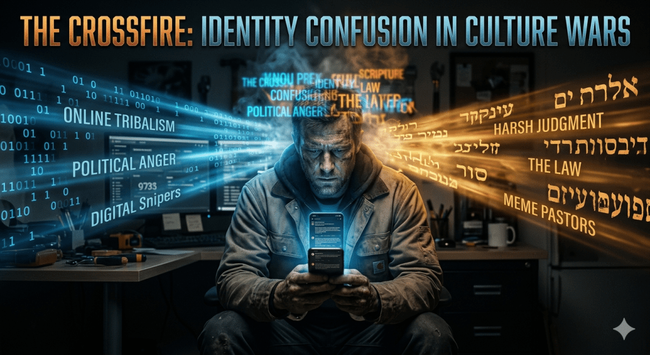
 WIST Quotations