NASA's #data collection has undergone massive shifts in lifecycle management, #FAIR_data, technological trends, and policy. Evolving from 1980s magnetic tapes to a network of over 30 online repositories, the tech trends are easiest to identify. Adoption of #DataPipeline and #DataStandards an ongoing focus. #DataGovernance and #DataRescue are emerging. NASA #DataStewardship navigates rapid technology and long-term science.

Bugbee, K., & Ramachandran, R. (2025) https://doi.org/10.1029/2025EA004413 #SciLit

Operationalize CARE data governance by 1) centering relationships both individual and institutional, 2) practicing ongoing learning and assessment of governance, 3) collaborative permitting including shared protocols, and 4) documentation of governance reflected in metadata and naming. Jennings et al 2025 https://doi.org/10.1038/s41467-024-53480-2 #DataGovernance #CAREData #OperationalEthics #SciLit

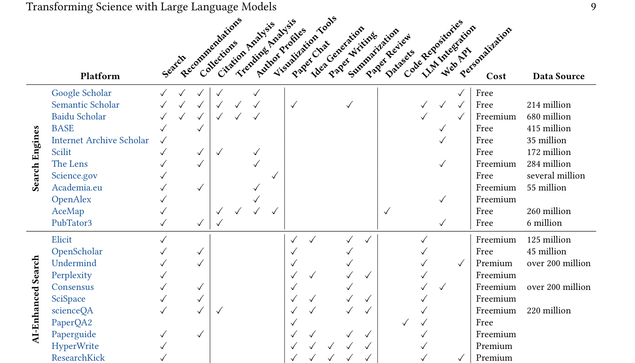
"Transforming Science with Large Language Models: A Survey on AI-assisted Scientific Discovery, Experimentation, Content Generation, and Evaluation"

Wonderful paper I found from my IArxiv.org feed. It gives nice comparison between features of the leading AI search engines.

#research #Elicit #SciSpace #Undermind #OpenScholar #Perplexity #OpenAlex #Scilit
#AceMap #ConnectedPapers #CiteSpace #Consensus #SemanticScholar #Lens
#ResearchRabbit #Baidu
#notesumAI #ResearchTrend
#ORKG

The ARID project scoped a possible new #dryland focused project area for NASA. Emerging high resolution spatial-temporal satellite and other data products provides new prospectives on the pulse-y hydrology that governs drylands. Drylands make up a large socially-important biome and right holder #engagement needs to be prioritized to provide #ActionableScience. Feldman etal 2024 https://doi.org/10.1029/2024EF004811 #SciLit
Training PhD students often follows ‘magician’s apprentice’ approach where advisors taking hands-on/off approach but rarely have a more nuanced language to discuss the advising journey. Wagner etal 2017 https://www.facetsjournal.com/doi/10.1139/facets-2015-0013 introduces stages 1) enthusiastic beginner, 2) discouraged learner, 3) cautious performer, and 4) self-reliant achiever. They frame roles and strategies for each stage for both the mentor and mentee and provide worksheets in their SI. #HowToScience #Mentoring #SciLit
How to share the process of graduate advising

This paper starts a two-part series on graduate advising that integrates concepts from adult learning, leadership, and psychology into a conceptual framework for graduate advising. A companion paper provides guidance on how to communicate effectively in graduate advising. Here, we present concepts and tools that enable advisors and graduate students to collaborate effectively and share the responsibility for the student’s learning. We specifically discuss (1) how to promote learning about learning to help students make sense of their experience and identify their supervision needs; (2) how to clarify roles and address conflicts of interest between different roles; and (3) how to establish an effective, learning-centered working relationship. By making the advising process explicit, using the concepts and worksheets presented here, advisors will contribute to the training of the next generation of graduate advisors.

FACETS

Agroecosystem is a promising shift in how we feed ourselves that has been under developed outside of academia for a number of political and economic reasons. Scientists, food security advocates, and social justice organizations need to rethink how we can leverage an integrated understanding of social and ecological systems to feed ourselves in the future. (Ong etal 2024 https://doi.org/10.1038/s43016-024-01006-w)

#agroecosystem #ecology #agricultural #TheoryOfChange #SciLit

New study: "Non-selective databases (#Dimensions, #OpenAlex, #Scilit, and #TheLens) index a greater amount of retracted literature than do databases that rely their indexation on venue selection (#PubMed, #Scopus, and #WoS)…The high coverage of OpenAlex and Scilit could be explained by the inaccurate labeling of retracted documents in #Scopus, Dimensions, and The Lens."
https://link.springer.com/article/10.1007/s11192-024-05034-y

#Retractions

The indexation of retracted literature in seven principal scholarly databases: a coverage comparison of dimensions, OpenAlex, PubMed, Scilit, Scopus, The Lens and Web of Science - Scientometrics

In this study, the coverage and overlap of retracted publications, retraction notices and withdrawals are compared across seven significant scholarly databases, with the aim to check for discrepancies, pinpoint the causes of those discrepancies, and choose the best product to produce the most accurate picture of retracted literature. Seven scholarly databases were searched to obtain all the retracted publications, retraction notices and withdrawal from 2000. Only web search interfaces were used, excepting in OpenAlex and Scilit. The findings demonstrate that non-selective databases (Dimensions, OpenAlex, Scilit, and The Lens) index a greater amount of retracted literature than do databases that rely their indexation on venue selection (PubMed, Scopus, and WoS). The key factors explaining these discrepancies are the indexation of withdrawals and proceeding articles. Additionally, the high coverage of OpenAlex and Scilit could be explained by the inaccurate labeling of retracted documents in Scopus, Dimensions, and The Lens. 99% of the sample is jointly covered by OpenAlex, Scilit and WoS. The study suggests that research on retracted literature would require querying more than one source and that it should be advisable to accurately identify and label this literature in academic databases.

SpringerLink
Flat teams drive scientific innovation, moving beyond team size Xu etal 2022 (https://www.pnas.org/doi/pdf/10.1073/pnas.2200927119) looked at reported contribution, contextual authorship records, and author ordering to disentangle + quantify relative leadership contributions. Tall teams maximize immediate benefits to senior leads, flat teams were more innovative. #TeamScience #SciLit
Socio-environmental design process for a just climate transition seeking to be community centered and adaptive rather the proscriptive, this approach blends complexity theory with social justice. Enfors-Kaustky etal 2021 https://www.ecologyandsociety.org/vol26/iss2/art39/ #JustTransition #ClimateChange #SciLit