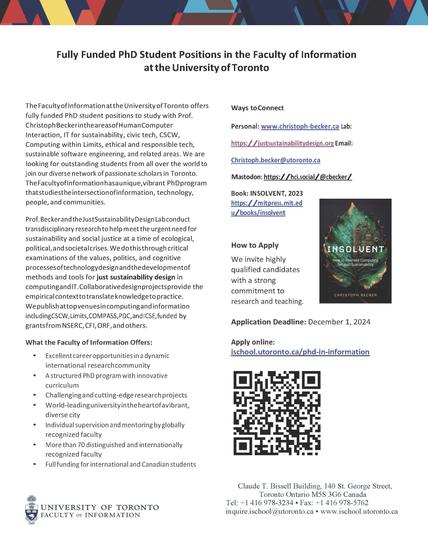
📢 The Faculty of Information at UofT offers fully funded PhD student positions to study w/ me in the areas of #HCI, IT for sustainability, #CivicTech, #CSCW, Computing within Limits, ethical & responsible tech, alternative AI, & related areas. Deadline: Dec. 1 for Fall 2025 start.

Come join the Just Sustainability Design Lab! https://justsustainabilitydesign.org/lab/

@academicchatter #PhD #UofT #sustainableHCI #ComputingWithinLimits #Degrowth #TechOtherwise #RRI #ResponsibleComputing

JSD Lab

Technologies for Just and Sustainable Communities.

Doing the monthly backup of my home computer and hard drives.

#TimeShift #Rsync #Linux #Mint #ResponsibleComputing

Six steps to corporate responsible computing.

Digital technology also harms the planet. We need a framework for responsible use.
By Llewellyn D.W. Thomas (IESE), Rashik Parmar (CEO at BCS, The Chartered Institute for IT) and Marc Peters (IBM)

https://www.iese.edu/insight/articles/six-steps-to-corporate-responsible-computing/
#responsiblecomputing

Six steps to corporate responsible computing

Digital technology also harms the planet. We need a framework for responsible use.

IESE Insight

Our next #BCSPolicyJam - Tomorrow, 14th March 12-1PM, join us!

Looking at:

Chris Skidmore MP's #MissionZero Report Role of #OpenSource, #GreenIT & #ResponsibleComputing in #NetZero

Panel -

@bcs CEO Rashik Parmar

@openuk_uk CEO @AmandaBrock

Carbon 3IT MD John Booth

https://www.eventbrite.co.uk/e/bcs-policy-jam-registration-514925083787

BCS Policy Jam

Join the BCS policy team for a monthly forum where we will engage with our members. We will hold these 'Policy Jams' every third Wednesday.

Eventbrite

Part of my day job is chairing the Responsible Systems working group of the Responsible Computing Consortium.

Here's a short article I wrote about Generative AI and a Responsible Systems approach.
https://responsiblecomputing.net/a-responsible-systems-approach-to-generative-ai/

#generativeAI #responsiblecomputing #responsiblesystems

A Responsible Systems Approach to Generative AI - RC

Generative Artificial Intelligence (AI) has become a technology tour de force in recent years, allowing the use of natural language to "create" and lending credence to the idea of an emerging Artificial General Intelligence (AGI).

RC
@paulralph @gvwilson @seresearchers And if anyone were to write a good article about all this, the new @ACM Journal of Responsible Computing would be glad to consider it! 😉 #ethics #ResponsibleComputing https://dl.acm.org/journal/jrc
ACM JOURNAL ON RESPONSIBLE COMPUTING Home

The ACM Journal on Responsible Computing (JRC) publishes high-quality original research at the intersection of computing, ethics, information, law, policy, responsible innovation, and social responsibility from a wide range of convergent, interdisciplinary, multidisciplinary, and transdisciplinary perspectives. We welcome papers using any or a combination of computational, conceptual, qualitative, quantitative, and other methods to make contributions to knowledge, methods, practice, and theory, broadly defined. Relevant domains include but are not limited to: Values and ethics in the design and evaluation of computing and information technology; Ethical and societal implications of computing and information technology; Public interest technology (information technology that serves the public interest); Fairness, accountability, and transparency in computing and information technology; Computing, information, health, and wellbeing; Approaches to addressing threats such as adversarial machine learning, misinformation, and disinformation; Examples of how computing and information can be leveraged to achieve outcomes that benefit humanity. The journal encourages contributions that address emerging areas in computing and information including but not limited to artificial intelligence, extended reality, internet of things, machine learning, and quantum computing, as well as a wide range of ethical frameworks and perspectives from a contemporary global perspective. Authors from the Global South, from groups currently underrepresented in computing and information, and from communities adversely affected by inequities in computing and information are particularly encouraged to submit. We are particularly interested in papers that bring a convergent, interdisciplinary, multidisciplinary, and transdisciplinary perspective, and that include an orientation toward culturally relevant and situated ethical perspectives and human values.

ACM Journal on Responsible Computing

I'm organizing a conference at Harvard on the ethics of technology! We're looking for research or teaching presentations on #AIethics, #ResponsibleComputing, #Philosophy of technology, and other areas.

The conference will also launch a new consortium of teacher-scholars at Harvard, MIT, and Northeastern. Registration information will be available in the new year.

Here's the call for submissions: https://philevents.org/event/show/105273

Boosts and shares appreciated!

@philosophy @facct

Inaugural Conference of the Technology Ethics eXchange of the NorthEast

The Technology Ethics eXchange of the NorthEast (teχnē) invites submissions of extended abstracts for an interdisciplinary conference on research and teaching on the ethics of technology, to be hosted at Harvard on May 18–19, 2023. Potential topics for submissions include but are not limited to: Philosophical research on AI ethics, the ethics of computing, or the ethics of technology generally Social research on the impacts of technologies Interdisciplinary research in responsible computing and responsible technology development Scholarship on educational initiatives in responsible computing and STEM ethics, such as courses, modules, workshops, or masterclasses Pedagogical reports of success stories, challenges, and strategies for teaching ethics to students in technology-focused concentrations Submission details: Submit an extended abstract of no more than 750 words, along with other requested details, through the following form: https://forms.gle/CKBbHNogcQheX4AY9 The submission must be suitable for a 25–30 minute presentation, to be followed by Q&A. Deadline: February 3, 2023 (anywhere on Earth). Accepted presenters are expected to attend the conference in-person, but the event will be livestreamed via Zoom. For more information, visit the conference's main PhilEvents page https://philevents.org/event/show/105209 or email [email protected]

#Introduction Post to be pinned.
(just realized I've not done this here 😂 )
PhD Candidate @ UCD Ireland
(MA/BA in Clinical Counseling/Psych)
Employed:
Office of Research - Dell
Responsible Computing Consortium member (ask me about joining)

Interests/Research:
#agonism
#adversarialagonism
#socialtransformation #data #systems #responsiblecomputing

Further to the last boosted post about the lawsuit against GitHub Copilot – https://fediscience.org/@riedl/109282064359790093

This case connects with something I’m thinking about in connection with AI image generators like DALL•E, but it shows that this issue generalizes to any case of AI trained on data scraped from the web. There’s a presumption in AI development that data of any kind that one finds on the public web is free for the taking. They treat those data as, in effect, unclaimed natural resources, the sort of thing that John Locke argued is yours once your labour improves or builds upon it to produce something new.

But this is false on its face. First, as decolonial thinkers have pointed out, no natural resources are “unclaimed”—what explorers found and declared to be terra nullius actually belonged to indigenous communities. Data on the web are no different: they don't just exist there waiting to be exploited; they belong to real people on the other side of the network. The resource-extraction mindset of AI development based on data scraped from the web is modelled after the plunder and pillage of colonization.

Second, and building on this, as the lawsuit against GitHub Copilot argues, these data are the intellectual property of their creators. Code uploaded to GitHub is rarely released into the public domain; it is often libre or open source, and where no licence is included the presumption should be that it is protected by copyright. The lawsuit alleges that coders’ intellectual property rights have been infringed by the developers who used their code to train Copilot, because the terms of the various copyright licences have not been respected.

Third, even if the lawsuit and similar legal arguments don't succeed, there’s an ethical argument about intellectual property that does. This brings us back to Locke: recall that he argues that things produced by your labour are yours by right. This argument has been used to justify intellectual property rights as well as physical property rights: the products of your labour belong to you, so long as what you transformed with your labour wasn’t itself stolen. This goes for both the labour of the body and the labour of the mind—creative and intellectual labour, such as that which goes into writing code or painting digital images. But Locke's argument is set up so that it doesn't depend on any particular legal framework of property rights, intellectual or otherwise. His account of labour and property is set in the state of nature, where there is no government or law to enforce anyone’s rights.

So the ethical point stands regardless of whether the lawsuit against Github Copilot succeeds or fails. Using code or images or whatever kind of data you can download from the web and encode for training AI, without seeking permission from the creators or respecting the terms under which they licensed their work, is theft. And, it is not just theft of intellectual and creative property: it’s theft of labour and plunder of goods that the colonialist mindset frames as unowned.

There are plenty of unanswered questions here of course but I'm interested to hear what folks think of this argument. I'm currently working on writing it up as a paper, maybe for @facct. Am I missing anything? What objections do I need to answer?

Here’s the announcement of the lawsuit against GitHub Copilot: https://githubcopilotlitigation.com/

#aiEthics #ethicsOfComputing #artificialIntelligence #AI #ethics #philosophy #facct #responsibleComputing #techEthics #computerEthics #computerScience

Hi, all. I'm a writer and educator, currently working as a Postdoctoral Fellow of Embedded EthiCS in the Department of Philosophy at Harvard University.

In my day job, I’m currently writing about moral responsibility, epistemic injustice, and the ethics of computing and artificial intelligence. I'm also interested in the philosophy of education, feminist philosophy, queer theory, and scholarship of teaching and learning. I also help develop and teach ethics modules that are embedded into computer science courses at Harvard, and in the spring I’ll be teaching an ethics of computing course for Harvard College. Before this, I worked with Ethically Aligned AI, Inc. and Athabasca University to create an AI ethics micro-credential certificate; held a Banting Postdoctoral Fellowship at Dalhousie University in Halifax, NS; and studied at Waterloo, York, Toronto, Sheffield, and (briefly) The Graduate Center, CUNY.

When I'm not on the clock, I'm pretty much always thinking about, writing, or playing tabletop roleplaying games. For that side of my life, follow @ErrantCanadian

A heap of hashtags for visibility because searching Mastodon for people to follow is hard:
#introduction #twitterMigration #mastodonMigration #philosophy #AIethics #ethicsOfComputing #appliedEthics #epistemology #epistemicInjustice #ethics #moralResponsibility #responsibleComputing #SoTL #scholarshipOfTeachingAndLearning #queerTheory #feministPhilosophy #feministTheory #feminism #philosophyOfEducation #ttrpg #writing #teaching