Tonight I got a message from a fellow #appleII nerd, who got a #Quicktake for Christmas, tried it with his Apple II and had everything work perfect from start.
If fills me with joy, both on the software side and on the documentation side (custom cable building required! )

Repórter Retro 120
https://retropolis.com.br/2025/11/28/reporter-retro-120/
#ReprterRetro #8BitGuy #AcornArchimedes #AdrianBlack #Amiga #Apple #ARPANET #ArtefatosDeCor #Bendix #C #CmeraDigital #CoCoTown #Comix35 #Comx35 #COSMAC #crash #DeVoltaParaOFuturo #DosBox #DRAM #ElectronikaBK #Elektronika #FbioNMI #fail #Hercules #Homebrew #IBM #imagens #Intel80386 #Jogos #Macintosh #MazeOfGalious #MSDOS #MSXRio #MSXSP #NTSC #Olivetti #PampasAndSelene #PhintageCollector #ProdestPC #Quicktake #RCACDP
Este é o Repórter Retro 120, produzido pela A.R.N.O. (Agência Retropolitana de Notícias)! MP3 para ouvir offline Escute no YouTube Do que falamos? 40 anos da rede Token Ring 40 anos do C++ 40 anos do Intel 80386 (ou apenas 368 para os íntimos) O processador que mudou o jogo O processo de boot do
This week-end's release of #Quicktake for Apple II brings another 30-plus-second improvement on the Quicktake 200 decoder, down from 103 to 68 !
https://www.colino.net/wordpress/en/quicktake-for-apple-ii/
I am starting to be very happy with the performance of all three decoders.
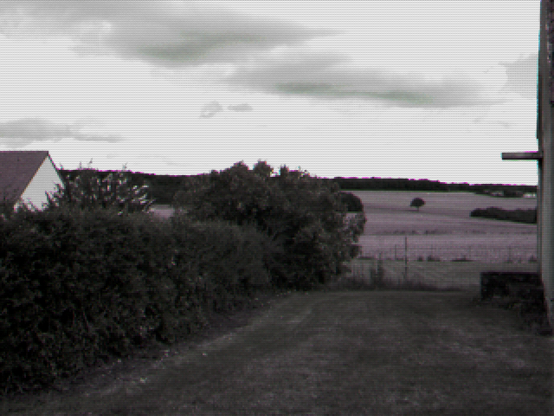
I managed to get a "for parts" #Quicktake 150 for 15 euros, it only needed 15 minutes of work to "fix it" (the Trash button was stuck down). Here's its first picture!
This week-end's release of #Quicktake for Apple II brings the decoding speed to under 60 seconds for Quicktake 150 pictures.
Quicktake for Apple II is a program to fetch and view your Quicktake pictures on your Apple II. Reject planned obsolescence!
6502 optimisation challenge anyone?
This is one of the two longest functions in my #Quicktake 150 decoder, it's called 110k times, takes 7.9M cycles.
The vars are in zero-page already.
The function reads bits from a buffer to get the next valid Huffman code out of the buffer and return its value.
I'm out of ideas :)
Edit: Reading multiple bits using a lookup table will not be better, as it requires a 16-bits buffer which is extremely slower to asl/rol. It was the previous implementation.
The function:
https://www.colino.net/tmp/getdatahuff.s.txt
Still on the #Quicktake 150 decoder. I didn't think actually looking close at the data would really help, but I did, and it did. Apparently the most common factor (which is used for half the pixels, both multiplying and later, dividing) is 48, and appears more than 50% of the time in my test set of 30 pictures. Sometimes more than 70% of the time.
That called for special-casing. The division became a lookup table, losing a bit of precision in a non-visible manner, and the division n/48 became equivalent to (n&0xFF00)/48.
This got us to < 100 seconds decoding time!