 osr
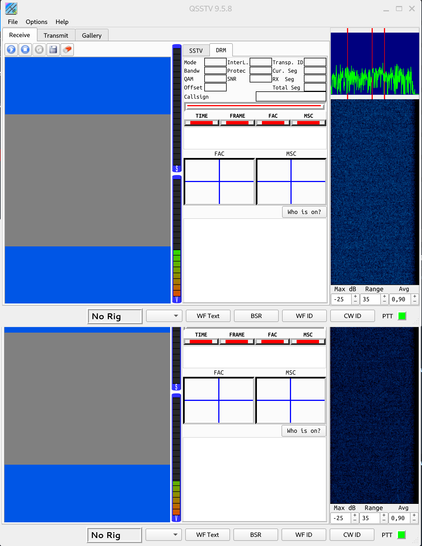
osrImagen en Cassette (QSSTV)

Imagen en Cassette (QSSTV)
@Quantensalat At least #OpenWebRX+ and #QSSTV support P5 and P7, so there should be enough common software around to decode them
I've been trying to receive some Digital SSTV pictures with #QSSTV the whole evening, but there doesn't seem to be much going on on 20m and 40m. At least not at my receiver location and with my #RTLSDR.
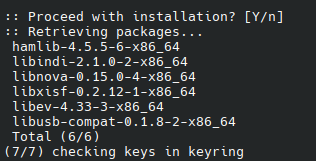
Why does QSSTV have libindi (astrophotography camera library) as a dependency
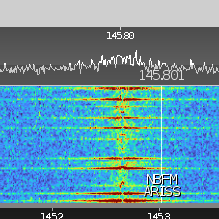
Welp, so much for enjoying #ARISS #SSTV transmissions from space this week.
Yesterday, there was NOTHING on this frequency except while the ISS was above the horizon.
Today, all morning so far, there's been a strong, pulsating signal right on 145.800MHz.
We had a good pass around 9:35am here. Got enough of the tones such that #QSSTV started to draw a picture, but the QRM (which seems malicious & intentional) made it entirely illegible.
I'd never seen #QSSTV decode anything but colorful snow/noise. Figured I'd better test this.
Found an SSTV audio test at https://www.youtube.com/watch?v=SffT9U8scBc to play through my headphones, which sat upon my HT, transmitting lowest possible power at 144.8MHz.
With QSSTV's Mode set to Auto, no joy. But when I forced it to PD120, I got a perfect copy of the image.
Need to test whether "Auto" even works, or find out in advance what mode #ARISS will use.

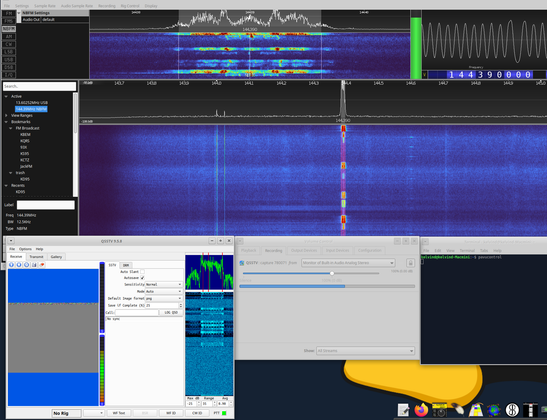
I've got #CubicSDR running, outputting to the Mac Mini (linux) headphone jack.
Then I've got pavucontrol running a Monitor of Stereo Output, & set the Recording Input to be that same Monitor.
Then #QSSTV is listening to the PulseAudio Sound Server.
Shown, it's on the APRS 2m frequency, just so I can SEE some signal making it all the way through.
@aregsstv "Wasn't watching the S-meter"…
20m definitely seems to be the better band QG62→PF95.
That image was via QSSTV.
Did some more experiments with #SSTV this afternoon.
This time, using #QSSTV. Not sure why, but modulation is well down. Receive is fine. The command I used last time is fine too. Just QSSTV is "low".
I had to also make up my own #rigctld implementation, enough to fool QSSTV into thinking it was the real deal, so I could use that to control the GPIO pin on the UDRC-II for PTT. This is hacky and nasty, but it's enough to trick QSSTV.
Well today trying to receive the #ISS #SSTV experiment yielded nothing to be heard on 437.800MHz over #PF95. and one the passes was 60°+ in the sky. 😿
my setup was FT-857D, X50M antenna, digirig, laptop for hardware side. Software had #rigctld, #gpredict interfaced with rigctld to control the doppler, and #QSSTV to do the decode of the signal.
 Simon DC6ST
 Sturmflut
 myska
myska 
 Kelvin n0mql EN35ld
 Stuart Longland (VK4MSL)
 de VK5ZSH 🇦🇺 🐧 🏳️🌈