 Bernd von Mallinckrodt 🦋
Layered Early-Warning Architec...
Layered Early-Warning Architecture under Partial Observability: CRTI, Projection Geometry, and ORCI as a Modular Monitoring Framework
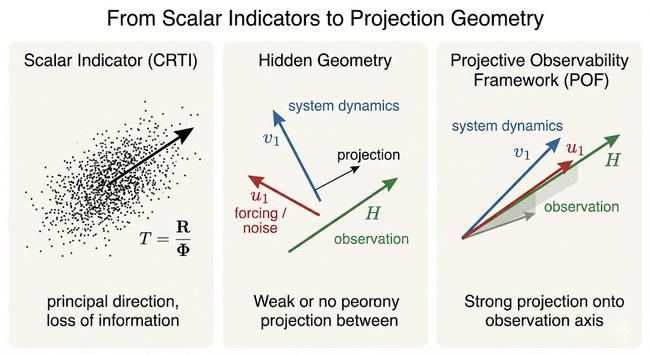
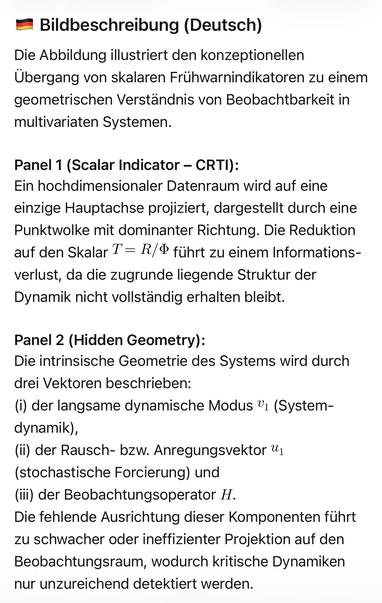
Diese Arbeit präsentiert eine modulare Architektur für Frühwarnsysteme unter partieller Beobachtbarkeit in komplexen dynamischen Systemen. Der Ansatz trennt drei Ebenen, die in der bisherigen Literatur häufig vermischt werden:(1) die latente strukturelle Dynamik des Systems, beschrieben durch den Compression–Response Transition Index (CRTI),(2) die Projektionsgeometrie des Beobachtungsoperators, beschrieben durch PDF/POF (Projection Detectability / Projection Observability Functions), sowie(3) die empirische Nachweisbarkeit unter endlichen Daten, Rauschen und begrenzter Sensorik, beschrieben durch ORCI (Observer-Relative Critical-Information Audit). Die Arbeit argumentiert, dass viele Fehlinterpretationen von Frühwarnsignalen nicht primär aus falscher Dynamikmodellierung entstehen, sondern aus projektionsabhängigen Beobachtungsgrenzen. CRTI wird dabei als latenter Strukturindikator interpretiert, PDF/POF als geometrische Sichtbarkeits-Schicht und ORCI als operationales Beobachter-Audit. Das Ziel ist keine neue physikalische Theorie, sondern eine wissenschaftlich belastbare Monitoring-Architektur, die geometrische Observability-Theorie, Informationstheorie und empirische Frühwarnsysteme modular miteinander verbindet. Keywords (DE):Frühwarnsignale, kritische Transitionen, partielle Beobachtbarkeit, nichtlineare Observability, Informationsgeometrie, Fisher-Information, effektiver Rang, Spektralentropie, Projektionsgeometrie, Systemmonitoring, komplexe Systeme, ORCI, CRTI, PDF, POF English – Description This paper presents a modular architecture for early-warning monitoring under partial observability in complex dynamical systems. The framework separates three layers that are often conflated in the literature:(1) the latent structural dynamics of the system, represented by the Compression–Response Transition Index (CRTI),(2) the projection geometry of the observation operator, represented by PDF/POF (Projection Detectability / Projection Observability Functions), and(3) the empirical detectability of warning signals under finite data, noise, and limited sensing, represented by ORCI (Observer-Relative Critical-Information Audit). The paper argues that many failures of early-warning systems arise not primarily from incorrect dynamical modeling, but from projection-dependent limitations of observation channels. Within this architecture, CRTI functions as a latent structural indicator, PDF/POF as the geometric visibility layer, and ORCI as an operational observer audit. The contribution is not a new physical law, but a scientifically defensible monitoring architecture that modularly connects geometric observability theory, information theory, and empirical early-warning methodologies. Keywords (EN):early warning signals, critical transitions, partial observability, nonlinear observability, information geometry, Fisher information, effective rank, spectral entropy, projection geometry, systems monitoring, complex systems, ORCI, CRTI, PDF, POF

 Fahrenheit
 🅱🅸🅶🅾🆁🆁🅴.🅾🆁🅶
 Freezenet
 Lorry
Lorry Cambrian_Kid