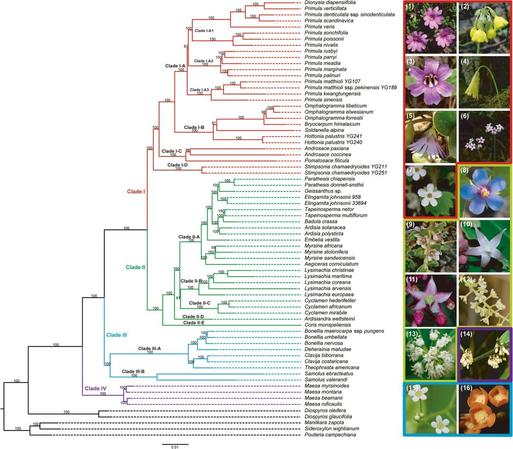
Yan et al. use whole #plastid #genomes to clarify the complex #evolutionary history of the Primulaceae, laying groundwork for future studies that may unravel the intricate #evolutionary dynamics within this #plant family.

https://doi.org/10.1111/jse.13154

@WileyEcolEvol
#systematics #JSE #botany

Using whole #plastid #genomes, Yan et al. elucidate the complex #evolutionary history of the #Primulaceae and lay the groundwork for future research to unravel the intricate #evolutionary dynamics within this family.
https://doi.org/10.1111/jse.13154
@WileyEcolEvol
#systematics #JSE #botany
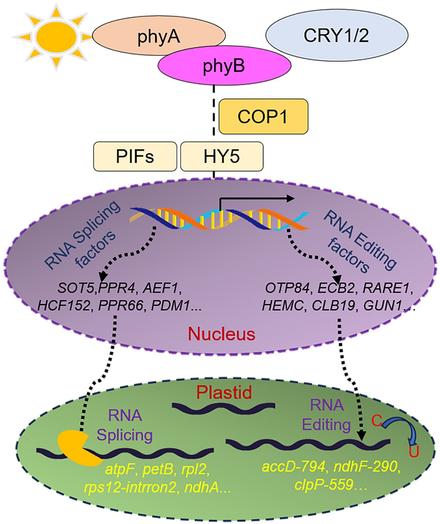
Hu et al. shed some💡#light💡on the mechanisms underlying light-mediated post-transcriptional #regulation of #plastid #gene expression.
https://doi.org/10.1111/jipb.13779
@wileyplantsci
#JIPB #PlantScience #RNA #plant #PlantDevelopment #Arabidopsis #HY5 #PIF1
The evolutionary history of plant #plastid & #mitochondrial proteomes reveals that major changes in #organelle biology may have facilitated #plant diversification and the emergence of major lineages such as land plants @Parthkr21 @watertoland #PLOSBiology https://plos.io/3wngsUn
A molecular atlas of plastid and mitochondrial proteins reveals organellar remodeling during plant evolutionary transitions from algae to angiosperms

Tracing the evolutionary history of plant plastid and mitochondrial proteomes reveals that major changes in organelle biology may have facilitated plant diversification and the emergence of major plant lineages such as the land plants.

❤️#Bryophytes? Same!

Li et al. reveal a reconstructed ordinal & familial #phylogeny of bryophytes, created using the largest #plastid #data set to date, incl. 549 taxa representing almost all known orders and 2/3 of families!
https://doi.org/10.1111/jse.13063
@WileyEcolEvol
#PlantSci #botany

Just read this, https://www.pnas.org/doi/10.1073/pnas.2317240121, that extraordinary high rate of mtDNA evolution in some plants is associated low mtDNA copy number. Lower Ne is the obvious explanation - but the authors instead put fwd homologous recombination, because it is less effective in low copy number environments. More complicated explanation, with no direct evidence? Thoughts?
#genomics #mtDNA #mitochondria #plastid #plants

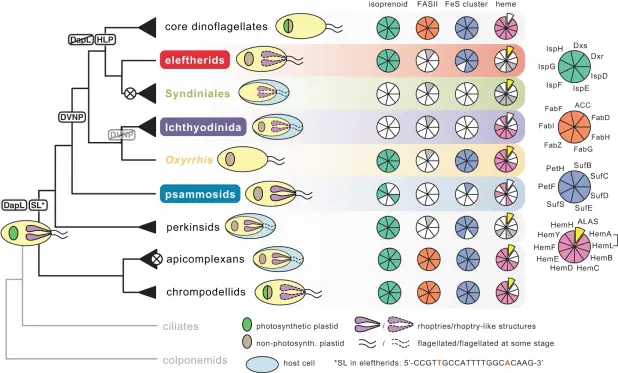
New #ISEPpapers! Multiple parallel origins of parasitic Marine Alveolates https://www.nature.com/articles/s41467-023-42807-0 #protists #parasites #microbes

"similar forms of #parasitism evolved multiple times and #photosynthesis was lost many times. By contrast, complete loss of the #plastid #organelle is infrequent and, when this does happen, leaves no residual #genes."

Multiple parallel origins of parasitic Marine Alveolates - Nature Communications

The Marine Alveolates (MALVs) include important parasites of other protists/animals. Here, using new data from MALV-I, the psammosids, and a new group called the eleftherids, the authors show MALVs, and therefore parasitism in early dinoflagellates, evolved from two distinct free-living ancestors.

Nature

Some #microalgae smartly switch energy systems to support growth under nutrient limitation https://microbiologycommunity.nature.com/posts/some-microalgae-smartly-switch-energy-systems-to-support-growth-under-nutrient-limitation

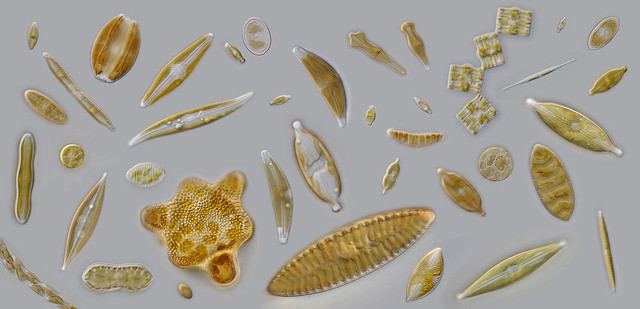
#Plastid-localized #xanthorhodopsin increases #diatom biomass and ecosystem productivity in iron-limited surface oceans https://www.nature.com/articles/s41564-023-01498-5

"marine #diatoms, a globally important group of #algae can switch between #photosynthesis and a light-driven #rhodopsin proton pump to support growth in iron-deprived waters"

#protists #microbes #metabolism #plankton

Some microalgae smartly switch energy systems to support growth under nutrient limitation

In a recent article published in Nature Microbiology, we show how marine diatoms, a globally important group of microalgae can switch between photosynthesis and a light-driven rhodopsin proton pump to support growth in iron-deprived waters. (Poster image: Oliver Skibbe, CC BY 4.0)

Springer Nature
⏩Coming through!⤵️🕳️
In a new #plant #cell #biology study, Zhang et al. find that #plastid KEA-type cation/H+ antiporters are required for vacuolar #protein trafficking in #Arabidopsis.
https://doi.org/10.1111/jipb.13537
@wileyplantsci
#JIPB #vacuole #stromules #antiporter #plantscience #PlantSci
#SciFi? More like #PlantSci!
In a new #plant #cell #biology study, Zhang et al. find that #plastid KEA-type cation/H+ antiporters are required for vacuolar #protein trafficking in Arabidopsis
https://doi.org/10.1111/jipb.13537
@wileyplantsci
#JIPB #vacuole #stromules #antiporter #PlantScience