 PGYBMS
If your 🔋lithium battery🔋 suffers from bulging, overheating or shortened runtime, install a PGY BMS for protection.
PGY-141 8-24S 60-200A
⚙️Mobile APP Monitoring
⚙️ Active Balancing Technology
⚙️ NTC Temperature Monitoring
If your 🔋lithium battery🔋 suffers from bulging, overheating or shortened runtime, install a PGY BMS for protection.
PGY-141 8-24S 60-200A
⚙️Mobile APP Monitoring
⚙️ Active Balancing Technology
⚙️ NTC Temperature Monitoring
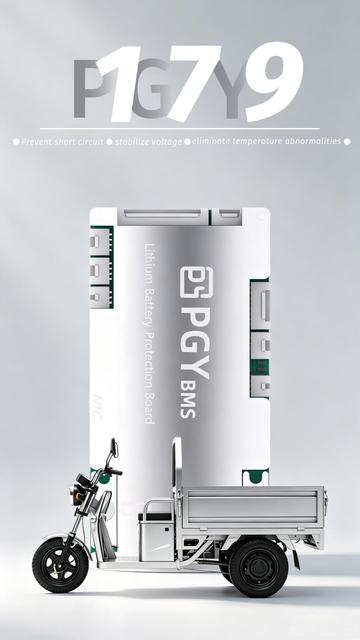
🔋PGY-179🔋
✅RS485 communication✅long-distance anti-interference✅
✅ Supports Bluetooth connection to mobile phones✅
✅ Suitable for lithium iron phosphate batteries✅

🔋PGY-179 🔋
Protect your battery health
⚙️Supports Bluetooth connection to mobile APP
⚙️ RS485 communication technology
If you want to protect your lithium battery products, PGY BMS is definitely the wise choice.
⚙️ maintain stable voltage
⚙️ prevents abnormal temperature
⚙️extends battery life
Come and buy a suit of armor for your lithium batteries!
Fast protection isn’t always better
Engineers often try to make overvoltage protection as fast as possible.
But:
Lithium cells tolerate brief transients
Overly fast cutoff → nuisance trips
System-level stability suffers
📊 Better approach:
Use time-based filtering + voltage thresholds
👉 Think in terms of:
“Is this dangerous?” vs “Is this momentary?”
www.pgybms.com +85264793197 +85265053443
Your BMS measurement error is probably a layout problem
Even with a good IC, poor PCB design ruins everything.
Top mistakes:
Shared ground paths for power and sensing
No Kelvin connection for shunt resistor
High-current traces too close to signal lines
📉 Result:
Offset errors, noise injection, unstable protection behavior.
👉 Fix:
Treat current sensing like analog precision design, not power routing.
Passive balancing isn’t as “simple” as it looks
Many assume passive balancing = safe + reliable.
But in practice:
Heat dissipation becomes a bottleneck
Balance current is often too low for large packs
Timing strategy matters more than hardware
📌 Observation:
In multi-cell packs, imbalance is often driven by temperature gradients, not capacity differences.
👉 Design tip:
Balance control logic > resistor selection.
Choosing MOSFETs for BMS? Rds(on) is NOT enough.
Many designs fail because engineers optimize only for conduction loss.
In reality
Rds(on) vs thermal rise
Gate charge (Qg) → switching speed & driver stress
SOA (Safe Operating Area) under fault conditions
⚠️ Key insight:
Short-circuit events stress MOSFETs far beyond steady-state specs.
👉 Rule of thumb:
Always validate MOSFET behavior under pulse conditions, not just DC.