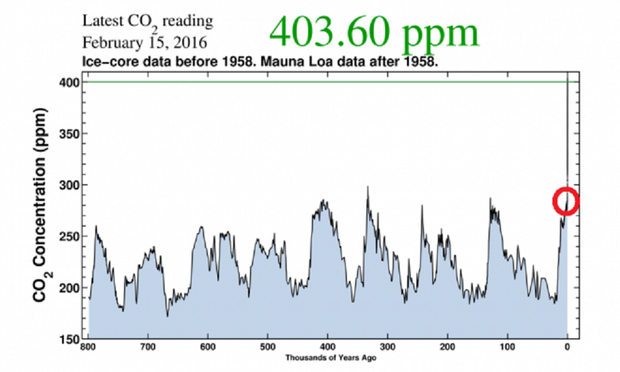
Vandaag 10 jaar geleden https://sailing-dulce.nl/home/article-4786 #koolstofdioxide #primateritis #PETM #JansenSteur Woensdag 17-02-2016 Omzien naar het verleden is vaak leerzaam. Hierboven een grafiek, gebaseerd op ijsboorkernen en na 1958 op metingen. Hij toont de CO2-concentraties over de afgelopen 800.000 jaar. Keurig tekenen zich de verschillende ijstijden en de tussenliggende warme periodes, de interglacialen, af. Rechts zie je hoe bizar hoog de huidige concentraties van kooldioxidegas in de atmosfeer zijn..

From 2021: An Ancient Era of #GlobalWarming Could Hint at Our Scorching Future [Bonus -- We're adding #PFAS, #microplastics and #radiation to the mix! Oh boy...!]

Looking back at the strange and sweaty days of the #PETM.

by Riley Black, August 16, 2021

"THERE WAS A TIME when alligators slid through weed-choked swamps near the North Pole. Some 55 million years ago—just around 10 million years after the mass extinction that killed T. rex and most of its kin—the average global temperature sat more than 20°F higher than it does today. Subtropical forests spread to northern latitudes, and mammals thrived in lush new habitats.

"The toasty weather had nothing to do with the event that killed the dinos. The driver for the climatic shift came not from above, but from below—in Earth’s oceans. Paleontologists and geologists suspect that some amount of natural warming that took place during the Paleocene, or the period following the die-off, caused great deposits of crystallized methane to transform into gas. Seabeds belched the excess out into the water and the air, which was bad news for the planet: Methane is a greenhouse gas far more potent than carbon dioxide. The globe rapidly warmed in response—jumping about 10°F in less than 20,000 years—and held steady for some 70,000 more before starting a long and slow recovery.

"Paleontologists call this hot spot the #Paleocene​EoceneThermalMaximum (PETM). It’s a time when subtropical forests spread over the continents and new animals got to stake their claims on the planet, all thanks to an atmosphere and oceans in turmoil. This part of the fossil record is a remnant of the past, but it may also be a preview of our future."

Read more:
https://getpocket.com/explore/item/an-ancient-era-of-global-warming-could-hint-at-our-scorching-future?utm_source=firefox-newtab-en-us

#HungryInsects #DeadZones #LossOfOceanOxygen #ToxicAlgae #RapidEvolution #StrangeNewRains #Extinction #NewLifeForms

An Ancient Era of Global Warming Could Hint at Our Scorching Future

Looking back at the strange and sweaty days of the PETM.

Pocket

#climate #petm

An ancient warming event may have lasted longer than we thought
https://phys.org/news/2025-05-ancient-event-longer-thought.html

An ancient warming event may have lasted longer than we thought

Fifty-six million years ago, during the Paleocene-Eocene Thermal Maximum (PETM), global temperatures rose by more than 5°C over 100,000 or more years. Between 3,000 and 20,000 petagrams of carbon were released into the atmosphere during this time, severely disrupting ecosystems and ocean life globally and creating a prolonged hothouse state.

Phys.org
Inbox | Substack

“"De klimaatverandering in het PETM ging ongeveer tien keer zo langzaam als wat wij nu doen", zegt Sluijs. In de afgelopen eeuw is de aarde ruim 1 graad opgewarmd, en we stevenen af op bijna 3 graden in 2100.”

Aarde: “Seen that done that.”
Mensheid: “We are done.”

#OpwarmingVanDeAarde
#Overstromingen
#PETM

Overstromingen Spanje waren echo van klimaatverandering in prehistorie https://www.nu.nl/klimaat/6339767/overstromingen-spanje-waren-echo-van-klimaatverandering-in-prehistorie.html

Overstromingen Spanje waren echo van klimaatverandering in prehistorie

Valencia werd in oktober totaal verrast door de overstromingen die meer dan tweehonderd mensen het leven kostten. Maar diep onder de grond werd jaren geleden al bewijs gevonden dat dit zou kunnen gebeuren, zegt hoogleraar Appy Sluijs in een eindejaarsinterview met NU.nl.

NU

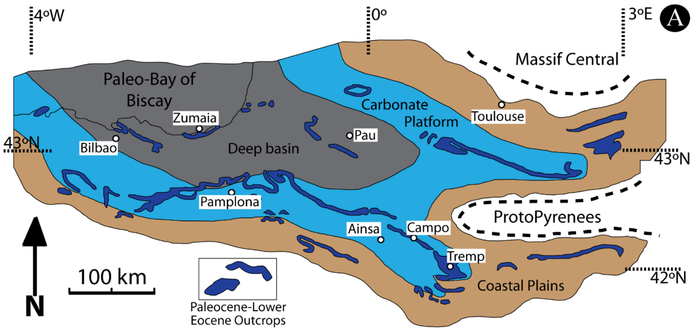
Congratulations to Dr. Pascale Daoust, who successfully defended, "Ocean Acidification: Insights from the Behaviour of Ancient and Modern Carbonates", supervised by Al Mucci and Galen Halverson.

The work involved field and laboratory studies of the Paleocene-Eocene Thermal Maximum section near Campo, Spain.

The figure shows the depositional environments at the time; from Daoust et al, submitted, modified from Pujalte et al. (2014)

#McGillUniversity #EarthSystemScience #Carbonates #PETM

🚨new #preprint🚨
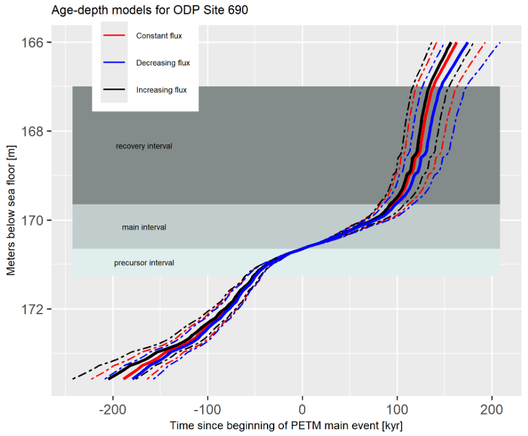
Age depth models are crucial to determine the timing and rate of past change, but are often based on simplified model assumptions that result in convenient mathematics. We built two new methods to estimate them from complex #stratigraphic and #sedimentological data to produce empirically realistic age-depth models 😁
It's open #PeerReview
@Emiliagnathus

Fig: 3 scenarios for the #petm, showing fluctuations in sed. rates by a factor of 20!

https://egusphere.copernicus.org/preprints/2024/egusphere-2024-2857/

Nonparametric estimation of age-depth models from sedimentological and stratigraphic information

Abstract. Age-depth models are fundamental tools used in all geohistorical disciplines. They assign stratigraphic positions to ages (e.g., in drill cores or outcrops), which is necessary to estimate rates of past environmental change and establish timing of events in sedimentary sequences. Methods to estimate age-depth models commonly use simplified parametric assumptions on the uncertainties of ages of tie points. The distribution of time between tie points is estimated using simplistic assumptions on the formation of the stratigraphic record, for example that sediment accumulates in discrete events that follow a Poisson process. In general, age-depth models are a crude simplification that fail to provide a comprehensive implementation of all empirical data or expert knowledge (e.g., from sedimentary structures such as erosional surfaces or from basin models). In other words, many information sources that can potentially provide geochronologic information remain un- or underused. Here, we present two non-parametric methods to estimate age-depth models from complex sedimentological and stratigraphic data. The methods are complementary as they use different sources of information (sedimentation rates and observed tracer values), are implemented in the admtools package for R Software and allow the user to specify any error model and distribution of uncertainties. As use cases of the methods, we construct age-depth models for the Late Devonian Steinbruch Schmidt section in Germany and use it to estimate the timing of the Frasnian-Famennian boundary and the duration of the Upper Kellwasser event. use measurements of extra-terrestrial 3He from ODP site 960 (Maud Rise, Weddell Sea) to construct age-depth models for the Paleocene–Eocene thermal maximum (PETM). The first case study suggests that the Upper Kellwasser event lasted 89 kyr (IQR: 84 to 97 kyr) and places the Frasnian-Famennian boundary at 371.834 ± 0.101 Ma (2 σ), whereas the second case study provides a duration of 41 to 48 kyr for the PETM recovery interval. These examples show how information from a variety of sedimentological and stratigraphic sources can be combined to estimate age-depth relationships that accurately reflect uncertainties of both available data and expert knowledge.

@Life_is @geist @Kmachel Und bei einer Durchschnittstemperatur von 10 oder 15 Grad mehr findet das Leben von Säugetieren wie uns dann eben in Nordkanada, auf Grönland, auf Spitzbergen und in der Antarktis statt. Das hat es alles vor Jahrmillionen schon einmal gegeben, #PETM
Earth's Orbit Mysteriously Altered by Chance Encounter Million of Years Ago

A grazing encounter between the Solar System and a passing star could once have changed Earth's orbit enough to wreak havoc on the climate, new research has found.

ScienceAlert

Idiosyncratic #paleontology paper of the week for #fossilfriday: studies of the #Paleocene-#Eocene Thermal Maximum (#petm) focus on some animals (👋 mammals!), leaving others behind (👋 #turtles!). Here's a fun contribution to rebalancing:

A pan-chelydrid, Chelydropsis aubasi sp. nov., from the Middle Eocene (MP 15, early Bartonian) of Chéry-Chartreuve, France
Walter G. Joyce, Jean-Luc Landréat, Yann Rollot
The Anatomical Record
https://doi.org/10.1002/ar.25001

#paleobiology #fossil #SnappingTurtle