The Lord establishes peace, and He completes our work. 🙏

#biblians #bibliansapp #verseoftheday #Isaiah26 #peaceofGod #trustHim #Godworks #prayerful #hopeful
Your identity is secure in Jesus, fear cannot hold you. đŸ›Ąïž

#biblians #bibliansapp #faithoverfear #trustgod #identityinChrist #peaceofGod #hopeanchored

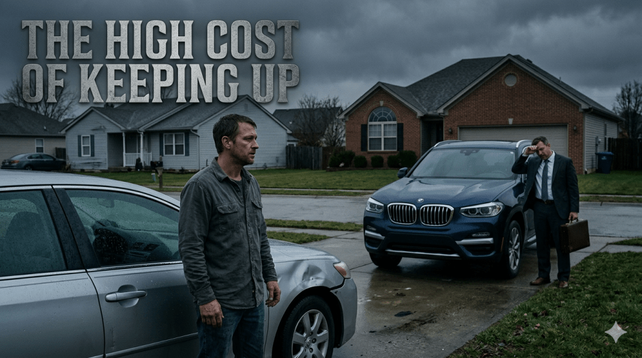
The High Cost of Keeping Up

3,108 words, 16 minutes read time.

Caleb shifted the gear into park, but he didn’t turn off the ignition. The heater was blowing a dry, dusty warmth against his face, and the old sedan hummed with a familiar, tired vibration. He sat there for a moment, the grocery bags in the passenger seat settling with a soft plastic crinkle. Through the windshield, the world was tinted in the muted shades of a late November afternoon, and his eyes, almost against his own will, drifted to the house across the street. The Miller place was glowing. It wasn’t just the professional-grade landscaping or the way their windows caught the dying light; it was the sheer, unapologetic Newness of it all. Parked in their driveway was a pristine, midnight-blue truck, the kind with a grill that looked like a wall of chrome and tires that had never seen a speck of real dirt. Caleb looked at his own hands, calloused and stained from a morning spent wrestling with a rusted lawnmower blade, and felt a sudden, sharp pang of something that wasn’t quite anger, but felt just as heavy.

He wasn’t a bitter man. If you asked the guys at the warehouse or the deacons at the church, they’d tell you Caleb was the first one to show up with a toolbox when a neighbor’s basement flooded. He loved his wife, he took pride in his work, and he usually thanked God for the roof over his head before he closed his eyes at night. But lately, the roof felt lower. The walls felt thinner. Every time he saw Miller—a guy who was perfectly nice, who always waved, who once gave Caleb’s son a signed baseball—Caleb felt a strange, hollow ache in his chest. It wasn’t that he wanted Miller to lose what he had; it was just that Miller’s “more” made Caleb’s “enough” feel like “nothing.” It was a slow-acting poison, a quiet thief that slipped into his house every time he scrolled through a filtered feed or looked across the pavement. It made the life he had built with his own sweat look like a consolation prize.

He finally killed the engine, and the sudden silence was louder than the humming had been. He stayed in the seat, staring at the chrome across the street until it blurred. He thought about the ancient words from the stone tablets, the ones about not desiring your neighbor’s house or his ox or his anything else. He used to think that command was for people with black hearts, for people who plotted and schemed. He didn’t realize it was also for the tired men in driveways who just wanted to feel like they weren’t failing a test they never signed up for. The coveting wasn’t a violent act; it was a slow erosion of his own gratitude. It was the way he looked at his wife’s aging kitchen and saw only the chipped Formica instead of the thousand meals she had cooked there with love. It was the way he looked at his son and wondered if the boy noticed the difference between their life and the one across the street.

The front door of his house opened, and a rectangle of warm, yellow light spilled out onto the porch. Sarah stood there, wrapped in an oversized cardigan, looking for him. She didn’t have a designer coat or a life that looked like a magazine spread, but she had a way of looking at him that usually made him feel like a giant. Today, however, he felt small. He felt like a man who was bringing home a bag of generic cereal and a heart full of shadows. He realized then that the “stuff” across the street wasn’t the enemy. The truck wasn’t the problem. The problem was the way he was letting the image of another man’s life become a judge over his own. He was standing in the middle of a beautiful, messy, blessed life, and he was ignoring the fire in his own hearth because he was too busy staring at the sparks from his neighbor’s chimney.

He stepped out of the car, the cold air hitting him like a splash of water. He grabbed the grocery bags, the plastic handles digging into his palms. He took one last look at the blue truck, the chrome glinting in the twilight, and he made a conscious, painful effort to let it go. It didn’t belong to him, and he didn’t belong to it. He turned his back on the Miller house and walked toward the yellow light of his own porch. It was just a house with a squeaky step and a mortgage that wasn’t paid off, but as he reached the door and Sarah smiled at him, he felt the weight in his chest loosen just a fraction. He wasn’t cured, and the itch of comparison would surely come back tomorrow, but for tonight, he chose to walk into the warmth he actually had.

Inside, the smell of roasted chicken and floor wax met him—a scent that usually meant home, but tonight felt like a reminder of the ordinary. He set the groceries on the counter, his movements heavy and deliberate. Sarah was humming a hymn, something about mercies being new every morning, and the sound grated against the static still buzzing in his brain. He wanted to tell her about the truck. He wanted to complain about the unfairness of a world where some men glide while others grind their gears into dust, but the look on her face stopped him. She looked content. It was a terrifying kind of peace, the kind that didn’t require a receipt or a warranty to stay valid.

“Caleb, you okay?” she asked, pausing with a wooden spoon in her hand. “You look like you’ve been chasing the wind.”

“Just tired, Sar,” he said, and it wasn’t a lie, though it wasn’t the whole truth. “The traffic was a bear.” He moved to the sink to wash his hands, staring at the window above the basin. It looked out over the backyard, where the grass was long and the shed door hung on a single, rusted hinge. He saw the work that needed to be done, the endless list of repairs that sucked the marrow out of his weekends. In his mind, the Miller’s backyard was a sanctuary of pavers and fire pits, a place where labor was something you paid for, not something that broke your back. He squeezed the soap too hard, a green streak of liquid trailing down the stainless steel.

He sat down at the table, the old wood groaning under his weight. His son, Leo, came skidding into the room with a drawing in his hand, a chaotic explosion of crayons that was supposed to be a spaceship. The boy held it up with a grin that suggested he had just painted the Sistine Chapel. Caleb looked at the drawing, then at his son’s scuffed knees and the hand-me-down shirt that was a size too large. A voice in the back of his head—a gritty, cynical whisper—reminded him that Miller’s kid probably had the best of everything. New cleats. A private tutor. A future paved with gold leaf.

“That’s great, buddy,” Caleb said, but his voice sounded hollow to his own ears. He felt like a fraud. How could he teach his son about being a man of God when he was currently measuring his own soul against a neighbor’s driveway? He realized that coveting wasn’t just a personal sin; it was a generational shadow. If he didn’t kill the rot now, he’d pass the infection down to the boy, teaching him to look at the world as a series of gaps to be filled rather than a landscape to be explored.

Later that night, after the house had gone quiet and the only sound was the wind rattling the loose pane in the bedroom, Caleb lay awake. The moonlight sliced through the blinds, casting a ladder of shadows across the ceiling. He thought about the rich young ruler in the stories, the man who had everything but couldn’t let go of the one thing that owned him. Caleb didn’t have much, but he realized he was being owned by the things he didn’t have. The lack was becoming his idol. He sat up, the sheets rustling, and put his feet on the cold floor. He didn’t go to the window this time. He knelt.

It wasn’t a pretty prayer. There were no stained-glass words or theological flourishes. It was the prayer of a man in the trenches, a man tired of his own skin. I’m sorry, he whispered into the dark. I’m sorry for making Your grace small. I’m sorry for acting like You’ve held out on me. He stayed there for a long time, the silence of the house pressing in around him. He didn’t feel a sudden surge of magic, but he felt the fever break. The truck across the street was still there, and his siding was still warping, but for the first time in months, the air in his own lungs felt like it was enough to live on. He went back to bed, and as he closed his eyes, he didn’t see the chrome; he saw the yellow light of his own kitchen, and for tonight, it was plenty.

The next morning broke with the same relentless grey, but the air felt thinner, easier to swallow. Caleb stood in the kitchen, the linoleum cold beneath his socks, watching the coffee pot hiss and sputter. He didn’t look out the front window. Instead, he watched Sarah come into the room, her hair sleep-mussed and her eyes soft. He realized then that he had been looking at her for weeks as a co-conspirator in a life of “less than,” rather than the woman who had stood in the rain with him to bury his father and held his hand through every lean December. He walked over and kissed her temple, the scent of her shampoo hitting him like a grounded reality.

“You’re in a better mood,” she noted, leaning into him as she reached for a mug.

“Just realized I’ve been acting like a man with a hole in his pocket,” Caleb said, his voice low and raspy. “Worrying about what’s falling out instead of what’s actually in there.”

He left for work ten minutes early. As he backed the sedan out, the familiar metallic cough of the engine didn’t grate on his nerves the way it had the day before. It was just a machine doing its job, carrying him to a place where he could earn a living for the people he loved. He passed Miller’s house. The blue truck was gone, likely already whisking its owner toward some glass-towered office. For a split second, the old itch flared up—a phantom limb of desire—but Caleb choked it out. He focused on the weight of the steering wheel and the way the heater finally kicked in, warming his hands.

At the warehouse, the day was a grind of inventory and logistics, the kind of repetitive labor that usually gave his mind too much room to wander into dark corners. But today, he stayed in the present. When a coworker complained about the measly Christmas bonus or the boss’s new boat, Caleb just nodded and kept moving. He wasn’t being a martyr; he was being a soldier. He was guarding the perimeter of his own peace, knowing that once you let one “if only” through the gates, the rest of the army would follow. He found a strange, gritty satisfaction in the work itself, the physical reality of crates and clipboards acting as an anchor against the drift of aspiration.

By the time he pulled back into his neighborhood that evening, the sun had already dipped below the horizon, leaving the sky a bruised purple. He saw the Miller house, the lights glowing with that same expensive warmth. But as he turned into his own driveway, he saw something else. Leo was in the front yard, bundled in a coat that was still a little too big, kicking a deflated soccer ball against a tree. The boy saw the car and dropped the ball, his face lighting up as if a king had just arrived in a golden carriage.

Caleb killed the engine and sat for a heartbeat. The siding was still warped. The porch still needed paint. The bank account was still a source of strategic planning rather than comfort. But as he stepped out of the car and his son tackled his knees, Caleb looked up at the grey sky and felt a sudden, sharp clarity. The rot was gone. It hadn’t been replaced by a new truck or a bigger house, but by the quiet, dangerous realization that he already had everything he needed to be the man he was supposed to be. He picked up the boy, felt the cold wind on his face, and walked into his house, leaving the rest of the world to its own shadows.

The following Sunday, Caleb stood in the back of the sanctuary, his hands shoved deep into his pockets. The preacher was speaking on the desert wanderings, on the way a whole generation of people had looked at a land of promise and saw only the giants they didn’t have the strength to fight. Caleb listened, but his mind kept drifting back to the driveway. It was raining again, a cold, needle-like drizzle that blurred the stained glass, and for the first time in a long time, he felt like he was standing on solid ground. He wasn’t there to ask for a promotion or a windfall; he was there to offer up the only thing he had left—his pride.

After the service, he ran into Miller in the foyer. The man was dressed in a suit that cost more than Caleb’s first car, but up close, in the harsh fluorescent light of the fellowship hall, Caleb noticed the deep, dark circles under Miller’s eyes. He noticed the way the man’s hands trembled slightly as he reached for a paper cup of lukewarm coffee.

“Hey, Caleb,” Miller said, his voice sounding thin, like wire stretched too tight. “Good to see you.”

“You too, Jim,” Caleb replied. He looked at the man, really looked at him, and the last of the green rot dissolved. He didn’t see a rival. He didn’t see a titan of industry. He saw a man who looked like he hadn’t slept in a week, a man who was probably white-knuckling his own steering wheel for reasons Caleb would never know. “You doing alright? You look a little worn down.”

Miller paused, a strange, flickering look passing over his face—a momentary crack in the polished veneer. “Just life, you know? It’s a lot to keep moving. Sometimes I think the more you have, the more you’re just a servant to the things you own.” He gave a hollow laugh and shook his head. “Anyway, see you around, neighbor.”

Caleb watched him walk away, moving toward that midnight-blue SUV with the heavy stride of a man carrying a pack full of lead. He realized that the “shining city on a hill” he had been envying was actually a fortress under siege. He felt a sudden, sharp pang of genuine compassion for Miller, a prayer that the man would find a way to set the weight down before it crushed him.

He walked out to his own car, the one with the dent in the rear fender and the upholstery that smelled like damp earth. He turned the key, and when the engine sputtered and finally caught, Caleb didn’t wince. He drove home through the grey afternoon, pulling into his driveway and looking at his house. It was small. It was old. It was imperfect in a thousand visible ways. But as he stepped through the door, he heard the sound of Leo’s laughter and the clatter of plates in the kitchen. He saw the warped siding and the peeling paint, and instead of seeing failure, he saw a shelter that had held firm against every storm. He was a man who owned very little, but as he sat down at his table and took Sarah’s hand, he knew he was the richest man on the block. He had finally learned the grittiest truth of all: that the only thing a man truly possesses is the peace he refuses to trade away.

Author’s Note

Coveting is a quiet rot. It doesn’t start with a heist; it starts in the driveway. It’s the hollow sound of a man measuring his soul against his neighbor’s chrome.

We’ve turned “enough” into a moving target. We look at the man next door and decide our own blessings are insults. We forget that a house is just wood and nails, and a truck is just iron and grease. When you let another man’s life define your value, you aren’t just losing your peace—you’re committing a slow suicide of the spirit.

Scripture isn’t a suggestion. It’s a blueprint for survival.

“For where your treasure is, there your heart will be also.” — Matthew 6:21

If your treasure is the midnight-blue paint on a truck that isn’t yours, your heart is already in the dirt.

This story isn’t about being poor. It’s about being free. It’s about the grit it takes to kill the envy before it kills you. It’s about the man who stops staring at the sparks from his neighbor’s chimney and starts tending to the fire in his own hearth.

The high cost of keeping up is everything you actually own. Your peace. Your gratitude. Your son’s respect.

Stop looking across the street. Look at your hands. Look at your wife. Look at the God who gave you breath. That is the only math that matters.

The rest is just noise. Leave it in the driveway.

Call to Action

If this story struck a chord, don’t just scroll on. Join the brotherhood—men learning to build, not borrow, their strength. Subscribe for more stories like this, drop a comment about where you’re growing, or reach out and tell me what you’re working toward. Let’s grow together.

D. Bryan King

Sources

Disclaimer:

The views and opinions expressed in this post are solely those of the author. The information provided is based on personal research, experience, and understanding of the subject matter at the time of writing. Readers should consult relevant experts or authorities for specific guidance related to their unique situations.

#biblicalContentment #biblicalManhood #blueCollarFaith #characterStudy #ChristianEthics #ChristianLiving #ChristianMasculinity #ChristianShortStory #ChristianTestimony #contentmentInChrist #covetousness #dailyBread #envyInMen #faithAndWork #faithBasedFiction #familyValues #gospelHope #gospelCenteredLiving #gratitude #gritLit #heartOfMan #heartPosture #homeLife #humbleLiving #internalConflict #killingEnvy #lifeOfCaleb #marriageAndFaith #materialismInChurch #menSDevotionalStory #mentalHealthAndFaith #midlifeCrisisFaith #modernMaterialism #moralDilemma #narrativeTheology #neighborhoodRivalry #overcomingGreed #peaceOfGod #peaceOverPressure #pressureToSucceed #pursuingHoliness #raisingGodlySons #redemptiveFiction #religiousFiction #religiousNarrative #resistingTemptation #saltAndLight #socialComparison #spiritualFreedom #SpiritualGrowth #spiritualRot #spiritualWarfare #statusAnxiety #stewardship #struggleWithComparison #tenthCommandment #trueWealth

Guarded by a Peace You Cannot Explain

As the Day Begins

“And the peace of God, which surpasses all understanding, will guard your hearts and your minds in Christ Jesus.” — Philippians 4:7

There is something almost unsettling about the promise Paul makes in this verse. He does not describe a peace that makes sense, nor one that arrives because circumstances have improved. Instead, he speaks of a peace that surpasses understanding—using the Greek phrase hē eirēnē tou Theou hē hyperechousa panta noun, a peace that literally rises above the mind’s ability to process or reason. This is not peace as the world defines it, where calm follows control or certainty. This is peace that exists in defiance of circumstance. When Paul wrote these words, he was not reclining in comfort; he was confined, opposed, and acquainted with suffering. Yet he speaks as one who has discovered a deeper reality: that God’s presence is not diminished by hardship, but often revealed through it.

To the objective observer, Paul’s life would appear anything but peaceful. He endured shipwreck, persecution, and physical violence. Yet he learned that peace is not the absence of conflict but the presence of God. The word Paul uses for “guard” (phroureƍ) is a military term, describing a soldier standing watch over a city. In this sense, God’s peace is not passive; it actively protects the heart (kardia) and mind (nous) from being overrun by fear, anxiety, and despair. It is as though the Lord Himself stations His presence at the gates of your inner life, refusing to let chaos take dominion. This is especially meaningful as we consider this week’s theme: “Jesus Is Alive!” The same Christ who entered Jerusalem on a donkey—unexpected, humble, misunderstood—is the One who now guards our hearts. His arrival then was not what people expected, and His peace now often comes in ways we do not anticipate.

This morning, the invitation is not to figure everything out before you can experience peace. It is to trust that peace is a promise rooted in the character of God. Like the crowds in Triumphal Entry, we often look for signs that match our expectations. But Jesus comes differently—quietly, humbly, yet decisively. His peace enters not because life is orderly, but because He is present. As one commentator has noted, “Peace is not found in the explanation of life, but in the companionship of Christ.” When you begin your day, you are not stepping into uncertainty alone; you are stepping into a guarded life, one watched over by the risen Savior.

For further reflection on this promise, you may find encouragement in this article:

Triune Prayer

Heavenly Father, I come before You this morning aware of the many uncertainties that surround my day. Yet I thank You that Your peace is not dependent on what I see or understand. You are the God who orders all things, even when my life feels disordered. Guard my heart from fear and my mind from anxious thoughts. Teach me to trust You beyond what I can reason. Let Your presence settle over me like a watchful guard, keeping me steady and secure. I surrender my need to control outcomes and instead choose to rest in Your faithful care.

Jesus the Son, You entered Jerusalem in humility, not as the conquering king people expected, but as the Savior they truly needed. You continue to come into my life in ways I do not always recognize. Help me to see You today—not in the dramatic, but in the quiet assurance of Your peace. You are alive, and because You live, I can walk forward with confidence. Guard my thoughts from despair and my heart from discouragement. Let Your voice be louder than my fears, and Your presence more real than my circumstances.

Holy Spirit, dwell within me and make the peace of God alive in my experience today. When my thoughts begin to race or my emotions begin to rise, remind me that I am not unprotected. You are actively guarding my inner life. Lead me into moments of stillness where I can sense Your nearness. Shape my responses so that I reflect the peace You give. Let others see in me a calm that cannot be explained, a steadiness that points back to You. I yield my heart and mind to Your guidance.

Thought for the Day:
When anxiety rises, do not try to solve everything—pause and remember that God’s peace is already standing guard over your heart and mind. Walk forward knowing you are protected by His presence.

FEEL FREE TO COMMENT, SUBSCRIBE, AND REPOST, SO OTHERS MAY KNOW


#ChristianMorningDevotional #guardedHeartAndMind #peaceOfGod #Philippians47Meaning #resurrectionLife #spiritualDisciplines
There is no rest quite like the peace that comes from a day spent in His grace.
"In peace I will lie down and sleep, for you alone, Lord, make me dwell in safety." Psalm 4:8 Type "AMEN" if you are resting in His peace tonight!
#DailyBread #ChristianLiving #PeaceOfGod #NightPrayer

Christ the Cornerstone of Peace

As the Day Begins

“Let the peace of God rule in your hearts, since as members of one body you were called to peace. And be thankful.” (Colossians 3:15)

Peace is one of the deepest longings of the human heart. Every generation has searched for it—through success, security, wealth, or personal achievement. Yet Scripture consistently reminds us that peace is not something we manufacture through effort. It is something we receive through grace. The apostle Paul writes to the church in Colossae that believers must allow the peace of God to “rule” in their hearts. The Greek word Paul uses for rule is ÎČραÎČΔυέτω (brabeuetƍ), which means “to act as an umpire” or “to decide a contest.” In other words, the peace of Christ becomes the inner authority that settles the restless arguments of our hearts. When Christ stands at the center of our lives, His peace becomes the deciding voice over fear, guilt, and uncertainty.

The article reminds us of a foundational truth: none of us are righteous enough to earn heaven on our own. Scripture speaks clearly about this condition. “For all have sinned and fall short of the glory of God” (Romans 3:23). If human effort could bridge the gap between us and God, then the suffering of Jesus would have been unnecessary. Yet God’s redemptive plan is rooted in mercy rather than human achievement. The Hebrew Scriptures speak of this mercy through the word Ś—Ö¶ŚĄÖ¶Ś“ (chesed), meaning steadfast covenant love. God’s plan is simple yet life-changing: we confess our sins, receive His mercy, and trust in Christ for salvation. This act of humble faith becomes the doorway through which divine peace enters the human soul.

Jesus Himself is described as the cornerstone of that peace. Paul writes in Ephesians that Christ “is our peace” (Ephesians 2:14). He does not merely give peace as a gift separate from Himself; rather, His very presence produces peace within us. When a house is built, its foundation determines whether it stands firm during storms. If the foundation is weak, the entire structure eventually collapses. In the same way, when our lives are built on personal success, reputation, or control, our peace becomes fragile. But when our foundation is Christ, the storms of life may shake us, yet they cannot destroy us. As theologian Charles Spurgeon once said, “Peace is not the absence of trouble, but the presence of Christ.” When we begin the day with Him, our hearts are steadied by a peace the world cannot imitate.

Triune Prayer

Father, You are the Most High (El Elyon) who reigns above every circumstance and every anxious thought. As this day begins, I come before You with gratitude that Your mercy opened the door to salvation when I could not open it myself. Thank You for providing the path of forgiveness through confession and faith. I ask You to establish Your peace in my heart today. When my thoughts begin to race or worry creeps into my mind, remind me that You are the sovereign Lord who governs all things. Let my heart rest in the truth that Your plans for me are shaped by wisdom and love. Guide my decisions today so that I may walk in humility and gratitude.

Jesus, my Christ, the promised Messiah and Savior of the world, I thank You for becoming the foundation of my peace. You endured suffering and death so that my sins could be forgiven and my relationship with God restored. Because of Your sacrifice, I no longer need to live under the burden of guilt or fear. Teach me today to trust You more fully. When pressures rise and distractions compete for my attention, remind me that Your peace is stronger than the chaos around me. Help me to follow Your example of obedience, humility, and compassion toward others. May my life reflect the peace that flows from knowing You.

Holy Spirit, my Comforter (Paraclete) and guide, I ask You to dwell actively within me today. Quiet my restless thoughts and align my heart with the truth of God’s Word. Lead me into wisdom when I face decisions, and strengthen me when my faith feels weak. Help me to recognize moments where I can show patience, kindness, and grace to those around me. Let the peace of God truly rule in my heart, directing my attitudes and responses throughout the day. Fill me with courage to live faithfully and with sensitivity to Your gentle prompting.

Thought for the Day

Begin this day by placing Christ at the center of your heart. When you surrender your worries to Him, His peace becomes the steady foundation that guides every step you take.

For further reflection, see this helpful article on biblical peace from GotQuestions:
https://www.gotquestions.org/peace-of-God.html

FEEL FREE TO COMMENT, SUBSCRIBE, AND REPOST, SO OTHERS MAY KNOW


#ChristOurPeace #ChristianMorningPrayer #Colossians315Devotion #dailyDevotionalMeditation #peaceOfGod

The Fortress the Storm Cannot Break

On Second Thought

Scripture Reading: Philippians 4:4–7
Key Verse: Psalm 31:3
“You are my rock and my fortress; therefore for Your name’s sake lead me and guide me.”

There is something within the human heart that longs for a place of safety. From childhood onward, people instinctively search for a refuge where they can rest when life becomes overwhelming. Many of us can recall childhood spaces that felt like fortresses—a backyard treehouse, a quiet corner of a room, or some place where worries seemed to fade. Joni Eareckson Tada once reflected on such a place from her childhood. She described a small treehouse she built with her sister on their family farm. Though it was only wood and nails perched in a tree, it felt like a fortress. It stood apart from the house and the watchful eyes of adults. Rain would strike the tin roof, wind would shake the branches, yet inside that little structure they felt secure.

But childhood eventually gives way to adulthood, and with it comes a sobering realization. The safe places we once depended on cannot protect us from the deeper pressures of life. The storms we face are no longer rain and wind but exhaustion, responsibilities, disappointments, and anxieties that press upon the soul. In those moments, the question quietly rises within us: Where do we go now for refuge?

The Scriptures answer that question clearly. David wrote in Psalm 31:3, “You are my rock and my fortress.” The Hebrew word for rock, áčŁĂ»r, conveys the image of a massive, immovable cliff—something strong enough to withstand the fiercest storm. A fortress, or māáčŁĂ»d, referred to a fortified stronghold built high upon a rock where enemies could not easily reach. David’s words are not poetic exaggeration; they are a declaration of experience. He had fled enemies, faced betrayal, and endured long seasons of uncertainty. Yet through all of it, he discovered that the safest place in the world was not a structure or strategy—it was the presence of God.

The Apostle Paul echoes this truth centuries later in Philippians 4:4–7. Writing from prison, Paul calls believers to rejoice in the Lord and to bring every anxiety to God through prayer. He writes, “Be anxious for nothing, but in everything by prayer and supplication, with thanksgiving, let your requests be made known to God.” Then comes one of the most comforting promises in Scripture: “And the peace of God, which surpasses all understanding, will guard your hearts and minds through Christ Jesus.”

The Greek word Paul uses for “guard” is phroureƍ, a military term describing soldiers standing watch over a city. It paints the picture of God’s peace acting like a protective garrison around the believer’s heart and mind. In other words, when we bring our burdens to God, His peace becomes a spiritual fortress.

Many people search for relief from the pressures of life in other ways. Some turn to hobbies, entertainment, vacations, or distractions. Others rely on friends or personal strategies to manage their stress. While these things may offer temporary relief, they cannot provide lasting refuge. Once the vacation ends or the distraction fades, the pressures of life return.

Jesus invites us to a different response. Instead of running away from our burdens, we are invited to bring them directly to Him. In prayer, we lay down the weight we have been carrying and place it into His hands. Over time we discover that God Himself becomes our safe place. As the prophet Isaiah declared, “Trust in the Lord forever, for in the Lord, the Lord himself, is the Rock eternal” (Isaiah 26:4).

This truth becomes especially meaningful during seasons of spiritual reflection within the church calendar. As believers draw closer to the events surrounding Christ’s sacrifice and resurrection, we are reminded that our ultimate refuge is found in Him. Through the cross, Jesus secured a peace that the world cannot manufacture. His presence becomes the fortress where weary hearts find rest.

A.W. Tozer once observed, “The man who has God for his treasure has all things in One.” That statement captures the heart of biblical refuge. The believer’s security does not come from circumstances aligning perfectly or problems disappearing. It comes from knowing that God Himself is our rock and fortress.

Every day presents moments when life feels overwhelming—deadlines pressing in, relationships straining, responsibilities piling up. Yet in those very moments we are invited to pause and turn toward the One who stands stronger than every storm. When we pray, we step into the fortress of God’s presence. There we find not only protection but guidance. David’s prayer in Psalm 31 continues, “Lead me and guide me.” The fortress of God is not merely a hiding place; it is also the place from which God directs our steps.

On Second Thought

There is an interesting paradox hidden within the idea of a fortress. In childhood, we built fortresses to keep the world out. The walls were meant to separate us from whatever might threaten our peace. Yet when Scripture describes God as our fortress, the meaning shifts in an unexpected way. God’s refuge does not isolate us from life; it strengthens us to face life.

When we retreat into human safe houses—comfort, distraction, or avoidance—we temporarily escape the pressure of our problems. But the problems remain outside the door, waiting for us when we return. God’s refuge works differently. When we bring our anxieties to Him in prayer, He does not always remove the situation immediately. Instead, He changes the condition of our hearts. His peace guards our minds, giving us strength and clarity that we did not have before.

In other words, the fortress of God is not designed to hide us from life but to prepare us for it. When we leave the place of prayer, we return to the same world, the same responsibilities, and often the same challenges. Yet something within us has shifted. Fear loosens its grip. Anxiety gives way to trust. The storm may still be raging, but the soul standing within God’s fortress is no longer shaken.

The surprising truth is that the safest place in the world is not the absence of trouble—it is the presence of God in the middle of it.

FEEL FREE TO COMMENT, SUBSCRIBE, AND REPOST, SO OTHERS MAY KNOW


#peaceOfGod #Philippians467Devotion #Psalm313Reflection #refugeInGod #trustingGodInStress

When Peace Walks Into the Prison Cell

“Be anxious for nothing, but in everything by prayer and supplication, with thanksgiving, let your requests be made known to God.”
Philippians 4:6

As I sit with this passage today, I am struck by how startlingly unqualified Paul’s words sound. “Be anxious for nothing.” Not for fewer things. Not for manageable things. Not for things that make sense to surrender. Nothing. The command feels almost unreasonable—until I remember where Paul is standing when he says it. He is not writing from comfort, nor from the illusion of control. He writes as a man who knows chains, misunderstanding, physical suffering, and the looming possibility of death. And yet, he speaks of peace as something real, accessible, and sustaining. That alone forces me to pause and reconsider how lightly I excuse my own anxieties.

When I reflect on A Day in the Life of Jesus, I realize that Paul’s exhortation echoes what we repeatedly see in Christ Himself. Jesus lived amid constant pressure—crowds demanding miracles, religious leaders plotting His downfall, disciples misunderstanding His mission. And yet, the Gospels never portray Him as driven by anxiety. He withdraws to pray, entrusts outcomes to the Father, and moves through each day with purposeful calm. His peace was not denial; it was rooted trust. Paul is not inventing a new spiritual concept here—he is applying the lived pattern of Jesus to the everyday burdens of believers.

Paul’s own circumstances make this teaching deeply credible. His nation was under occupation. Corruption was normal. False accusations had placed him in prison. Relationships were strained, reputations questioned, and physical suffering constant. As he later catalogs in 2 Corinthians 11:23–29, his life was marked by beatings, shipwrecks, hunger, and danger. And still, he insists that there is no crisis so severe that God cannot meet us with peace in the midst of it. As theologian Gordon Fee notes, Paul’s peace is “not the absence of trouble but the presence of God reigning in the heart.” That distinction matters, because it corrects the expectation that peace must look like problem removal.

This is where the passage gently confronts me. I often approach God hoping He will take away the weight rather than help me carry it. But Paul’s language suggests something more enduring. God does not promise to erase every difficulty; He promises to guard the heart that turns toward Him. The Greek word for “guard” (phroureƍ) carries a military image—a sentry standing watch. God’s peace does not float vaguely around us; it actively protects our inner life. Anxiety may knock, but it does not have to rule.

Paul also offers a pathway, not a platitude. Prayer, supplication, and thanksgiving are not religious accessories; they are the means by which anxiety is transferred from our shoulders to God’s care. I find it insightful that thanksgiving is included before circumstances change. Gratitude reframes reality. It reminds me that God has been faithful before, and that present trouble does not negate past grace. As the psalmist writes, “Cast your burden on the LORD, and He will sustain you” (Psalm 55:22). The burden is real—but so is the sustaining.

What encourages me most is that this peace is not reserved for emotionally resilient personalities or spiritually elite believers. Paul insists it is for everyone. You do not have to understand how peace can exist in your situation to experience it. You only have to turn toward God with what you are carrying. Jesus Himself said, “Do not let your hearts be troubled” (John 14:1), not because trouble would disappear, but because His presence would remain. That is the heart of discipleship—learning, day by day, to trust as Jesus trusted.

If I am honest, anxiety often reveals where I believe responsibility ultimately lies. When I cling tightly to outcomes, I reveal a subtle belief that everything depends on me. Paul’s words invite a daily surrender: naming my fears, offering them honestly to God, and allowing His peace to stand guard over my thoughts. This is not a one-time transaction; it is a daily discipline. In this way, A Day in the Life of Jesus becomes a pattern for my own—moving from prayer to action, from trust to obedience, from anxiety to peace.

For further reflection on biblical peace and anxiety, this article from Desiring God offers helpful theological insight:
https://www.desiringgod.org/articles/do-not-be-anxious-about-anything

FEEL FREE TO COMMENT, SUBSCRIBE, AND REPOST, SO OTHERS MAY KNOW


#anxietyAndFaith #beAnxiousForNothing #ChristianSpiritualDisciplines #JesusAndTrust #peaceOfGod #Philippians46Devotional

Prospering in All Things by Trusting the God Who Sees

As the Day Begins

“The eyes of the LORD run to and fro throughout the whole earth, to show Himself strong on behalf of those whose heart is loyal to Him.”
2 Chronicles 16:9


The promise of 2 Chronicles 16:9 is quietly powerful. It reminds us that we do not begin this day unseen, unmanaged, or unsupported. Scripture presents a God whose gaze is active and intentional—His eyes are not drifting, but running to and fro across the earth. This vivid language speaks of divine attentiveness. The LORD is not waiting for us to achieve spiritual stability before He acts; rather, He is actively looking for hearts that are loyal, undivided, and willing to trust Him in the midst of uncertainty. Prosperity, in this biblical sense, is not first about outcomes, but about alignment—about living in step with the God who is already present in every detail of our lives.

Anxiety often presses in when our thoughts fragment—when worries about the future, unresolved conversations, and subconscious fears compete for our attention. Scripture does not dismiss this reality. Instead, it gently redirects us. The first and most faithful response to anxiety is not self-management, but Godward movement. We are invited to go to God repeatedly, sometimes many times in a single day, asking Him to bring His peace and His truth into both the conscious and hidden places of our minds. This kind of prayer is not a sign of weakness; it is a disciplined act of trust that acknowledges our limits and God’s sufficiency.

What does it look like, then, to prosper in all things as the day unfolds? It begins with focus—asking the Lord to help us attend to the immediate moment rather than being consumed by imagined futures or unresolved pasts. When we entrust our scattered thoughts to God, He shows Himself strong not always by removing challenges, but by stabilizing our hearts within them. The loyalty God seeks is not perfection, but dependence. As we step into the day, this verse invites us to live with the quiet confidence that the God who sees us is already at work on our behalf.

Triune Prayer

LORD (YHWH), You are the One who sees fully and knows completely. I thank You that Your eyes are not distant, but attentive to every corner of my life today. You see the concerns that weigh on my heart, including those I cannot yet put into words. I ask You to steady my thoughts and quiet the inner noise that fuels anxiety. Help me to bring both my conscious worries and my unspoken fears into Your presence. Teach me to return to You again and again throughout this day, trusting that You are strong on behalf of those who place their loyalty in You.

Jesus Christ, You entered fully into human weakness and understand the pressures that surround daily life. I thank You for modeling what it looks like to turn toward the Father in moments of stress, fatigue, and uncertainty. As I face the responsibilities and decisions before me today, help me to keep my attention on what is immediately in front of me rather than being overwhelmed by what lies beyond my control. Shape my responses so that they reflect trust rather than fear, patience rather than urgency, and faith rather than self-reliance.

Holy Spirit, You are the Spirit of Truth and the One who dwells within me. I ask You to gently surface the thoughts and emotions that are influencing me beneath the surface, and to bring God’s peace into those places. Guide my focus, guard my mind, and help me remain attentive to Your promptings as the day unfolds. When anxiety returns, remind me to turn again to God, confident that He is present, active, and faithful to strengthen those who depend on Him.

Thought for the Day

When anxiety arises, do not attempt to manage it alone. Pause, go to God, and ask Him to bring His peace and truth into both your thoughts and your focus for the moment at hand.

For further reflection on finding God’s peace in anxious moments, you may find this article helpful:
https://www.desiringgod.org/articles/anxiety-and-the-peace-of-god

FEEL FREE TO COMMENT, SUBSCRIBE, AND REPOST, SO OTHERS MAY KNOW


#2Chronicles169 #anxietyAndFaith #ChristianSpiritualDisciplines #morningDevotional #peaceOfGod #trustingGodDaily

Bound Together by Peace

As the Day Begins

“Let the peace of God rule in your hearts.” Colossians 3:15

The apostle Paul’s invitation is neither sentimental nor abstract. When he urges believers to let the peace of God “rule” in their hearts, he uses language drawn from the public square. The verb translated “rule” carries the sense of an umpire or arbiter, one who decides what prevails. At the center of this command is the Greek word eirēnē, a term far richer than the mere absence of conflict. In its biblical sense, eirēnē speaks of what has been bound together again after being torn apart—relationships restored, inner fractures mended, scattered loyalties drawn back into harmony. Paul assumes what many of us experience daily: that the human heart is easily divided, pulled in multiple directions by fear, memory, expectation, and unfinished burdens.

This peace is not generated by willpower or emotional suppression. It is received. Scripture consistently frames peace as a gift that flows from reconciliation with God, not as a technique for calming ourselves. When we are united to God by faith, the disjointed pieces of our inner life begin to cohere. Augustine famously observed that the human heart remains restless until it rests in God, and Paul echoes that wisdom here. The peace of Christ does not merely soothe; it reorders. It teaches the heart what deserves attention and what may be released. In a world that rewards urgency and noise, God’s peace establishes a different authority—one that quiets the soul without diminishing clarity or resolve.

Paul also describes this peace as a settled condition of the inner life, a state in which the heart is no longer easily agitated or ruled by every passing disturbance. This does not mean the believer is spared difficulty or emotion. Rather, it means that turmoil no longer holds the final word. Like a deep current beneath the surface of a river, God’s peace carries the soul forward even when the surface appears unsettled. As the day begins, this peace invites us to move slowly enough to listen, to allow God to bind together what yesterday scattered, and to trust that calmness of spirit is not withdrawal from responsibility but preparation for faithful obedience.

Triune Prayer

Heavenly Father, as this day opens before me, I acknowledge how easily my heart becomes divided. I carry concerns from yesterday and uncertainties about what lies ahead, and I confess that I often allow those voices to rule my inner life. I thank You that Your peace is not dependent on my circumstances but flows from Your faithful presence. Bind together what feels fragmented within me—my thoughts, my emotions, my desires—and let Your wisdom arbitrate my decisions today. I receive Your peace not as an escape from responsibility but as the grounding from which I may live attentively and faithfully.

Jesus the Son, You are the living expression of God’s reconciling peace. Through Your life, death, and resurrection, You have restored what sin and fear had torn apart. As I begin this day, I invite Your peace to take authority in my heart, to overrule anxious impulses and reactive judgments. Teach me to move through conversations, tasks, and interruptions with the calm assurance that comes from belonging to You. Where I am tempted to rush, steady me. Where I am tempted to withdraw, give me courage shaped by trust rather than agitation.

Holy Spirit, dwell deeply within me today. Quiet the inner noise that competes for my attention and attune my heart to Your gentle guidance. Help me recognize when unrest is signaling misplaced trust and gently lead me back to dependence on God. Shape my responses so that others encounter patience, clarity, and steadiness through me. As I walk through this day, may Your presence sustain a peaceful spirit that reflects the restoring work of God in my life.

Thought for the Day

Begin today by consciously allowing God’s peace to decide what truly deserves your concern and what you can entrust to Him.

For further reflection on biblical peace, see this helpful article from The Bible Project: https://bibleproject.com/explore/video/shalom-peace/

FEEL FREE TO COMMENT, SUBSCRIBE, AND REPOST, SO OTHERS MAY KNOW


#biblicalPeace #ChristianMorningDevotional #Colossians315 #dailyPrayer #innerQuiet #peaceOfGod #spiritualRest