📑 Cinematic Identification Revisited in the Eyes of Buddhist Philosophies (A ✨NEW✨, free, 14-page paper)
Tags: #Origination #Feeling #Film
https://buddhistuniversity.net/content/papers/illuminating-reality_fan-victor
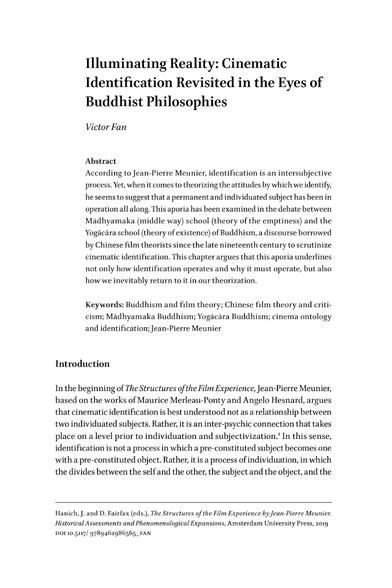
Illuminating Reality: Cinematic Identification Revisited in the Eyes of Buddhist Philosophies
A film appears to us as a reality that has its own existential value, one that is initiated from the existential value of the photographed being or object in the past. Yet, it remains a set of sense data, an assemblage of light and shadow that runs 24 frames per second.
The most-valuable idea I have got from this book so far is that #consciousness could be an #emergent #property of #matter in the same way magnetic fields, for example, are an emergent property. I tend to lean toward #Idealism, in terms of what I would \*like to believe\*, but as a #dhamma practitioner I also appreciate the teachings of #dependent #origination, which says that mind and matter (namarupa) arise in dependence on each other and other phenomena. 1/2
https://bookwyrm.social/book/198456/s/waking-dreaming-being
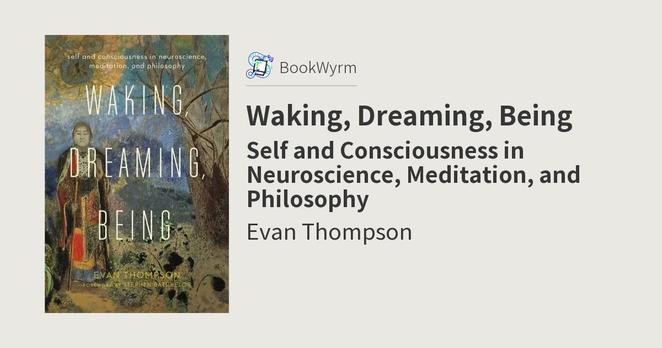
Waking, Dreaming, Being - BookWyrm
A renowned philosopher of the mind, also known for his groundbreaking work on Buddhism and cognitive science, Evan Thompson combines the latest neuroscience research on sleep, dreaming, and meditation with Indian and Western philosophy of mind, casting new light on the self and its relation to the brain.
Thompson shows how the self is a changing process, not a static thing. When we are awake we identify with our body, but if we let our mind wander or daydream, we project a mentally imagined self into the remembered past or anticipated future. As we fall asleep, the impression of being a bounded self distinct from the world dissolves, but the self reappears in the dream state. If we have a lucid dream, we no longer identify only with the self within the dream. Our sense of self now includes our dreaming self, the "I" as dreamer. Finally, as we meditate-either in the waking state or in a lucid dream-we can observe whatever images or thoughts arise and how we tend to identify with them as "me." We can also experience sheer awareness itself, distinct from the changing contents that make up our image of the self.
Contemplative traditions say that we can learn to let go of the self, so that when we die we can witness its dissolution with equanimity. Thompson weaves together neuroscience, philosophy, and personal narrative to depict these transformations, adding uncommon depth to life's profound questions. Contemplative experience comes to illuminate scientific findings, and scientific evidence enriches the vast knowledge acquired by contemplatives.

SN 22.60 Mahāli Sutta: With Mahāli
But because consciousness is painful—soaked and steeped in pain and not steeped in pleasure—sentient beings do grow disillusioned with it. Being disillusioned, desire fades away. When desire fades away they are purified. This is a cause and reason for the purification of sentient beings.

SN 12.26 Upavāṇa Sutta: With Upavāna
Rather than saying “who” creates our suffering, the Buddha says “what” suffering (and views about it) depend on.

SN 12.60 Nidāna Sutta: Sources
Fed and fuelled by that, the great tree would stand for a long time.

SN 46.29 Ekadhamma Sutta: One Thing
Bhikkhus, I do not see even one other thing that, when developed and cultivated, leads to the abandoning of the things that fetter so effectively as this

SN 46.2 Kāya Sutta: The Body
…the sign of the beautiful: frequently giving careless attention to it is the nutriment for the arising of unarisen sensual desire…

Perceiving
Perceiving is the process by which evanescent sensations are linked to environmental cause and made enduring and coherent through the assignment of meaning, utility, and value.
 The Open Buddhist University
 Bodhi 心
 🤘 The Metal Dog 🤘