New US bill H.7656 just dropped: supporting marine carbon dioxide removal activities. Referred to the Science, Space & Technology Committee.

Ocean CDR is getting serious legislative attention β€” this matters for ocean alkalinity enhancement, seaweed sinking, and electrochemical approaches. Policy is finally catching up to the science. πŸŒŠβš—οΈ

#CarbonRemoval #OceanCDR #ClimatePolicy #OAE

The first EPA-permitted ocean alkalinity enhancement field trial β€” and results are being presented TODAY at #OSM26 in Glasgow. 🌊

WHOI's LOC-NESS project tested adding alkalinity to seawater in the Gulf of Maine to lock COβ‚‚ in the ocean.

If the science checks out, OAE could be a massive CDR pathway. Transparency and community engagement are key.

#CarbonRemoval #CDR #OceanCDR #ClimateAction #OSM26

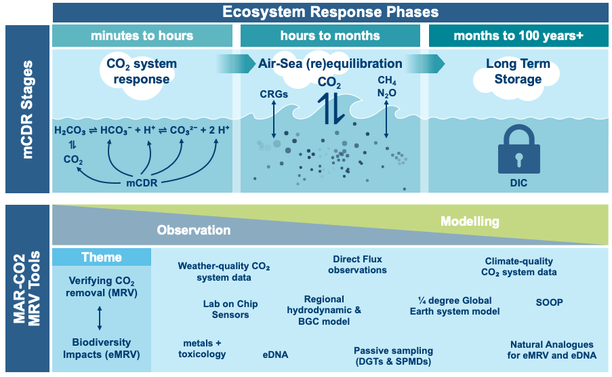
The idea of storing carbon dioxide (CO2) in the ocean, also referred to as ocean carbon dioxide removal (CDR), involves a range of methods to enhance the ocean's capacity to absorb more CO2 from the atmosphere. This approach is gaining increasing attention as a potential solution to tackle the adverse effects of climate change.

#OceanCDR #CarbonDioxideRemoval #ClimateChangeMitigation

https://www.sciencenews.org/article/ocean-carbon-removal-climate-change

Will stashing more CO2 in the ocean help slow climate change?

Research is needed on how ocean carbon removal methods β€” such as iron fertilization and direct capture β€” could impact the environment.

Science News
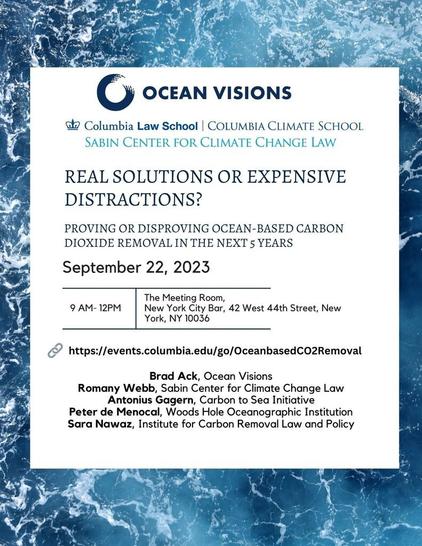
4️⃣ 🌊 Immerse in the #climateaction future! Join us on Sept 22, 9-12 PM ET, partnered with Ocean Visions for "Real Solutions or Expensive Distractions?" which delves into ocean-based CO2 removal's 5-year potential. πŸ—“οΈπŸ” Discover #OceanCDR insights: https://events.columbia.edu/go/OceanbasedCO2Removal
3️⃣ 🌊 Dive into the future of #climateaction at our in-person event on Sept 22, 9-12 PM ET hosted with Ocean Visions! Take part in "Real Solutions or Expensive Distractions?" to explore ocean-based carbon dioxide removal's potential in the next 5 years. πŸ—“οΈπŸ” #OceanCDR https://events.columbia.edu/go/OceanbasedCO2Removal
🌍 🌊 Happy #EarthDay2023! Today, we shine a spotlight on the ocean's power to combat #climatechange, including through ocean-based #carbondioxide removal strategies. Read about the Sabin Center' for Climate Change Law's work in this area: https://blogs.law.columbia.edu/climatechange/2023/04/21/harnessing-the-oceans-power-to-combat-the-climate-crisis/ #OceanCDR #carboncaptureandstorage #Ocean #ClimateAction
Harnessing the Ocean’s Power to Combat the Climate Crisis - Climate Law Blog

While progress is being made, there is still a lot to do. The IPCC has said that, in addition to reducing emissions, it will likely also be necessary to draw greenhouse gases out of the atmosphere to mitigate climate change. The Sabin Center for Climate Change Law, an affiliate of the Columbia Climate School, has been exploring various ways of doing that, including through β€œblue carbon” approaches. Blue carbon is carbon captured by ocean and coastal ecosystems. In this post, we will focus specifically on ocean-based carbon dioxide removal and sequestration, also known as β€œocean CDR”.

Climate Law Blog
🌊 We released model legislation, with support from Ocean Visions, to advance safe & responsible #ocean #C02removal research in US waters: https://buff.ly/3YOXyO7 #OceanCDR #climateaction
Developing Model Federal Legislation to Advance Safe and Responsible Ocean Carbon Dioxide Removal Research in the United States

This model federal legislation aims to advance safe and responsible ocean carbon dioxide removal (CDR) research in U.S. waters. Controlled field trials and other in-ocean research is critical to improve scientific and societal understanding of CDR techniques that could help the U.S. reach its climate goals. However, existing legal frameworks were not designed to regulate ocean CDR and, in some cases, unnecessarily or inappropriately restrict needed research. The purpose of this proposed model legislation is to establish clear and efficient permitting regime for in-ocean CDR research. At the same time, the model legislation builds in consultation, monitoring, and other safeguards to ensure research occurs in a scientifically-sound manner and minimizes potential risks to the environment and communities.

Scholarship Archive
🌊🌱
---
RT @Mar_Walimai
#jobalert I am hiring a biogeochemical modeller to study the potential of #sargassum for #OceanCDR If you have the skills and want to find solutions to the climate crisis, apply before 19.03.2023 @CDRmare @AWI_Media https://jobs.awi.de/Vacancies/1322/Description/2
https://twitter.com/Mar_Walimai/status/1640994296366080000
Scientist with a focus on Biogeochemical modelling (m/f/d)

Layout AWI Forschung englisch extern

Today, we with support from Ocean Visions published model federal legislation to advance safe & responsible #OceanCDR research in U.S. waters.

Korey Silverman Roati & Romany Webb outline the proposed new legal framework: https://blogs.law.columbia.edu/climatechange/2023/03/15/developing-model-federal-legislation-to-advance-safe-and-responsible-ocean-carbon-dioxide-removal-research-in-the-united-states/
Paper is available here: https://scholarship.law.columbia.edu/sabin_climate_change/199/

Developing Model Federal Legislation to Advance Safe and Responsible Ocean Carbon Dioxide Removal Research in the United States - Climate Law Blog

The Sabin Center today published model federal legislation to advance safe and responsible ocean carbon dioxide removal (CDR) research in U.S. waters. Controlled field trials and other in-ocean research is critical to improve scientific and societal understanding of CDR techniques that could help the U.S. reach its climate goals. However, existing legal frameworks were not […]

Climate Law Blog
Our deputy director Romany Webb participated in roundtable discussions at this week's Aspen Ideas: Climate! event series, where she discussed scaling terrestrial CDR and creating a code of conduct for #OceanCDR.