 NIOO-KNAW
New publication: #Beech decline reshapes fine #root traits, microbial composition and soil carbon–nutrient cycling. #nutrientcycling #soilcarbon #forestdecline
https://doi.org/10.1111/1365-2745.70346
https://doi.org/10.1111/1365-2745.70346
I can't stress enough how important it is to close the nutrient cycle and utilize human excrements as fertilizers. We would save so much resources and energy while decreasing the environmental impact of our horribly expensive and inefficient sewage system and fertilizer production.
Yes, there are challenges when using human excrements (mainly pathogens and pharmaceutics), but the hazards are mostly much lower than people think, and solvable.
Nice info [in German]:
https://www.naehrstoffwende.org/
#Sanitärwende #CompostingToilet #humanure #UrineFertilizer #Faeces #NutrientCycling #SourceSeparatingToilets #RecyclingFertilizers #CircularBioeconomy #Aurin #Nährstoffwende
【🎉Latest accepted article】
Root-microbe-soil coupling enhances rhizosphere priming and nitrogen acquisition in #InvasivePlants
#RhizospherePrimingEffect | #RootTraits | #NutrientCycling | #MicrobialBiomass | #SoilEnzymeActivity
【💡High Cited 】
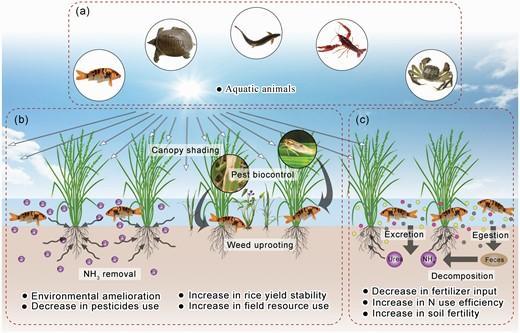
Coculturing #Rice with aquatic animals promotes ecological intensification of paddy ecosystem
Core:
a Review of a quantitative analysis of literature on rice–aquatic animal coculture systems. (‼️NEW‼️)

For some month, even years, I claimed that my initial biogas system “Jean Luc” was too big for a family of two. A 1000 litre IBC digester with an Hydrolic Retention Time (HRT) of 20 days can be fed about 50 litres / day. The most we fed over the years is 10 litres / day. If we calculate the size of the digester based on the amount of food scraps and the HRT the resulting size is 200 litres.

 Earthworm 🐌
 Journal of Plant Ecology
 Nick Chase
 Kensington Compost Network
 richardnair