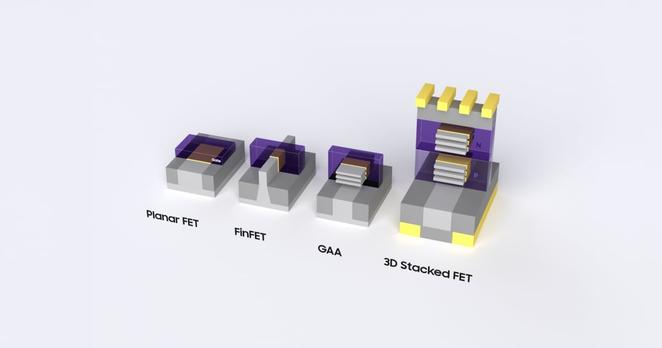
FinFET, Nanosheet, Nanostack... learning new things every day!

That said, I think it’ll take a few more years before we see these breakthroughs in commercial AI chips.

Therefore, we're likely to see the AI bubble pop. Soon. Then, once time has passed, we’ll finally benefit from cheap AI utility services as human productivity accelerators.


https://research.ibm.com/blog/sub-1nm-node-chips

#ibm #finfet #nanosheet #nanostack #ai

IBM introduces the smallest computer chip in the world

It’s the world’s first sub-1nm chip technology, powered by IBM’s new nanostack architecture, paving the way for more powerful chips for years to come.

IBM Research
From GAA to 3D Stacked FET: Expanding the Transistor into the Third Dimension | Samsung Semiconductor Global

Samsung Electronics' Semiconductor Research Center presented the paper “First Demonstration of 3D Stacked FETs at Gate Pitch of 42 nm Featuring Triple Stacked Nanosheet Channels for Advanced Logic Applications” at the 2026 VLSI Symposium, held from June 14–18.

Samsung Semiconductor Global
Hoffnung auf supersparsame KI-Chips: Fraunhofer Dresden und das TSRI aus Taiwan entwickeln Hafniumoxid-Nanosheets. Die ferroelektrischen Zellen sollen den Energieverbrauch merkfähiger Speicher um Faktor 100 senken.
https://oiger.de/2025/12/02/daempfer-fuer-den-energiehunger-der-kis-taiwan-und-sachsen-arbeiten-an-ferroelektrischen-speichern/195847
#KI #Speicher #Hafniumoxid #Nanosheet #Fraunhofer #TSRI #Taiwan #Ferroelektrisch #FeMFETs #Energieeffizienz #Dresden #VonNeumannArchitektur
Dämpfer für den Energiehunger der KIs: Taiwan und Sachsen arbeiten an ferroelektrischen Speichern - Oiger

Fraunhofer Dresden und das TSRI aus Taiwan entwickeln Hafniumoxid-Nanosheets für KI-Speicher. Die ferroelektrischen Zellen sollen den Energieverbrauch um Faktor 100 senken

Oiger
Tsmc introduceert nieuwe 2nm chips met verbeterde capaciteiten

De Taiwanese chipfabrikant TSMC heeft aangekondigd dat klanten nu hun eigen 2nm chips kunnen ontwerpen met behulp van de nieuwste technologieën, waaronder sup

Tech Nieuws
TSMC wird in Dresden anscheinend auch feinere Chipstrukturen fertigen als bisher angenommen. Daheim stoßen die Taiwanesen bereits mit „Nanosheets“ in die 2-Nanometer-Welt vor
https://oiger.de/2024/05/15/tsmc-will-auch-feinere-chipstrukturen-in-dresden-fertigen/190906
#TSMC #ESMC #Dresden #Sachsen #nanometer #Nanosheet
TSMC will auch feinere Chipstrukturen in Dresden fertigen - Oiger

TSMC wird in Dresden auch feinere Chipstrukturen fertigen als gedacht. Daheim stoßen die Taiwanesen mit Nanosheets in die 2-nm-Welt vor

Oiger
Innovative nanosheet method revolutionizes brain imaging for multi-scale and long-term studies

The human brain has billions of neurons. Working together, they enable higher-order brain functions such as cognition and complex behaviors. To study these higher-order brain functions, it is important to understand how neural activity is coordinated across various brain regions.

Phys.org

👉 Samsung svela i primi dettagli del suo processo a 1.4 nm
Il processo produttivo di chip a 1.4 nm di Samsung dovrebbe arrivare nel 2027 per offrire prestazioni superiori e consumi inferiori

https://gomoot.com/samsung-svela-i-primi-dettagli-del-suo-processo-a-1-4-nm/

#chip #GAA #nanosheet #nodo #processo #Samsung #SF14 #SF3 #transistor

Processo a 1.4 nm nel 2027 : Samsung svela i primi dettagli

La principale novità del processo a 1.4 nm: l'introduzione di transistor con quattro nanosheet, contro i tre nanosheet attualmente utilizzati nel nodo a 3 nm.

Gomoot : news Tech e Lifestyle Scopri le ultime novità in fatto di hardware,tecnologia e altro
Der taiwanische Auftragsfertiger TSMC hat ehrgeizige Pläne: Im N2-Prozess sollen ab 2025 in Massenproduktion die fortschrittlichsten Transistoren entstehen.
N2: TSMC will mit Nanosheet-Transistoren ab 2025 bester Chipfertiger bleiben

Der taiwanische Auftragsfertiger TSMC hat ehrgeizige Pläne: Im N2-Prozess sollen ab 2025 in Massenproduktion die fortschrittlichsten Transistoren entstehen.

heise online