
A major step in understanding Facial Eczema disease in livestock. 🐄🐏

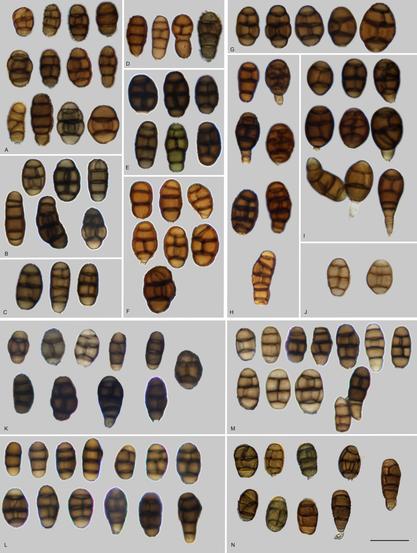
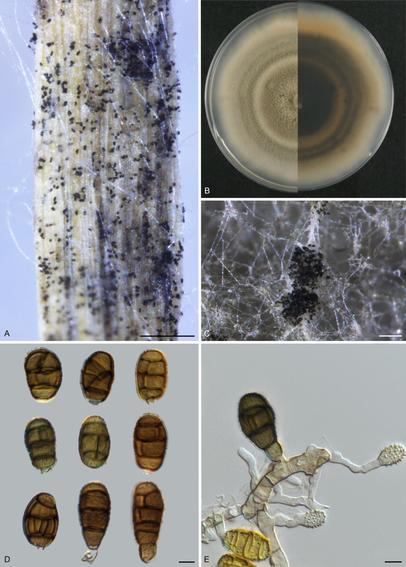
In a scientific article just published we investigate the fungal cause of the Facial Eczema (FE) disease in livestock. We found that there are two species of the fungus (Pseudopithomyces) on farms in NZ with identical spores but different genetics, and only one of them produces the toxin that causes FE.

For technical reasons, this species needs a new name which we call Pseudopithomyces toxicarius, in Latin this means ‘the toxin producer’.

For Farmers this discovery means that the current method of accessing FE risk by spore counting could also be counting non-toxic spores leading to inaccurate assessments. The image shows the spores of three different Pseudopithomyces species, could you tell them apart under the microscope?!

We will be developing a DNA-based diagnostic for the toxic fungus.
We also clarify the taxonomy of the genus Pseudopithomyces using globally diverse isolates setting up for future discoveries in this group of fungi.

This publication is culmination of over 4 years of work in collaboration with Beef+Lamb NZ, Manaaki Whenua Landcare Research, and AgResearch.

Press release: https://beeflambnz.com/news/major-step-understanding-facial-eczema-livestock

This research was published in the journal “Studies in Mycology” available at: https://doi.org/10.3114/sim.2025.112.02

#mycology #farming #mycotoxin #nomenclature #pasture #pithomycotoxicosis #taxonomy #NZ #fungi #science
Major step in understanding Facial Eczema in livestock

A significant breakthrough in understanding Facial Eczema (FE) in livestock brings New Zealand closer to reducing the disease's devastating impact on farmers, animals, and rural communities.

Beef + Lamb New Zealand

Mycotoxin exposure in a changing European climate

Mycotoxins are toxins from fungi which contaminate crops, food and feed. Climate change alters fungal behaviour and distribution, increasing the risk of exposure to these toxins. This briefing explores associated health concerns and how a One Health approach can prevent contamination.

https://www.eea.europa.eu/en/analysis/publications/mycotoxin-exposure-in-a-changing-european-climate

#Mycotoxin #fungi #food #climate

Mycotoxin exposure in a changing European climate

Mycotoxins are toxins from fungi which contaminate crops, food and feed. Climate change alters fungal behaviour and distribution, increasing the risk of exposure to these toxins. This briefing explores associated health concerns and how a One Health approach can prevent contamination.

Study reveals fewer mold toxins in organically grown grain, compared to grain grown conventionally

An international meta study reveals that there may be less of certain mold toxins in organically grown grain, compared to grain grown in the conventional manner. This, and other findings from research into agricultural products, can have major consequences.

Phys.org
this is not an easy pathway to develop :/ The literature has drawings (no SMILES, no InChI) and I need to double check the correctness of the structures and link them to the experimental identification (e.g. of stereochem). Not all structures are even in #PubChem! I just added one to #wikidata (so that it will show up in PubChem soon)
https://classic.wikipathways.org/index.php/Pathway:WP5425 #mycotoxin @wikipathways #chemistry
Metabolism of T-2 toxin and HT-2 toxin (Triticum aestivum) - WikiPathways

#Globalwarming affects food safety, esp. mycotoxin contamination, as warmer #temperatures enable more #mycotoxins-producing fungal species. Abiotic stress linked to #climatechange weakens crops & renders them more vulnerable: https://doi.org/10.1111/1541-4337.13323 #mycotoxin #foodsafety
Μυκοτοξίνες Υδατοκαλλιέργειες - Myconos Ερευνητικό Έργο - Παν. Θεσσαλίας

Μυκοτοξίνες στις Υδατοκαλλιέργειες. Προστασία της Υγείας Ιχθύων και καταναλωτών. Myconos Ερευνητικό Έργο - Πανεπιστήμιο Θεσσαλίας , Τμήμα Γεωπονίας Ιχθυολογίας και Υδάτινου Περιβάλλοντος. Myconos Ερευνητικό Έργο Πανεπιστήμιο Θεσσαλίας, Βόλος.

Μυκοτοξίνες στις Υδατοκαλλιέργειες: Καινοτόμες διαχειριστικές πρακτικές για την προστασία της υγείας ιχθύων και καταναλωτών

R to @EFSA_EU: Ochratoxin A (OTA) is a naturally occurring #foodborne #mycotoxin found in a wide variety of agricultural commodities, ranging from cereal grains to dried fruits to wine and coffee.

Learn more about mycotoxins in #food and #feed ⤵️

https://europa.eu/!hJrGtd

🐦🔗: https://nitter.cz/EFSA_EU/status/1721833499244499111#m

[2023-11-07 10:14 UTC]

Mycotoxins

Mycotoxins are toxic compounds that are naturally produced by different types of fungi. They enter the food chain as a result of infection of crops.

European Food Safety Authority
Timing matters when reducing Fusarium head blight in winter barley

When Fusarium head blight (FHB) threatens winter barley, the best time to apply a fungicide is about six days after full barley head emergence, according to a recent study published in Plant Disease.

Phys.org
Magnetic recoverable enzyme formulation removes mycotoxin from fruit-derived products

A research team led by Prof. Li Boqiang from the Institute of Botany of the Chinese Academy of Sciences has developed an immobilized enzyme preparation with high efficiency, stability, safety and easy separation, which can degrade patulin in contaminated apple juice without any adverse effect on juice quality.

Phys.org

Today, at the World #Mycotoxin Forum we have presented new approaches for #RiskAssessment of mycotoxins, critical issues for assessing the ones carcinogenic together with results from recent assessments & our initiatives in support of research activities.
@MycotoxinForum

🐦🔗: https://nitter.eu/EFSA_EU/status/1526570798881841155

EFSA (@EFSA_EU)

Today, at the World #Mycotoxin Forum we have presented new approaches for #RiskAssessment of mycotoxins, critical issues for assessing the ones carcinogenic together with results from recent assessments & our initiatives in support of research activities. @MycotoxinForum

Nitter