China’s Desert Solar Tower Turns Sunlight Into Night Shift Electricity
Looks like sci-fi… but it’s solving one of solar energy’s biggest problems.
Dear Cherubs, in the Dunhuang Desert, China, a solar tower looks like it escaped from a sci-fi set and decided to become useful. The Shouhang 100 MW molten-salt tower plant uses thousands of heliostats to focus sunlight onto a central receiver, where the heat is stored and later turned into electricity long after sunset.
HOW IT WORKS
This is not your average “put panel, get power” situation. According to China’s State Council Information Office site, the Dunhuang plant spans more than 1.4 million square meters and is ringed by 12,000 heliostats around a 260-meter-high tower. The mirrors track the sun, bounce concentrated light upward, and heat molten salt inside the system.
The engineering trick is storage. A 2025 industry review from the SolarPACES community explains that molten-salt tower systems use the salt as both the heat-transfer fluid and the storage medium; in the receiver, the salt can reach about 565°C, then move into insulated hot tanks until the plant needs power. Later, that heat makes high-temperature steam that spins a turbine. Translation: the sun clocks out, but the plant does not.
CGTN reported that the Dunhuang site can keep releasing stored heat in a planned way, which is the whole point of concentrating solar thermal technology in the first place. Unlike conventional photovoltaic farms, this setup is built to smooth out the “sunny right now, useless later” problem. Human progress, finally, with a storage tank attached.
WHY IT MATTERS
The capacity is significant. People’s Daily Online reported that the plant was designed to generate about 390 million kilowatt-hours of electricity annually, while CGTN described it as the largest molten-salt tower power station built in China and said it could cut carbon dioxide emissions by about 350,000 tons per year. That is a pretty tidy way to turn desert glare into grid power.
There is also a tourism angle, because apparently even giant industrial infrastructure now has to be photogenic. CGTN reported that Dunhuang’s booming tourism industry helped shape the project’s development, and the company has explored visitor activities such as fishing and camping under the starry sky near the site. The message is subtle: yes, it is a power plant, but also, please admire the mirrors.
The broader lesson is simple. China’s Dunhuang tower is not just a flashy desert landmark; it is a working example of how concentrated solar power can store heat, supply evening electricity, and reduce dependence on fossil fuels. In a world still arguing with itself about energy storage, this project has already moved on to the part where the sun is optional.
Sources:
Reuters — https://www.reuters.com/sustainability/climate-energy/russiaukraine-energy-shock-why-geopolitics-demands-clean-energy-shift–ecmii-2026-02-12/
Reuters — https://www.reuters.com/sustainability/climate-energy/china’s-solar-industry-association-calls-for-end-to-price-wars-2025-08-22/
State Council Information Office / gov.cn — https://english.www.gov.cn/news/202308/16/content_WS64dc3dd5c6d0868f4e8de991.html
CGTN — https://news.cgtn.com/news/2023-09-11/Power-of-Dunhuang-Gardening-steel-sunflowers-in-the-Gobi-Desert-1n18VGuXbs4/index.html
People’s Daily Online — https://en.people.cn/n3/2021/1021/c90000-9909825.html
SolarPACES / Blue Book of China’s Concentrating Solar Power Industry 2023 — https://www.solarpaces.org/wp-content/uploads/2024/02/Blue-Book-of-Chinas-Concentrating-Solar-Power-Industry-2023.pdf
The Thisclaimer logo blends a classic warning symbol with a brain icon to represent critical thinking, curiosity, and thoughtful disclaimers.
#China #cleanTech #climateChange #concentratedSolar #desertInnovation #dunhuang #energy #energyStorage #environment #heliostats #moltenSalt #renewableEnergy #solarPower #sustainability ietsist - Free Palestine!
 Eric Maugendre about carbon
 Thoughtful Disclaimer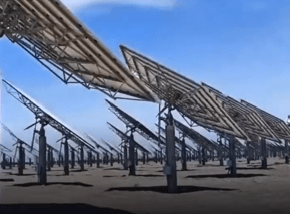

 Benjamin Carr, Ph.D. 👨🏻💻🧬
 Dennis Bours
 Frédéric Jacobs
 otheorange_tag
 DoomsdaysCW
 Paul Houle