 rikard
Vi lever i en ugn som redan är för varm. Varje biltur till affären medför att värmen skruvas upp. Oavsett var i ugnen du befinner dig är höjd temperatur ett problem, oavsett temperaturskillnader högst upp och längst ner. #klimatkris #metafor
#statstab #354 Modeling Non-Linear Associations in Meta-Regression {metafor}
Thoughts: Modelling non-linear effects is easier than you think with splines!
#splines #metafor #r #metaanalysis #nonlinear #moderator #metaregression #cubic
https://www.metafor-project.org/doku.php/tips:non_linear_meta_regression
 I was waiting for this exterior view, Aral.
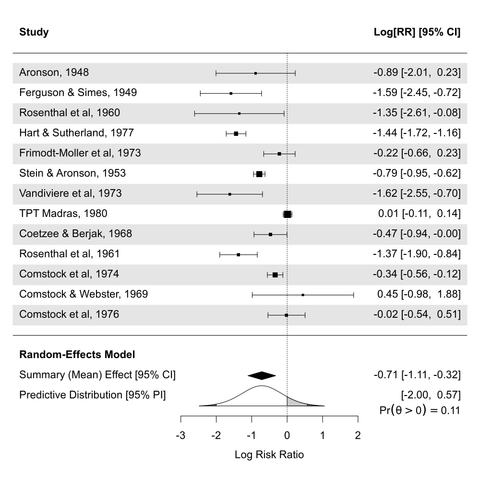
 Kinda excited about some additions to the metafor package I am working on. Can now visualize the entire predictive distribution in a forest plot (in addition to showing the prediction interval itself).
#statstab #109 Fixed-Effects, (Equal-Effects) and Random-Effects Models in Meta-Analysis via {metafor}
Thoughts: A great, quick overview of the inferences each type of #metaanalysis allows you to make and why.
#metafor #stats #rstats #statistics
https://wviechtb.github.io/metafor/reference/misc-models.html
Books and articles about meta-analysis often describe and discuss the difference between the so-called ‘fixed-effects model’ and the ‘random-effects model’ (e.g., Cooper et al., 2009). The former term is (mostly) avoided throughout the documentation of the metafor package. The term ‘equal-effects model’ is used instead, since it more concretely describes the main assumption underlying this model (i.e., that the underlying true effects/outcomes are homogeneous, or in other words, that they are all equal to each other). The terms ‘common-effect(s) model’ or ‘homogenous-effect(s) model’ have also sometimes been used in the literature to describe this model and are equally descriptive. Moreover, the term ‘fixed-effects model’ creates a bit of a conundrum. When authors use this term, they are really typically referring to the equal-effects model. There is however another type of model, the ‘real’ fixed-effects model, that is different from the equal-effects model, but now we would need to invent (unnecessarily) a different term to refer to this model. Some have done so or tried to make a distinction between the ‘fixed-effect model’ (without the s!) and the ‘fixed-effects model’, but this subtle difference in terminology is easily overlooked/missed. Using the term ‘equal-effects model’ avoids this confusion and is more informative. However, the question then remains what the real fixed-effects model is all about. The purpose of this page is to describe this model and to contrast it with the well-known random-effects model.
For those interested in meta-analysis and R (and in particular the metafor package):
I will do another special live stream on this topic on November 30th (6pm CET), where I will discuss in detail how to draw nice forest plots with the metafor package. Further details about my live streams here: https://www.wvbauer.com/doku.php/live_streams
Quick reminder for those into R, statistics, and in particular meta-analysis:
On the 'Open Online R Stream' tonight (starting at 6pm CEST), I will talk about some of the recent updates to the metafor package. This will actually be the 100th stream, which in itself is a reason for some celebration.
Further details about these live streams can be found here: https://www.wvbauer.com/doku.php/live_streams
I released a new version (4.4-0) of the metafor package on CRAN. Details about the updates can be found here: https://www.metafor-project.org/doku.php/news:news
For the 100th 'Open Online R Stream' (my semi-weekly live stream on R and statistics), I will do a special session on the updates in this version, with focus on how to draw nice forest plots. This session will take place on Oct 19th, starting at 6pm CEST. Details about these live streams here: https://www.wvbauer.com/doku.php/live_streams
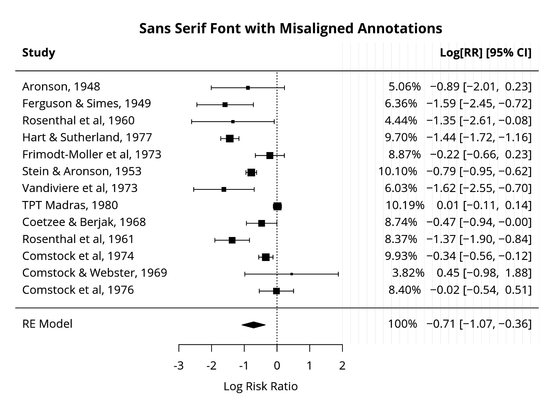
1/ One of the things that has always bothered me about the forest() functions in the metafor package is the fact that the annotations (i.e., the numbers on the right) are by default not properly aligned. Here is a (purposefully exaggerated) example to illustrate the problem (the vertical gray lines are added to see this more clearly).
1/3 I have given some love to the fsn() function in the metafor package. It can now calculate the 'fail-safe N' also under the assumptions of a random-effects model (using type="General"). This is a generalization of the methods by Orwin (1983) and Rosenberg (2005) (which are both based on the equal-effects model). See the documentation and some examples here:
 Dr Mircea Zloteanu 🌺🌞🍃
 Guillotine Jones, Flâneur
 Wolfgang Viechtbauer