 amen zwa, esq.
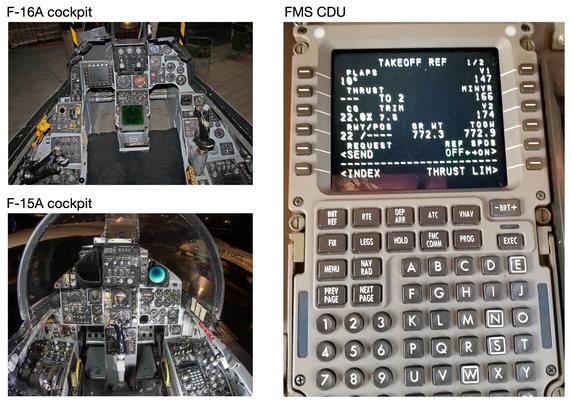
The F-16A cockpit, designed in the early 1970s (in the era of slide rules), is still the epitome of an effective, efficient, ergonomic design. Its superiority is evident, when compared to the cockpits of its contemporaries, especially that of the F-15A. Another admirable UI design, albeit on a much smaller scale, is the Control Display Unit (CDU) of a typical Flight Management System (FMS). It, too, was designed in the 1970s. These interfaces were designed, through iterative usability testing, by a team of psychologists, industrial engineers, electronic engineers, mechanical engineers, and experienced pilots.
In-cockpit, real-time UIs like these aim to decrease the potential for human error and to increase the pilots' situational awareness. They use the smallest possible set of usage conventions, control types, display components, fonts, and colours. They allow pilots to focus their attention completely on the critical information needed for the task at hand.
The traditional philosophy of human-machine interaction design is "usability without visibility". But today, the #web #UI's primary role is not #usability, but #marketability. Users falsely equate flashy UIs with service quality. Coders want to showcase their superior abilities over those of their coworkers. Companies take pride in owning bling.
This expensive trend is profitable to marketeers and attractive to casual users. So, it is justifiable for social media platforms and other non-mission-critical software. But these excesses are unsuited to enterprise software, especially those designed for internal use. Such flashy antics diminish business users' #productivity and increase the company's #cost of ownership.
 Gemma ⭐️🔰🇺🇸 🇵🇭 🎐