#3Dprinted at #makersasylum

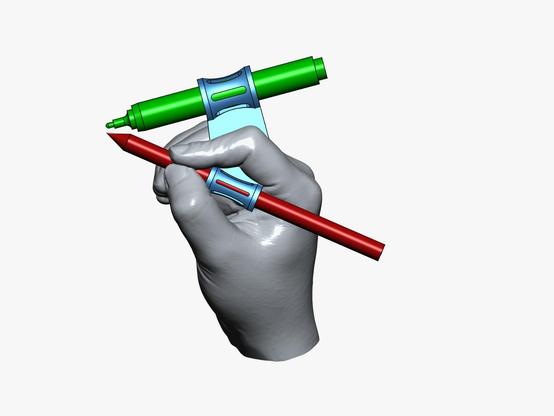
"Doodad for holding whiteboard markers at a more ergonomic angle when writing on a vertical surface without drying out the ink tip"

Prolly the longest project name I've ever thought of. 🤣

Needs a few tweaks and iterations. The springy bits to hold the pen and marker are not as springy in PLA. Maybe I need to try TPU or PETg

Designed in @FreeCAD

Innovation School is a STE(A)M program designed to drive hands-on, collaborative learning where projects focus on solving real world problems. Aligned with the maker philosophy of “Learning by doing” the program has been developed to help students and even those continuing education to build a maker mindset

Blog post for more info
https://makersasylum.com/innovation-school-a-unique-learning-by-doing-s-t-e-a-m-program/

#CAD
#diy
#drone
#electronics
#frugalinnovation
#IoT
#makerspace
#MakersAsylum
#opensource
#pcbdesign
#rapidprototyping
#robotics
#soldering

Innovation School – A Unique “Learning By Doing” S.T.E.A.M. Program - Maker's Asylum

What is Innovation School? Innovation School is a STE(A)M program designed to drive hands-on, collaborative learning where projects focus on solving real world problems. Aligned with the maker philosophy of “Learning by doing” the program has been developed to help students and even those continuing education to build a maker mindset.

Maker's Asylum
Raspberry Pi Team Visits Maker’s Asylum For Woodworking Fun! - Maker's Asylum

The Maker’s Asylum is an open community maker space and we thrive in building collaborative relationships with organizations invested in the open source movement. So it was a great opportunity for us to host the team from the Raspberry Pi Foundation India a couple of weeks back for a weekend of woodworking and team building fun. After all, Moira, the quaint little village in north Goa that we call home, has long been home to a resident community of skilled carpenters.

Maker's Asylum

Remoticon 2021 // Vaibhav Chhabra and the M19 Collective Make One Million Faceshields

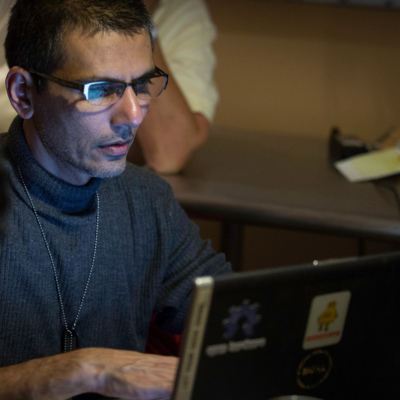
[Vaibhav Chhabra], the co-founder of Maker's Asylum hackerspace in Mumbai, India, starts his Remoticon talk by telling a short story about how the hackerspace rose to its current status. Born out of frustration with a collapsed office ceiling, having gone through eight years of moving and reorganizations, it accumulated a loyal participant base - not unusual with hackerspaces that are managed well. This setting provided a perfect breeding ground for the M19 effort when COVID-19 reached India, mixing "what can we do" and "what should we do" inquiries into a perfect storm and starting the 49 day work session that swiftly outgrew the hackerspace, both physically and organizationally.

When the very first two weeks of the Infinite Two Week Quarantine Of 2020 were announced in India, a group of people decided to wait it out at the hackerspace instead of confining themselves to their homes. As various aspects of our society started crashing after the direct impact of COVID-19, news came through - that of a personal protective equipment shortage, especially important for frontline workers. Countries generally were not prepared when it came to PPE, and India was no different. Thus, folks in Maker's Asylum stepped up, finding themselves in a perfect position to manufacture protective equipment when nobody else was prepared to help.

We've seen collective projects like these over the years - this one is magnificent in its thoughtfulness at scale. All of that is here for us to learn from - for instance, nuances of manufacturability optimisations in context of diverse variety of hackerspace infrastructure. An often-forgotten requirement for any project wishing to be successful is expanded upon - keeping the end users, healthcare specialists, in a tight iterative design loop. The sheer amount of this effort, coupled with media coverage, didn't go unnoticed by other hackerspaces, which is where the challenge of sharing knowledge rose up, and was swiftly dealt with. End result? One million faceshields produced across India's hackerspaces and other lasercutter-equipped places, in only a bit longer than a month and a half's time.

After the demand for face shields started to finally get fulfilled, the new capabilities and strengths of the hackerspace consortium were waiting for the next goal to be unlocked - at least, those that didn't need to be diverted to quality assurance and keeping the effort running. The experiences and frameworks developed during are now a vital part of a research case study and QA/QC principle formation effort, both led and funded by University of Cambridge. In turn, the maker resources available were then directed towards designing and manufacturing oxygen concentrators, as well as repairing the ones that were just waiting to be put into working order.

If you were ever looking for a tale of a myriad hackerspaces collaborating on a social project, this is it - and there's plenty to learn for anyone wishing to inspire other hackers to conquer large social problems. This talk covers about every part of the process that you would like to learn from, wrapped in an exciting story you could make a documentary on. The effort lives on, and we will certainly see its principles in action whenever it is that the next storm hits us.

#cons #hackadaycolumns #hackerspaces #medicalhacks #2021hackadayremoticon #covid #covid19 #india #m19collective #makersasylum #remoticon
Remoticon 2021 // Vaibhav Chhabra And The M19 Collective Make One Million Faceshields

[Vaibhav Chhabra], the co-founder of Maker’s Asylum hackerspace in Mumbai, India, starts his Remoticon talk by telling a short story about how the hackerspace rose to its current status. Born…

Hackaday

Indian Makers Respond To The COVID-19 Pandemic By Producing Oxygen Concentrators

We've all spent the last year or more under the shadow of the COVID-19 pandemic, and though some of us may have been vaccinated or come through its various waves it remains far from over. One of the hardest-hit parts of the world at the moment is in India, where health services are struggling to maintain adequate oxygen supply such is the demand for it from sick patients.

India's hacker and maker community have risen to the challenge and done their bit to supply needed resources, and fresh from last year's PPE manufacturing efforts a group from the Makers Asylum hackerspace in Goa have launched upon a fresh challenge. They aim to start producing the established open-source OxiKit oxygen concentrator in the Indian hackerspace community using locally manufactured parts, and they've launched a crowdfunding effort to cover their development, prototyping, and certification work.

The oxygen concentrator project builds on Makers Asylum's experience last year as part of an extremely successful network of makerspaces producing PPE, which demonstrates that they have the resources, logistics, and ability to take on a project of this size. The OxiKit is no hare-brained contraption but an established and successful design that is already at work, so we believe that this project has a good chance of success. It's close to home for Hackaday too, and one of the people involved with it is our colleague [Anool Mahidharia].

In a global pandemic only a global response can overcome the incredible challenges before us. For that reason we'd like to urge you to take a look at the Makers Asylum page wherever you are, and if you can, support it.

#medicalhacks #covid #crowdfunding #makersasylum #oxikit #oxygenconcentrator

Indian Makers Respond To The COVID-19 Pandemic By Producing Oxygen Concentrators

We’ve all spent the last year or more under the shadow of the COVID-19 pandemic, and though some of us may have been vaccinated or come through its various waves it remains far from over. One…

Hackaday