 Culturieuse
 Steiger
 aboutgrau
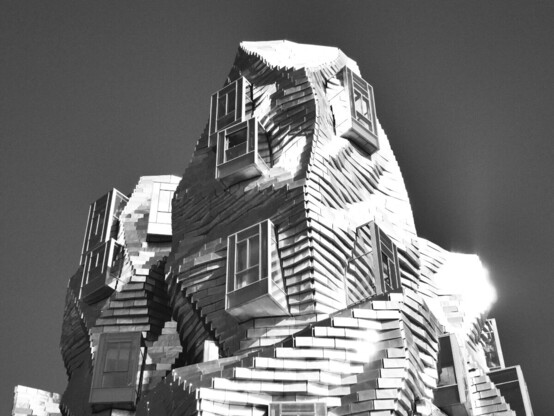
exploring the newish tower of frank gehry in arles, france. the tower is called „tour tuma“ and it‘s more or less a public building built for maja hoffmann’s luma foundation. read about some of the details in my recent blog post. there are more images as well 🙃
https://aboutgrau.com/tourluma
#blog #writing #art #mastoart #france #arles #lumaarles #frankgehry #deconstructivism #architecture
 Hagen
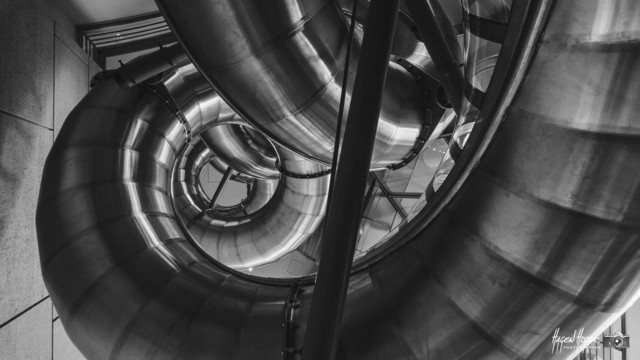
HagenInside Luma, Arles
.....
#lumaarles #arles #architecture #architecturephotography #photography #photo #bnwphoto #bnwphotography #art #photographyisart #architectureisart
 dezeen (unofficial)
This week we interviewed Frank Gehry about his Luma Arles tower
This week on Dezeen, we spoke to Frank Gehry about the environmental performance of his latest project, The Tower in the French town of Arles.
In an exclusive interview with Dezeen, the 92-year-old Canadian-American architect said The Tower responds to concerns about the carbon footprint of architecture.
"We fit into it," he said. "But I can't explain it. I respond to every fucking detail of the time we're in with the people we live with, in this place."
Iwan Baan photographs Frank Gehry's Luma Arles tower
Following the opening of The Tower last week, architectural photographer Iwan Baan took photos of the building.
Baan's photos show the distinctive stainless steel tower rising above the Luma Arles arts campus in the town of Arles.
Hemp "more effective than trees" at sequestering carbon says Cambridge researcher
We continued our carbon revolution series with a pair of stories focused on hemp, which can capture atmospheric carbon twice as effectively as forests, according to Cambridge University researcher Darshil Shah.
However, the use of hemp in architecture and design is being held back by "ridiculous" rules, a UK farmer who a house made from the material told Dezeen.
As part of the series, we also interviewed Pakistani architect Yasmeen Lari who said that using "ancient wisdoms and techniques" can lead to carbon-neutral buildings.
Antepavilion building "smashed up" and staff arrested in police raid on design workshops
In the UK, police raided the building that hosts London's annual Antepavilion architecture commission and arrested a number of its staff.
A UNESCO report also revealed that Liverpool is set to lose its World Heritage status due to the planned construction waterfront developments that are "eroding the integrity" of the site.
Kéré Architecture uses local clay to construct Burkina Institute of Technology
This week Burkinabe architect Diébédo Francis Kéré unveiled a pair of recently completed education projects.
In western Africa, his studio built a university in Burkina Faso, with walls made from locally sourced clay and screens of eucalyptus wood.
The studio also revealed a campus for non-profit organisation Learning Lions on the banks of Lake Turkana in Kenya.
Helen & Hard hangs Woodnest treehouses from pine trees above Norwegian fjord
Popular projects this week included a treehouse overlooking a fjord in Norway, a brick house inserted into a stone ruin in Portugal and a Corten extension to the Manchester Jewish Museum.
Our lookbook this week focused on L-shaped kitchens.
This week on Dezeen is our regular roundup of the week's top news stories. Subscribe to our newsletters to be sure you don't miss anything.
The post This week we interviewed Frank Gehry about his Luma Arles tower appeared first on Dezeen.
#all #architecture #news #frankgehry #thisweekondezeen #lumaarles


Iwan Baan photographs Frank Gehry's Luma Arles tower
Architectural photographer Iwan Baan has captured The Tower and its interiors, which was designed by architect Frank Gehry as the centrepiece of the Luma Arles cultural district.
Baan's photos show the distinctive tower rising above the surrounding buildings on the recently opened Luma Arles arts campus in the town of Arles, France.
The Tower was designed to be a landmark in Arles
Clad in 11,000 irregularly arranged stainless steel panels, the 56-metre-high tower was designed to be a landmark for the 27-acre cultural campus, which was commissioned by Swiss collector Maja Hoffmann, founder of Luma Foundation.
As well as being a marker for the site and a lookout tower, the building contains exhibition galleries, archives, a library, offices, seminar rooms and a cafe.
It is clad in stainless steel panels
According to the architect, the tower was informed by Vincent Van Gogh's paintings, while the glass drum it rises out of recalls the nearby Roman amphitheatre, which can be seen in Baan's photographs.
"We wanted to evoke the local, from Van Gogh's Starry Night to the soaring rock clusters you find in the region," said Gehry.
"Its central drum echoes the plan of the Roman amphitheatre."
It rises above the surrounding buildings in Arles
As with several of Gehry's previous buildings, including the Walt Disney Concert Hall in Los Angeles and the New York by Gehry skyscraper, the tower is clad in stainless steel.
However, in an exclusive interview with Dezeen Gehry said that the project was a one-off rather than fitting into an evolution of his architectural approach.
"I try not to repeat myself," said Gehry. "I just think about it at the time I'm doing it, the people I'm working with, like Maja, the community."
"So I don't think of it," he added. "I mean, naturally, there's like this historical lineage but it's just how I feel at this time in this place."
An atrium stands at the centre of The Tower
Baan's photos also reveal the arts tower's interior, where a large lobby space is intersected by numerous curved staircases.
On the ground floor, this space is surrounded by several galleries and a cafe.
Above this on the first and second floor are more galleries and studio spaces along with a library and members area.
The building is topped with a viewing platform.
Numerous curved staircases give access to the upper floors
The Tower was built as part of the redevelopment of a former railyard that was left vacant in 1986.
Together with a series of industrial buildings that have been renovated by New York-based Selldorf Architects, the site is now Luma Arles.
At night the tower's facade reflects light
Pritzker Architecture Prize winner Gehry is one of the world's leading architects. Recently completed projects by the architect include the renovation and extension of the Philadelphia Museum of Art, Louis Vuitton Maison Seoul and Facebook's California campus.
He also recently designed a gold bottle to mark the 150th anniversary of Hennessy X.O.
Photography is byIwan Baan.
The post Iwan Baan photographs Frank Gehry's Luma Arles tower appeared first on Dezeen.
#all #architecture #cultural #frankgehry #iwanbaan #france #lumaarles


"I respond to every fucking detail of the time we're in" says Frank Gehry
Frank Gehry's new tower in Arles fits with both the ancient Roman city and today's environmental agenda, the architect claimed in an exclusive interview with Dezeen.
Speaking to Dezeen in Arles last week the Pritzker Prize-winner said The Tower, which has a steel-and-concrete frame and a glazed drum at its base, responds to current concerns about the carbon footprint of architecture.
"We fit into it," said the Canadian-American architect. "But I can't explain it. I respond to every fucking detail of the time we're in with the people we live with, in this place," added the 92-year-old when asked about the building's environmental performance.
"So it's all taken into account as best I can," he continued.
"You know, I believe that's the most important thing to do," he added, gesturing to the face mask in his hands. "To live in the place and time you are in and what the issue is, you know, even with these fucking masks."
Sustainable elements include natural ventilation of the circular glazed podium while some of the building's energy comes from renewable sources. However, precise details of the building's embodied carbon have not been disclosed. The team did not submit the building for environmental certification under the French HQE programme.
The tower forms part of the Luma Arles cultural campus
The Tower finally opened last week along with the rest of the vast Luma Arles cultural campus after a 14-year gestation period.
It serves as an entrance pavilion, lookout tower, exhibition-and-events space and beacon for the 27-acre campus commissioned by Maja Hoffmann, the art-collecting founder of Luma Foundation and the heiress to the Hoffmann-La Roche (now Roche) pharmaceutical fortune.
Founded in 2004, the philanthropic foundation "focuses on the direct relationships between art, culture, environmental issues, human rights, education and research".
The Luma name comes from Hoffmann's children, Lucas and Marina, echoing the way her father, the eminent environmentalist and World Wildlife Fund co-founder Luc Hoffmann, named his philanthropic conservation body MAVA Foundation after the initials of his children.
"I try not to repeat myself"
Gehry and Hoffmann, who is Swiss but grew up on her father's estate in the Camargue wetlands near Arles, first began discussing the building in 2006. This was long before sustainability topped the architectural agenda but when shiny icons were still very much the rage.
Their conversations began nine years after the opening of Gehry's titanium-clad Guggenheim Museum Bilbao and three years after the completion of his stainless-steel Walt Disney Concert Hall in Los Angeles.
But Gehry said that each project is a one-off rather than fitting into an evolution of his architectural approach.
"I try not to repeat myself," he said. "I just think about it at the time I'm doing it, the people I'm working with, like Maja, the community."
"So I don't think of it," he added. "I mean, naturally, there's like this historical lineage but it's just how I feel at this time in this place."
Gehry's influences include Roman and Romanesque architecture
The 1997 Bilbao building introduced Gehry to the world, rebooted the city's economy and self-image, and fuelled the trend for iconic cultural buildings in cities hoping to replicate "the Bilbao effect".
Gehry sounds a little bemused by the term. "I don't really care about that, but it's nice that it changed the community," he said, as one of his team interjected, pointing out that he received death threats when the building was first proposed.
"When I went to Bilbao it was sad," he continued. "They were having a hard time economically. The kids growing up left Bilbao to go to college. They didn't stay there."
Gehry's Guggenheim is credited with turning around the fortunes of the post-industrial city in Spain's Basque country.
"I didn't mean to change the city"
"This has changed the economy," he said. "People come. I've been told they earn over eight billion Euros since the building opened. When you go there now it's friendly and open and happy."
"People are always telling me how I changed the city," he added. "I didn't mean to change the city, I just meant to be part of the city."
But Arles is no Bilbao. The UNESCO world heritage site is already a magnet for visitors coming for its spectacular Roman remains, its connection with artist Vincent van Gogh and Les Rencontres d'Arles, its world-renowned annual photography festival.
Located in a former SNCF railway engineering works on the edge of town, the Luma Arles campus adds another world-class attraction to the tiny city, which has a population of just 50,000.
The Luma Arles campus is at the edge of the ancient city
The railway sheds, repurposed into workshops, galleries and performance spaces by Selldorf Architects, are monumental in scale but these are eclipsed by Gehry's 56-metre-high tower. It is by far the tallest building in the area and dominates Avenue Victor Hugo, the main route into Arles, on a rise above the campus.
It towers over French architect Marc Barani's low-slung and discreetly minimalist École Nationale Supérieure de la Photographie, the French national photography school that sprang from the photo festival and opened in 2019, which lies directly across the road.
Arles, once a Roman provincial capital, sits on a low hill beside the river Rhône just before it enters the Camargue wetlands (which Hoffmann's father is credited with saving and where he established the Tour du Valat nature reserve) on its way to the Mediterranean, which is over 40 kilometres away.
"I don't antagonise. I don't try that"
The idea to build a tower came from Hoffmann, who expressed a desire to be able to "see the sea from the tower". But despite the requirement to build tall, Gehry said he did not intend to build a provocative structure.
"Well, I try to make it the scale of where we are," he said when reminded of the backlash from neighbours when he built his seminal 1978 home in Santa Monica. "And I try to make it user-friendly and not off-putting. So, you know, I don't make it black. And I don't antagonise. I don't try that. That's not my way."
The design process involved making dozens of scale models, many of which are exhibited in the vast exhibition space beneath the tower. These show how various approaches were explored including stacks of cubes, piles of oblongs and fabric-like forms.
However, none of the early models shows the twin concrete lift towers that break up the sculptural form at the rear of the tower.
A pair of concrete lift towers protrude from the rear of the tower
"There are over 100 models made of metal, wood… it was a long, long journey," said Gehry.
Over his career, Gehry has pioneered new approaches to creating architectural form, including scanning roughly made paper and card models and manipulating them in 3D software.
But this time, the models were made by his team. "I don't make them myself," he said. "I used to. It is a collaborative effort."
Gehry cites numerous local influences on the tower's form. Vincent van Gogh, the artist who lived in the city between 1888 and 1889 and painted many of his best-known works here, is one of them.
Gehry has compared the stainless-steel facade to the brushwork in Van Gogh's painting of Les Alpilles, a low range of mountains to the north-east of Arles that features distinctive limestone outcrops. He has also cited the nocturnal Starry Night painting as an influence.
The cladding was informed by Vincent van Gogh's paintings
The Roman architecture of Arles is another influence, with its famous amphitheatre informing the glazed drum at the base of The Tower.
"Certainly the Roman amphitheatres were in my mind but I didn't want to copy them," he said at the press conference that marked the building's opening, when he joked that The Tower is "my first Roman building".
"But I thought that having a drum on the boulevard that became the foyer for the whole building was a simple way of inviting people from all sides, from all directions, as well as having a strong symbol, presence on the street."
The drum is naturally ventilated, one of a number of energy-saving features that were reverse-engineered into the project to make it more sustainable as the project rumbled on.
Others include a biodiesel plant and solar panels that provide some of the power for the campus, and the use of interior cladding made from local materials including agricultural waste, algae and salt to replace the originally specified gypsum drywall.
The glazed drum is informed by Arles' Roman amphitheatre
The latter interventions were carried out by designers at Atelier Luma, a design research lab located at the campus and headed by curator and educator Jan Boelen. There was apparently some tension over these interventions: when another journalist asked one of Gehry's team about the materials, he replied: "That wasn't us".
Gehry took further inspiration from Romanesque architecture, including landmarks he visited when studying architecture in Paris in the 1950s.
"I visited here," he said at the press conference. "I was living in Paris and studying Roman architecture. I was very moved by the architecture."
Speaking to Dezeen later, he rattled off a list of Roman-influenced medieval buildings around the country he recalls visiting in his student days, admiring their stonework.
"Autun, Vézelay, Tournus... I guess that's Romanesque. Yeah. I liked the stone blocks but I didn't want to repeat that."
Rather than stone, The Tower is faced in 11,000 hollow, non-structural blocks made of stainless steel sheets that have a textured pattern on them, allowing them to reflect the harsh Provençal light in a softer way.
"So we studied metal because it reflects the light. But I wondered if it could be soft and feel comfortable. Which it does."
Inevitably, the building has its detractors. Does criticism concern Gehry? Or does he prefer to give people a bit of time to get used to new buildings in their neighbourhood?
"It's more like the latter," he replied. "I don't presume anything. Really. I call it friendly or happy insecurity."
The post "I respond to every fucking detail of the time we're in" says Frank Gehry appeared first on Dezeen.
#interviews #all #architecture #frankgehry #france #lumaarles


