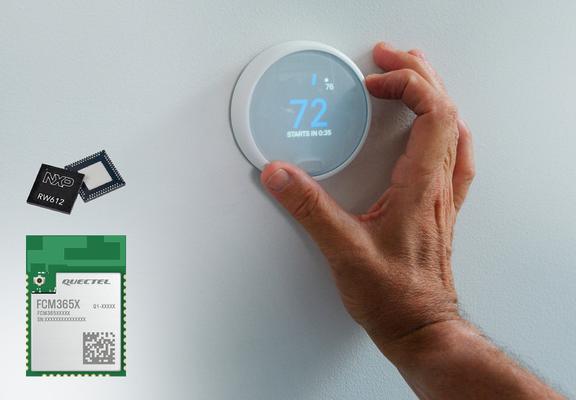
Quectel FCM365X dual-band WiFi 6, BLE 5.4, 802.15.4 IoT module features NXP RW612 MCU, optional PSRAM
Quectel FCM365X is a short-range IoT module based on NXP RW612 wireless MCU with support for dual-band Wi-Fi 6, Bluetooth Low Energy (BLE) 5.4, and 802.15.4 (Zigbee and Thread) connectivity. The compact 25.5 x 18.0mm RW612 module features 8MB flash and optional PSRAM, and operates in the -40 °C to +85 °C temperature range for demanding Smart Home and industrial IoT (IIoT) applications. The FCM365X module exposes GPIO, SDIO, UART, USB, JTAG, I2C, I2S, ADC, LCD, and PWM interfaces through its LCC+LGA package. Quectel FCM365X specifications: SoC - NXP RW612 CPU Core - Arm Cortex-M33 core @ 260 MHz with Arm TrustZone-M Memory - On-chip 1.2 MB SRAM Wireless Dual-band Wi-Fi 6 Target wake time (TWT) support Integrated Wi-Fi PA/LNA, and T/R switch Tx power - Up to 19 dBm ±2 dB Rx sensitivity - Down to -96 dBm ±2 dB AP/STA modes Security - WPA-PSK/ WPA2-PSK/ WPA3-SAE/ AES-128 Bluetooth 5.4
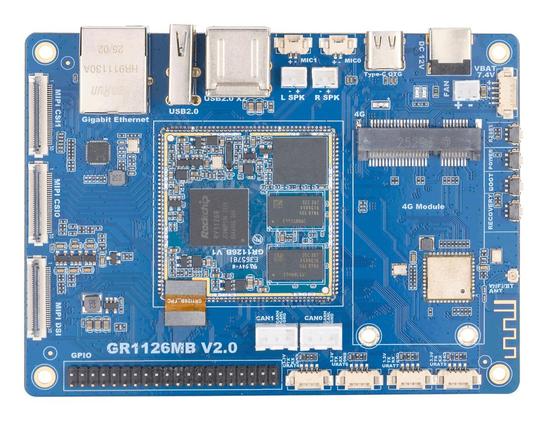
Graperain GR1126MB development board features solder-on 3 TOPS Rockchip RV1126B AI Vision module
Graperain GR1126MB development board is based on a 42x42mm GR1126B 160-pin stamp-hole system-on-module powered by a Rockchip RV1126B AI camera SoC with a 3 TOPS NPU designed for AI vision, machine vision, and edge AI applications. Graperain GR1126 AI Vision system-on-module GR1126 specifications: SoC – Rockchip RV1126B CPU – Quad-core Arm Cortex-A53 up to 1.6 GHz with 32KB L1 I-Cache and 32KB L1 D-Cache, unified 512KB L2 Cache GPU – 2D Graphics Engine VPU Video Decoder – H.265/H.264 up to 4K @ 30 FPS Video Encoder – H.265, H.264, JPEG up to 4K @ 45 FPS JPEG Decoder ISP - Built-in 12M ISP and 8M AI-ISP AI accelerator – Rockchip NPU engine up to 3 TOPS (INT8); supports INT4, INT8, INT16, and FP16 models; TensorFlow, ONNX, PyTorch, and Caffe frameworks. System Memory – 1GB or 2GB DDR3 by default, customizable up to 4GB LPDDR4/LPDDR4x Storage – 8GB, 16GB, 32GB, 64GB,

$7.99 Seeed Studio Wio-S3 WiFi, Bluetooth LE, and LoRa IoT module combines ESP32-S3 and SX1262 RF transceiver
Seeed Studio Wio-S3 is a compact (21.6 x 16.5 x 3.3 mm) wireless module that combines an ESP32-S3R8 dual-core WiFi 4 and Bluetooth LE MCU and a Semtech SX1262 LoRa transceiver. The module includes 16MB Flash and 8MB PSRAM, and supports LoRa (EU868/US915) with up to +20.9 dBm transmit power and -137 dBm sensitivity. It also supports Wi-Fi 4 and BLE 5.0, and comes with two IPEX connectors for external antennas. With interfaces such as UART, I2C, SPI, ADC, and USB, and support for -40°C to 85°C operation, it is designed for remote monitoring, industrial automation, smart agriculture, and IoT data logging. Seeed Studio Wio-S3 module specifications: SoC – Espressif ESP32-S3R8 CPU – Dual-core Tensilica LX7 microcontroller up to 240 MHz with vector instructions for AI acceleration Memory – 8MB PSRAM Wireless - 2.4 GHz 802.11b/g/n WiFi 4 and Bluetooth 5.0 LE + Mesh connectivity Storage – 16MB external SPI flash
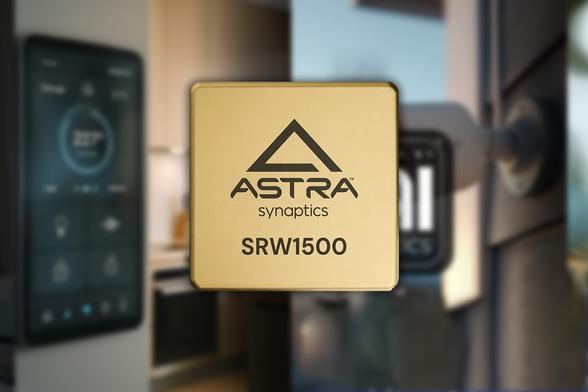
Synaptics Astra SRW1500 Cortex-M52 Edge AI MCU features Ethos-U55 NPU, Wi-Fi 6/7, Bluetooth 6.0, 802.15.4 connectivity
Synaptics has introduced the Astra SRW1500 Series of AI-native Edge AI MCUs designed for smart IoT edge devices. The family features an Arm Cortex-M52 core, an optional Arm Ethos-U55 Neural Processing Unit (NPU), and tri-band Wi-Fi 7 or Wi-Fi 6, Bluetooth 6.0 LE, and 802.15.4 connectivity, in a single package. It targets low-latency on-device AI workloads such as voice-trigger detection, sound-event classification, and AI-enhanced Wi-Fi sensing. The series currently comes in four variants offering different wireless and USB options. Since sensing, AI processing, and wireless connectivity are integrated into a single chip, this approach helps reduce system costs, simplify PCB design, and lower power consumption in devices such as smart home hubs, building automation systems, and home appliances. Synaptics SRW1500 Series specifications: CPU Arm Cortex-M52 application core up to 200 MHz with Arm Helium (MVE) vector extensions for DSP and ML Arm Cortex-R4 WiFi core with 960 KB SRAM and 1408
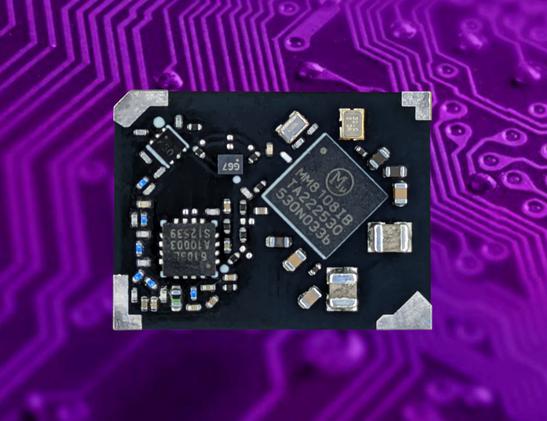
Morse Micro MM8108-M20 high-power Wi-Fi HaLow module delivers up to 28.5 dBm Tx output power
Morse Micro MM8108-M20 is a high-power Wi-Fi HaLow module based on the MM8108 SoC and a high-power amplifier delivering up to 28.5 dBm transmit output power, alongside a surface acoustic wave (SAW) filter tuned for the 902-928 MHz band of the North American market. Other MM8108 modules, such as the Quectel FGH200M Wi-Fi HaLow module, are limited to 26 dBm Tx power, but US and Canada regulations enable higher power transmissions, and by extension longer range. The obvious downside of the MM8108-M20 is that it might be outright illegal or may require a special license in other countries. Morse Micro MM8108-M20 specifications: SoC – Morse Micro MM8108 32-bit RISC-V Host Applications Processor (HAP) Standard – IEEE802.11ah Wi-Fi HaLow Frequency band – 850-950 MHz (Worldwide sub-1 GHz license-exempt range) Operating Modes – Access Point (AP) and Station (STA) Channel Width – 1/2/4/8 MHz Modulation – BPSK, QPSK, 16QAM, 64QAM, 256QAM. Data rate

Microchip dsPIC33CK low-cost motor control MCU sells for $0.51 and up
Microchip has expanded its dsPIC33 lineup with the dsPIC33CK Value Line family, a new series of low-cost 16-bit digital signal controllers (DSCs) designed for motor control applications. The devices deliver up to 100 MIPS of deterministic performance and integrate high-resolution PWM and a 12-bit ADC, making them suitable for motor Field-Oriented Control (FOC) and precision sensing tasks. These DSCs are designed to bridge the gap between basic microcontrollers and higher-end dsPIC33A devices. It offers flash memory from 32 KB to 256 KB, supports function consolidation to reduce component count and BOM cost, and is available in automotive-grade (AEC-Q100 Grade 1) versions with secure boot. Microchip dsPIC33CK specifications: MCU Core – 16-Bit dsPIC33CK CPU operating up to 100 MHz / 100 MIPS and DSP with 40-bit wide accumulators Memory & Storage 8 KB to 16 KB Data RAM 32 KB to 256 KB Program Flash with Error Correction Code (ECC) 384
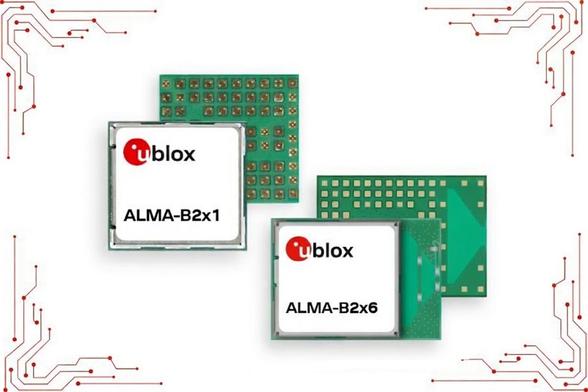
u-blox ALMA-B2 Bluetooth 6.0 and 802.15.4 module features Nordic nRF54LM20 Edge AI wireless MCU
u-blox has recently announced the ALMA-B2 standalone BLE 6.0 and 802.15.4 module family built around the Nordic Semi nRF54LM20 Cortex-M33 wireless microcontroller with a dedicated NPU for low-latency Edge AI applications. There are four specific product variants in the u-blox ALMA-B2 series: ALMA-B201, ALMA-B206, ALMA-B211, and ALMA-B216, all of which support Bluetooth 6.0 and Bluetooth Channel Sounding for distance measurement. They also support IEEE 802.15.4, including Thread, Zigbee, and Matter, as well as Nordic’s proprietary 2.4 GHz protocol and NFC. The company also mentions that the nRF54LM20B-based ALMA-B211 and ALMA-B216 variants include an Axon NPU that performs machine learning tasks up to 15 times faster and with greater energy efficiency than running the same tasks on the main processor alone. u-blox ALMA-B2 Series Specifications: Wireless SoC - Nordic Semiconductor nRF54LM20A (for ALMA-B201 and B206) or nRF54LM20B (for ALMA-B211 and B216) CPU Arm Cortex-M33 application processor clocked at up to 128 MHz RISC-V
So as of yesterday, 90 days have passed with my entire #homelab in a "single stack" all running atop an M1 mac mini. Under 30 watts total power consumption, 4 VMs and dozens of services in containers. Zero issues.
#linux #opensource #macmini #docker #debian #plex #jellyfin #uptimekuma #portainer #lowpower #caddy #selfhost #selfhosting #privacy #sovereignty
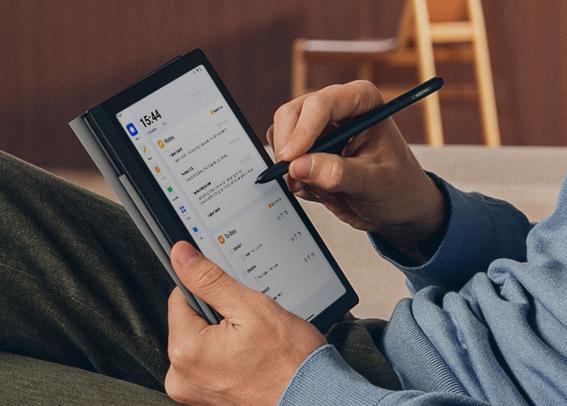
Huion Note E – A 8.4-inch Android 15 electronic notebook with battery-free, pressure sensitive stylus
Huion Note E is an Android 15 note-taking device/electronic notebook powered by a MediaTek Helio G99 SoC and equipped with an 8.4-inch color LCD designed to work with a battery-free PenTech 3.0 pressure-sensitive stylus. The device ships with 6GB LPDDR4 memory, 128GB storage, and a single USB-C port for charging and data. The company says the 1920x1080 display leverages "AG nano-etching technology to create a refined, matte surface that mimics the traditional pen-on-paper experience" and provides an e-Paper-like experience, while maintaining a 60 Hz refresh rate. Huion Note E (X50) specifications: SoC - MediaTek Helio G99 CPU – Octa-core processor with 2x Arm Cortex-A76 cores @ 2.2 GHz, 6x Arm Cortex-A55 cores @ 2.0 GHz GPU – ARM Mali-G57 MC2 VPU Video Encoding – H.264, H.265/HEVC up to 2Kp30, 1080p60, 720p120 Video Playback – H.264, H.265/HEVC, VP-9 up to 2Kp30, 1080p60, 720p120 System Memory - 6GB LPDDR4 Storage - 128GB
 cnx-software.com [Unofficial]
 Dimly Lit Corners
 Ernest de León