 Miro Collas
Major Little Red Dot Revelation Just Challenged Galactic Models - YouTube
https://www.youtube.com/watch?v=4IidxRZ47M0
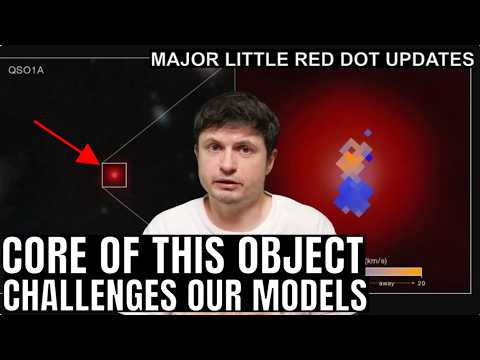
Major Little Red Dot Revelation Just Challenged Galactic Models - YouTube
https://www.youtube.com/watch?v=4IidxRZ47M0
James Webb Space Telescope | Extremely High Redshift Failure
The James Webb Space TelescopeThe James Webb Space Telescope (JWST) is an exquisitely designed and constructed telescope now orbiting in space some 1.5 million kilometers from Earth around a stationary point called Lagrange point L2, co-orbiting the Sun with the Earth. It is pointed away from the Sun so that its sensitive mirrors are not damaged by the solar wind and the intense radiation. The JWST was designed to “see” at very long wavelengths past red down into the infra-red.
Because of this design, and its location in the vacuum of space, it was expected to see more red-ward than any other human made telescope. So when it started to see hundreds of Little Red Dots, assume galaxies, with very large redshifts, suggesting they were the most distant galaxies ever observed, it was hailed a success.
But a problem occurred. The apparent luminosity and redshifts of those objects meant that if they are galaxies they are too mature (or massive in size) to exist so soon after the alleged big bang, that is only 500-700 million years after the beginning of time.
From the observed luminosity and redshift the cosmologist cranks the handle, using the assumed cosmological model, and calculates their absolute luminosity, which means the effect of the alleged expansion of the universe is corrected for. The resulting absolute luminosity (or magnitude) means they must be massively large.
This discovery challenged the standard belief that galaxies began as smaller entities evolving over time as they accumulated mass, meaning accumulating more stars and shining brighter.
According to the standard theory they exist too soon, that is, too early, for them to evolve into such massive galaxies. This means the big bang galaxy formation story is unraveling. Read the following.
In 2024 the JWST spectroscopically measured the redshift of an alleged galaxy with z = 14. That made it the farthest known galaxy and placed it at about 290 million years after the big bang. The gold standard redshift measurement is using the source’s spectrum, therefore spectroscopic as compared to photometric or drop-out method.
But now a new problem. A new object, CEERS-U-100588, provisionally named “Capotauro”, was observed with a photometric redshift of z = 32, far greater that any previously measured.
[Capotauro] is characterized by a significant absence of light in certain wavelengths and a pronounced drop in others. Its paucity of light and spectral peculiarities make it an enigmatic object, defying conventional classifications and sparking debate about whether the standard cosmological model might need adjustments,[2] although another study suggests otherwise for galaxies up to redshift z=30.[3]
According to standard big bang theory a galaxy with a redshift of about z = 32 puts it in a universe only about 90 million years after the beginning. But that is impossible, because calculations based on its apparent luminosity and redshift mean it must be ridiculously massive, if you believe the theoretical derived calculation of its absolute magnitude.
The object’s apparent luminosity implies a mass near a billion suns which is difficult to reconcile with current theories.
Watch this video below! But beware of the standard big bang cosmic evolutionary assumptions.
https://www.youtube.com/watch?v=NKLzYWnoKYo
The commentator Anton Petrov said that such objects, meaning massive galaxies like this one, should not exist because they wouldn’t have had time to grow into such a massive size, as calculated from the apparent luminosity, redshift and the standard cosmological model. For this reason he said the object breaks the models.
In fact, as he explains it cannot be a galaxy at all, but is most probably a Brown Dwarf star in our Milky Way galaxy. That means it is not the most distant galaxy ever observed and it did not exist when the universe was only 90 million years old.
Part of the problem is that the astronomers assumed that because it was so red, indeed observed in the infra-red by the JWST, it must be due to the massive stretching of the light wavelengths from the source. But they didn’t get a spectrum. There was a paucity of light and they photometrically determined the redshift based on the assumed model and its colour. That is the drop out method he mentions, which has certain limitations.
However the detection of two other objects, BD1 and BD2, found in the Bullet cluster, was an eye opener. They allegedly had spectroscopic redshifts greater than z = 20, under the assumption that they are galaxies.
Then the astronomers waited and a year later measured the same objects. They found that they both moved on the night sky relative to where they were first observed. Of course this implies that their redshift determinations were erroneous and could not be due to cosmological expansion.
No object out on the edge of the visible universe could ever have proper motion. That would be impossible because they would be just too far away. They should appear as fixed background objects.
So these BD1 and BD2 objects with claimed very large redshifts must be in our galaxy, and that means their redshifts are not due to the Hubble expansion.
Petrov said “They just looked like distant galaxies”. But he does not mention the fact that some quasars, as recently as 2022, have also been discovered to have proper motion.
One study published in the journal Astronomy & Astrophysics (A&A 660, A16 (2022)) identified “a set of 41 quasars with a proper motion exceeding 10 mas/yr, which can be considered as very high for objects which are a priori fixed in the celestial sphere.”
Quasars are believed to be active galactic nuclei in the standard cosmology. Thus they could not be galaxies inside our Milky Way galaxy. Read The Heavens Declare a Different Story.
So BD1 and BD2 turned out to be cool Brown Dwarf stars, with surface temperatures of around 300 K and not so far away. They only emit infra-red light and were confused with extremely distant galaxies. This is because certain assumptions are made and filters applied. They had spectra for the Brown Dwarf stars but confused them with distant early universe galaxies. This fact calls into question the veracity even of spectroscopically measured redshifts.
An assumption Petrov speaks of is that the Brown Dwarfs must have existed for billions of years just so that they have had time to cool to their current temperature. This is a standard cosmic evolutionary assumption. I don’t accept that.
In regard to these Brown Dwarf stars Petrov asked “How did the professional astronomers get this so wrong?”
His first suggestion is the apparent similarity to the Lyman-α break in their spectra. According to standard cosmology once you have to look down in the far infra-red spectra due to the reddening of the light wavelengths you run out of spectral lines after the Lyman break. That is due to the physics of the hydrogen atom. But the astronomers must assume that that is what they are seeing and with the Brown Dwarfs they assumed the wrong thing. It so model dependent it could be anything.
Secondly both the BD’s and the expected Little Red Dot galaxies at the edge of time are tiny red dots in images, so are very similar. And the third cause of misinterpretation is dust. Dust in the foreground filters out the shorter wavelengths leaving red images. The BD’s are naturally red due to their surface temperature. They are brown after all.
Thus there may be many BD’s in our galaxy which have been misidentified as early universe distant galaxies.
What more can one say? Many objects in the Milky Way galaxy may have been misidentified as distant galaxies in the alleged early universe. The reason this has happened is the result of the worldview of the astronomers takes precedent over everything else. The observations are always interpreted in light of big bang evolutionary cosmology.
But cosmology is not real science! At best it is a forensic search for what is already believed to be true, that the universe created itself some 14 billion years ago out of nothing. It is a faith position, which fails to make any sense.
Comment by a physicist friend
Although it is possible that we are looking at a brown dwarf rather than a galaxy, I am not convinced either way.
Spectroscopic redshifts are known to be inaccurate; without sharp emission/absorption lines there is no way to establish the correct redshift. The new paper discussed by A. Petrov uses the NIRSpec PRISM spectrometer on JWST, but no obvious sharp line is seen in the noise. They compare the observed spectrum with a dwarf model and with a galaxy model. But the galaxy model is not designed to work beyond z = 10, and it assumes space-expansion redshift which yields brighter galaxies than the actual brightness of the observed galaxies. So the models are off, which may explain why the fit to ‘a galaxy’ is not as good as a fit to a ‘brown dwarf’.
As for the proper motion, it is at the limit of JWST’s resolution. It is strange that the proper motion of the two brown dwarfs discovered in the same area of the sky move in the same direction and by the same amount! I suspect that JWST used a guide star that was not accurately centered on the tracking system, giving the entire frame an apparent proper motion that differs from the GAIA measurements. Unfortunately the paper only looks at the proper motion of the two galaxies (or brown dwarfs), I suspect every other object would appear to have moved in the same direction.
I would say “JWST galaxy redshift = 32 uncertain.” From the spectrum, the Lyman break is more likely at z = 38, but without a sharp line it’s impossible to say. Also, at such a large distance (48 Gly!) inhomogeneities in the electron density start to distort the image and the spectrum.
Related Reading
Free Subscribers
Subscribe to our Newsletters as a Free Subscriber and be notified by email. Just put your email address in the box at the bottom of your screen.
You’ll get an email each time we publish a new article. It is quick and easy to do and totally free. You only need do it once.
Premium Subscribers
Subscribe to our Newsletters as a Premium Subscribers at $5 USD/month or $30 USD/year (you choose). Cancel anytime.
Paid Premium Subscribers will get exclusive access to certain content I publish. That will only cost you a cup of coffee per month.
Also you’ll be able to download, for free, a PDF of my book Apocalypse Now and also a PDF of my book The Physics of Creation The Creator’s Ultimate Design for Earth.
You can download them from the link below.
click for Premium SubscriptionSubmitting formThis is how you can support my work. I have been publishing this website for 10 years now and up to 2024 I never asked for any support.
Press the button “Premium” on the front page to find a list of Premium content. Thanks so much to all supporters.
At a minimum, please join as a Free Subscriber. It’ll cost you nothing. It may also help me beat the shadow banning of some posts.
Comments Welcome Below
#BrownDwarfStars #cosmologicalRedshift #JamesWebbSpaceTelescope #JWST #LittleRedDots #properMotion #quasars #redshift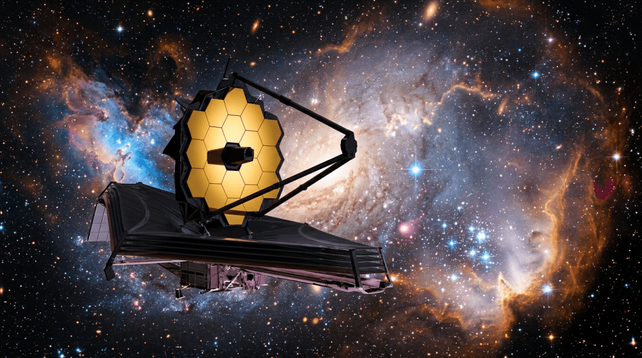
Misurata la massa di un buco nero agli albori dell'universo. È stata ottenuta la misura diretta della massa di un buco nero situato in uno dei "piccoli punti rossi" (Little Red Dots, Lrd) rilevati dal telescopio spaziale James Webb. L'oggetto si trova in una galassia risalente a un’epoca in cui l’universo aveva solo 700 milioni di anni.
#Abell2744QSO1 #Astronomia #buchineriprimordiali #Cosmologia #Evoluzionegalassie #LittleRedDots #telescópioJamesWebb
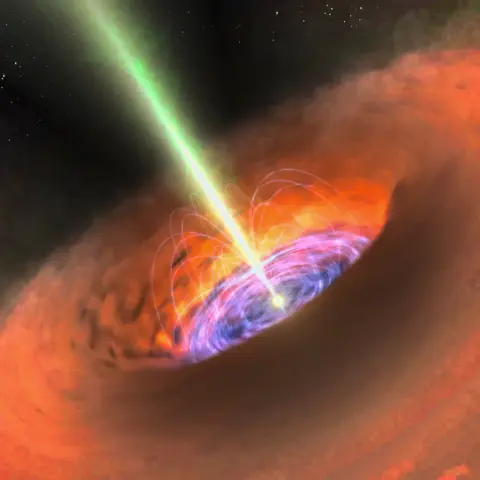
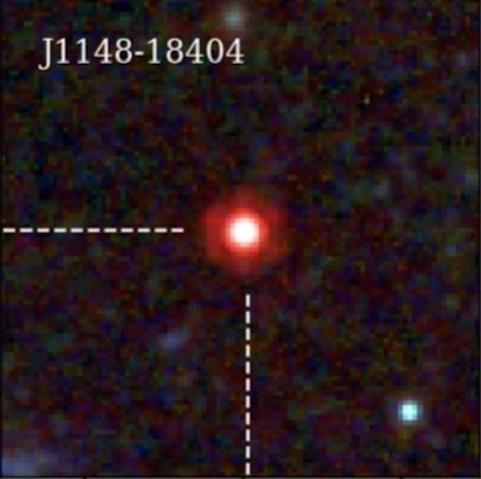
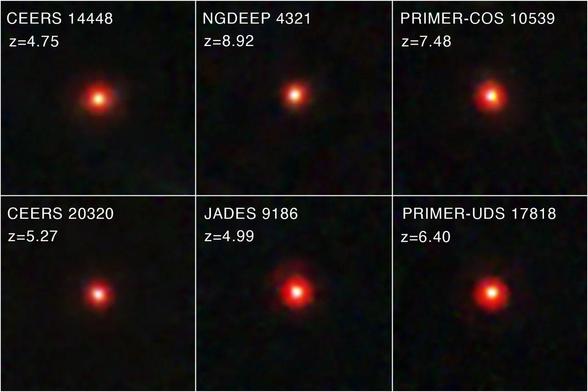
Little Red Dots and Their Progenitors from Direct Collapse Black Holes, Jeon, Junehyoung, Liu, Boyuan, Bromm, Volker, Fujimoto, Seiji, Taylor, Anthony J., Kokorev, Vasily, Larson, Rebecca L., Chisholm, John, Finkelstein, Steven L., Kocevski, Dale D.
#UniWien:
"
Die kalte und staubige Seite der Galaxienentstehung
"
"Neue Simulationen bestätigen kosmologisches Standardmodell – COLIBRE macht Galaxien-Entwicklung auch hörbar"
14.4.2026
#Astrophysik #COLIBRE #Galaxie #Gas #JWST #Kosmologie #LittleRedDots #LCDM #SchwarzesLoch #Simulation #Standardmodell #Staub #Universum
Then it would seem (to novice me) that the collapse of a gigantic star tossing off unusual elements found in globular clusters would form the black hole in the center of larger galaxies which dwarf galaxies travel with. The spin of the gigantic star would seed the spin of the black hole and its emergent galaxy.
Record Breaking Massive Black Holes Challenge Modern Models - YouTube
https://www.youtube.com/watch?v=58K_z0MeDdk

 Bible Science Forum
 Scienza et Magia
 Mistheart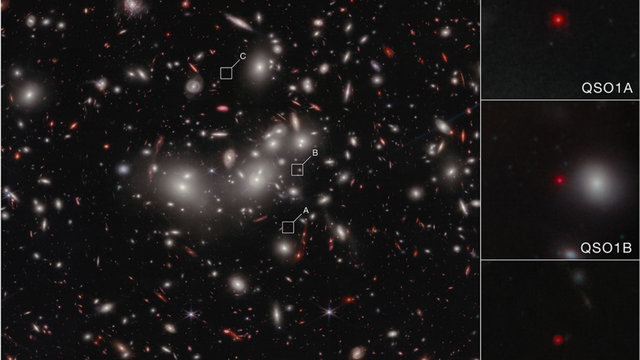
 Kuuke's Sterrenbeelden
 Daniel Fischer
 RTN
RTN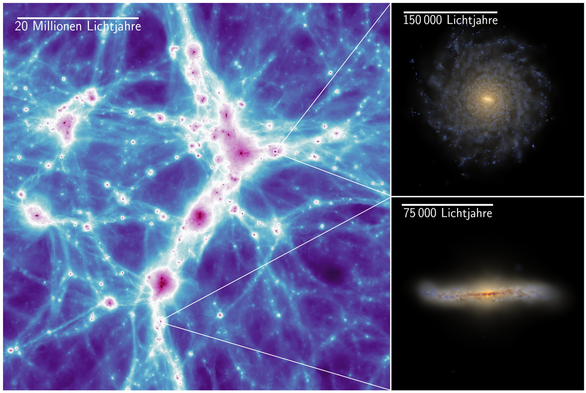
 Steve's Place
 Khurram Wadee ✅