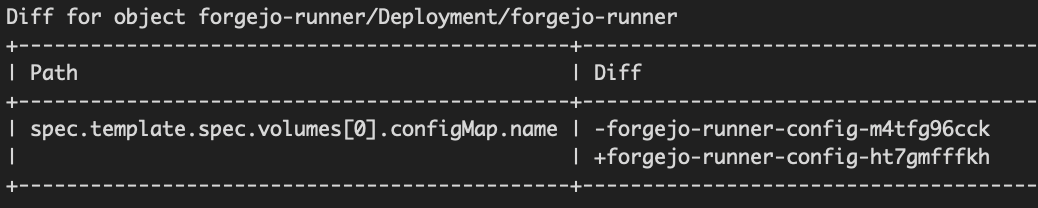
First steps with #kluctl to experiment with it as a higher level wrapper around my #kustomize work.
I like the diff a lot.
First steps with #kluctl to experiment with it as a higher level wrapper around my #kustomize work.
I like the diff a lot.
I genuinely don't understand why the kubernetes ecosystem settled on helm over kustomize. Kustomize is so much nicer: you can still provide a default chart, but users can override whatever the heck they want, support is built right in to kubectl, no weird extra tooling or "repos" needed, and no &$*%ing YAML templates.
I've been working on the infrastructure for Launchpad023. Everything declaratively configured because servers should be cattle not pets.
I've put it up on Codeberg if anyone wants to take a look.
https://codeberg.org/launchpad023/launchpad023-infra
#kluctl #kustomize #metallb #talosLinux #selfhosting #kubernetes #envoy_gateway #externalsecrets #stalwart #JMAIL #haarlem
My impression about #Kustomize is that reading the examples is more important than trying to read the information out of the documentation.
Had a few cases where I struggled because I accidentally worked against the tool. One was the name suffix generation of config maps and not knowing that one can configure custom name fields.
π€ If I want to patch a patch, then it seems I better put this into a file instead of having it embedded.
Heads down into #Kubernetes #Kustomize land. Not as easy as I assumed it to be π³
Might be that this is due to the combo with #Flux and trying to make reusable blocks is just not so easy in this context.
Could also be that I am just on a learning journey here.
Helm or Kustomize? The real question is: how do you get secrets into either one safely?
Andrew Block explains how SOPS integrates with both in this π©οΈ Thunder episode: https://youtu.be/9jgKuHzaYpU
This weekend's learning activity was figuring out a good way to make k8s templates out of my YAML files. There are a number of ways to do this, including from Ansible or Helm, but after looking at Kustomize, that's the best way for me to go.
Ansible could do it by either:
a) native k8s modules in ansible
b) with YAML files, and the template function, which would just do variable substitution
Helm is extremely overkill for my use case, although I'm sure I could get it to cooperate.
Kustomize is the best mix of $inputFiles + modifications = $outputFiles per environment, and I really like how it works.
You define your top level YAML files and then tell the environments in an overlays/ directory how you want things to change. You can even have it apply a namespace to all resources in there so it's never forgotten or replace values such as ingress hostnames, which have to be unique per env anyways.
This will let me write one set of files and then push the YAML to k8s properly. I also fully intend to use this for a DR kind of situation where I need to recover everything.
All of this will fit very well into my new Gitea instance, replete with an Actions runner.
#homelab #k8s #kubernetes #kustomize #learning #neverstoplearning #technology #yaml #selfhosted

New blog post out 'FluxCD OCI Artifact Verification'
https://calebwoodbine.nz/fluxcd-oci-artifact-verification/
#fluxcd #kustomize #helm #kubernetes #cncf #homelab #sigstore