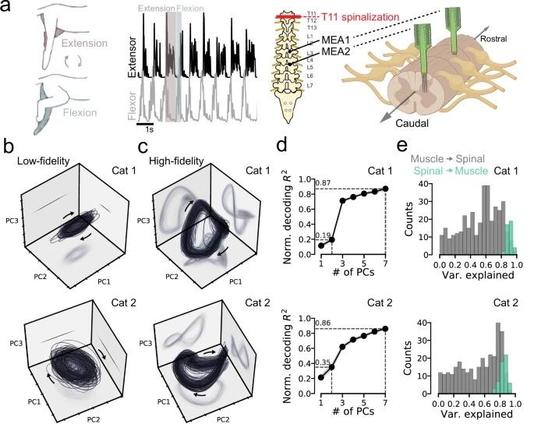
đź§  New paper by Wimalasena, Pandarinath, AuYong et al: #spinal #interneuron populations form a low-dimensional #manifold that robustly organizes step cycles.

Distinct regions of the manifold mark flexion–extension transitions, and a specific “hold region” tightly controls cycle duration. Deletions emerge as failures to enter the flexor region, giving a dynamical signature of disrupted CPG function.

🌍 https://doi.org/10.1038/s41467-025-64629-y

#Neuroscience #Locomotion #SpinalCord #PopulationDynamics #CompNeuro
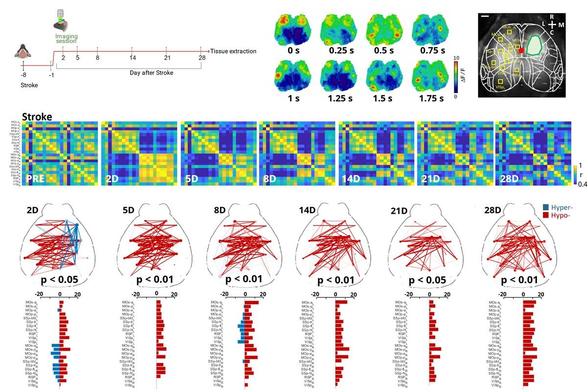
How to restore #motor function after #stroke? This study shows in mice that a combination of #RoboticRehabilitation & non-invasive gamma band #neuromodulation improves motor recovery by restoring movement-related oscillations & parvalbumin #interneuron dynamics @PLOSBiology plos.io/4n7QJng
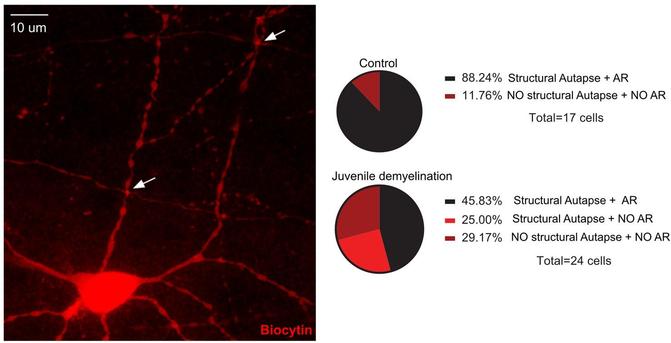
What role does #myelination play in #PrefrontalCortex development? This study shows that juvenile #demyelination disrupts PV #interneuron firing & self-inhibition, revealing a developmental window where myelination is essential for long-term cortical function @PLOSBiology https://plos.io/4mI4lVO
How are the different aspects of interneuron development coordinated? This study shows that the #Drosophila temporal TF Hunchback promotes #interneuron molecular identity, morphology & presynapse targeting in the NB5-2 neural progenitor lineage @PLOSBiology https://plos.io/3Rt2d7d
The Hunchback transcription factor determines interneuron molecular identity, morphology, and presynapse targeting in the Drosophila NB5-2 lineage

Interneuron diversity in the central nervous system is essential for proper circuit assembly, but how are the different aspects of interneuron development coordinated? This study shows that the Drosophila temporal transcription factor Hunchback is sufficient to promote interneuron molecular identity, morphology, and presynapse targeting in the NB5-2 lineage.

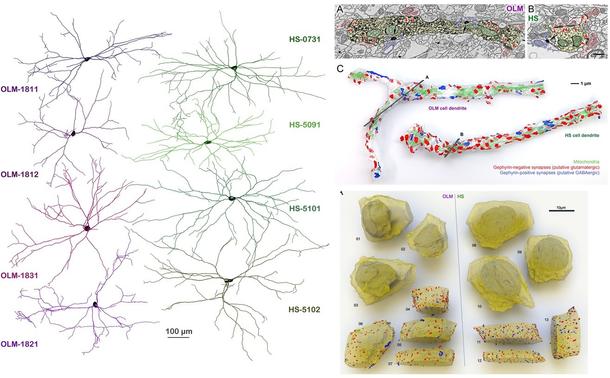
Diversity of somatostatin #GABAergic inhibitory interneurons. Study compares anatomical & physiological properties of 2 subtypes of #somatostatin #interneuron, finding key differences that may underlie their functionalities #PLOSBiology https://plos.io/3wRTXXD
Synaptic and dendritic architecture of different types of hippocampal somatostatin interneurons

Somatostatin GABAergic inhibitory interneurons have important roles in neuroplasticity, learning and memory, but the functional roles of some subtypes are not well understood. Here, the authors compare the anatomical and physiological properties of two subtypes of somatostatin interneurons, finding key differences that could underlie their functionalities and providing essential information to model the hippocampal network.

@reiver @chris_e_simpson if you are interested in #PNN you might also like www.pnnatlas.sns.it an Atlas of pnns and #parvalbumin positive #interneuron

Cerebellar #interneuron activity is triggered by reach endpoint during #learning of a complex #locomotor task – new #preprint by Andrianarivelo et al. (2023)

🌍 https://www.biorxiv.org/content/10.1101/2023.10.10.561690v2

#Neuroscience

Newest from the super talented @s_hijazi & the MCN CNCR team, out now:
https://www.nature.com/articles/s41380-023-02168-y

A great resource for all things #PV #interneuron:
-beautiful summary of PV function in health
-insightful discussion on the impact of early PV alterations & the development of #AD pathology.

Fast-spiking parvalbumin-positive interneurons in brain physiology and Alzheimer’s disease - Molecular Psychiatry

Fast-spiking parvalbumin (PV) interneurons are inhibitory interneurons with unique morphological and functional properties that allow them to precisely control local circuitry, brain networks and memory processing. Since the discovery in 1987 that PV is expressed in a subset of fast-spiking GABAergic inhibitory neurons, our knowledge of the complex molecular and physiological properties of these cells has been expanding. In this review, we highlight the specific properties of PV neurons that allow them to fire at high frequency and with high reliability, enabling them to control network oscillations and shape the encoding, consolidation and retrieval of memories. We next discuss multiple studies reporting PV neuron impairment as a critical step in neuronal network dysfunction and cognitive decline in mouse models of Alzheimer’s disease (AD). Finally, we propose potential mechanisms underlying PV neuron dysfunction in AD and we argue that early changes in PV neuron activity could be a causal step in AD-associated network and memory impairment and a significant contributor to disease pathogenesis.

Nature