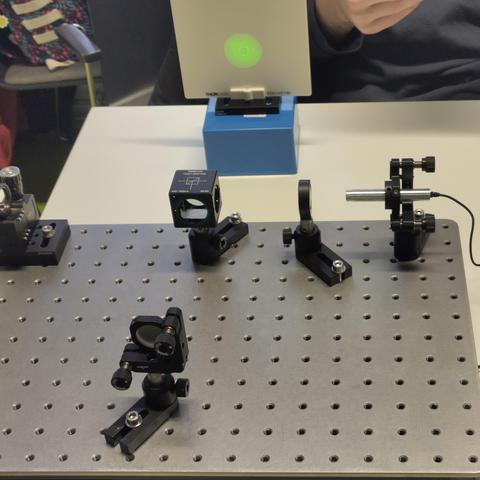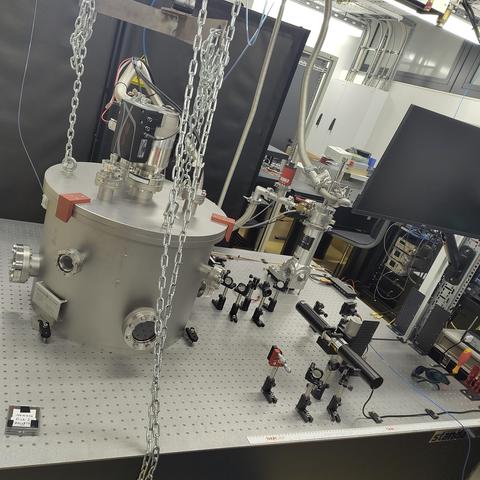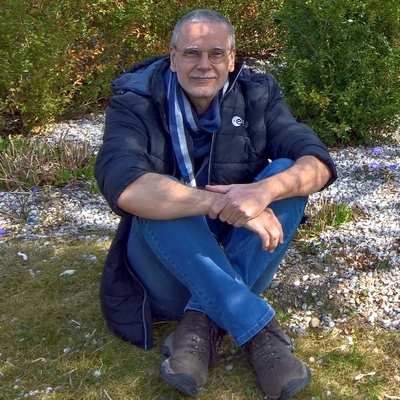
⚛️ Letzte Woche hatte mein Physik-LK die Möglichkeit an der Master Class zum Michelson-Interferometer an der @tubraunschweig teilzunehmen.

Selbst aufgebaut, kalibriert und gemessen bleibt sicher mehr hängen, als beim Demonstrationsversuch.
Neben der kompetenten Versuchsbetreuung gab es noch eine spannende Laborführung durch das LENA.

Ein sehr gelungener Exkursionstag. 👍

#Physik #PhysikEdu #Exkursion #MINT #4K #Schule #TUbraunschweig #MasterClass #LENA #Interferometer #CJD #CJDBS #FediLZ
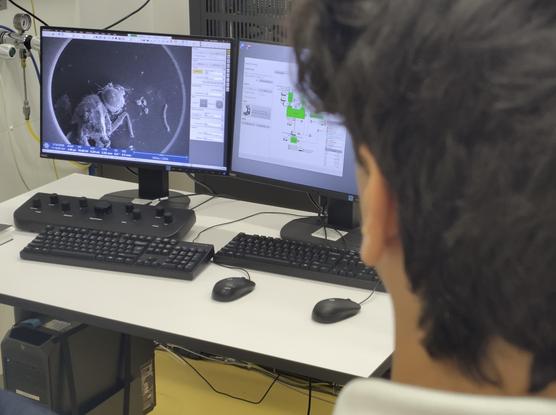
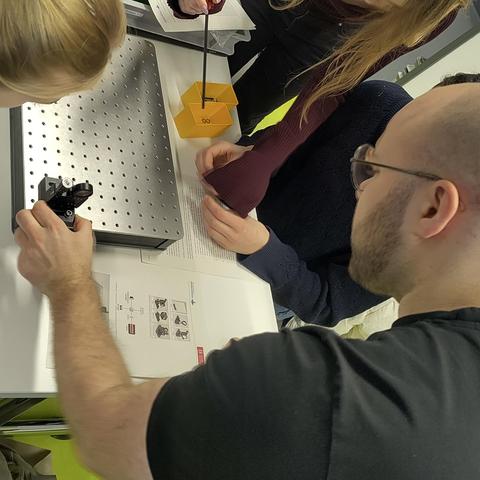
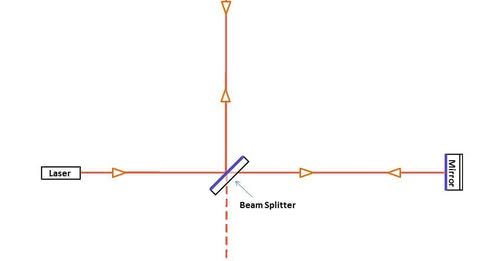
An #Interferometer is a scientific instrument that precisely measures changes in optical path length by causing light waves to interfere with each other.

In a typical setup, a beam of light is split into two, sent along different paths, and then recombined to produce an interference pattern.

https://knowledgezone.co.in/kbits/68df8388210eeccc603b71ec

Interferometer Device Sees Text from a Mile Away

A high-resolution imaging system captures distant objects by shining laser light on them and detecting the reflected light.

Physics

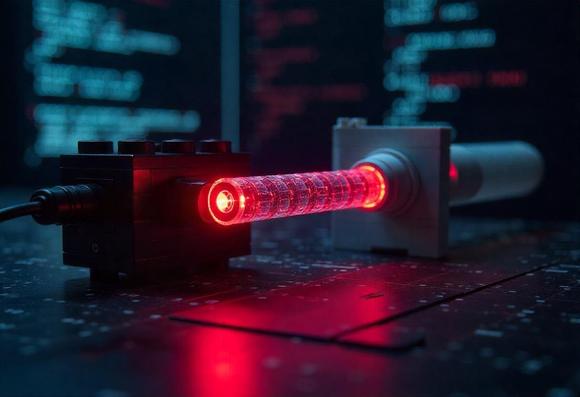
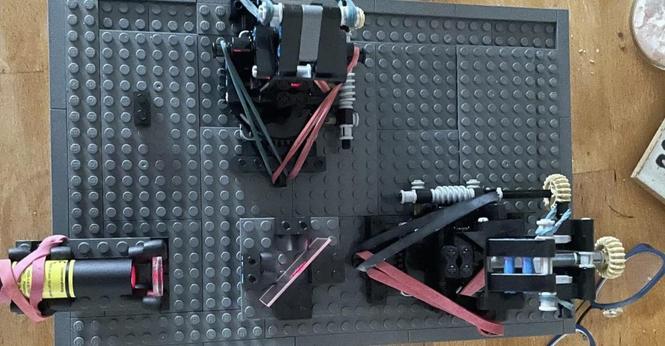
Building an Interferometer with LEGO.

LEGO! It’s a fun toy that is popular around the world. What you may not realize is that it’s also made to incredibly high standards. As it turns out, the humble building blocks are good enough to build a interferometer if you’re so inclined to want one. Kyra Cole shows us how it’s done.

https://www.linkedin.com/pulse/michelson-morley-interferometer-kyra-cole-rc9me/?trackingId=1zkqJebSTXS2qqSFfPoqKw

#lego #interferometer #maker #engineer #media #tech #news

Michelson-Morley interferometer

Sometimes, when life gets a bit chaotic, it's nice to reconnect with your roots. I had been wanting to do this for a long time, and finally found the opportunity.

NASA Innovative Advanced Concepts Phase I Final Report - A Lunar Long-Baseline UV/Optical Imaging Interferometer, Artemis-enabled Stellar Imager (AeSI): https://arxiv.org/abs/2503.02105 -> We're One Step Closer to a Giant #Interferometer on the Moon: https://www.universetoday.com/articles/were-one-step-closer-to-a-giant-interferometer-on-the-moon
NASA Innovative Advanced Concepts Phase I Final Report -- A Lunar Long-Baseline UV/Optical Imaging Interferometer: Artemis-enabled Stellar Imager (AeSI)

This report presents the findings of a NIAC Phase I feasibility study for the Artemis-enabled Stellar Imager (AeSI), a proposed high-resolution, UV/Optical interferometer designed for deployment on the lunar surface. Its primary science goal is to image the surfaces and interiors of stars with unprecedented detail, revealing new details about their magnetic processes and dynamic evolution and enabling the creation of a truly predictive solar/stellar dynamo model. This capability will transform our understanding of stellar physics and has broad applicability across astrophysics, from resolving the cores of Active Galactic Nuclei (AGN) to studying supernovae, planetary nebulae, and the late stages of stellar evolution. By leveraging the stable vacuum environment of the Moon and the infrastructure being established for the Artemis Program, AeSI presents a compelling case for a lunar-based interferometer. In this study, the AeSI Team, working with the NASA Goddard Space Flight Center's Integrated Design Center (IDC), has firmly established the feasibility of building and operating a reconfigurable, dispersed aperture telescope (i.e., an interferometer) on the lunar surface. The collaboration produced a credible Baseline design featuring 15 primary mirrors arranged in an elliptical array with a 1 km major axis, with the potential to expand to 30 mirrors and larger array sizes through staged deployments. Additionally, this study identified numerous opportunities for optimization and the necessary trade studies to refine the design further. These will be pursued in follow-up investigations, such as a NIAC Phase II study, to advance the concept toward implementation.

arXiv.org
Quite happy of my very first #animation---illustrating the principle of the #Michelson #interferometer for gravitational wave detection---made with #Inkscape and the super handy extension inkscape-animation (https://github.com/anonymou8/inkscape-animation) which nicely turns the sketch layers (or its objects by order of depth) into a gif or an mp4 video.
GitHub - anonymou8/inkscape-animation: Inkscape animation export extension. Exports layers as frames.

Inkscape animation export extension. Exports layers as frames. - anonymou8/inkscape-animation

GitHub
Der Drehimpuls eines Teilchens scheint sich von diesem zu lösen und sich körperlos zu bewegen. Dieser seltsame Effekt wurde in Experimenten beobachtet – und sorgt für Debatten.#Quanten #Quantenphysik #Quantenmechanik #Doppelspalt #Teilchen-welle-dualismus #Interferometer #Physik
Neues Quanten-Paradoxon löst Kontroverse aus

Der Drehimpuls eines Teilchens scheint sich von diesem zu lösen und sich körperlos zu bewegen. Dieser seltsame Effekt wurde in Experimenten beobachtet – und sorgt für Debatten.

Spektrum.de

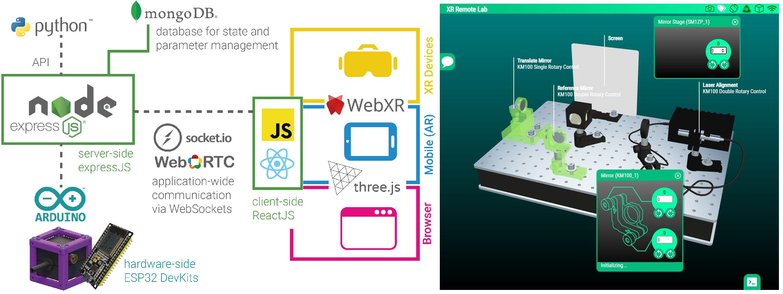
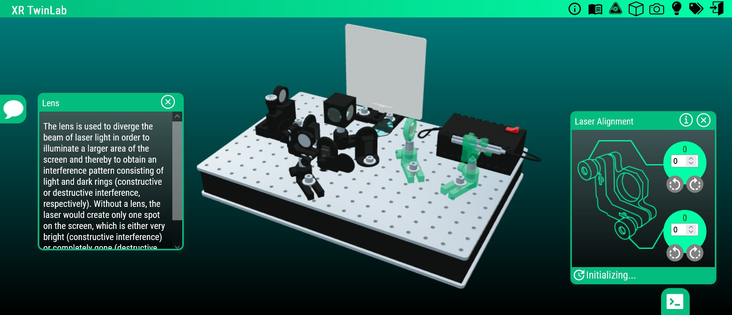
#XRTL: Explore the world of #optics & #interferometry by remotely controlling a #Michelson #interferometer in real-time & observing the interference pattern:

Web: https://xrtl.uni-jena.de/
Github: https://github.com/Lichtwerkstatt/XRTL_SPA

#DIYbio #physics #lab #instruments #education #STEM #MINT

XRTL Remote Lab

Anyone got a desktop #interferometer I can borrow? Need to measure the height of the tide in a cup of #tea. #science #NauticalShenanigans

"
Uni Wien: Quantenverschränkung misst Erdrotation

Quantenverschränkte Photonen reagieren auf den Spin der Erde. Eine Pressemitteilung der Universität Wien.
"
https://www.raumfahrer.net/uni-wien-quantenverschraenkung-misst-erdrotation/

14.6.2024

#Erde #Erdrotation #Interferometer #Photonen #Quantenverschränkung #SagnacEffekt #Spin #UniversitätWien #Wien

Uni Wien: Quantenverschränkung misst Erdrotation - Raumfahrer.net

Quantenverschränkte Photonen reagieren auf den Spin der Erde. Eine Pressemitteilung der Universität Wien. Quelle: Universität Wien 14. Juni 2024. 14. Juni 2024 – Ein Forschungsteam unter der Leitung von Philip Walther an der Universität Wien hat in einem bahnbrechenden Experiment die Auswirkungen der Erdrotation auf quantenverschränkte Photonen gemessen. Die Arbeit, die soeben in Science Advances […]

Raumfahrer.net