I gave one of my first-year university lectures today, on biodiversity and extinction rates, in which I mention the recent population growth of the Earth's most abundant large animal species ever: us.

I still remain completely gobsmacked by the magnitude of the world's recent human population growth.

8.27 billion: today's population, according to worldometers.info.

7.2 billion: in 2015 when I started teaching the course.

6.8 billion: in 2008 when my daughter was born.

3.8 billion: in 1971 when I was born.

2.3 billion: in 1946 when my parents were born.

1.9 billion: in 1923 when my Dad’s Dad was born.

So 1.9 billion to 8.2 billion in just over a century!

I worry about whether we can sustain this many people on the planet long-term while retaining and restoring a thriving wild biosphere that supports us.

Some of us are going to have to learn to use a lot less energy and resources.
#SoManyPeople #HumanPopulation

🇳🇴 🇸🇪 "To conclude, our study has produced new insights about some of the inequalities Indigenous people face in egalitarian societies. The prevalence of experiences of discrimination among the Sámi is strongly connected to their language use and thus rooted in the cultural status dimension." https://doi.org/10.53779/SBPL3716 #Research #Study #DOI #PoliticalScience #Sami #Land #Policy #Human #Population #HumanPopulation #Inequalities #Norway #Sweden #Europe #Academia #Academic #Academics @politicalscience
ECMI Minorities Blog. Indigenous Inequalities in Egalitarian Societies: The Case of the Sámi People in Norway and Sweden

Many Indigenous peoples live in firmly unequal societies and face substantial material disparities towards the ethnic majority populations. Yet, inequalities between ethnic groups are usually multidimensional and go beyond material status. But are they also present when economic inequality is absent? That is, what kind of inequalities do Indigenous peoples face in societies conventionally considered egalitarian? This blog post reports on new research about the situation of the Sámi people in Norway and Sweden. It indeed supports the proposition that the Sámi are on a material par with their non-Indigenous compatriots. Nonetheless, they are more likely to experience discrimination, and these experiences are strongly linked to how proficient Sámi are in their Indigenous languages and how frequently they use them. This shows that the Sámi face inequalities especially in the dimension of cultural status. Finally, the post points out potential further inequalities in the case of the Sámi…

How climate change impacted the human population 5,000 years ago

Talker
Researchers identify molecules that optimize immune presentation of antigens across the human population

Researchers at Children's Hospital of Philadelphia (CHOP) have identified variants of a chaperone molecule that optimizes the binding and presentation of foreign antigens across the human population, a finding that could open the door to numerous applications where robust presentation to the immune system is important, including cell therapy and immunization. The findings were published today in Science Advances.

Medical Xpress
my features published in #CurrentBiology this year, issue 1: Human population at the crossroads. After the passing of the #8billion threshold, I am discussing population trends for the decades ahead and what they will mean for global issues. https://proseandpassion.blogspot.com/2023/01/now-were-8-billion.html #HumanPopulation #GlobalIssues
now we're 8 billion

This year, there are 8 billion humans alive on the planet, and very soon there will be more people in India than in China. As I am old enoug...

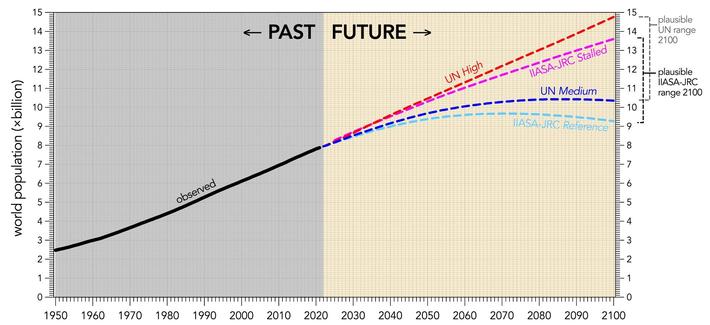
Turns out, the 1982 UN Medium prediction for what the global human population would be in 2000 was nearly spot on (predicted = 6.119 billion; observed = 6.108 billion) #humanPopulation
Food for thought. The global human #population just passed 8 billion. Based on an analysis we've just completed, the most-plausible projections from the UN & IIASA-JRC indicate where we're headed #humanPopulation