Geodynamo Mystery - Inside Earth’s Restless Core: Geomagnetism? Churning iron outer core powers the #geodynamo creates our protective #magnetic field, and why subtle shifts - like field weakening and past magnetic reversals matter. #Geomagnetism. youtu.be/8n8NsDaPx-A statusl.ink/geodynamomys...

Geodynamo Mystery: Inside Eart...
Geodynamo Mystery: Inside Earth’s Restless Core

YouTube
Erdmagnetfeld: Schwächezone weitet sich aus. Anomalie im Südatlantik wächst und vertieft sich – aber warum? #Erdmagnetfeld #Magnetfeld #Südatlantik #Magnetanomalie #Geowissen #Geodynamo
https://www.scinexx.de/news/geowissen/erdmagnetfeld-schwaechezone-weitet-sich-aus/
Erdmagnetfeld: Schwächezone weitet sich aus

Rätselhafte Anomalien: Im Südatlantik hat sich die riesige Schwächezone des Erdmagnetfelds weiter vergrößert und vertieft, wie aktuelle Analysen belegen.

scinexx | Das Wissensmagazin

Earth’s #geodynamo has operated for over 3.5 billion years.

The #magnetic field is currently powered by thermocompositional convection in the outer core, which involves the release of light elements and latent heat as the inner core solidifies.

However, since the inner core nucleated no more than 1.5 billion years ago, the early dynamo could not rely on these buoyancy sources and an alternative mechanism was required to sustain the geodynamo.

#Earth #planets
https://astrobiology.com/2024/09/thermal-and-magnetic-evolution-of-an-earth-like-planet-with-a-basal-magma-ocean.html

Thermal and Magnetic Evolution Of An Earth-like Planet With A Basal Magma Ocean - Astrobiology

Earth's geodynamo has operated for over 3.5 billion years.

Astrobiology
Wann entstand das schützende Magnetfeld unseres Planeten – und wie stark war es? Eine überraschende Antwort liefern nun 3,7 Milliarden Jahre alte Gesteine aus Grönland. #Erdmagnetfeld #Magnetfeld #Erdgeschichte #Geologie #Geodynamo
https://www.scinexx.de/news/geowissen/ur-magnetfeld-ohne-festen-erdkern/
Ur-Magnetfeld ohne festen Erdkern?

Wann entstand das schützende Magnetfeld unseres Planeten – und wie stark war es? Eine überraschende Antwort liefern nun 3,7 Milliarden Jahre alte Gesteine

scinexx | Das Wissensmagazin
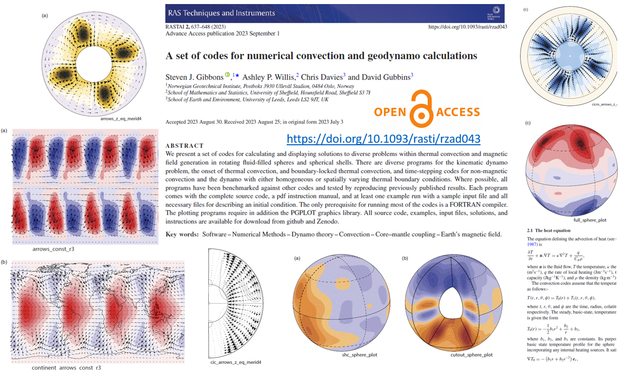
New #OpenAccess paper in RAS Techniques and Instruments #RASTI in final format now. "A set of codes for numerical convection and #geodynamo calculations" - convection and magnetic field generation in rotating fluid-filled spherical shells.
https://doi.org/10.1093/rasti/rzad043
A set of codes for numerical convection and geodynamo calculations

Abstract. We present a set of codes for calculating and displaying solutions to diverse problems within thermal convection and magnetic field generation in rota

OUP Academic

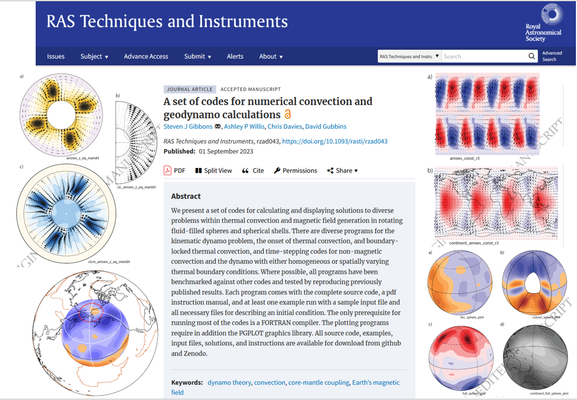
New paper in #RAS Techniques and Instruments, rzad043,
https://doi.org/10.1093/rasti/rzad043
"A set of codes for numerical #convection and #geodynamo calculations"
Steven J Gibbons, Ashley P Willis, Chris Davies, David Gubbins.
Published:
01 September 2023
In advanced access (pdf only) format from September 1, 2023.
All code, documentation, and auxiliary files freely available from https://github.com/stevenjgibbons/LEOPACK-2022-revision

Codes are provided and documented in the hope that they will be useful :-)

A set of codes for numerical convection and geodynamo calculations

Abstract. We present a set of codes for calculating and displaying solutions to diverse problems within thermal convection and magnetic field generation in rota

OUP Academic

Earth’s innermost region is separated into two major components: a solid #inner #core that measures about 750 miles in radius and sits within the #outer #core, which is a 1,300-mile-thick layer of liquid metal.
Due to its remote location 1,800 miles under our feet, the core has long evaded easy observation, though scientists can peer at some of its hidden features by recording seismic waves from earthquakes that pass through this enigmatic area.
Past studies with seismic waves have offered tantalizing hints that the inner core might itself contain a distinct core, though the size and nature of this potential “fifth layer” of Earth has remained a matter of debate. 
Now, Thanh-Son Phạm and Hrvoje Tkalčić, a pair of researchers at The Australian National University, have used “a previously unobserved and unutilized class of seismological observations” to expose the #IMIC, which they say “could be a fossilized record of a significant global event from the past,” according to a study published on Tuesday in Nature Communications.
“Earth’s #inner #core ( #IC ), which accounts for less than 1% of the Earth’s volume, is a time capsule of our planet’s history,” said Phạm and Tkalčić in the study.
“As the IC grows, the latent heat and light elements released by the solidification process drive the convection of the liquid #outer core, which, in turn, maintains the #geodynamo,” referring to the mechanism that generates Earth’s #magnetic field.  

https://www.vice.com/en/article/4axkwj/earth-core-discovery-scientists

There's Another Core Within Earth's Core, Scientists Discover

The innermost inner core (IMIC) “could be a fossilized record of a significant global event from the past,” scientists say.

The paper is still not ready, but some may find interest in the #scientific #poster about #geodynamo #reversals simulated with a rare event method.
https://doi.org/10.6084/m9.figshare.21989324.v1
Geodynamo reversals simulated with a rare event algorithm

Geomagnetic reversals are rare events. Simulations must run for long times to catch such events. Long simulations can only be performed at unrealistic parameters, which questions their relevance to the Earth. Here, we use a rare event algorithm called Adaptive Multilevel Splitting (AMS) to simulate many reversals at a small fraction (1/25) of the cost of a naive simulation. Although we are still not able to reach fully realistic parameters, we operate at high magnetic field strength, vigorous convection, and large magnetic Reynolds number (Rm ∼ 600). Invariably, the simulated reversals MAGNETIC FIELD DURING A REVERSAL imply a collapse of the dipole amplitude together with the total magnetic energy in the core. The dipole may then grow in the opposite direction. With many simulated reversals, we can hope for a statistically significant description of the typical reversal behaviour and mechanisms. However, using the AMS algorithm efficiently at low viscosity is still challenging as it requires simulations of many advective time-scales.

figshare

The paper "The inherent instability of axisymmetric magnetostrophic dynamo models", written by Colin Hardy, Phil Livermore and myself, is now published online in the journal Geophysical & Astrophysical Fluid Dynamics.

Link (open access): https://www.tandfonline.com/doi/full/10.1080/03091929.2022.2148666

Below I will give a (relatively) non-technical explanation of some background of our paper.

#geomagnetism #geodynamo #EarthsCore #magnetohydrodynamics #magnetostrophic

The inherent instability of axisymmetric magnetostrophic dynamo models

Recent studies have demonstrated the possibility of constructing magnetostrophic dynamo models, which describe the slowly evolving background state of Earth's magnetic field when inertia and viscos...

Taylor & Francis

First paper of a PhD student in our team.
It is a preprint #OpenAccess and #OpenReview paper, so you can comment online.

It is about correcting for alignement with rotation axis of the main inertial axis of the Earth in a #simulation of Mantle #convection. We need this to get plausible heat flux maps for later #geodynamo simulations.

https://egusphere.copernicus.org/preprints/2022/egusphere-2022-1172/

EGUsphere - True polar wander and heat flux patterns at the core-mantle boundary in a mantle convection simulation