 ~/phranck
#Codex hat eine interessante Auswahl an Namen für Sub-Agenten eines umzusetzenden Tasks. Und natürlich ist #Fermat der "Letzte". 😃

EL PAÍS - ‘Nobel’ de #Matemáticas para el lobo solitario que iluminó el enigma garabateado en el margen de un libro en 1637 #Faltings #Fermat
He publicado, en el blog, una reseña del libro "Fermat. El mago de los números" escrito por Blas Torrecillas Jover.
https://jarban02.blogspot.com/2026/03/fermat-el-mago-de-los-numeros-de-blas.html
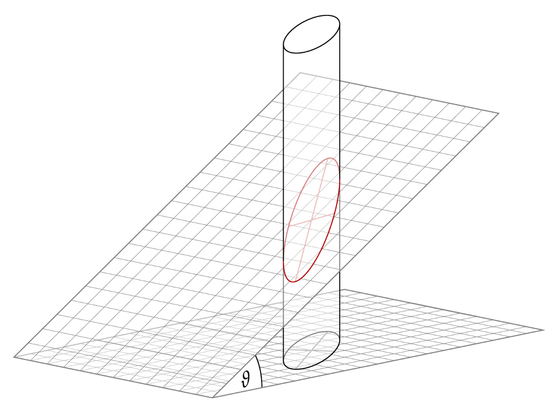
Results ranging from visualizable theorems of solid geometry to abstract propositions of analysis were called beautiful by Leonhard Euler (1707–83). For instance, he thought beautiful the following result:
If an elliptical cylinder is cut by any plane at an angle θ, then the ratio of the product of the principal axes of the section and of the product of the principal axes of the base is 1:cos θ (see attached image).
Aesthetic concerns seem to have been part of what drew Euler to number theory. Christian Goldbach (1690–1764) persuaded him to take an interest in the subject and to make a serious study of Fermat's work. His attention was drawn by the theorem:
Every natural number can be expressed as a sum of four squares.
With presumably deliberate understatement, Euler described it as a ‘not inelegant theorem’. The result remained unproven in Euler's time, and the first proof was given by Joseph-Louis Lagrange (1736–1813), becoming known as ‘Lagrange’s four-square theorem’.
Thus, for Euler, *unproven* conjectures could have aesthetic value. And so he judged another well-known then-unproven result of Fermat:
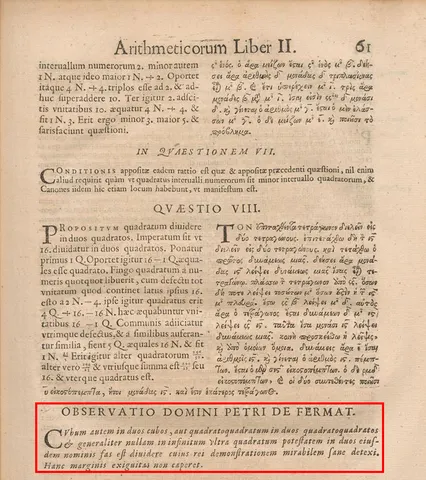
‘In Fermat there is another very beautiful theorem for which he claims to have found a proof. […] the formula $a^n + b^n = c^n$ is impossible whenever $n > 2$’
1/2
[Each day of February, I am posting a short interesting story/image/fact/anecdote related to the aesthetics of mathematics.]
#Euler #Fermat #Goldbach #Lagrange #FermatsLastTheorem #MathematicalBeauty
Number theory was the one area of mathematics on which Pierre de Fermat (1607–65) worked throughout his life, and he found it ‘very beautiful and very subtle’.
Among other results, he said that the Polygonal Number Theorem (which asserts that every natural number is the sum of at most $n$ $n$-gonal numbers) was ‘a most beautiful and wholly general proposition […] this marvellous proposition’.
(He offered no proof of this result, but claimed to have one in a marginal note to Diophantus' Arithmetica; this was the same book in which he noted what became known as Fermat's Last Theorem.)
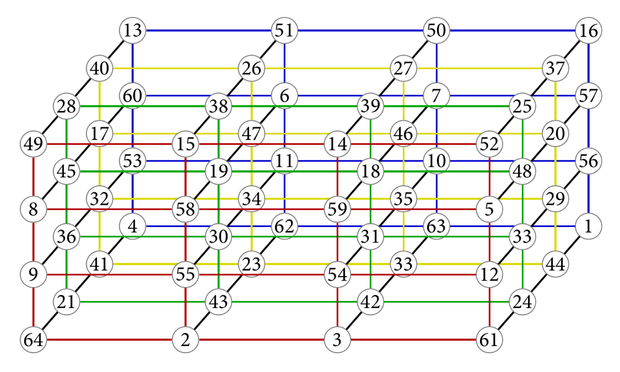
Fermat also seems to have counted magic squares and analogous configurations as part of number theory, and wrote that: ‘I know hardly anything more beautiful in arithmetic than these numbers that some call planetary and others magic’. (The term ‘planetary’ is derived from certain treatises linking the magic squares to planets used in talismans.)
He said he had found a rule to find magic cubes (one of his examples is in the attached image) and also determined how many different ways each such cube can be arranged, which he called ‘one of the most beautiful things in arithmetic’.
1/2
[Each day of February, I am posting a short interesting story/image/fact/anecdote related to the aesthetics of mathematics.]
#Fermat #NumberTheory #HistMath #MathematicalBeauty #MagicSquare
#Fermat's Last #Theorem states that no three positive integers a, b, and c can satisfy the equation a^n + b^n=c^n for any integer value of n greater than 2.

#Fermat’s Last #Theorem: The 350-Year-Old #Mathematical #Drama That Finally Ended : Medium
#Amazon lakes hit ‘#Unbearable’ hot-tub temperatures amid mass die-offs of pink #River #Dolphins – study : Guardian
Great #Nicobar #Island: Hurtling Towards an #Environmental #Catastrophe : Misc
Latest #KnowledgeLinks


 Marquis de Geek
 Tronsawyer
 jarban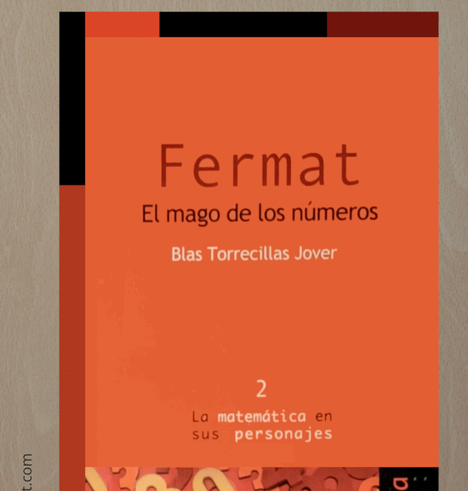
 Alan J. Cain
 Knowledge Zone
 ƧƿѦςɛ♏ѦਹѤʞ